
 Continue with onX Maps
 Sign in with Facebook






Anyone can climb V10/5.14-


|
|
I'm going to vote in favor of any average athlete who isn't giant would be able to climb both v10 and 5.14a if they dedicated themselves to it. I've witnessed it many times. Might take years, and an unholy focus, but it could be done. |
|
|
An athlete is made as much by their mentality as by their physicality. There is no such thing as an average athlete who would be able to dedicate themselves to the pursuit of this goal. I think that this is a worthless exercise because I see the drive and willingness to commit to the goal and sacrifice to it as a part of an athlete's skill set. Average athletes don't have the skill of commitment to the degree that advanced/elite athletes do, and as such will never achieve advanced/elite goals (excepting superior genetics). |
|
|
Dan Schmidtwrote: An example is any '4 move' v10. I have done somewhere around 20 or more v10's, and I can't think of one which had exactly four equally hard moves plus filler climbing, sorry. Also, eight v6 moves in a row should be more like v12, give or take. If you can think of a v7 which is non-trivial but noticeably easier (like v4) climbing into one hard move, or the other way around, that one hard move is likely ~v6. At a certain point easier moves are just filler. Like, if your V10 project has a V4 topout, the topout doesn't really add to the grade. It might be a heartbreaker, but at V10 you're pretty much expected to onsight V4 all day long. Exactly. The silly formula I have always used is (x+y)/2 + 2. It seems to work just fine as long as there are no rests involved. At a certain point adding a problem does not mathematically increase the grade: (10+4)/2 + 2 = 9, and we know that adding a v4 onto a v10 does not make the grade easier than v10, so this is the point at which adding a (single) v4 to the end of a v10 does not increase the grade. In fact neither would adding a single v5, nor a single v6, but adding a single v7 gets you to 'tough v10' and a single v8 gets you to v11. That is the other thing I like about that formula: it provides a cutoff for where the added climbing does not increase the grade, and for where it does. |
|
|
I think "the formula" works reasonably well for sport routes also, though I'd argue you might want to go something like +2.5 letter grades, on average. If you string a 5.13c into a 5.13c with minimal rest in between, you're looking at a route of at least 5.14a. There is a bit of nuance to this though, in that putting a power crux on top or an endurance problem is much harder than taking that same super powerful first move and then following up with some endurance climbing. Putting a solid V7 on top of a pumpy 5.13b with no rest in between would be 5.14 for sure, but putting a V7 at the start of an existing 5.13b probably wouldn't quite get you there, IMO. |
|
|
I was taught that a boulder problem is rated for its single hardest move. That would make a problem with four V1 moves and one V5 move a V5 problem, and a problem with five V4 moves would be a V4 problem. |
|
|
Artem V wrote: Maybe the rule about rating a problem for its hardest move breaks down at the higher grades. I do not know as I haven't climbed at that level. But I'd be interested in knowing why multiple, consecutive V6 moves yields a problem that is harder than V6, but the same number of consecutive V3 moves does not yield a problem that is harder than V3. Genuine question. |

|
Going into predictable weeds! |
|
|
Well, unless you are talking about an enduro route, a V10 crux should translate to about 14a. |
|
|
Mike Stephanwrote: Bouldering is weird. Warmup Roof in Hueco is a benchmark V3 and doesn’t have a single V3 move on it, more like a whole bunch of V1. Upper Wisdom in Morrison is as long as a short route, has a single hard V3 move towards the end, and is a benchmark V3. |
|
|
The idea that routes or boulder problems should be graded based on their hardest move is a horribly outdated one that dates to the time when people where only climbing low-angle terrain where one could immediately fully rest and recover after climbing a tricky move. While valid for such routes, it completely breaks down anytime endurance remotely comes into play. |
|
|
Dylan Colonwrote: I think "the formula" works reasonably well for sport routes also, though I'd argue you might want to go something like +2.5 letter grades, on average. If you string a 5.13c into a 5.13c with minimal rest in between, you're looking at a route of at least 5.14a. There is a bit of nuance to this though, in that putting a power crux on top or an endurance problem is much harder than taking that same super powerful first move and then following up with some endurance climbing. Putting a solid V7 on top of a pumpy 5.13b with no rest in between would be 5.14 for sure, but putting a V7 at the start of an existing 5.13b probably wouldn't quite get you there, IMO. By my grading 13c to 13c, translated to boulder grades, would be solid v9/easy v10 to solid v9/easy v10, so it would be somewhere between about solid v11 and mid v12 depending on the constituents, so anywhere from solid 14a to 14b. A 13b into a v7 would be like a (at most) v9 into a v7, so v10, or 13+. I think it is super important to keep in mind though that these are just guidelines to get one close to where the grade really sits relative to other things. |
|
|
Dylan Colonwrote: I think this is a really interesting concept. This obviously begs the question: what is the single hardest move that has been done by a human? what climb was it, and who did it? The one that comes to mind is the jump move to the pinch on Lucid Dreaming, which is v15. Maybe one of the moves on Burden of Dreams? Though that seems to be 4 moves of the same difficulty, but maybe each of those is v13. On a rope, maybe that fucked up toe jam kneebreaker from Silence? |
|
|
Lucid Dreaming is a perfect example of how moves stack to add difficulty. The stand start to Lucid, which grabs the pinch from stacked pads and then does the dyno in isolation, is consensus V12. So Lucid is two V12 moves in a row with some easier stuff before and after, which creates a V15 because of the difficulty of doing that first V12 move so well that you're ready for the next one. With the stand start, you can make sure that the body position and grips are flawless before pulling on. For the world's hardest moves, look for hard problems that revolve almost entirely around a single move. The crux move of Jade in Rocky Mountain National Park is almost certainly not the "hardest move" but this is the sort of thing to look for. I think I've heard it described as V7 into a brutal crux into the V10 stand start, to make very solid V14. This suggests a crux move which may be V12/13. |
|
|
This is cool. 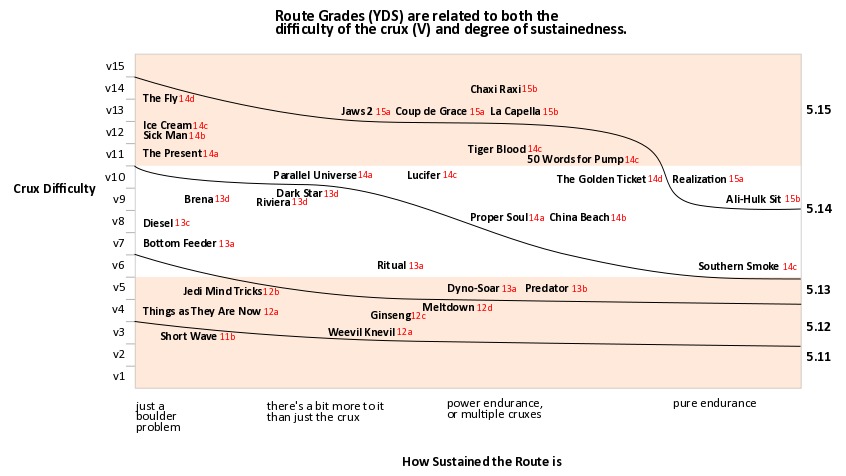 |
|
|
Hope for Movementwrote: This is cool. ^ with that graphic and motivation from this thread, I now have my tick list for the year. |
|
|
Ok so if we just accepted the theory that the average athlete/climber could reach 5.14 with proper training and dedication, what do you see as the theoretical human limit due to laws of biology and physics that only the very genetically gifted top 1% might attain? Based on the difficulty of 5.15b now, is 5.16-5.17 humanly possible? |
|
|
I'll set my sights on climbing Short Wave 4 times in a row and call it Southern Smoke and nab my 5.14 that way. |

|
Pepe LePoseurwrote: Ok so if we just accepted the theory that the average athlete/climber could reach 5.14 with proper training and dedication, what do you see as the theoretical human limit due to laws of biology and physics that only the very genetically gifted top 1% might attain? Based on the difficulty of 5.15b now, is 5.16-5.17 humanly possible? The hardest climb right now is "The Silence", clocks in at proposed 5.15d. This is one grade away from 5.16, so yes, 5.16 is humanly possible. Silence is broken down to having two V15 cruxes with separate V13, V10, V5 sequences, and "rests" in-between. Make it more sustained, the grade will go up. Southern Smoke clocks in at 5.14c; it is claimed not to have anything above "rather pedestrian" V5-6. |
|
|
Dylan Colonwrote: Lucid Dreaming is a perfect example of how moves stack to add difficulty. The stand start to Lucid, which grabs the pinch from stacked pads and then does the dyno in isolation, is consensus V12. So Lucid is two V12 moves in a row with some easier stuff before and after, which creates a V15 because of the difficulty of doing that first V12 move so well that you're ready for the next one. With the stand start, you can make sure that the body position and grips are flawless before pulling on. For the world's hardest moves, look for hard problems that revolve almost entirely around a single move. The crux move of Jade in Rocky Mountain National Park is almost certainly not the "hardest move" but this is the sort of thing to look for. I think I've heard it described as V7 into a brutal crux into the V10 stand start, to make very solid V14. This suggests a crux move which may be V12/13. Yes, with Lucid Dreaming I think one can see how powerful single moves can add significant difficulty to any route, especially when they are near the end. These types of moves often punch above their weight class, so to speak. An example from my personal experience is the NFL Dyno and the NFL Dyno Sit. The NFL Dyno is in my estimation a single v11 move, and the sit into it is something like v6. A few summers back I could walk up and repeat the NFL as many as four times in a row with no failed attempts, even on hot days while in the sun (and Vedauwoo is very moisture/temperature sensitive), yet adding the sit start took me several months and only happened after I went and did about a month worth of power endurance circuits. This despite the fact that v6 should not add to the grade of v11. I don't think the sit jumps the grade to v12, but I was surprised how much harder specifically a single limit move became when placed at the end of what is essentially easy climbing. |
|
|
So if I drive down the road at 70mph & I keep going stacking that 70mph like how long before I'm doing 140mph? |


