Mountain Project Logo

What does your Woody look like??? 2.0

Dustin K · · Unknown Hometown · Joined May 2015 · Points: 0
Optimistic wrote:

Really nice graphics/art work there! How did you do it? Painter's tape? Very large color printer? 

Painters tape and a lot of patience.  I think I counted and on the far right panel there is 12 coats of paint in one area plus three coats of a urethane.

EJN · · Unknown Hometown · Joined May 2012 · Points: 263
Optimistic wrote:

"Upper supports" meaning the chains? I think as long as the hinges are bomber (I used like 10-12 heavy strap hinges), the kicker is completely immobilized, and the board is stiff, you should be good to go. My board actually goes up to 10 degrees (good for warming up, or for the kids), and even at that angle it really doesn't move.

Yes, meaning the chains, as opposed to a stiffer connector like angle iron. Awesome, thanks for the answer!

J Miles · · Queensbury, NY · Joined Mar 2012 · Points: 15

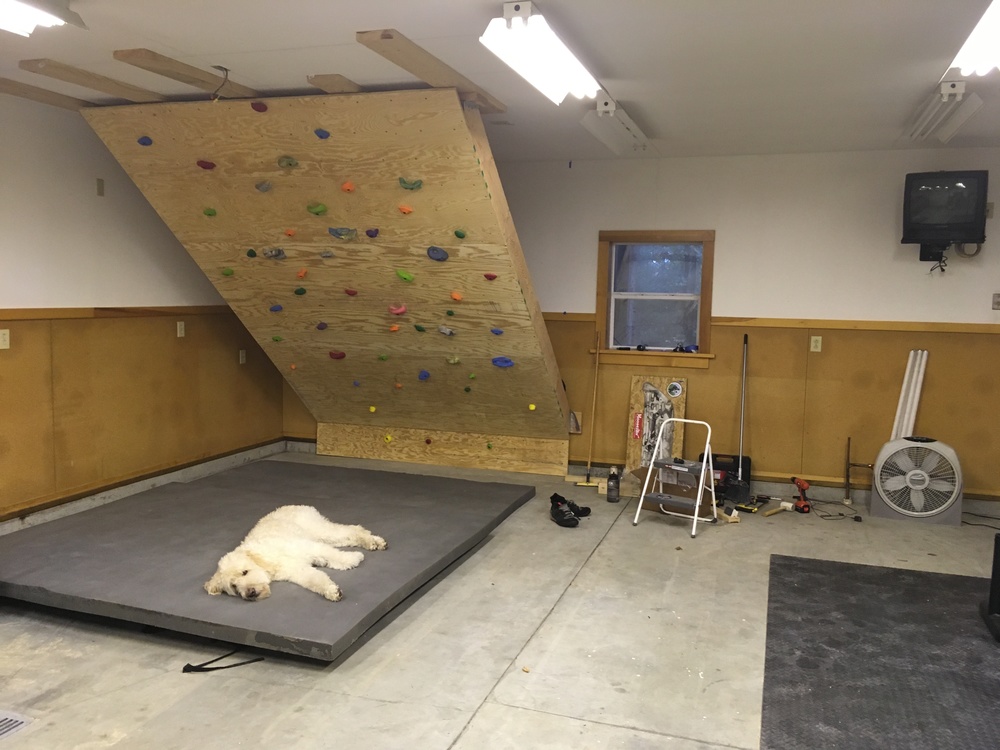
This is from when I first built it, so I have quite a few more holds on it now.  The wall is pretty steep (~50 degrees) and I'm nowhere near good enough to make more than a lap or two (on jugs) without getting tired.  My ceilings are only about 8.5' which is why I made this so steep, but I'd like to get something else for training other than training hard overhanging bouldering moves.  Any thoughts?  As you can see I have lots of horizontal room to work with, but shorter ceiling than I'd like.
Schyluer Jarman · · Vineyard, UT · Joined Aug 2019 · Points: 0
D Elliot wrote:

So to get this straight, you’re anchoring both ends of dual ratchet straps, one end to board, through a sheave down to the kicker/ledger? What type of ratchet strap is this? 

2 1000 lbs straps. Think they are for like tightening down a dune buggy or something. 

C Limenski · · Unknown Hometown · Joined Mar 2016 · Points: 15
Dustin K wrote: I joined the quarantine woody club over the past few weeks, now all I need to do is wait for the holds I ordered to show up!  There's a 2 inch hand crack and a 1inchish finger crack that feels super hard.  

Beautiful! I want to climb that finger crack!

Nkane 1 · · East Bay, CA · Joined Jun 2013 · Points: 475
Schyluer Jarman wrote:

2 1000 lbs straps. Think they are for like tightening down a dune buggy or something. 

When I was a teenager, my dad and used a ratchet strap to bend a tree (I don't remember why it was important to bend the tree. I think it blocked the view in some way and my mom wouldn't let us cut it down). We attached the ratchet strap to the tree and another tree in the direction we wanted it to go and every day we went out and tightened it a few clicks.

One day it exploded and it was just dumb luck that no one lost an eye.

Just something to think about.

Schyluer Jarman · · Vineyard, UT · Joined Aug 2019 · Points: 0
Rich Farnham wrote:

Schyleur - I hate to rain on your parade, but I have to say that I'm pretty concerned about the wall you're building.  I don't want to hear that this thing ripped out of the wall and collapsed on you.  I'm a structural engineer, and calculate wood connections everyday, and I'm not sure where some of your numbers are coming from, but they seem really high.  I'm also not sure you have a good understanding of the forces involved here.

This thread has had a long run of people posting home walls, and I really enjoy seeing what people are building!  But as more gyms have adjustable walls, I've started seeing them in this thread.  The few I can think of (Monty's comes to mind, it seems Optimistic has a nice one, but can't recall what it looks like other than the nice connection he posted above), were well built by people that clearly knew what they're doing.  I don't know if they are carpenters by trade, but it looks like it.

Building fixed walls is reasonably easy, and there is a lot of safety in the redundancy of all of the studs, joists, etc.  No single connection is working that hard.  But adjustable walls are a completely different subject.  The need to raise and lower them means the forces are concentrated to a few points, and those points see high loads.  If you are going to build one of these, you need someone involved that understands this and can make sure those points are strong enough.

I wish I had the time to work with you to help you make your wall safe.  But, unfortunately, I really don't.  I would really encourage you to find someone that knows more about construction to help you out.  It sounds like you might at least have a knowledgeable neighbor.  Maybe you can offer them beer to help you sort this thing out.  

A few thoughts for you:
1) There has been a bit of discussion about how to anchor the bottom of the strap, but less about the other anchor points.  The anchor at the location of your pulley is actually what will see the highest forces.  The connection to the back of the wall is also critical.  Your sketch says something about a screw eye that is good for 350#.  I think that isn't nearly enough capacity, and I'd also question whether a screw eye is actually that strong in a single stud.

2)  Where does the load go once you connect to a stud?  You're putting a lot of horizontal force into the stud where the pulley attaches.  Can that stud handle that load?  Short answer is probably not.  It is probably connected at the top with two or three nails through the top plate.  That isn't close to enough.

3) Without digging into the details of your design (loads, connections, etc), I would look for ways to spread the forces out.  It sounds like you've installed a ledger to spread the loads out on the bottom connection.  Consider doing the same at the top connection, and at the back of the wall.  If you can engage 3 or 4 studs, you have a much better chance of not having issues.  Again, I don't know if that will be enough to make your design work, but it's a good start.

4) Lag screw capacities - I'm not sure where your numbers are coming from, but the 1500#, or even 620# numbers I've seen you using seem really high for connections into the narrow edge of a stud.  Those sound more like the kind of capacities you can get bolting 4x4's together (or bigger).  I'd have to have a better understanding of what you are connecting to give you a more accurate value, but it's pretty unusual to get more than 200# (maybe 250#) out of a lag into the narrow face of a stud.

Again, I wish I had the time to really dig into this with you and help you size these connections.  But I'm busy trying to build my own (fixed angle) quarantine wall, and working too much.  I jump on MP for a break from those things when I have a few free minutes.  But seeing your photos and the sketch of your design, I just felt I needed to say something.  I hope you are able to find someone to work with you to make a nice strong wall!  I'll keep an eye on the thread and weigh in if I can.

Rich! Thanks so much for the help and concern! Very kind of you! This helps me a lot. I thought maybe I made a mistake conveying my thinking when I said “stud?” 

To be more clear, I was hoping that if I drilled the ledger into the 7 studs with 3 3 in” screws each the ledger would be sufficient to hang the board on. I can get better lag screws if 3 inch construction screws won’t hold it. Thank you for taking time out of your day to help me out. I sometimes feel like I’m rushing to get this up because not climbing has made me start to get a little bummed. I’m doing it myself and asking this great community for help because people who say they will help here where I live just flake in the long run. I didn’t think about the actual load capacity of the wood itself. That’s my bad. I thought the wood could take a lot more load capacity than 200 lbs per bolt skinny side up. Back to the drawing board. 

Optimistic · · New Paltz · Joined Aug 2007 · Points: 450
Schyluer Jarman wrote:

2 1000 lbs straps. Think they are for like tightening down a dune buggy or something. 

If you are talking about the ratcheting kind, a lot of problems will come up. First is that to change the angle of a 12 foot board by 10 degrees, you need to move the top of it about 4 feet. Tie down strap gives you like a 6 or 8 inches of travel, in 1/4" increments. Also when you tighten one the entire load will be on that one strap, and the board will twist, hard on the hinges, board, and kicker. Other issues exist too. An electric hoist is really the way to go, although as someone said above the tongue jack idea is actually really cool (but much less travel is possible that way). 

D Elliot · · Unknown Hometown · Joined Jun 2017 · Points: 0
Optimistic wrote:

If you are talking about the ratcheting kind, a lot of problems will come up. First is that to change the angle of a 12 foot board by 10 degrees, you need to move the top of it about 4 feet. Tie down strap gives you like a 6 or 8 inches of travel, in 1/4" increments. Also when you tighten one the entire load will be on that one strap, and the board will twist, hard on the hinges, board, and kicker. Other issues exist too. An electric hoist is really the way to go, although as someone said above the tongue jack idea is actually really cool (but much less travel is possible that way). 

This 100%. And I’m not sure how you plan to release the ratchet once you bring the board up and want it back down to a steeper angle...it won’t under that load. It’s a poor support/adjusting system. Pony up the extra cash and get a proper load rated electric hoist/winch, you’ll thank yourself every day after. 

chris boylston · · Unknown Hometown · Joined Dec 2019 · Points: 0

Has anybody used structural screws to hold up their board?  I am making a freestanding wall and am debating between lag screws and structural screws for the main joints.  Anybody have any knowledge about the difference between the two?

Kevin Cottle · · Unknown Hometown · Joined Apr 2018 · Points: 0

I used lag screws for mine.

Matt Castelli · · Denver · Joined Feb 2017 · Points: 280

I used lag screws to frame out everything that wasn’t plywood directly on the wall

Dave Holliday · · Unknown Hometown · Joined Feb 2003 · Points: 1,023

I'm thinking about a woody in my garage. The builder of my townhouse was nice enough to outfit the garage with a tall ceiling so I could get an 8'x11'3" wall at 30 degrees with a one-foot kicker. The wall will fit perfectly between the door to the kitchen and the breaker box.
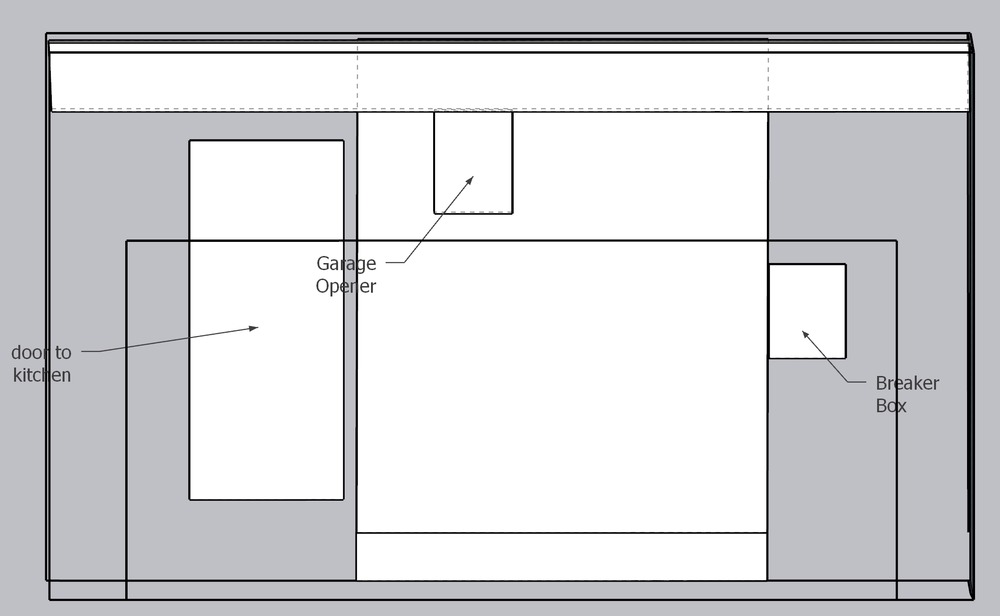


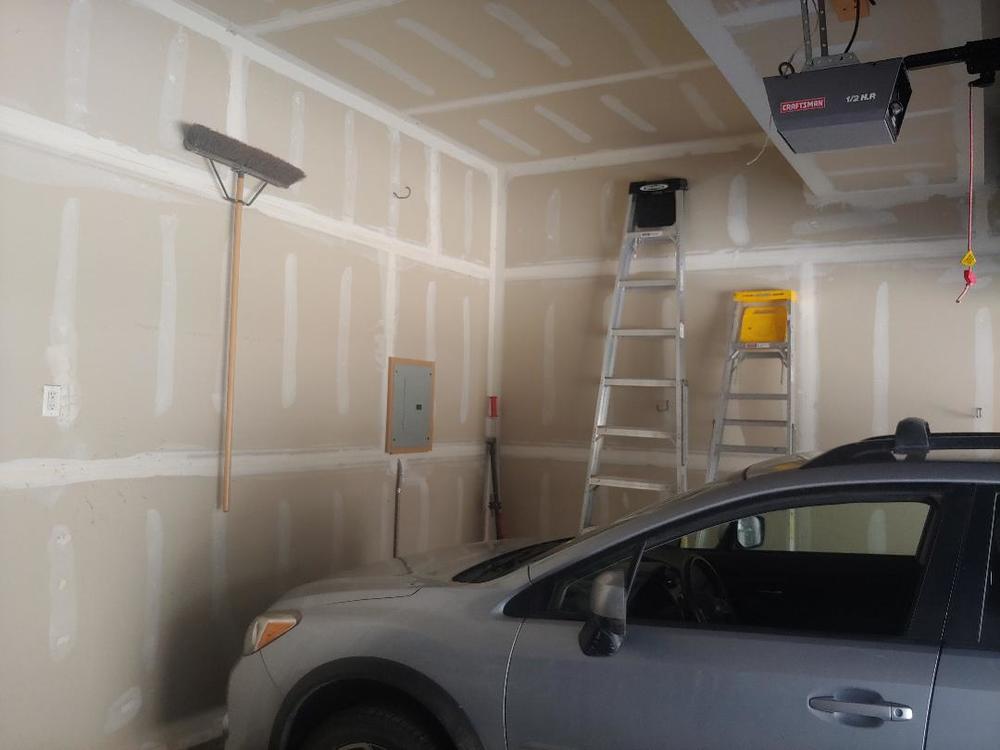
Unfortunately, that doesn't leave a lot of clearance between the wall and the garage opener and the structure from which it hangs (which runs all the way across the garage). I don't know for sure but I suspect the structure isn't all that structural, if you know what I mean.
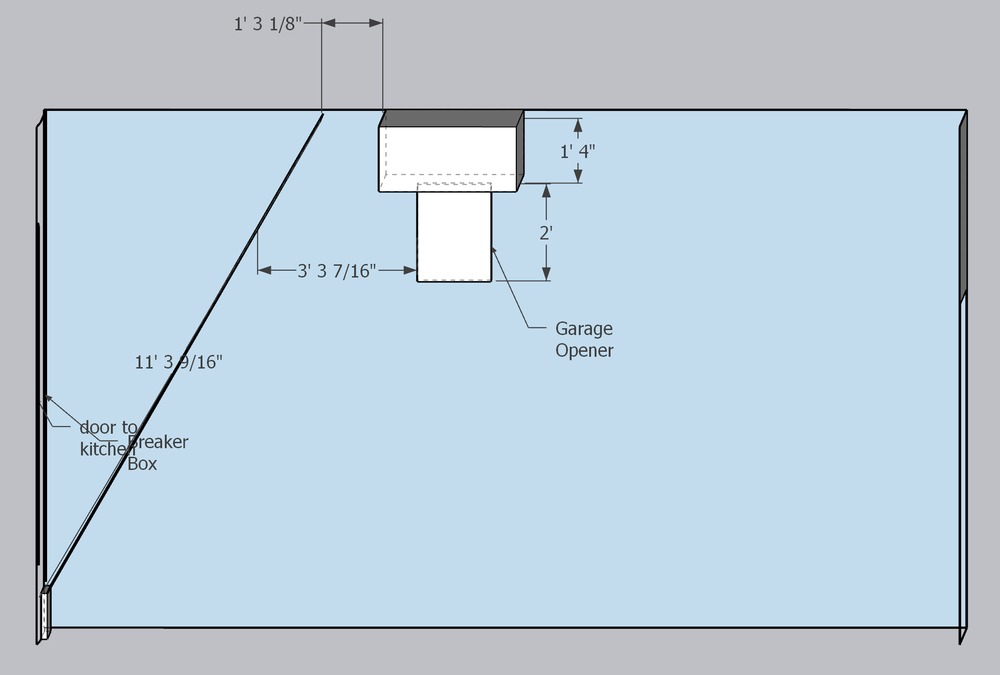
I'm a little concerned about the clearance to the garage opener. If I could magically move the breaker box (or pay an electrician $$$ to move it), I'd position the wall to the right so the garage opener wouldn't be an issue. I could conceivably align the right edge of the wall with the right edge of the breaker box so that it's still more or less accessible. Building the wall at 25 degrees would create a bit more clearance. Any thoughts?

Here's a photo of my garage for reference.

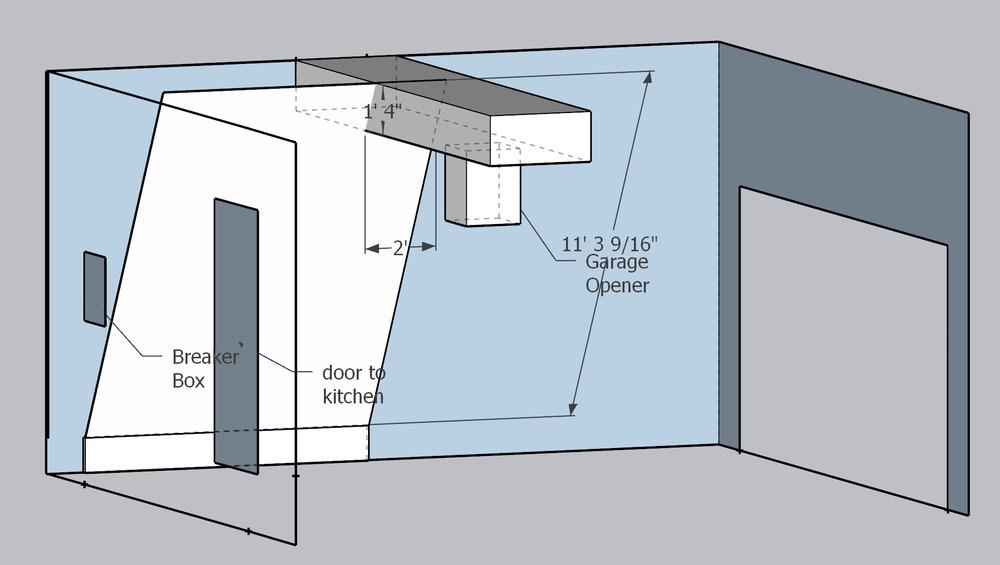
The other idea is to do something like this. There'd be a small notch cut out of the wall which would be fine; there would be a lot more clearance to the garage opener.
Optimistic · · New Paltz · Joined Aug 2007 · Points: 450
Dave Holliday wrote: I'm thinking about a woody in my garage. The builder of my townhouse was nice enough to outfit the garage with a tall ceiling so I could get an 8'x11'3" wall at 30 degrees with a one-foot kicker. The wall will fit perfectly between the door to the kitchen and the breaker box.


Unfortunately, that doesn't leave a lot of clearance between the wall and the garage opener and the structure from which it hangs (which runs all the way across the garage). I don't know for sure but I suspect the structure isn't all that structural, if you know what I mean.

I'm a little concerned about the clearance to the garage opener. If I could magically move the breaker box (or pay an electrician $$$ to move it), I'd position the wall to the right so the garage opener wouldn't be an issue. I could conceivably align the right edge of the wall with the right edge of the breaker box so that it's still more or less accessible. Building the wall at 25 degrees would create a bit more clearance. Any thoughts?

Here's a photo of my garage for reference.

-since the garage door opener is narrow, what about just not putting holds on the part of the wall directly in front of it? 

-switch to manual garage door?
-are there openers that have the drive to the side of the door?
-blocking access to the panel, even partially, seems dangerous somehow, but I can't exactly think of a specific reason why. 

Optimistic · · New Paltz · Joined Aug 2007 · Points: 450

Also, looks like it might be easier to tie into the floor joists if you use the side wall. But could you still park the car if you go that way?
What is inside that bump out/chase in ceiling? 

Schyluer Jarman · · Vineyard, UT · Joined Aug 2019 · Points: 0

Update on my wall. I listened and made a bunch of changes. I took down my ledger, took out the screw eyes. Put in eye bolts. Rescrewed in the lag screws into the ledger and studs 2-3 in” up so that it was not in same screw holes. Ignore those ugly pieces of wood below the ledger it was just to help me put up the ledger by myself. 
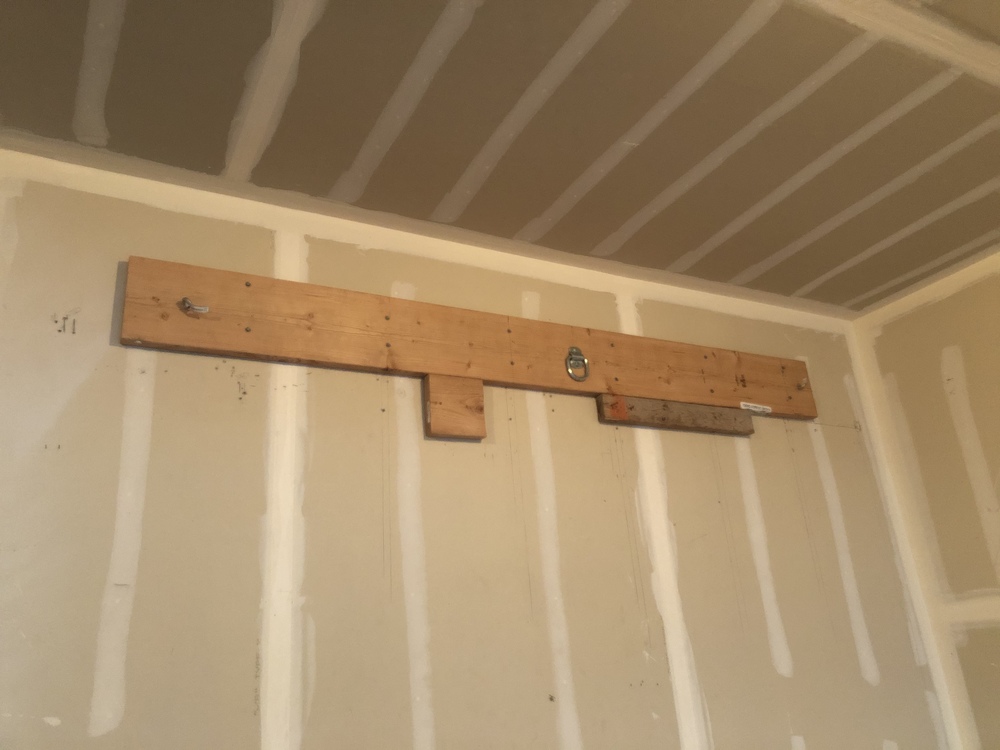

Got a pipe (this ones too big, going to get a 1.5 or 1.25 inch pipe), going to stick the pipe through all the studs at the top to displace the weight.
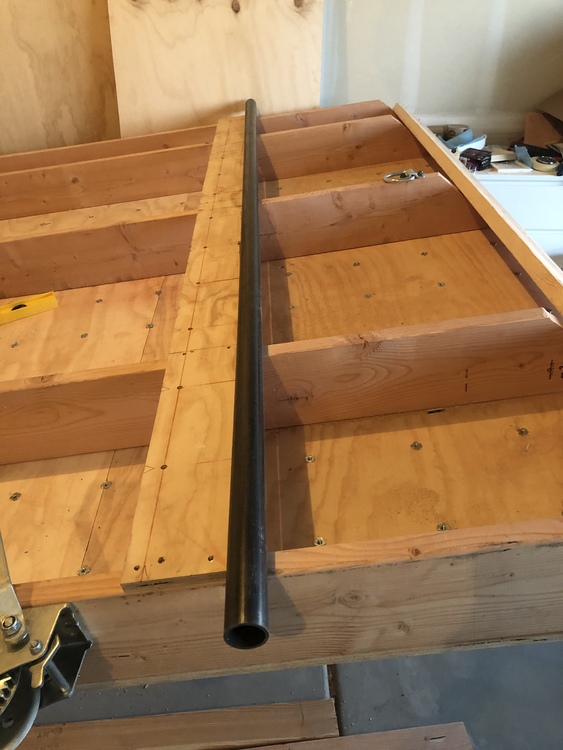
Put U-Bolts on the pipe and connect to chain instead of ratchet system.

One Ratchet will go on middle just to add tightness and keep board from wobbling. 

This is the winch to adjust board. We put it on a pulley system. Which works awesome. Tried it out with screw eyes before. Legit. Highly recommend it for easy adjustable wall. Winch can hold 1000 lbs- I know that’s not what the wood can hold but we aren’t going to use the winch at all to hold board when climbing. Just to adjust.
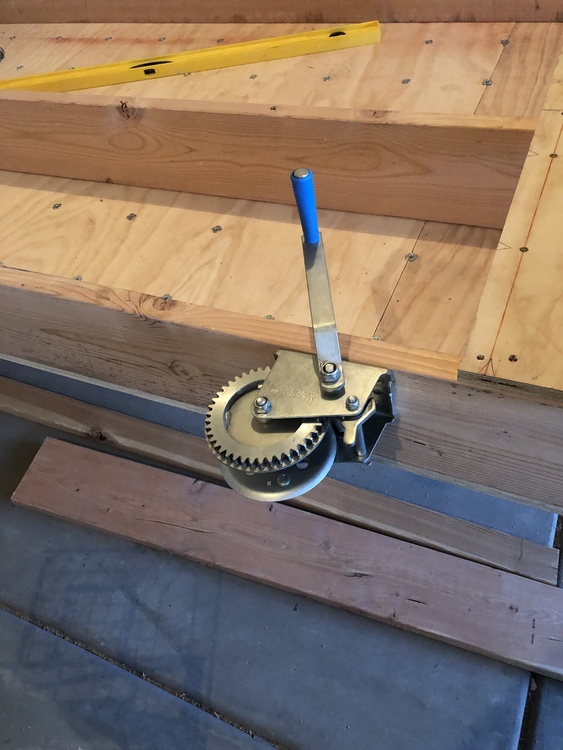
Optimistic, Brett, Rich others what do you guys think? I’m I pretty redundant now? 
Dave Holliday · · Unknown Hometown · Joined Feb 2003 · Points: 1,023
Optimistic wrote: Also, looks like it might be easier to tie into the floor joists if you use the side wall. But could you still park the car if you go that way?
What is inside that bump out/chase in ceiling? 

It's a two-car garage so plenty of room for my car if the wall was on the side. No idea what's inside the bump. To your other message, it probably is a bad idea (and maybe even illegal) not to have quick and easy access to a breaker box.  This seems like an interesting alternative to the garage opener.

Optimistic · · New Paltz · Joined Aug 2007 · Points: 450

Hi Schuyler,
-that winch looks interesting. Do you do one on each side, or it pulls both chains?
-If by ratchet you're talking about the tie down strap, I really really would not use it. Best case it will totally undermine the functionality of your winch, and worst case it will fail explosively when you release it. Try threading the ratchet through the eye bolt and making a loop hanging a couple of inches off the ground. Now stand in the loop and try to release the strap under load. 
-this may betray the fact that I'm not a professional carpenter (arguably not an amateur carpenter either) but I feel like I'm used to the drywall tape lining up with the studs (because the tape is covering the screws that hold the drywall on the studs), and those aren't the stud marks you have. I've encountered a situation where I was hanging something on the wall of an addition. Behind the drywall was plywood sheathing, so that everywhere I drilled was plywood. This was fine for a towel rack but could be disastrous in your situation. Are you positive that you're on the studs?
-If I were using screws for the ledger I would use 4 or 6" (depending on your building's framing) star drive construction screws. These would need to be predrilled, and they're unfortunately kind of pricey. Very beefy though. 

J Miles · · Queensbury, NY · Joined Mar 2012 · Points: 15

@Dave Holliday, we got something like this when we moved into our house ( youtube.com/watch?v=Kz00Rhp… )...ours is a liftmaster.  We got it installed for something ridiculously cheap like $400 (component cost + installation + external keypad).  That only answers part of your question, but may help your decision making.  Just say page 28 of this thread and it looks like you already found the wall mount (good job :-)).

Andrew Krajnik · · Plainfield, IL · Joined Jul 2016 · Points: 1,739
Dave Holliday wrote:

It's a two-car garage so plenty of room for my car if the wall was on the side. No idea what's inside the bump. To your other message, it probably is a bad idea (and maybe even illegal) not to have quick and easy access to a breaker box.  This seems like an interesting alternative to the garage opener.

You mentioned this is a townhome? I'm guessing there is a room above the garage? That soffit is likley built around a structural beam that supports that room. (Picture the beam in a basement that holds up the whole first floor.) The soffit isn't necessarily attached to the beam itself, especially if it's a steel I-beam. It's likely hung from the joists, and just built out around the beam.

This topic is locked and closed to new replies.

Log In to Reply
Welcome

Join the Community! It's FREE

Already have an account? Login to close this notice.