
 Continue with onX Maps
 Sign in with Facebook






“Guide Mode” usage


|
NegativeK wrote: I once saw a guide quickly give a client slack by pinching the sides of the Reverso and rotating the body so it wouldn't lock when they shot out an arms-length of rope. Obviously this only works if the climber isn't tensioning the rope. Sounds safe as much as fingers are kept away from pinching or getting trapped in a loop should the second fall. With the ATC Guide not tensioned, I pull out an armload of slack by first pulling up on the locker that captures the rope, essentially lifting it clear of the ATC. I imagine it might also be done by manually rotating the ATC so the brake strand is freed from the climber’s strand. |
|
|
NegativeK wrote: I once saw a guide quickly give a client slack by pinching the sides of the Reverso and rotating the body so it wouldn't lock when they shot out an arms-length of rope. Obviously this only works if the climber isn't tensioning the rope. I think it's safe as long as you are holding the brake stand in the hand that's pinching the plate, to make sure that you stop pinching when the climber falls. The device itself provides very little friction in the configuration you describe, the rope zips through the device really easily. So I'm sceptical whether it would be yanked out of your hand in the event of a fall. |

|
Former Climber wrote: |
|
|
Nick Sweeney wrote: Put a full-strength cord or webbing on your chalk bag and you can always make a prusik. |
|
|
Joe Prescott wrote: I have no idea why more people don't prefer the Pivot. Marketing and DMM is less popular than BD and Petzl? My suspicion is that if BD/Petzl came out with a similar design, you would see them everywhere. Expect to see Pivot knock-offs as soon as the patent expires. ATC Guide and Reverso are effectively obsolete. If DMM were more aggressive marketing this, they'd be eating BD's and Petzl's lunch in this (admittedly narrow) market. |
|
|
Joe Prescott wrote: I have no idea why more people don't prefer the Pivot. I have a Pivot and a "normal" ATC Guide. I don't have a strong preference for the Pivot because I think it "solves" a non-problem. If you are lowering followers out of autoblocking mode so often that you need a special device that makes it easier, I think you're probably doing something else wrong. For scenarios where lowering is probable (single-pitch routes, routes with large roofs, partner working a pitch, etc.), don't use an autoblocking plaquette device. Use a Grigri, belay off your harness, do a slingshot belay, etc. Use the plaquette in situations where it makes sense and lowering is unlikely (ice climbing, big alpine routes, etc.), and then the Pivot's "feature" isn't that valuable. |
|
|
Joe Prescott wrote: I have no idea why more people don't prefer the Pivot. Marketing and DMM is less popular than BD and Petzl? My suspicion is that if BD/Petzl came out with a similar design, you would see them everywhere. I don't have a ton of experience lowering in guide mode, for any device, but the few times I did it with the Pivot, it was very easy and I only tied a backup knot in case I lost control, no other leverage other than a biner in the hole. This was to lower my partner 10-15 meters to work a section of a pitch that was vertical and all of his weight was on the rope. MUCH easier than the BD (and I assume the Petzl). The Pivot is a little sticky in guide mode with 9.8mm and thicker ropes, but not bad at all. It is great with 9.5 and thinner ropes and feels very secure belaying/rapping on doubles or tag lines. I'll buy another when needed, unless they come out with a slightly smaller version (like the Alpine Guide ATC), then I would buy that. Can you explain why the pivot is better for lowering? I think part of my confusion is that just looking at it, it appears to be the same thing as an ATC, reverso, whatever. So I can't understand how it is better for lowering. |
|
|
Kyle Tarry wrote: Put it this way - if you wanted to buy a similar guide mode device, and I told you there were a handful out there that are almost equal (sure, some very slight rope diameter and cost differences), but one allows easier lowering in an emergency, what would you choose? This might have made the difference for the OP's situation. I use guide mode sparingly and use devices similar to your statements above. I have a fair amount of experience with several partners' BD ATC Guides (I have almost exclusively used ATC-XP in the past and like it still) and have lowered partners short distances in non-emergency situations just 2-3 times, mostly to practice, but I didn't own one. I wanted to buy a device with guide mode for specific types of climbs (moderate-semi-difficult multipitch where lowering is unlikely (strong partners)). I did some research and it seemed like there was no drawback in going with the Pivot, with the potential advantage of easier and more controlled lowering. IME it is MUCH easier and smoother than the BD device. You are not giving anything up for the ability to make lowering easier (as far as I know). I used it to lower someone that wanted to work a route (actually, he fell and I encouraged him to try it so I could try out my new Pivot!) and this was a good test. Went smooth (had back-up knot) and way better than the BD and in an emergency, I'd potentially be very glad I had it. I'm not telling anyone that they should ditch what they are using, but if someone is in the market for a guide mode device, I highly recommend the Pivot over the BD or Petzl. Unless there is a reason or situation where the Pivot is inferior? Could be, and if that is the case, I'd like to know. Slight holding power difference from Jim Titt testing? |
|
|
Rob Basanta wrote: No, I'm not an engineer, so I couldn't do it justice. If you google DMM Pivot, there are several good videos like this one: https://www.youtube.com/watch?v=twOt5HG7Nf4Joe |
|
|
NegativeK wrote: I once saw a guide quickly give a client slack by pinching the sides of the Reverso and rotating the body so it wouldn't lock when they shot out an arms-length of rope. Obviously this only works if the climber isn't tensioning the rope. Everyone should know how to do this, and it isn't unsafe if done right. "Right" in this case means keeping the brake hand on the brake strand. So the motion is to reach down with the brake hand and pull up some slack, then, keeping hold of the brake strand (it now has a loop of slack in it), use the brake hand to tilt the plaquette and use the non-brake hand to pump the slack loop through to the second. What is dangerous is the "hands-free" approach in which the belayer completely lets go of the brake strand and uses one hand to tilt the plaquette and the other hand to pump slack, with neither hand on the brake strand. |
|
|
rgold wrote: Sweet. I was a little surprised that I hadn't seen it mentioned before I saw the guide do it, and I figured I should check for unknown unknowns. |
|
|
Rob Basanta wrote: You can think of them all as simple levers ("Class 2" levers, like a wheelbarrow). 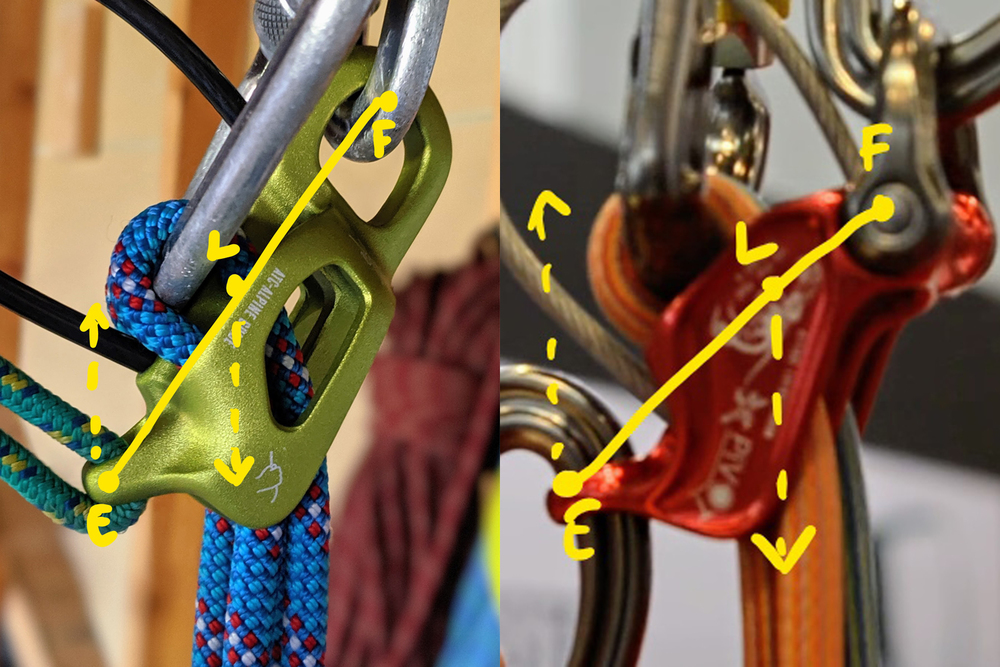 |
|
|
Former Climber wrote: |
|
|
rgold wrote: Negativek implied this could only be done if the rope was unweighted. Rgold, it sounds like you are saying that is not necessary. By pumping the slack thru, I assume you mean levering the biner back and forth, is that right? |
|
|
Greg R wrote: That's not supported by his description. Ratcheting with the blocking 'biner is a separate method. |
|
|
I love Guide mode. I just think some people don't know how to relieve the tension and give slack in this mode. |
|
|
Rob Basanta wrote: I believe it is because the attachment point is on hinges so it "pivots" making it easier to ease up the friction. |
|
|
Martin le Roux wrote: this would explain why I've never used a biner to release the pivot, always just done it by hand (only 4-5 times, IIRC). I'm not a super strong person, so it has to be the ease of device, as far as I can tell. Never had a problem, with climbers up to 180lbs, and 9.9 rope. |
|
|
FosterK wrote: I understand the typical ratcheting method. Rgold is describing creating some slack above the brake hand and changing the angle on the device. What I’m not clear about is how to execute the technique he describes as “pump the slack through to the second”. |
|
|
GDavis Davis wrote: Option 3: use a Grigri. Unless you're needing to save weight there's never a reason not to do that (and you need one less carabiner anyway, so it's not even a big weight difference). Belaying from above is faster to set up, easier to manage, lowering requires a simple re-direct through equipment you already have set up, and you can build a 3:1 with only one prussik, one carabiner, and 15 seconds. |


