
 Continue with onX Maps
 Sign in with Facebook






Should we stop saying "biner"?


|
|
Artful Dodger wrote: Context, you have to be a child to not know which words will hurt some people. You learn social cues including what language to use when and as you age. Your group identity provides exculpation given word choice and use particular to the group. Once outside the group, the rules change, you have to change too or come against the new meanings and ways of being. Confusing to some because they didn't know the language they use is racist, classist or sexist among other markers of identity. Or they knew and its ok because being those things is acceptable to their group. Your post is a great example of one of the key elements of the problem: The nonsensical idea that we can neatly categorize everyone into a "group" |

|
Attentive Follower wrote: Still not that simple. You left out the part about social signaling & affirmative identity politics. |
|
|
Attentive Follower wrote: Can anyone simply declare a word as hurtful at any time, in any context? My point is no they can't be declared hurtful in any context. 'biner used as a climbing term is not hurtful. Beaner to a Mexican American may very well be. If I said 'biner and got a look of disgust or insult from someone I'd probably repeat: "''biner as in caribiner" and say caribiner to that person from then on. But if that person said you can't say 'biner, I'd say sorry if you take offense because I'm using a homophone I won't use it around you but it's a different word with a different meaning and I'm not going to stop using it because you misinterpret it. I'm much less worried about the power some people may be trying to exercise by being overly politically correct, vs. the widespread and long term use of derogatory terms used to marginalize and insult people (usually from minority groups). |
|
|
Yes. |
|
|
Maybe we, as a people, should start miming instead of talking and writing. That's got to be the solution. |
|
|
"Pass me a biner." OK |
|
|
Tim Stich wrote: Maybe we, as a people, should start miming instead of talking and writing. That's got to be the solution. I can think of at least one gesture that would be banned immediately |
|
|
Tim Stich wrote: Maybe we, as a people, should start miming instead of talking and writing. That's got to be the solution. I think that memes are our next evolutionary step |
|
|
For my last "contribution" to this thread, I'll recommend everyone read Haidt and Lukianoff's "The Coddling of the American Mind". It talks about how this huge push toward "safetyism" in the 1980s and 90s led to the current culture of "trigger warnings" and "safe spaces" and generally a culture where people demand to be protected from ideas that they may find upsetting. |
|
|
Brother Numsie wrote: As long as we don't get like that stupid Star Trek episode where they all talked in allegory. So fucking bad. |
|
|
Tim Stich wrote: Maybe we, as a people, should start miming instead of talking and writing. That's got to be the solution. But then we'd create hurtful mimes and we'd have to ask (well mime): |
|
|
Cosmiccragsman AKA Dwain wrote: Geez, just call them, KRABS (Crabs) That could be stigmatizing to anyone with an STD. |
|
|
Cosmiccragsman AKA Dwain wrote: How does "Cara" (pronounced "care-uh") get converted to "krabs"? I dated a girl named Cara once... no one ever called her "krabs" as a nickname, but maybe she'd have liked it. |
|
|
John RB wrote: It doesn't. Krabs has a different origin, which of course I cannot remember at the moment. |
|
|
John RB wrote: Geez. |
|
|
Cosmiccragsman AKA Dwain wrote: Geez. Huh? I'm a new climber because it seems odd to me that "carabiner" is shortened to "crab" by some people? I mean, I've heard people do it... it just doesn't seem very natural or logical to me. It'd be like saying "a spring-loaded camming device (aka a 'splad') is a device that...". |
|
|
Anonymous wrote: you beat me to this one.....dammit. the night school to get a b is my favorite part....... let the butthurt continue.......at least the mexican guy who owns the deli i went to this morning has a sense of humor...... 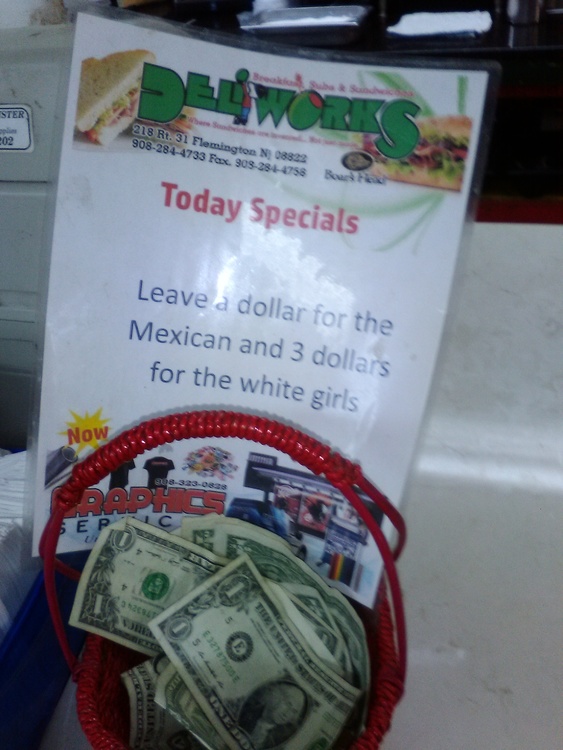 |
|
|
EFS wrote: I'm trying to understand the sign: if there was one Mexican and three white girls, each person gets $1. But if there are only two white girls, then each girl gets 50% more than the guy. And if 6 white girls, they get 50% less. Or maybe the sign means "leave 3 dollars for each white girl?" |
|
|
John RB wrote: The sign is brilliant. So many ways to interpret, so many ways to be offended. |

|
John RB wrote: In many places across the pond I've heard people pronounce it ka-RAB-inner (hence, I suppose, the contraction to crab). |


