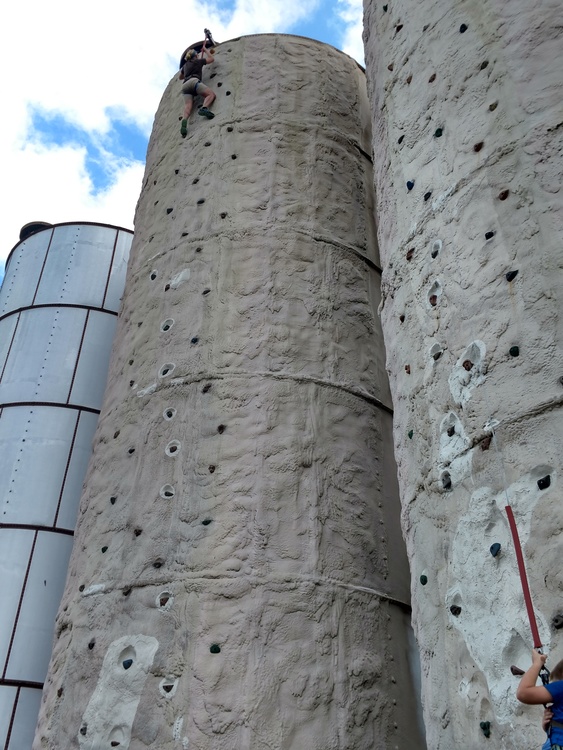
So, back at the gym ... I suddenly realize I’m hearing the word “sequences” a lot. I resumed working on one 10d that eluded me for weeks. This time Ryan said to think it through beforehand and remember the harder moves and the exact sequence of moves to get through it. For some reason he can remember every move I have made on every route in the last six weeks. (How can that be?). At any rate, honing in on sequence made all the difference today.
It was Bobs mantra all last week. “Lori you can turn a 5.7 climb into a 5.10 just by getting the sequence wrong.” And I surely proved him right. Both Bob and Ryan seem to have developed an eye for ease up routes...and it’s almost always the opposite of the steps I would have chosen. Sometimes I get stubborn and want to go my own way, which so far has NEVER worked.
I see left when they see right. I’m wondering when that clear sense will emerge—when I can read a route and know exactly where my body belongs,
"I see left when they see right. I’m wondering when that clear sense will emerge—when I can read a route and know exactly where my body belongs"
Give or take a few years. Depending on how much climbing in "many" different areas you climb. A well-rounded climber has a large catalog of moves learned over time from many experiences, including many different areas and numerous climbing techniques learned from those places.
Jeffrey Constine wrote: "I see left when they see right. I’m wondering when that clear sense will emerge—when I can read a route and know exactly where my body belongs"
Give or take a few years. Depending on how much climbing in "many" different areas you climb. A well-rounded climber has a large catalog of moves learned over time from many experiences, including many different areas and numerous climbing techniques learned from those places.
Jeff is exactly right. And this is also why a route is generally so much easier the 2nd or 3rd time. Most of us learn from our mistakes and figure out the right moves.
Jeff is exactly right. And this is also why a route is generally so much easier the 2nd or 3rd time. Most of us learn from our mistakes and figure out the right moves.
Thank you Jeff, thank you Senor. That’s wisdom speaking. Reading how Helen struggles with her slippery rock I envy the level of skill that could size that up and know how to climb it. The routes up at Donner/Truckee or at our quarry are all different kinds of rock. The first time I climbed at the quarry I was shocked when I pulled off hands full of holds, when foot holds just collapsed underneath me. I didn’t know what happened! The rock was so unstable. Jeff or Senor would probably have seen this before even starting a climb and known how to handle it. There’s so much to learn!
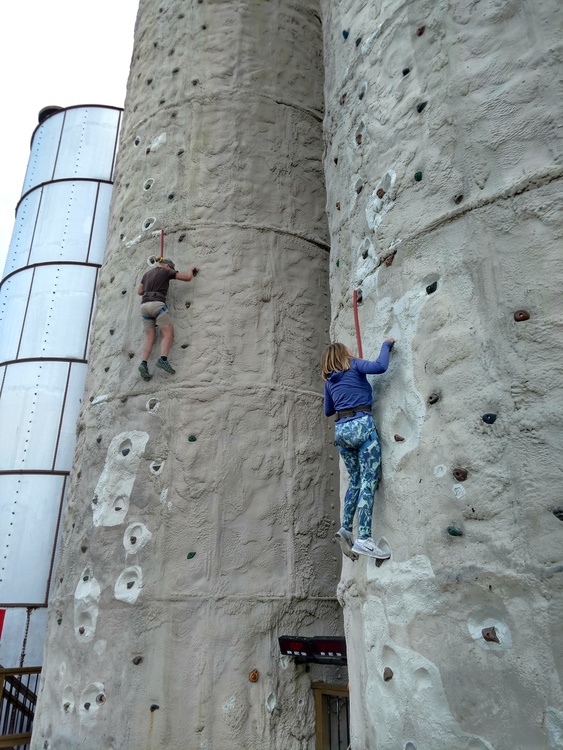
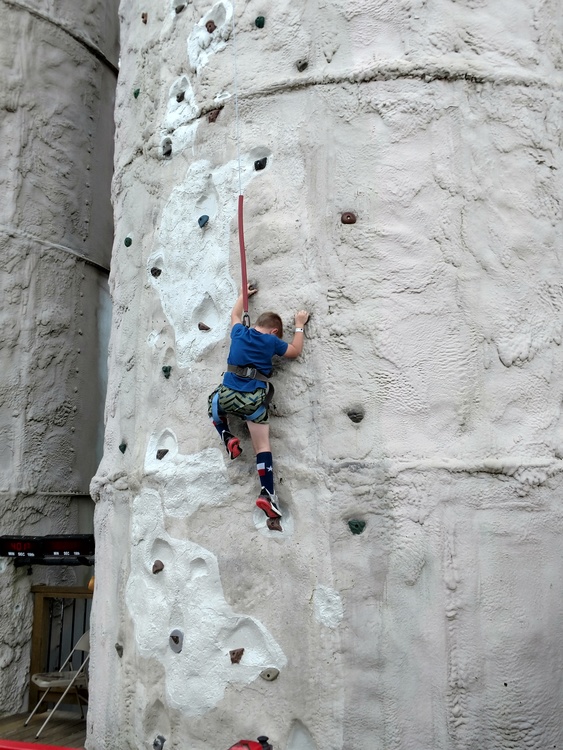
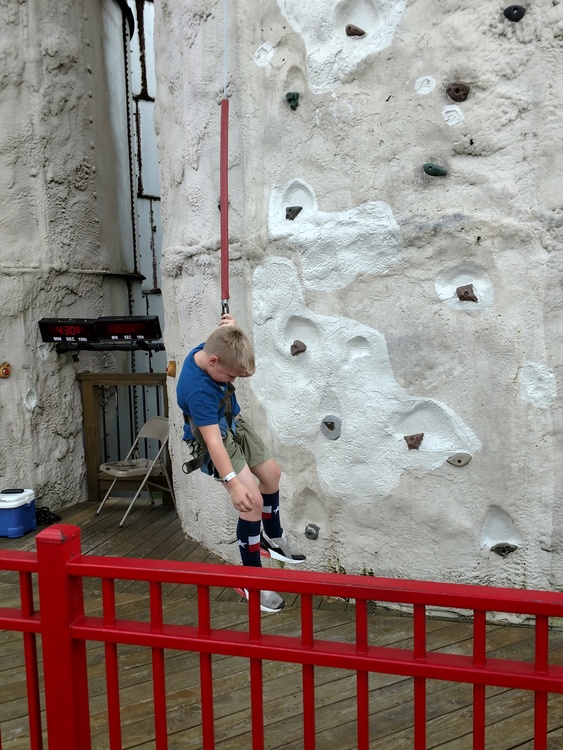
So..while I’m asking...this should have been an obvious observation but I’m just now really getting it: I like slab! I’m just in a zone on slab and I love the progression. So we talked about next time...and how much I’d like to climb Sidewinder and Run For Your Life as a next step. But I also said I don’t want to be a lopsided climber. I want to be able to deal with a crack, chimney or face climb. But I doubt I’ll ever have the upper body strength to do what you guys do. Now in J Tree I’m climbing 10a-b slabs, but a laborious 5.7 crack. There’s a question in here. Do you eventually “specialize” in a type of climbing you really love or do you work on your weaknesses more? Today at the gym I realized (again!) that those vertical reachy muscular climbs are really difficult for me—but I’m willing to get stronger and keep at it. But Ryan said for him slab is just as difficult. Who knew? Man... I’d love to be able to hop on the wall like those kids were doing in the pictures I posted and do that. That was GORGEOUS. And it was practiced precision vertical work for sure.!
Lori Milas wrote: So we talked about next time...and how much I’d like to climb Sidewinder and Run For Your Life as a next step. But I also said I don’t want to be a lopsided climber. I want to be able to deal with a crack, chimney or face climb. But I doubt I’ll ever have the upper body strength to do what you guys do. Now in J Tree I’m climbing 10a-b slabs, but a laborious 5.7 crack.
Upper body strength is over-rated. Really. The key to climbing is hand strength and core strength. Crack climbing doesn't take any more strength than any other type of climbing if you are doing it correctly. The key is to put in the time until your hand and fist jams become fluid and intuitive. Practice makes perfect.
Slab is actually a perfect example. Much of the skill in it is what you're NOT doing. I'm not a terrific slab climber. I'd take a 5.10 hand crack over a 5.10 slab any day.
Russ Walling wrote: Sidewinder and Run For Your Life?? Whoo-ee those are a couple of show_stoppers!
Climb what you like... who cares except you. Being well rounded is great and all for if you expand out onto bigger stuff that will demand all the disciplines. If you are just futzing around on basic local crags, climb the style you like. Lots of people climb nothing but the style they do well with and are proficient at, while never getting in an OW or on steep stuff or whatever.
I always wanted to be well rounded in all the styles of climbing, though I did a lot of wide cracks, I did everything else too... slab, crack, sport, aid, solo, roofs, bouldering etc... it was important for the stuff I wanted to do to have the ability to do it all, within my grade range. It has been said that being a 5.10 climber, that is a climber that can walk up to any 5.10 in the country and do it, is a very rare thing. And by "do it" I mean start at the bottom and finish at the top with no hangs, falls, or weird stuff. Usually the guys that can do that basically climb up to 5.12 while farting around on the crags. It is that sort of hard to be good at all the styles.
Thanks for that insight, Russ. A 5.7 crack climber means being a 5.7 climber, period. It also occurs to me that there are very few pure slab, crack or other climbs. There's always the need for cross-skills. Senor mentioned 'fingers and core'. I whanked out a couple of fingers yesterday at the gym (again), jumping for a tiny hold at the top of a climb.
On a really lovely slab climb last week there was a roof, with a jug (sort of) a few feet beyond my reach. Bob shouted "Lori, looks like you're going to have to do a dyno!" "SAY WHAT?" It was a most interesting leap... but landing and sticking that small hold felt like a shock to my fingers. (fingers again!). So... answering my own question, you have to be well-rounded to climb almost anything.
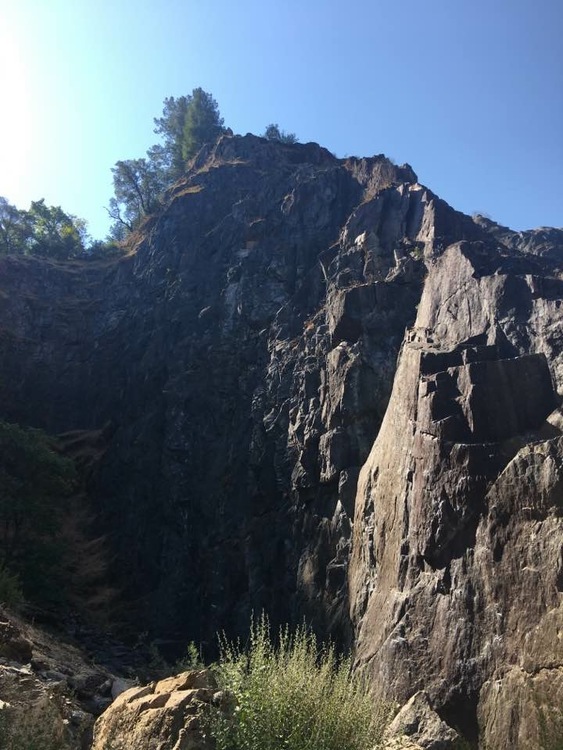
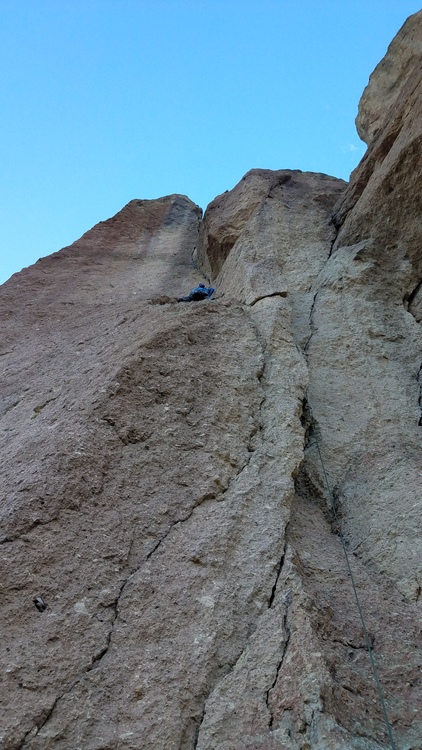
Funny how things change. Two years ago I hiked back to our Auburn Quarry (aka Cave Valley) and took a picture of this wall... and thought nope. Not doing that. I just bumped into this picture and thought maybe it's time to hike back again and climb this. I think the rock itself kind of freaked me out... dark, crumbly and not like J Tree. But it's close, and it's beautiful... I think Brittany Griffiths was recently back here to do a multi pitch inservice.
Quarries are some of the most dangerous climbing I've ever done.
Put up some lines at the quarry at limestone gap bitd.....scary stuff.
Granite quarries are a ton of fun if you don't mind drill scars being "thank God" holds between areas of virtually blank stone. At least it doesn't fall apart like limestone. On a positive note when you get back on natural stone there's holds everywhere....
The stuff on the right (in the sun) would be your best choice.
John Barritt wrote: Quarries are some of the most dangerous climbing I've ever done.
Put up some lines at the quarry at limestone gap bitd.....scary stuff.
Granite quarries are a ton of fun if you don't mind drill scars being "thank God" holds between areas of virtually blank stone. At least it doesn't fall apart like limestone. On a positive note when you get back on natural stone there's holds everywhere....
The stuff on the right (in the sun) would be your best choice.
John, thanks for sharing. This quarry has seen a death and plenty of injuries. It’s the place where I fell several times when I pulled hand and footholds right off the wall. Rocks fall a lot so you can’t go near climbing areas without a helmet. I thought it was just a different kind of climbing that I ought to get used to, but perhaps I’ll give it a pass and drive a little further up the road for better rock. Thank you!
EDIT: "Within the boundaries of the Auburn State Recreation Area (ASRA) is the remains of an old limestone quarry, formerly the Spreckels quarry. The quarry was bequeathed to the Bureau of Reclamation after the Teichert Inc. had determined that the lower quarry had yielded as much material as was financially feasible." So, I guess this is limestone.
To Old Lady H re dynamic ropes. While dynamic ropes have been around since WW2, there are other factors and they do coincide with the Sport Climbing revolution of the 80s. When I started climbing, the standard single rope was 11mm diameter, them 10.5, then 10. The thinnest single rope is presently 8.5mm. While there are other factors and the technology has evolved, it is generally true that the thinner the rope, the more the stretch. The catch is softer but the fall feels longer with the thinner ropes we climb with now.
john bicknell wrote: To Old Lady H re dynamic ropes. While dynamic ropes have been around since WW2, there are other factors and they do coincide with the Sport Climbing revolution of the 80s. When I started climbing, the standard single rope was 11mm diameter, them 10.5, then 10. The thinnest single rope is presently 8.5mm. While there are other factors and the technology has evolved, it is generally true that the thinner the rope, the more the stretch. The catch is softer but the fall feels longer with the thinner ropes we climb with now.
Thank you, John. That was likely me grasping at straws, thinking about the early bolts that went in. In my local area, the Black Cliffs, there are routes where ground fall seems a real possibility, even up past clip 2. Many of the same people bolted here as at City of Rocks and Smith, so my mind just wondered if a small part of how that played out may have had to do with shorter falls on less dynamic ropes.
Clearly, if that was any part all (not likely, I'm thinking), it was a small part indeed. The real takeaway, for me at least, is to climb in the style the route asks of us. In my case, that means take that gear along! Even on "sport" routes. Stick clip as I deem necessary. Downclimb, before I get past the point of it being dangerous, and, use judgement whether to climb the thing at all.
All of that? Is what makes it interesting, and I hope we can keep these routes as they are for future climbers to also challenge themselves.
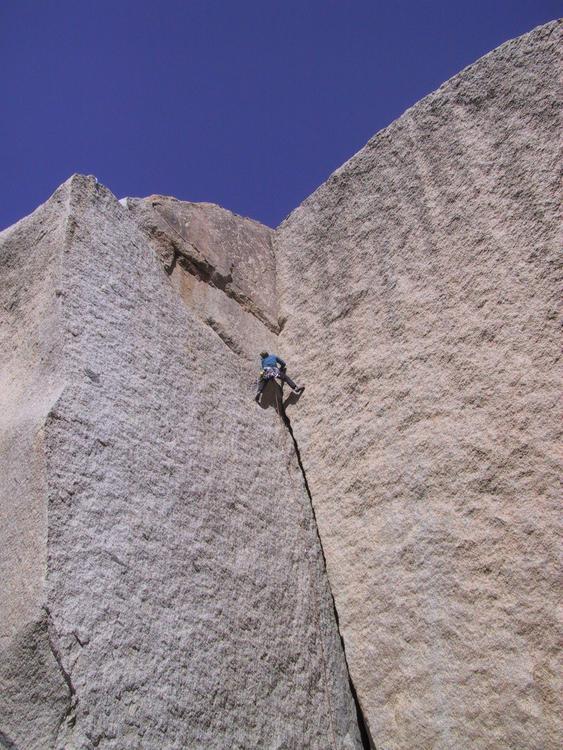
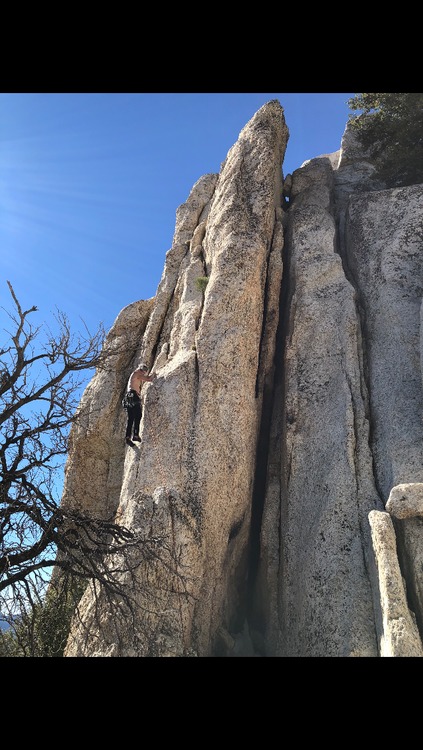
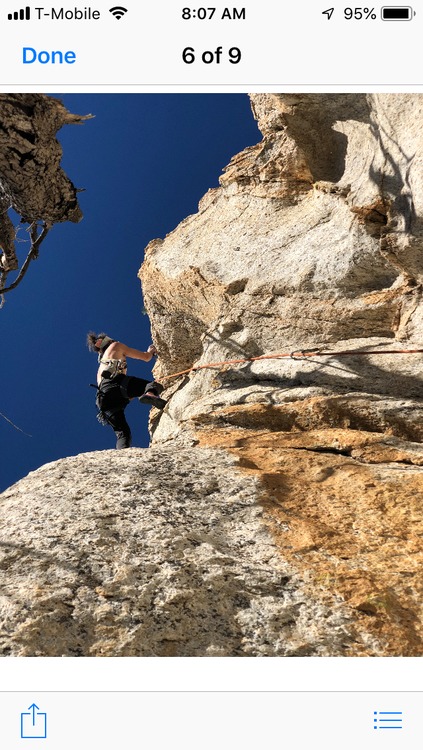
Today's route was my most intense... for me. 3 pitches up a vertical wall, 5.9 trad. I led the first pitch and followed on the next two. Since April 21 of this year I have logged 78 outdoor pitches. Its crazy to me that a little more than six months ago I was terrified top roping on a 5.8 outside. So much fun and climbing with incredible people.
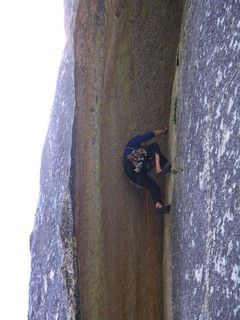
The crux of this climb was a crack near the top. No feet, just lay back working my hands and feet up.
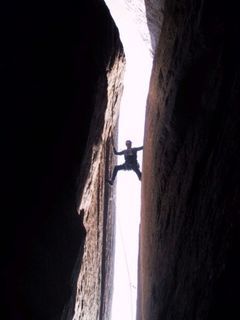
This was my climbing partner setting up the belay at the top of pitch 2.
Wow, Tom! I'm stunned! Congratulations on an awesome climb. You're rocketing right along! If we get to climb again, you'll have to dial it back for me, pretty please?? :-)

 Continue with onX Maps
 Sign in with Facebook