Mountain Project Logo

stopper only climbing

JohnnyG · · Unknown Hometown · Joined Nov 2009 · Points: 10

Some routes can be lead safely with just nuts (stoppers), but is rare in the 100+ different places I've climbed.

Most routes will be MUCH safer if you have some cams. Some placements simply work great for cams but not for nuts.

My suggestion is to buy a set of a nuts and a few cams in the mid-range (e.g Black Diamond purple, green, red and yellow). This sets you back a couple hundred bucks, but it can make you lead climbing MUCH safer.

Forever Outside · · Los Angeles, CA · Joined Feb 2017 · Points: 275

Only Royal Robbins could get away with this idea!!  YGD

Stephen L · · South + Van · Joined Aug 2013 · Points: 166

Jack:

The short answer is, yes of course you can lead with just nuts and passive pro. Some rock/routes are much more conducive to this than others, e.g. one route may be rich with concentric cracks while another is not. As already mentioned, you'd probably want some hexes as well for bigger placements if you're going for such a style.

"is it really safe" is a much more relative question, which all depends on one's experience and other endless variables.

BUT if your goal is to start climbing traditional routes and stay frugal, I would focus less on the whole "climbing on just nuts" inquiry and focus more on finding a good partner that is experienced and stoked to get you climbing on gear. Do you have a rope? Offer up your rope for some climbs with someone that has a full rack and can show you around. Doesn't hurt to go ahead and buy some nuts, you'll want them anyway at some point. But like others have said, it's going to be way more beneficial to find some experienced trad climbers to get you going. Depending on your skill level you might be able to go up some routes with just nuts, but if you're asking if that's possible/safe then I'm assuming it's not in your wheelhouse just yet.

rgold · · Poughkeepsie, NY · Joined Feb 2008 · Points: 526

Mike might be right about the last pic; i was striving to find shots of nuts placed with a bit of outward rotation.  Without a much better view of the inside of the crack, it is hard to tell, but it looks as if a bigger nut placed a bit higher would be a better bet.

David K · · The Road, Sometimes Chattan… · Joined Jan 2017 · Points: 434
rgold wrote:

I've used plenty of opposed nuts in horizontal placements and had a bunch hold both leader and second falls.  There is no question that the system can work, but the placements require careful inspection and industrious fiddling.  The main goal is to get the nuts into opposing constrictions in a way that will take some outward load, in other words not slotted entirely for horizontal loads.  It turns out, in practice, that you can manage this most of the time.  With the nuts slotted to resists a bit of outward loading, they can be connected in a way that doesn't create an extremely large angle, and so the potential for very high loads imposed by the rigging geometry is reduced.  It is true, and in a way the entire point, that if one of the opposed placements fails, the other one will too, otherwide you didn't really need the opposition.

I believe you that this works, but if that's the case, then I definitely am misunderstanding something about the physics. Could you explain a little more?

Maybe we're talking about different things? Certainly it sounds like you're talking about something different from examples I've seen in educational materials, for example this picture from climbing.com:
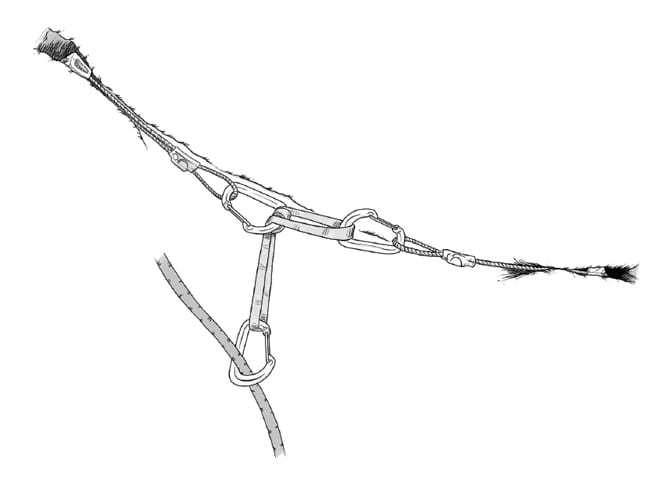


The angle in this picture is nearly 180 degrees (if it were literally 180, the force would literally be infinite). Even if we assume the materials will align during a fall to something like 170 degrees, that's a 574% force on each nut as compared to the downward pull. So a 4kN fall comes out to around 23kN on each nut? No nuts I know of are rated for anything close to that.

Jeff G · · Buena Vista · Joined Feb 2006 · Points: 1,286

Buy some used cams.  Silly to lead on just passive gear.

Paul Hutton · · Nephi, UT · Joined Mar 2012 · Points: 740
https://www.mountainproject.com/route/105833505/nutcracker

This route was FA'd using nuts, only. 

Matt Himmelstein · · Orange, CA · Joined Jun 2014 · Points: 194
Russ Keane wrote: Passive placement as your only option is a pretty advanced science.   You will have to stay on very easy terrain, and at times it will be scary.   If you are a very good and confident climber, sure no problem.  But believe me, when push comes to shove, a cam is your best friend.   My advice is to get the trad rack as complete as possible before launching onto the sharp end.

Going passive by itself is not an advanced science, it is an ancient art.  Cams have allowed us to progress faster and generally climb harder stuff safer.  I don't know how comfortable I would have been climbing this last weekend with only passive gear, I know I would have had more runouts in the tough areas and been a lot slower on lead in the easy sections, since I would have been placing more gear where I could get a good stance and placement.  I don't know if I would have even gotten on the climb.


That said, I have been on climbs were I left my passive gear behind only to find that it protects better with stoppers than cams.

Suburban Roadside · · Abovetraffic on Hudson · Joined Apr 2014 · Points: 2,419

Here is a Master of the Art Form, that is using only "passive" gear on overhanging routes, no cams or leg loops, thats a 1inch swami. . . .


Both at home in the Gunks, like here on The 5.11d rated,  (5.12?) Kligfield's Follies, & while climbing around the country, R Romano has only used cams a few times ever.

Gunkiemike · · Unknown Hometown · Joined Jul 2009 · Points: 3,732
David Kerkeslager wrote:

I believe you that this works, but if that's the case, then I definitely am misunderstanding something about the physics. Could you explain a little more?

Maybe we're talking about different things? Certainly it sounds like you're talking about something different from examples I've seen in educational materials, for example this picture from climbing.com:


The angle in this picture is nearly 180 degrees (if it were literally 180, the force would literally be infinite). Even if we assume the materials will align during a fall to something like 170 degrees, that's a 574% force on each nut as compared to the downward pull. So a 4kN fall comes out to around 23kN on each nut? No nuts I know of are rated for anything close to that.

In the absence of something like a clove hitch where the sling bends over that "middle" biner, the applied load will cause that biner to slide outward, reducing the loading. In the frictionless world of physics class, it would slide as far as it could, as nature seeks a straight line to each nut.

David K · · The Road, Sometimes Chattan… · Joined Jan 2017 · Points: 434
Gunkiemike wrote:

In the absence of something like a clove hitch where the sling bends over that "middle" biner, the applied load will cause that biner to slide outward, reducing the loading. In the frictionless world of physics class, it would slide as far as it could, as nature seeks a straight line to each nut.

Oh, interesting. In the picture there actually is a knot of some sort there (unclear which) but let's pretend there's no knot there. In that case, the biner acts like a pulley, no? So now we're dealing with deflection-angled pulleys and if we assume a frictionless pulley, the load on a pieces is at most 200% of the load from the fall. If we don't assume a frictionless pulley (as is reality) then the force will be greater, but with these numbers, both pieces surviving the fall looks a lot more plausible.

I think that's the part of the physics model I was missing, so thank you.

So the lesson here is, don't clove the biner when placing opposing nuts.

Robert Hall · · North Conway, NH · Joined Aug 2013 · Points: 28,846

Wow! I didn't think my one minor comment on horizontal placements would elicit so many responses. BUT THAT's GOOD.

 Kerkeslater's diagram is a good as any, although most of the (very few, in 50 yrs of climbing) opposed, horizontal nut placements I've made or seen (i.e. cleaned) were close enough together the two loops of wire could either be linked with a single biner (yes, yes...subject to cross loading) or had one wire loop just put through the other. Would it hold, break, or "blow out" the rock??? Who knew? (as yes, I did pass Physics 101 & 102 ) That's why before one of these got set up you searched the horizontal crack for a narrowing where you could slot just one nut from the (wider side) and "set" it.  And that's why most of the time today I'd use a cam in a horizontal if the crack is big enough, and for the 1st (and probably all) the placements in a steep corner pitch. But for thin horizontal cracks, I still think wired nuts are the best; and even for thin vertical cracks since most tiny TCUs and Cams just aren't rated strong enough compared to a wired nut of the same size.
 

Steve Marshall · · Concord NH · Joined Jul 2014 · Points: 45
David Kerkeslager wrote:

Oh, interesting. In the picture there actually is a knot of some sort there (unclear which) but let's pretend there's no knot there. In that case, the biner acts like a pulley, no? So now we're dealing with deflection-angled pulleys and if we assume a frictionless pulley, the load on a pieces is at most 200% of the load from the fall. If we don't assume a frictionless pulley (as is reality) then the force will be greater, but with these numbers, both pieces surviving the fall looks a lot more plausible.

I think that's the part of the physics model I was missing, so thank you.

So the lesson here is, don't clove the biner when placing opposing nuts.

Am I missing something? With no knot, the "middle" biner will slide towards the rightmost biner, making the angle CLOSER to 180 as everything tightens up.

The knot means that the middle biner will get pulled downwards, taking out slack in the setup and moving the angle further away from 180, which is what you want. In that situation I probably would have done a sliding X which would make the angle as far from 180 as possible. Assuming that the placements can tolerate that direction of pull. If the placements are only good at a near-180 angle, well then hopefully there's a better placement.

Gunkiemike · · Unknown Hometown · Joined Jul 2009 · Points: 3,732
David Kerkeslager wrote: So the lesson here is, don't clove the biner when placing opposing nuts.

Except when you do. To "set" the angle that the nuts are loaded, as dictated by the crack's features.

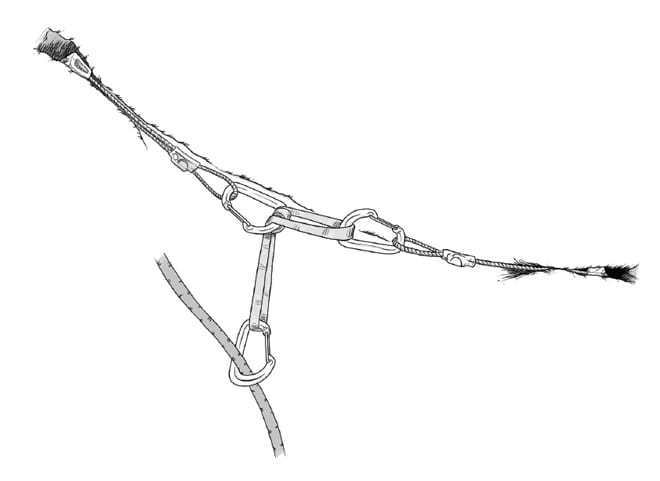
Back to that drawing - I'm 99% sure what you see is not a knot (or hitch for the pedants out there). It's a simple wrap of one strand of the sling around the biner. That's SOP to keep the right-side nut from flying through if it comes out of the crack.

While we're beating this to death, the Robinson error (through today's lens) was using a set up like this for VERTICALLY opposed nuts. Imagine the left nut in this illustration as the top piece. Bending that sling over the biner creates that dreaded "pully effect" in addition to the unavoidable effect by the rope bending over the top piece. So maybe 1.6X the load...squared.

Andrew Rice · · Los Angeles, CA · Joined Jan 2016 · Points: 11

There's a reason it's a DRAWING. I think it's funny that people here are obsessing over the theoretical physics of a drawing.

caesar.salad · · earth · Joined Dec 2012 · Points: 75

You're in Maine. Drive to north conway and go climb on cathedral and whitehorse. People have climbed there with nuts and hexes for longer than cams have existed.

Edit: Climb "Nutcracker" 5.9 on the Barber Wall at Cathedral. The name says it all.

David K · · The Road, Sometimes Chattan… · Joined Jan 2017 · Points: 434
SteveMarshall wrote:

Am I missing something? With no knot, the "middle" biner will slide towards the rightmost biner, making the angle CLOSER to 180 as everything tightens up.

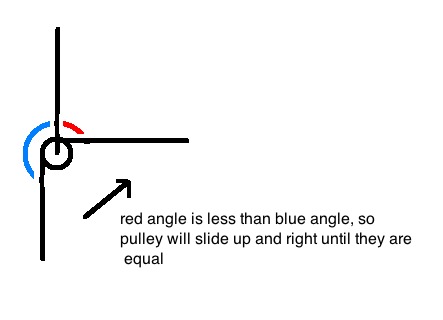
Introducing the pulley changes it from a vector load system to an angle vector load system. The middle biner won't slide toward the rightmost biner, it will slide whatever direction causes the angles between the ends of the pulley to equalize. Some craptastic illustrations:
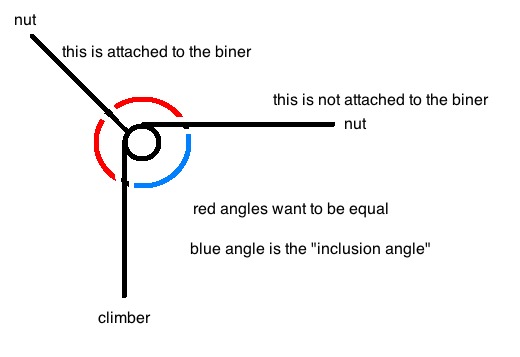


I'm saying this from memory so definitely check my physics here.

In any case, even if the angle is 180 (which can occur only if the nut attached to the pulley biner is pulling straight up and the other nut is pulling straight down) the maximum force is on the nut attached to the biner, and is only 2x the force of the fall, which in many cases can be handled by modern gear.

EDIT: All of what I'm saying in this post assumes a frictionless system, but obviously real life has friction. I'm unsure of how much friction will affect things.
David K · · The Road, Sometimes Chattan… · Joined Jan 2017 · Points: 434
Gunkiemike wrote:

Except when you do. To "set" the angle that the nuts are loaded, as dictated by the crack's features.

Unless I see some different physics here, it sounds like you're just going to break your gear if you tie that knot and fall on it, so if that's the case I'd just run it out and keep climbing. Better to hit the crux with more energy and no piece below you than to hit the crux more tired with a piece below you that won't hold anyway.

You might be right about that not being a knot, though. It's not really clear.

Gunkiemike · · Unknown Hometown · Joined Jul 2009 · Points: 3,732
David Kerkeslager wrote: Introducing the pulley changes it from a vector load system to an angle vector load system. The middle biner won't slide toward the rightmost biner, it will slide whatever direction causes the angles between the ends of the pulley to equalize. Some craptastic illustrations:
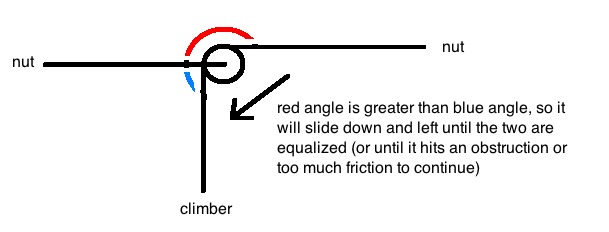


I'm saying this from memory so definitely check my physics here.

In any case, even if the angle is 180 (which can occur only if the nut attached to the pulley biner is pulling straight up and the other nut is pulling straight down) the maximum force is on the nut attached to the biner, and is only 2x the force of the fall, which in many cases can be handled by modern gear.

EDIT: All of what I'm saying in this post assumes a frictionless system, but obviously real life has friction. I'm unsure of how much friction will affect things.

Nice drawings. A simpler way to understand this (well, it works for me anyway) is that the line to the left nut is the resultant vector of the other two lines. In the frictionless realm of course.

Ted Pinson · · Chicago, IL · Joined Jul 2014 · Points: 252

Sounds great!  Just don’t fall.

Guideline #1: Don't be a jerk.

Trad Climbing
Post a Reply to "stopper only climbing"

Log In to Reply
Welcome

Join the Community! It's FREE

Already have an account? Login to close this notice.