|
|
Caleb Schwarz
·
Oct 24, 2017
·
Colorado Springs, CO
· Joined Mar 2016
· Points: 120
The grooved friction side and the regular side are interchangeable. Doesn't matter which side you use. However they have it set up so the brake strand is on top, climber side on bottom, instead of the other way around.
|
|
|
aikibujin
·
Oct 24, 2017
·
Castle Rock, CO
· Joined Oct 2014
· Points: 300
Kyle Tarry wrote:In the TNF photo, he has the belay device oriented 180-degrees off from what people normally do, but it's still totally safe. The strands don't cross, it's loaded correctly, and the brake hand would still apply appropriate force. Exactly. And if the belayer actually brakes for a fall, the belay loop will simply twist 1/4 of a turn to align the belay device with the tension/force on the rope and brake strands.
|
|
|
Beean
·
Oct 24, 2017
·
Unknown Hometown
· Joined Feb 2014
· Points: 0
Old lady H wrote:Gee thanks. At least the dogs and I can listen to music while pitching biners and bananas at drones. ;-) OLH I really enjoyed the recent sock thread.
|
|
|
Anonymous
·
Oct 24, 2017
·
Unknown Hometown
· Joined unknown
· Points: 0
Kyle Tarry wrote:That's not what he is doing. That image is BD telling you not to cross your brake strands over the strands going to the climber. However, the strands aren't crossed in the North Face photo. In the TNF photo, he has the belay device oriented 180-degrees off from what people normally do, but it's still totally safe. The strands don't cross, it's loaded correctly, and the brake hand would still apply appropriate force. Why is everybody so anxious to poo-poo this anyway? It's a jacket ad, who cares. Why I said it wasn't exactly what he was doing, however it looks like he is crossing the ropes on the side which still means ropes are rubbing and it isn't good for them. Is it going to kill you probably not but still would not recommend commonly belaying like that.
|
|
|
Tom Sherman
·
Oct 25, 2017
·
Austin, TX
· Joined Feb 2013
· Points: 433
I love the fact that >50% of the people in this thread still do not know what is actually being discussed. The brake strand is supposed to come out of the front (the bottom) of the ATC. The climber strand is supposed to come out the top (the back) of the ATC. (Switched the ____ (____) there just to fuck with ya!) In actuality this does not matter. But we're not talking about the rope running over the side, the rope running over the grooves, the extent of the bend of the rope (that's a consequence), or any of that BS. We're talking about loading the device wrong (backwards), and not having the brake oriented as it is intended to by the user instructions. Did I mention that it's been discovered that it doesn't actually matter?
|
|
|
Patrik
·
Oct 25, 2017
·
Third rock from Sun
· Joined Jun 2010
· Points: 30
Mark E Dixon wrote:Have you looked at the ATC user guide linked above? Looks to me as if the pictured device is being used just fine in high friction mode. Please correct me if I am missing something. Would you not prefer that the brake end strand of the ropes go into the V-slots of the belay device when the belayer catches a fall? Especially since these are double ropes, I would assume they are thin and would benefit from the V-slot feature. In the parka photo, simply turn the ATC 180deg, so that the V-slot is away from your body and use the brake hand pulling more down than sideways.
|
|
|
Old lady H
·
Oct 25, 2017
·
Boise, ID
· Joined Aug 2015
· Points: 1,375
Tom Sherman wrote:I love the fact that >50% of the people in this thread still do not know what is actually being discussed. The brake strand is supposed to come out of the front (the bottom) of the ATC. The climber strand is supposed to come out the top (the back) of the ATC. (Switched the ____ (____) there just to fuck with ya!) In actuality this does not matter. But we're not talking about the rope running over the side, the rope running over the grooves, the extent of the bend of the rope (that's a consequence), or any of that BS. We're talking about loading the device wrong (backwards), and not having the brake oriented as it is intended to by the user instructions. Did I mention that it's been discovered that it doesn't actually matter? Sorry if I missed it, but who "discovered it doesn't actually matter" if the ATC is "backwards"? A real question. It seems like the rope going over the side would be less friction, and hard to avoid with the ATC backwards. Anyone actually test this? Thanks! Helen
|
|
|
David Tysinger
·
Oct 25, 2017
·
Winston-Salem, NC
· Joined Oct 2007
· Points: 0
Old lady H wrote:Sorry if I missed it, but who "discovered it doesn't actually matter" if the ATC is "backwards"? A real question. It seems like the rope going over the side would be less friction, and hard to avoid with the ATC backwards. Anyone actually test this? Thanks! Helen Yup- I have. Not in the too distant past belay devices didn't even have grooves.
|
|
|
Anonymous
·
Oct 25, 2017
·
Unknown Hometown
· Joined unknown
· Points: 0
Tom Sherman wrote:I love the fact that >50% of the people in this thread still do not know what is actually being discussed. The brake strand is supposed to come out of the front (the bottom) of the ATC. The climber strand is supposed to come out the top (the back) of the ATC. (Switched the ____ (____) there just to fuck with ya!) In actuality this does not matter. But we're not talking about the rope running over the side, the rope running over the grooves, the extent of the bend of the rope (that's a consequence), or any of that BS. We're talking about loading the device wrong (backwards), and not having the brake oriented as it is intended to by the user instructions. Did I mention that it's been discovered that it doesn't actually matter? None of that matters the only thing that causes an issue is the rope rubbing against each other which is bad for the rope and should be avoided.
|
|
|
Kevin Mokracek
·
Oct 25, 2017
·
Burbank
· Joined Apr 2012
· Points: 378
ViperScale wrote:None of that matters the only thing that causes an issue is the rope rubbing against each other which is bad for the rope and should be avoided. And even the rope rubbing against itself is not that big an issue since it’s moving and never rubbing in the same place. Kind of the same as using a Munter hitch to rap or belay.
|
|
|
Old lady H
·
Oct 25, 2017
·
Boise, ID
· Joined Aug 2015
· Points: 1,375
Dave T wrote:Yup- I have. Not in the too distant past belay devices didn't even have grooves. Ah! Duh. I'm sorry, I just plain forgot about plain tube devices. So, do the grooves not add friction, then? Not being cantankerous, it's just good to know, and it doesn't seem like they do add much, to me. Different ropes, different weights for climbers I'm belaying, getting more or less friction out of an ATC has already come up for me. That's just for simple belaying, not rappells. Thanks! The pool of expertise and experience on here is a great deal of why I stick with it. Best, Helen
|
|
|
Kevin Mokracek
·
Oct 25, 2017
·
Burbank
· Joined Apr 2012
· Points: 378
Many current belay devices don’t have grooves either. It’s a preference thing and not a critical function of the device. I used to belay with stacked rap rings back in the day and before that a hip belay.
|
|
|
Allen Sanderson
·
Oct 25, 2017
·
On the road to perdition
· Joined Jul 2007
· Points: 1,100
Dave T wrote:Yup- I have. Not in the too distant past belay devices didn't even have grooves. Nor did they have a tube shape, they were flat as a plate. As in a Stitch Plate. Like this:
|
|
|
Jason Todd
·
Oct 25, 2017
·
Cody, WY
· Joined Apr 2012
· Points: 1,114
Old lady H wrote:So, do the grooves not add friction, then? Not being cantankerous, it's just good to know, and it doesn't seem like they do add much, to me. The grooves DO add friction, IME. I can tell the difference when I'm rapping. Lower angle I'll use the grooveless side, steeper, grooved. Belaying, I generally use the grooved side on break hand when lead/TR belaying. Lowering a climber is easier to control with more friction. I belay my kids on the smooth side though, as they don't offer enough resistance to lower on the grooved side.
|
|
|
Patrik
·
Oct 25, 2017
·
Third rock from Sun
· Joined Jun 2010
· Points: 30
Old lady H wrote:So, do the grooves not add friction, then? Not being cantankerous, it's just good to know, and it doesn't seem like they do add much, to me. If you ignore the "issues" discussed in regards to the photo and wonder if an ATC with V-slots/grooves can safely be threaded "backwards", the answer is in the user guide in the link provided by Allen Sanderson: http://demandware.edgesuite.net/aakn_prd/on/demandware.static/-/Sites-bdel/default/dwc035a6a1/instructions/S16_Instructions/M10798_B_ATCGuide_IS-WEB.pdf In the upper right corner, there are two pictures labeled HFM (High-Friction Mode) and RFM (Regular-Friction Mode) showing that (according to BD), there is a difference. The text claims "In the HFM, the ATC-Guide has two to three times the friction of the device when used in the RFM. Use the ATC-Guide in the HFM when you want more holding power—typically when using small diameter ropes, when rappelling a single line or when belaying a climber working a route". So, back to the photo issues. I would still prefer my belayer to belay in such a way that the ropes go through the V-slot appropriately and not cross over the "side" of the ATC. For those of you who claim there's no issue in the OP photo and it makes no difference whatsoever, do all of you "trust" the magical 1/4 turn alignment suggested by aikibujin? Or do you just say BS to the claim in the BD "user manual"? Or do you all use BITD 11mm ropes for which the "2-3x" friction could be somewhat annoying?
|
|
|
Allen Sanderson
·
Oct 26, 2017
·
On the road to perdition
· Joined Jul 2007
· Points: 1,100
Patrik wrote:So, back to the photo issues. I would still prefer my belayer to belay in such a way that the ropes go through the V-slot appropriately and not cross over the "side" of the ATC. For those of you who claim there's no issue in the OP photo and it makes no difference whatsoever, do all of you "trust" the magical 1/4 turn alignment suggested by aikibujin? Or do you just say BS to the claim in the BD "user manual"? Or do you all use BITD 11mm ropes for which the "2-3x" friction could be somewhat annoying? The reason I am not concerned with the set up is because the photo shows the belay without any tension in the system, i.e. it is relaxed. Frequently while belaying after feeding out rope, changing my stance, switching hands, etc. I have found the rope not aligned with the V-grove. Big deal, just give the rope a bit of flip and move your hand. I am willing to bet that if one took video of people belaying that there would be a 100% chance that at least once one would also see the rope not aligned with the V-grove. At that point and according to many I could say that that person is a failure at belaying. Folks should also remember that photo shoots with people are rarely static regardless if they are in a studio or in the field. As for the V-groves being oriented towards the belayer (as in the photo) or away. With either scenario when one is braking the braking is to the side and back. So the system will twist regardless. If one really wanted to be pedantic I would argue having the V-grove oriented towards the belayer is correct because there is less twisting. And if one looks carefully at the BD instructions that is actually what they show in all of the illustrations on the top row but the last (the one with green). The last one is also for an older tube style device. YMMV.
|
|
|
Patrik
·
Oct 26, 2017
·
Third rock from Sun
· Joined Jun 2010
· Points: 30
Allen Sanderson wrote:As for the V-groves being oriented towards the belayer (as in the photo) or away. With either scenario when one is braking the braking is to the side and back. So the system will twist regardless. If one really wanted to be pedantic I would argue having the V-grove oriented towards the belayer is correct because there is less twisting. And if one looks carefully at the BD instructions that is actually what they show in all of the illustrations on the top row but the last (the one with green). The last one is also for an older tube style device. YMMV. Now, that's an interesting twist to this thread! Assuming that all the pics in the BD manual are "what the belayer sees" (which would be the most natural way of picturing this in a user manual), Allen's detailed observation is correct. The BD setup is with the brake hand close to the belayer the same way as the OP photo. I get the impression that those who see the photo as "Duh, total fail!" see it as very natural (almost as if having been told or taken a class) to have the climber strand close to the body and brake hand away. Where does this come from? Would you consider the BD user manual also "Duh, total fail!"? Are there anyone teaching classes out there or "gym belay testers" that has any input on the topic? I'm more interested in hearing "why" you think the way you do than hearing an opinion with no reasoning (yeah, I know, maybe asking for a little too much on MP). For those of you who occasionally rapel, is there anyone out there rapelling with their brake hand strand close to their body?
|
|
|
Carson Leon-Gambetta
·
Oct 26, 2017
·
Newtown, CT
· Joined Feb 2016
· Points: 5
Backpacker magazine's instagram page recently posted a video with an upside-down grigri
|
|
|
Caleb Schwarz
·
Oct 26, 2017
·
Colorado Springs, CO
· Joined Mar 2016
· Points: 120
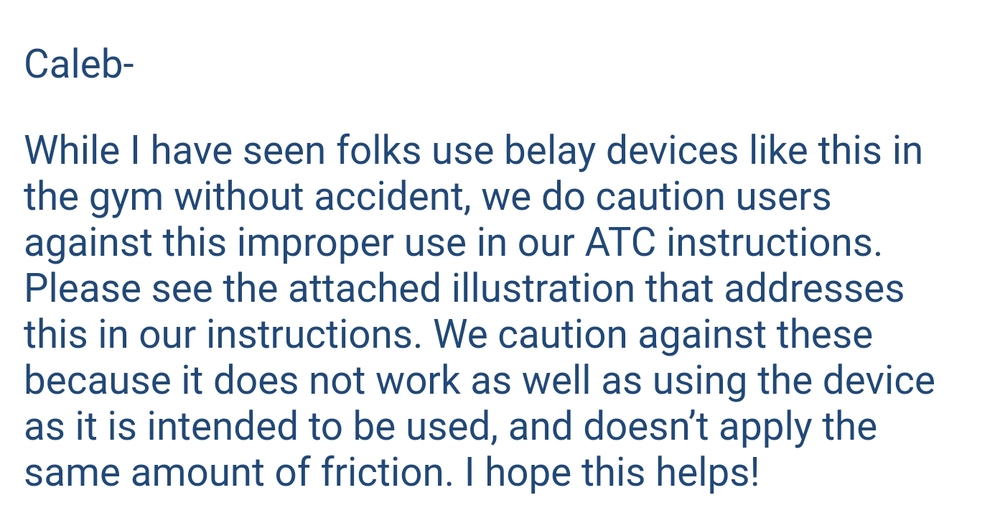
BD is the first to respond: So BD advises against using it in this way, calling it "improper use"
|
|
|
Anonymous
·
Oct 26, 2017
·
Unknown Hometown
· Joined unknown
· Points: 0
Carson Leon-Gambetta wrote:Backpacker magazine's instagram page recently posted a video with an upside-down grigri What is wrong with an upside-down grigri? I only use my grigri upside down to belay my second up. Did you mean the climber side and belayer side rope were backwards?
|

 Continue with onX Maps
 Sign in with Facebook