
 Continue with onX Maps
 Sign in with Facebook






Removing glue-in anchors
|
|
Is it possible to use a brazing torch to heat the anchor and perhaps the rock immediately surrounding the anchor so that the epoxy will soften and the anchor can be removed? If so, is the process expected to be messy? |

|
It is not ideal to go with that method. |
|
|
What type of glue in are you removing? Drilling out the glue I used a funkness on the eye to get the bolt out once glue was drilled out. Core drilling I cut the eye off and then drilled around the shaft. Both ways left reusable holes, but core drilling looked nicer. |
|
|
Forgot the core drilling route. |
|
|
bernard wolfewrote: It is possible but might not be the easiest, fastest or best way, as people have mentioned above. I've seen a series of photos of this being done, but not done it myself. Depending on what glue is used, it may soften or even burn when you heat the bolt-eye. Then you can funk out the bolt and, I assume, re-drill the hole to get the remaining glue out. It's not clear to me whether this compromises the integrity of the rock, so... |
|
|
Red neck core drill works for Wave bolts. It is not unusual for Wave bolts to be installed badly. You do need a pulling tool that will accomodate the eye of the bolt. Regular Core drill will work for any bolt if you have large enough long enough bit. |
|
|
Mr Rogerswrote: That always feel like cheating to me, but is a good option. Someone recently rebolted a route, but didn’t drill deep enough. While probably not a safety concern, it looks bad and freaks people out. I used the above method, but also upsized the bolt. I found it tricky to cut the bolt flush without also scarring the rock  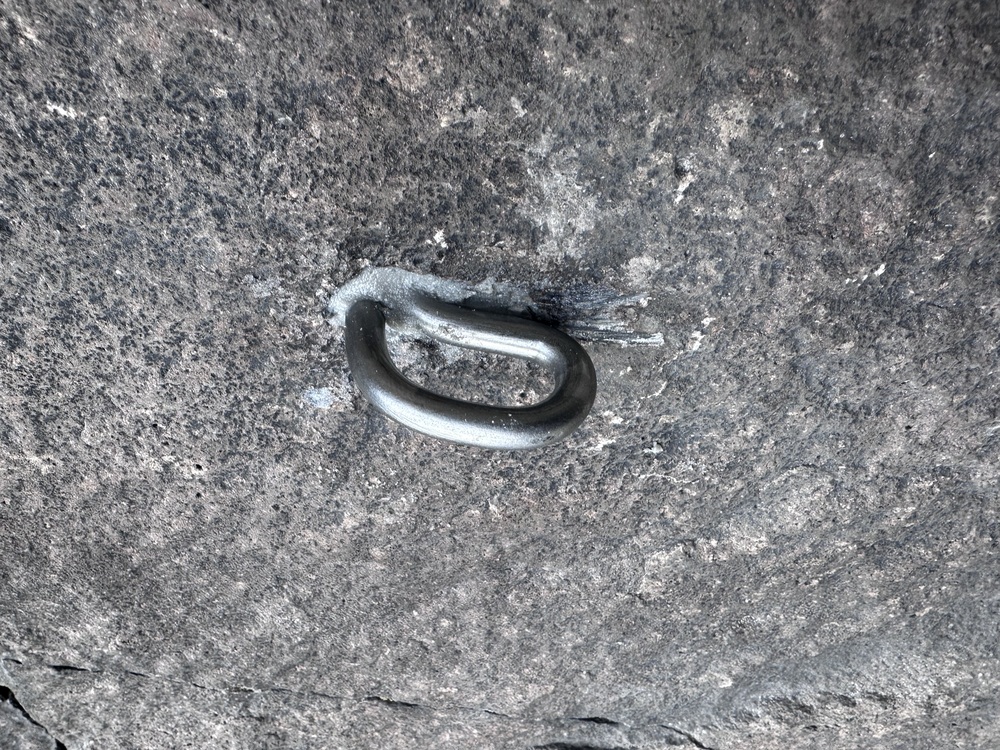  |
|
|
“That always feel like cheating to me, but is a good option. Someone recently rebolted a route, but didn’t drill deep enough. While probably not a safety concern, it looks bad and freaks people out. I used the above method, but also upsized the bolt. I found it tricky to cut the bolt flush without also scarring the rock” Try hammering the top rod straight down and deforming the shape to be more steeply-sloped downward, and then grind at a steep angle to the rock from the top down. Next hammer the cut-loop and bottom rod down and deform it to the same steep downward-bent position. Now grind in the same fashion with an angle held steeply to the stone again. You can also bend/hammer the cut loop back and forth to further deform the steel and gain some more space to cut precisely. This has worked remarkably well for me. I would never worry about exactly reusing the hole. Do your best with patch/camo and give the extra time to replacing a greater number bolts. Also, I’ve found that many times when waves are not flush and deep in the hole it is because the drill hole orientation was wonked with an unintentional vector change halfway through the drilling, and even though the hole is deep enough, the bolt can’t make the bend/angle change and get to depth. |
|
|
Great feedback. Thanks for responding. |
|
|
Steps to remove a Wave bolt: 1. Hammer the eye of the bolt to the left 2. Drill a 3/16" hole 4" deep on the right side of the bolt 3. Hammer the eye of the bolt to the right 4. Drill a 3/16" hole 4" deep on the left side of the bolt 5. Insert a pry bar into the eye and twist the bolt left and right weakening the seal between the rock and epoxy, this help prevent dinner plating of the rock when pulling 6. You've now damaged the epoxy enough to pull the bolt with a Hurly Senior 7. Redrill the hole 8. Replace with a new glue-in, no need to up size. I've pulled many Wave bolts this way with 100% success rate and you even get a friction fit with the new bolt. They are the simplest bolt to pull, in my opinion. I've haven't had an opportunity to try this on a single leg or twist bolt yet, but it's worth a try. Tim's red neck core drill works too. |
|
|
Peter Thomaswrote: What kind of moron would do this work is my big question |
|
|
M Mwrote: Not a wave in this case but I've seen dozens of wave bolts like this, the inability to dry fit the bolt without oversizing the hole is a big downside, along with the fact that people often beat them in with a carbon steel hammer, marring the surface of the bolt. The problem mostly lies in the fact that they're a 1/4" too long to be placed with the standard 6" sds bit most developers have laying around. |
|
|
DrRockso RRGwrote: That pic is close to an inch and longer bits are easy to buy for anyone who has invested 1k+ in tools and material! Typically a skilled tradesman would hold the bolt up against the bit and see if they were compatible before pounding the thing in, it's a common sense thing that gets overlooked by people who are in a hurry to get their FA. Definitely not saying I wouldn't trust it, just that it gives off a really icky vibe. |
|
|
M Mwrote: My point was not to defend the workmanship, but to point out that it's an unfortunate common occurrence, that is commonly seen in pound in style glue-ins. Another common instance of this is when reusing holes and the developer forgets to enlongate the old hole, with non pound in glue ins it's easy to pull the bolt out and fix the problem. In good rock it's unlikely to cause any harm, in poor quality rock I might be concerned about the leverage on the rock. |
|
|
Heating glue-ins with a blow torch has plenty of issues not least for extracting the anchor. Two issues; firstly most adhesives in use have fire retardant additives and secondly, transferring sufficient heat to the base of the hole is very time consuming and typically the eye snaps when any torque is applied to loosen the shaft. |
|
|
Francis Hadenwrote: You got some links to support this? Info on glue that is rated only for "smooth" holes of a core bit compared to a more standard 2/4 cutter SDS? |
|
|
Francis Hadenwrote: yep.......tracking your feedback, which corresponds to an earlier message in the thread on the efficacy of using a torch to soften the glue. I'll be going with the drilling out on either side of the anchor, then twist/flex to loosen approach....and see how that goes. Thank you! |
|
|
Mr Rogerswrote: Hilti RE 500 would be one example of an adhesive used by climbers, which is rated for diamond core drilled holes. |
|
|
I just rough up the diamond core drilled hole with a wire brush after, it works great for soft rock. But also use a pure epoxy like liquidroc or ep800 |
|
|
Thanks Fancis. Appreciate you for bringing that tidbit bit into the conversation for further exploration. |


