Continue with onX Maps
 Sign in with Facebook






Who makes a Dynamic Cordellette?



|
King Tut wrote: Yeah make a cordellete out of dynamic rope strands if you are making an anchor point for a winch cat otherwise... WAY overkill. Most of the whining I hear about cordelletes is because they are pretty limited in their use. The really good parts are they can be cut up into quite a few rap anchors and equalize trad anchors with more than 2 pieces. Plus they are small and light. |

|
coldfinger wrote: No, they don't. They distribute load, but equalization is a myth. |
|
|
cyclestupor wrote: Like most threads on MP. This started as a civil discussion but quickly fractured into several shit fights |
|
|
dynamic slings made by Beal |
|
|
Thaddeus VanDenBerghe wrote: Hooray. Now the OP has a solution to his problem. Although I doubt he cares anymore ;) |
|
|
He never wanted one. You guys need to actually read the OP! |
|
|
David Kerkeslager wrote: Obviously... also it seems that 25% would be small, compared to reality The point is...for any scenarios where impact failure is within the 75-100% (for a 25% reduction in impact force) then that reduction would be the difference in castastrophy versus a scare. But your point is disengebuous...if you made a 3 piece anchor with each piece only holding 2kN you'd also not see a dynamic anchor "save the day" compared to static but if you were talking marginal placements that may or may not pull...a dynamic could save the piece I think the drawbacks are abrasion and knot tying/untying difficulty |
|
|
I also do you understand the logic that people are stated in reference to Jim's info Stating, "dynamic anchoring is negligible" because "the trope will stretch so much more" doesn't make sense to me... Ok...so a bad fall onto static hear might break them and give 20kN+ loads, add the super dynamic lead rope and the impact force might be 8kN or whatever...aka the rope makes a HUGE difference...but if a dynamic anchor dropped that force again couldn't that possibly be practical under dire risk of a bad anchor (aka not bolts duhh, but sketchy placements for a traditional anchor)? maybe it only will save 10% of the otherwise catastrophic outcomes...but if there is no risk of it worsening the outcome...why not investigate it? Maybe that's the progression on safety? I mean...most of the time, the dynamic versus static nature of a group group versus ATC doesn't matter...but on bad traditional placements it sure would! |
|
|
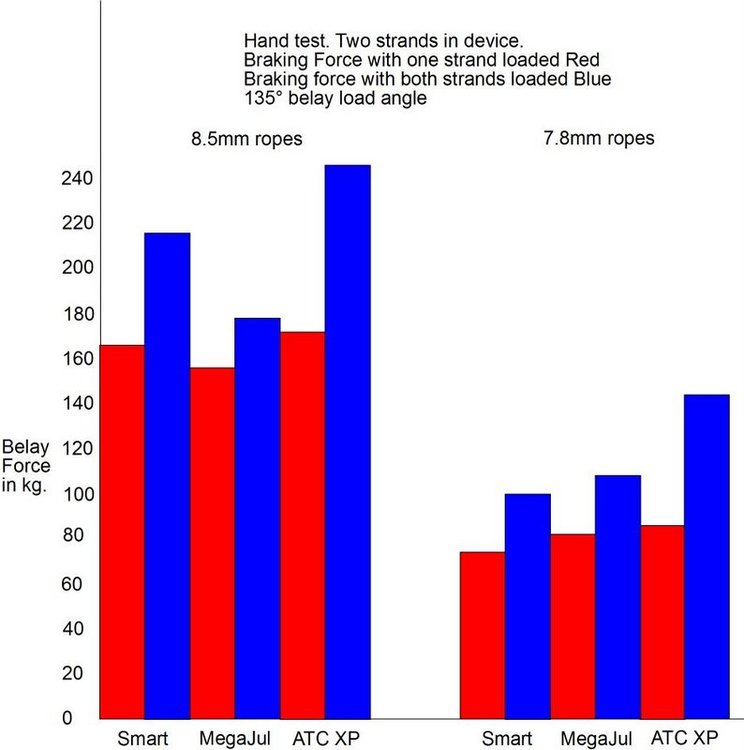
Jim Titt wrote: I heard from an unnamed source that Smart and Megajul are so called "assist lock devices" and as such they are supposed to give less dynamic to the system compared to a "tube" (ATC XP). This reduction of dynamics should give higher forces, but why is it the ATC XP that generates the higher forces in these graphs? Just a random fluke due to limited number of tests? Or maybe I'm misreading something ... (not completely unheard of). |
|
|
Patrik wrote: We've prepared pages and pages of thread earlier for just this question! TL;DR megajul locks up hard at low loads, but counter-intuitively to most people gets outperformed by ATC-XP at high load. |
|
|
r m wrote: Pretty interesting that this happens for both the Smart and the MegaJul. I wonder if it also happens with the ClickUp? |
|
|
Patrik, the graphs implicitly depict the grip-force enhancement capabilities of the devices, and you are speaking of peak loads to the anchors. Jim's Trumpian appendages are capable of a certain level of grip force. The devices multiply this by some amount to give the belay force he is capable of resisting without rope slippage. The graphs indicate these belay force levels various device and rope combinations. Belay forces above the levels in the graph would cause the rope to run through the device. At first, there seems to be something contradictory about the assisted locking devices holding lower forces. This is because they are nowhere near the classical concept of a force multiplier, in which the device multiplies the belayer's grip strength by some constant ratio regardless of the force level. What happens with the assisted locking devices is that at higher loads their force multiplication ratios fall below what the ATC provides. How can this be when the device locks? I'm not sure anyone has provided a tested explanation, but here is a theoretical one. (Caveat: this is my explanation and may be wrong in an infinite number of ways. But the described phenomena are based on tests by Jim.) The assisted lockers work not primarily by creating friction around an S-curve as ATC's do, but rather by physically pinching the rope with the device carabiner. This pinching is by virtue of a "hole" between the carabiner and the device walls that gets smaller as the carabiner is pulled along the device track. But this hole has a minimal size, and as the rope stetches under load, its diameter decreases, and that reduces and possibly even eliminates the pinching effect that makes the device lock. What is left to provide friction is an S-curve with the carabiner very close to the top of the device, and this configuration is the worst option for creating friction---the ATC with it's tall body providing more distance between the S-bends is a higher-friction device. Briefly, the assssted locker clamps down on relatively low-impact falls, but does not maintain locking ability as the load increases, and at some point performs worse than an ATC at magnifying hand grip strength. So it becomes a relatively poor friction belayer, and that's why the loads Jim can hold are lower. |
|
|
Patrik wrote: It´s not a fluke, it´s consistent in a number of different tests by myself and others. It´s more or less like rgold said but it´s easier to look at it this way; the braking force in the Smart etc is made up from the jamming effect PLUS the force multiplication through the bends. As the rope gets thinner under higher loads the jamming effect drops and because the devices are basically extremely poor conventional plates the force multiplication we would normally see is lower than in a normal device like an ATC XP so the overall performance of the assisted braking devices (the sum of the two braking forces) becomes poorer than that of a conventional device. With the MegaJul and thinner ropes (7.8mm) there is actually no jamming effect at all, the rope diameter is reduced so much it doesn´t actually touch the body of the device (with the karabiner completely forwards you can actually pass a 6mm steel bar through the remaining hole). If you change the design to allow the karabiner to come completely forwards to contact the body the devices become unusable as they persistantly jam when paying out and this is difficult to release. In the ClickUp and AlpineUP the karabiner can move much closer to the jamming part of the body which gives far better braking force but you then need to add something to stop the karabiner coming into this position in normal use, hence the spring-loaded plastic tab. One thing not included in those graphs (as it wasn´t the subject of the testing) is that with the ATC XP (and similar devices) is that is easy to increase the performance by adding karabiners, an option not available with the assisted braking devices. |
|
|
r m wrote: Ahww, how nice, just for me? You guys rock (!). When do you guys have time to go out climbing??
Sorry, clearly my misreading. For those of you who don't have time or patience to analyze that 15 page thread, my main takeaway is that for big, fat falls, make sure to use big, fat ropes. And if 10.2mm ropes don't tickle your fancy, be aware of Jim's summary (brutally shortened by undersigned) as:
Now, if we can only add in some pictures of cute, cuddly goats, this thread will be complete. |
|
|
Patrik wrote:  |