Continue with onX Maps
 Sign in with Facebook






John Ewbank on why he invented a new grading system
|
|
I rediscovered John Ewbank's amazing and very long lecture "Ironmongers of the Dreamtime" transcribed on the Supertopo archive. http://www.supertopo.com/climbing/thread.php?topic_id=2292864&tn=0 All of it is worthwhile, but I especially wanted to quote his thoughts on why exactly he decided to invent a new grading system for Australia. ----- When I wrote my guidebooks to climbing in the Blue Mountains, I was so appalled by the uselessness of the English system and the confusions of the European systems that it seemed best to just dump the lot in Sydney Harbor and start again. For example, the top English grade at the time — “extremely severe” — could include anything from riding an escalator to finding yourself on an overhanging greasy nightmare with no visible holds and nothing for protection except a tied-off twig. ----- RIP John. |


|
Excellent commentary. Thanks for 'excavating' this Sam. I look forward to reading the entire essay when I have a bit more time. I know that Steve Arsenault, who posts on here occasionally, had the opportunity to climb with Ewbank in the late '60s and remained in contact with him. I believe that Ewbank spent the last part of his life living in the US ( NY?), but I don't think that he ever climbed here. He was clearly a very clear-headed, articulate, and creative individual. Sam, is there any way that you can repost the link to the original essay so that it is 'clickable'.? Thanks. |
|
|
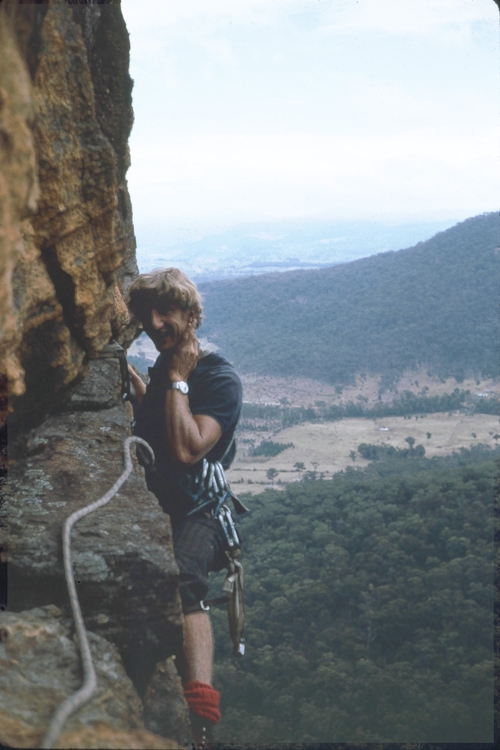
John Ewbank was perhaps the most memorable climber I ever climbed with. He had a unique personality, with extreme highs and lows, and I didn't learn until after his passing that he was bi-polar. He never knew his parents and was adopted. I climbed with him in Australia, and years later in New Hampshire just a year before his death. He was gifted in so many ways as exhibited by his climbing, writing, and composing of music, and verse. One of my vivid memories is encountering a huge Huntsmen Spider, while leading the crux pitch, on one of his routes on Dog Face, in the Blue Mnts. Here is a photo of John on his classic route- Genesis-circa 1969. |
|
|
John set routes at some Manhattan climbing gyms where I climbed in the late 1990s. He would be hanging upside down while singing Australian ditties. Always helpful to me as a beginner. Definitely a character. |
|
|
Great find, I enjoyed reading it. Re specifically to this point- > Furthermore, they were all using subdivisions, which created false psychological barriers. Genuine question to Aus climbers, is this actually accomplished by the Ewbank system? From the outside looking in, it would appear to me that it would just arbitrarily shift the ‘barriers’ to whatever grade the ‘pleasing number’- for lack of a better term- is. Using the standard conversion chart, I would wager that training for and sending your first 20, 25, and 30 are major milestones in an Aus climber’s career, similar to how 11a, 12a, and 13a are ‘chased’ grades in the YDS system. This is pretty noticeable at the red, where visiting Europeans will commonly be looking for a 13b (8a) to send during their visit and defer on commonly chased 13a (7c+) routes, largely because the 13b is the ‘pleasing grade’ in the Font system. I won’t pretend that this psychological effect of pleasing grades doesn’t affect me and the routes I, partially subconsciously, partially not, choose to get on. Here’s my current grade pyramid, which consists of almost every climb I’ve been on outside since 2017: 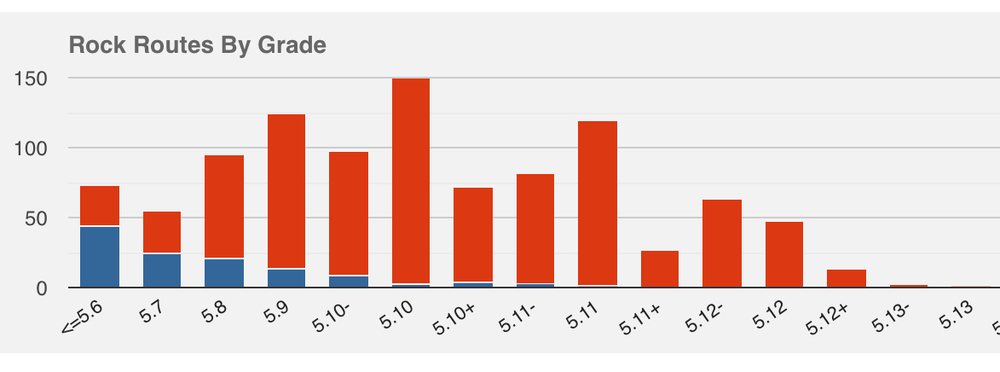 The pleasing grade effect is pretty noticeable on the 11+ column, though this is partially due to there being more 12a routes than 11d routes in the red. Do Aus climbers have a similar artificial dip at the grades prior to ‘pleasing grades’, like 19, 24, and 29? |
|
|
Noah Betz wrote: Good question. Grade 25 is certainly a milestone, especially because it's around the V5/5.12 range that is such a common plateau. It's funny because I was going also going to list some other Ewbank grades that are milestones. But then I was thinking, my first 19 was cool, and my first 20 on gear I remember, and 21 of course, my first 22 at Nowra I'm fond of, 23 is a classic grade, then 24 was like my first real project....so maybe the Ewbank system does accomplish this goal! What's mildly interesting, the Ewbank system kind of lines up with human age, and it turns out that Grade 18 and grade 21 often seem to be milestones as well. It's actually common for people to try and keep up with "climb their age" through their 20's. By the time you get to grade 30, you're a serious sport climber so people are usually thinking in terms of French grades half the time anyway (exactly the cultural cringe Ewbank warned about!) |
|
|
Noah, if you want to hear from climbers in Oz, you could post on Chockstone.org for Victoria which has a lot of knowledgeable and long time climbers on it and I think there is one for NSW climbers too |
|
|
richard aiken wrote: Unfortunately, Chockstone is totally dead, gone with Supertopo and RC.com to the great internet climbing forum in the sky. That's why I post here! Better off posting on theCrag.com |
|
|
https://www.acansw.org.au/index.cfm?module=news&pagemode=indiv&page_id=3094306 An impressive work about an outstanding climber. |
|
|
nutstory wrote: Does anyone know if this book is currently available anywhere in the US? I couldn't find it anywhere with a quick search. Unfortunately, thanks to Trump's tariffs it will likely now be exorbitantly expensive over here, as are some books I recently considered purchasing from the UK, but decided otherwise once I saw the 'price tag'. |
|
|
Hi Alan, Since I have a small contribution in the book, the author's offered a 50% discount, ( I would of paid full price). An old friend of mine, who lives in the Blue Mountains, picked up a copy for me. His relatives were visiting and they brought it back to the US. The book is monumental in scope, and quite large. John was a complex, multi-faceted individual who had many talents, and I was fortunate to climb with him on his home turf; as well as here in New Hampshire, shortly before he tragically took his own life. I have been working for days on a short article about climbing with John 55 years ago, and fortunately my memories are quite vivid, since he was such a unique person. There will be a big article in Alpinist magazine, and the editor called me, since he heard that I had climbed with Ewbank. Perhaps I was the 1st American to climb "Down Under", but who knows? The book has filled in many gaps, since John didn't talk about himself; although he did write 20 articles, including his seminal work, "Ironmongers of the Dreamtime". http://www.supertopo.com/climbers-forum/2292864/Ironmongers-of-the-Dreamtime When I climbed with him in 1970, he was already moving away from climbing, and focusing on his new career as a singer-songwriter. A few years later, he moved to NYC, where I visited him several times. After reading the newly published book, I learned that in the space of 7 years, he put in 180 FA, picking off the obvious classic lines, and establishing the hardest free climb in Australia, Janicepts. I think the book will become a collectors item, since only 650 copies were printed. |
|
|
Thanks Steve. I remember your stories about climbing in Oz with John once you returned to MA. You likely were one of the first, if not the first, US climber to climb there, at least on the 'modern' routes. |
|
|
This book was just published in Australia:  |
|
|
That book looks great, but unfortunately, in these days of Trump's tariffs, it seems difficult, if not impossible, to purchase it and others printed overseas, as most most publishers and stores will no longer ship such items to the US, |
|
|
Alan Rubin wrote: Perhaps some Australian climber could be convinced to purchase that book, open it once and send it as used book gift. Perhaps you could gift that person with something of equivalent or agreed upon value. Keep in mind - you are not paying for the book, you are exchanging gifts, because that is what climbers do.
|
|
|
I'd love a copy myself, I'll check in the local bookstores (Gleebooks and Megalong Books) next time I'm there and see if there's any copies. 650 is not a lot, I do reckon they'll sell that out. Fwiw i have an extra copy of Simon Carter's "Art of Climbing" Coffee table book - I bought a copy but then was also gifted one. I'd be willing to send it to the US if someone's having trouble finding it. |
|
|
Sam M wrote: Hi Sam, Yes, if you find a second copy of the Ewbank book, I'd be very interested to see if we could work something out. DM me if you find an available copy. Art of Climbing is available in the US ( imported pre-Trump)--it was a Holiday gift for me. Beautiful book, as are all of Simon Carter's. |
|
|
 |