
 Continue with onX Maps
 Sign in with Facebook






New and Experienced Climbers over 50 #40



|
phylp phylpwrote: Probably...ha ha. Save your ass...reach for the brass. Have seen them work. And not. I ripped seven micros and a bolt on a long aid fall years ago... Really like those steel ones that BD made. A set of those and RPs and HB offsets fit on a single biner and don't take up much space or weight in a rack of gear.... |
|
|
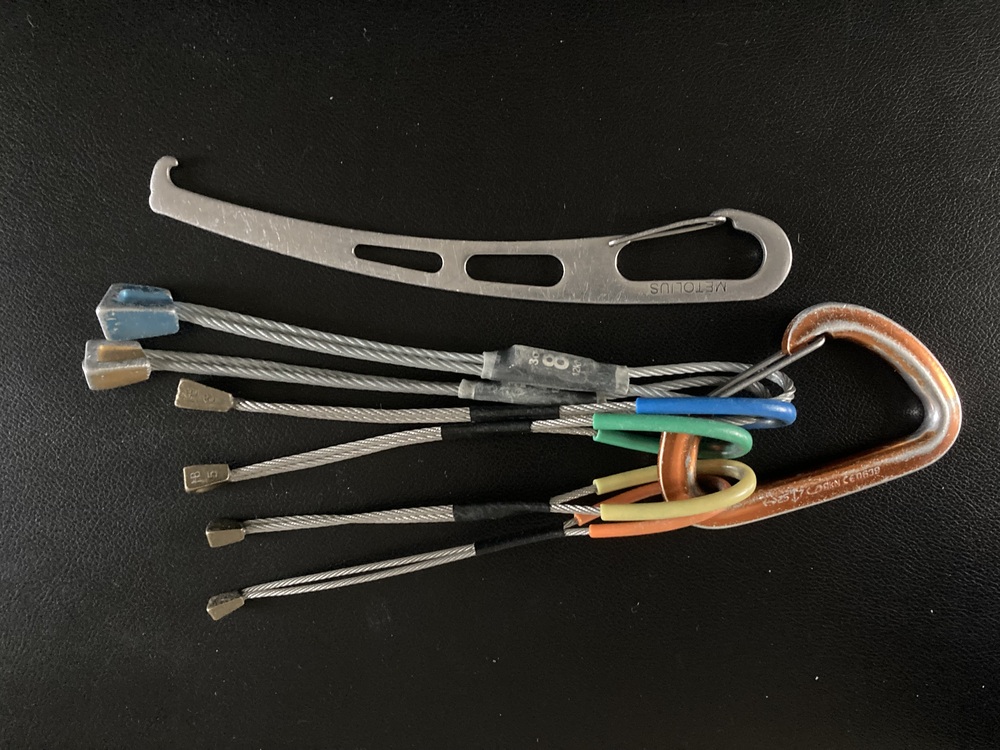 My usual selection for free climbing, and like Bob wrote, even the small sizes are bomber in quality rock. Offsets are perfect for the pin scars or flaring cracks often found at granite areas. Careful use of the nut tool is key in preserving the thin wires. |
|
|
In rock like the Gunks, which is much harder than granite, small brassies can and repeatedly have held falls. Calling them "bomber" is, however, a stretch, since they can break at relatively modest loads even if the nut itself holds. |
|
|
Tim Brattenwrote: Wonderful imagery! Inspiring! E7 at his age? That’s my dream goal! Couldn’t pull out his hooks then climbed on “at my limit” to loop into something that looks tenuous at best. That’s the way I’d like to go out! |
|
|
rgoldwrote: Plus they make you look 'hard core' while hanging around the Uberfall !!!! |
|
|
rgoldwrote: And when I do place them, there is usually no other option. Also, the smallest brassy that I carry is rated at 7kn, which is around 1500 lbs of force, and at 140 pounds fully dressed and racked feels pretty bomber to me. I do acknowledge that “bomber” can be in the eye of the beholder too. I have taken a pretty big fall when the cable on a fixed brassy snapped, but I know that this was caused by a team of silly Irish climbers who were attempting to funk out the fixed nut just before I led the pitch. Fortunately, the terrain was steep and aside from impacting my belayer as I fell past him, my fall was clean. I was confused about what happened, but it all made sense when I climbed back up to find the broken cable. For some strange reason the Irish team carried what looked to be an upholstery hammer and furiously pounded and jerked on all fixed placements. We asked them why they were proceeding in this manner and they replied that it’s just how they operate. lol different strokes for different folks lol |
|
|
 Dave Katz, El Cap rack, 1980 Like Daniel said, “bomber” is a relative term. When someone asks me what “bomber” means my definition is ”strong enough to withstand the greatest possible force you can exert while rock climbing.” For me, a “bomber” nut starts with 1/8-inch diameter cable (10kN, 2,248 lbf), although a bunch of teeny tiny ones would at least absorb some force as they break! The DMM Brass nuts (silicone bronze alloy) have surprising strength for their size, with the wires soldered directly into the alloy, allowing for larger diameter cable. Stoppers: [Size 1] 2 kN (450 lbf) • [Size 2] 2 kN (450 lbf) • [Size 3] 5 kN (1,124 lbf) • [Size 4] 6 kN (1,349 lbf) • [Size 5] 6 kN (1,349 lbf) • [Size 6] 10 kN (2,248 lbf) DMM Brass nuts: #1 4kN (900 lbf) #2 5kN (1,349 lbf) #3 5kN #4 7kN 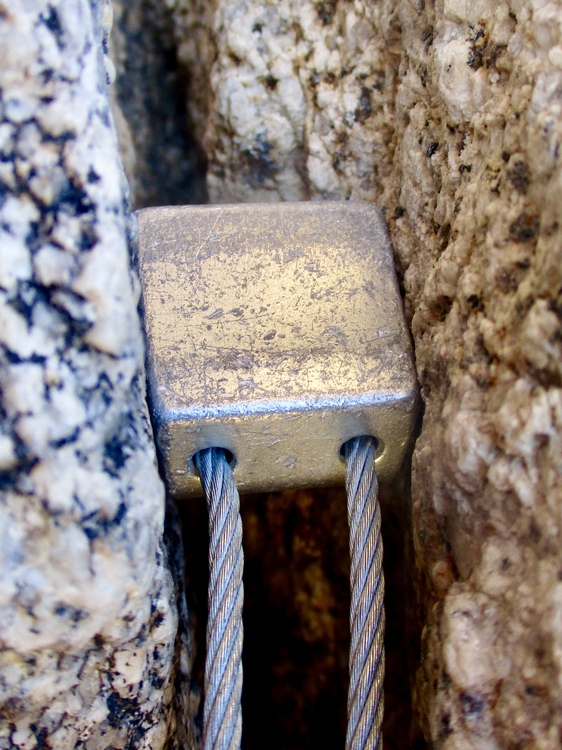 Regarding nuts shaped like Stoppers, it’s interesting to note that the endwise placements can be much weaker. From Climbing Anchors: “…the wider, endwise placement works for narrow slots and shallow cracks but has less surface contact and is generally less stable. In the medium sizes, the endwise placements have far less holding power than in the narrower, standard configuration, which provides more surface contact. According to Stopper manufacturer Black Diamond, in size #6 (0.40 inches in the narrow placement and .061 inches endwise) the narrower configuration holds 10 kN (2,248 Ibs.), but the endwise placement holds only 3kN (674 lbs.).” |
|
|
Bob Gaineswrote: I took several uneventful 15 foot falls on an HB #5 brass while working a crux. Retired it afterwards though as the cable was kinked. That size is rated to 7kN which is reasonable for someone my weight but I don't think I'd be happy falling on anything much smaller. |
|
|
From HowNot2 and other sources, it appears that the max force a top piece will see in a worst case scenario is somewhere around 7 to 9kN. Is that the general consensus? Did Ryan & Co get it about right? So, if you take a shorter fall, whilst, say, sliding down a slab, perhaps the top piece might see only 2 to 3kN??? If that is so, these smaller pieces would have a pretty good chance of saving you... or at least slowing you down, so would be worth putting in... Any good studies out there on this? |
|
|
I think being from the east perhaps affects my thinking but I seldom leave the ground without my micros. I suspect if I was mostly climbing on western sandstone that would be a different story. I do adhere to the principal that in order to be effective micro gear must be placed perfectly in good rock. I do consider the #5 purple BD stopper with its 6kn cable to be as good as a bolt for normal climbing purposes (free climbing not hanging a pig and a porta ledge etc) if it is placed perfectly in good rock. I would never trust a cam anywhere near that small to hold more than body weight... I have had some big falls held by micro stoppers and I have also had a few rip right out. |
|
|
Petzl got 6 kN for a factor-1 fall; for higher numbers, the belayer has to be falling past the leader (so not in a single pitch situation). There are two maybe three studies suggesting that gear that fails does reduce the ultimate fall loads compared to what would occur if no gear had been placed, The way this can happen si that after a gear failure, the rope 'snaps back" and recovers some of its original energy-absorbing ability, so that it is "beginning anew" to absorb fall energy when the next piece down is loaded. A concern is that the snap-back induces wild twists and turns that can result in the rope unclipping from the lower good gear that was supposed to back up the micro stuff. This has occurred in the field, in at least one case with pretty tragic results. |
|
|
Daniel Joderwrote: A couple of excerpts from Climbing Anchors, 4th Edition, 2024, that I coauthored with John Long: “Chris Harmston, Black Diamond’s quality assurance manager, reviewed field failures of climbing gear for eight years. No Stopper, rated at over 10 kN, ever failed, and only a few carabiners failed in closed-gate mode. Based on these and other telling factors, Chris concluded that forces exceeding 10 kN rarely happen in climbing falls.” Discussing the sliding X: ”Many tests, replicated by many labs conducted over the last thirty years, suggest that the maximum possible force anyone can generate in a climbing fall is 9 kN (2,023 lbf.). As long as each piece in your two-point sliding X rig is 9kN or stronger (e.g., a #.4 Camalot or larger), and the placement is bomber, there’s no worry about any inherent weakness in the rigging. As the saying goes: “Climbing gear does not break.” In fact, micro wired nuts do break, but you get the idea. With all that said, the Golden Rule still holds: Even with sophisticated load-distributing systems, the key is to rig off solid primary placements in solid rock.” |
|
|
rgoldwrote: I love my Edelrid slider lock biners for this. I use them on the rope end of draws/slings on my draw rack. |
|
|
I did not realize that you need two lockers? I often put a locker on the rope end of a critical piece but I never have a locker on the gear end. I also have had the rope unclip from sling/draw 3 times but never the sling from the actual gear... One of my closest calls was at the gunks BINTD when I did not wear a helmet. I thought I was on P38 which was 5.9 in my guide book. I am not sure if I was on the right climb. In my memory it was thin face climbing right off the ground with a tiny seam in it and the only gear I remember was a #2 silver soldered (C) steel micro stopper and then a #3 micro stopper. I slipped off and the #3 ripped, somehow I got my leg behind the rope and went upside down. the #2 was absolutely perfect and held me a few inches off the ground. I said a loud bad word as I was falling and some adult chewed me out for swearing loudly in public.. It must have been a pretty high fall factor because there was not much rope in the system. I think I was perhaps 15ft off the ground when I fell. |
|
|
rgoldwrote: Another excerpt from Climbing Anchors, 2024: ”Consider the Yates “screamer,” a loop of sling doubled back on itself with rows of barracked stitching. The screamer is rigged like a quickdraw, with carabiners at each end of the loop—one end clipped onto a marginal protection point, with the rope clipping through the other end. When fallen upon, the bar tacks rip out, directly absorbing energy owing to this stitch-ripping effect. The Screamer also allows your rope to absorb more energy from the fall by slightly increasing the time interval of the fall. The load does not multiply as the stitches rip out. In fact, lab tests (conducted by Black Diamond) comparing a regular quickdraw and a screamer, both connected to a bombproof anchor point, show the screamer lowers the peak loading force by 17.7 percent.” Many years ago I was nailing a difficult aid route at Joshua Tree, with a long string of marginal tied-off pitons up a 50-foot long crack. Just as I was reaching up to clip the sanctuary of the only bolt on the route, the pin I was hanging on popped, and I zippered a series of pins and hit the ground. But as luck would have it, as each pin pulled it absorbed some energy and slowed my fall, so when I hit the deck it was with about the same impact force as jumping down from a 4-foot tall wall, and I landed upright, standing on both feet, shocked and surprised how gentle the landing was. |
|
|
Woot woot! Be the first to get your brand new 2026 national parks pass. I was told that as long as I don’t lose my senior pass I won’t have to buy a new one. But if I did, it will have this beautiful America First design.  On a more cheerful note, we saw Nuremberg yesterday and I thought it was as close to a perfect movie as I have ever seen. Russell Crowe was magnificent.  |
|
|
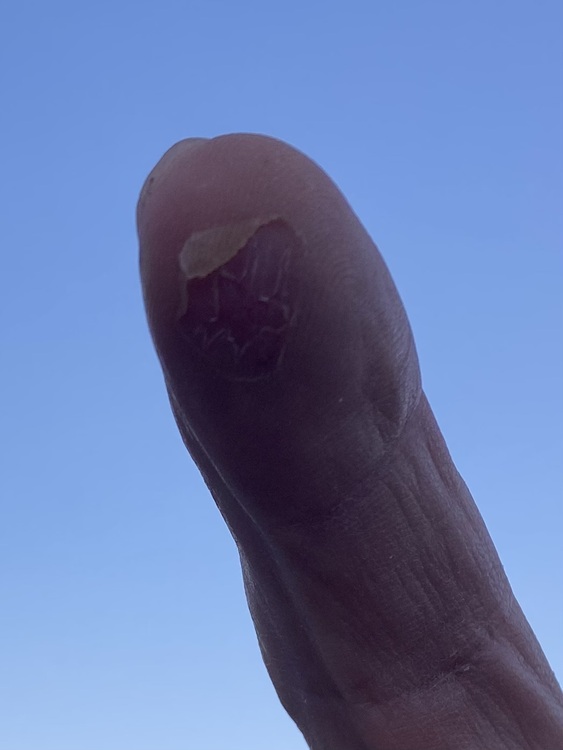 Too much crimping, so I went for a nice 58 miles on my road bike. 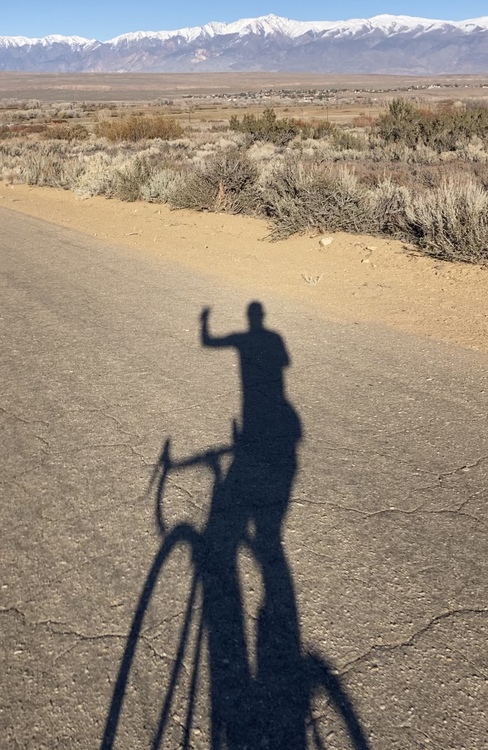 Then walked with Etienne to enjoy some beautiful late autumn light.  I hope that everyone had a nice weekend. |
|
|
Jeebus…is that really the way the new passes look? What a horrible juxtaposition of presidents. Was it really necessary to put any presidential image on those damn things? This guy goes out of his way to be an asshole. Can’t imagine having that damn thing in my wallet. |
|
|
Nick Goldsmithwrote: I think lockers on both ends make sense. We know the anchor end can come unclipped from bolts; dunno if there's ever been an instance with trad gear, but since rope gyrations after gear failure are a real thing, it's possible to imagine an extended sling being whipped up and then coming down to open a gate. In Wayne Crill's tragic accident, something analogous happened when two rope-end carabiners unclipped from their (extended) slings. The rope didn't come free from the carabiners, the carabiners came free from the sling, suggesting that the slings, not the rope, opened the gates.  |
|
|
Nick, thanks for the suggestion on duct tape alternatives. There is precisely zero chance I will be trying The Bells in this life but I recently acquired one of those Punky hooks and have easier 'head-points' in the back my mind... Rob is from the English Lake District and I recall Lakes climbers carrying hooks as a get out of jail card back in the 80s when no-one else seemed to. It's interesting to me how local variations in climbing style evolve, like Darwin's finches. On the Awesome Trad. Videos thread I suggested Rob may have deliberately dislodged the hook after clipping the peg to minimise rope drag but I might be over-thinking this. Thank you phylp, I wasn't 'in the know' when I tried it which is a blessing and a curse: you're less intimidated by reputation but some beta might have been helpful. I was school-of-Jim Erickson then so frowned on pre-inspection but I'd climbed a couple of other routes on the wall, they were only one grade easier on the (broad) UK scale so I thought this equipped me to try the big one. In US grades they were ~11b R/X to The Bells ~12b and I got a very rude awakening! This is all in what feels like previous life. |


