
 Continue with onX Maps
 Sign in with Facebook






The bolted stand with rope only?
|
|
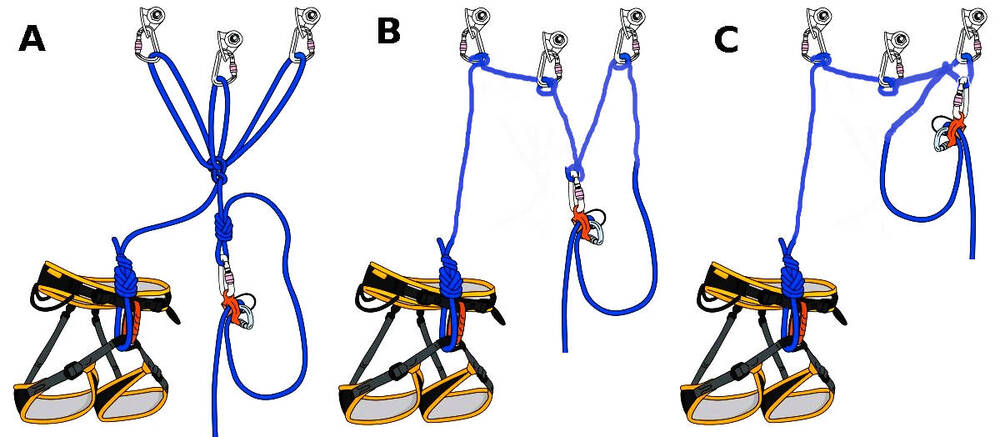 Injured and bored. So, just a question about the stand made with rope only and three solid bolts. Which one is your choise and why? A. Bowline with 3 loops and f8 for the masterpoint. B. Everything with clove hitch, including the masterpoint. C. Two left bolts with clove hitch and right bolt with Bowline on a Bight. D. Something else? (edit for the link) |


|
I wonder if bots can draw? But, because I'm sorta homebound today as well, I'll bite. First, though, it is a 'stance', not a 'stand'. My answer is basically A, but fundamentally modified. I'm an old-timer, so for me, the 'power point' is the belayer ( presumptively represented by the 'harness' in the drawings). The belayer is tied in directly to the power point coming off the bolts ( and with good looking bolts in solid rock maybe only using 2 of them). Additionally, I much prefer that the belay device should also be directly attached to the belayer in most circumstances. I understand the arguments for having the belay device be 'independent' of the belayer, but I feel that there is a loss of control in such scenarios. Again, I'm an old-timer, so pretty set in ways that have worked fine for decades, but still believe that a 'unified system' is simpler and, in most basic climbing situations, 'simpler' is better. |
|
|
What Alan says. |
|
|
I wouldn’t built the Anchor with the rope but any of the above would be fine. Not sure why you would Bother with C. |
|
|
Another: WHAT Alan says. That's what should be S.O.P. AS for the nuances of variations, well, they are nuanced. If you don't understand that, you shouldn't be doing it. My personal habit for tying to 2 bolts is a kinda large figure 8 to one, then clove to the other. You can create the semi load sharing no extension thing that way. In your figure #1 you don't need the figure 8, you have a "shelf" that serves the same function. If you feel the need. |
|
|
Rope from your harness to clove hitch at 1st bolt, loose loop of rope to clove hitch on second bolt and then back to your harness. Belay off your harness (or tie a masterpoint in the loose rope loop between the bolts. Simple and fast. Or what Alan Rubin wrote |
|
|
If anyone wants a simple solution from what the kids are doing these days, the "clove clip clove" is pretty badass. 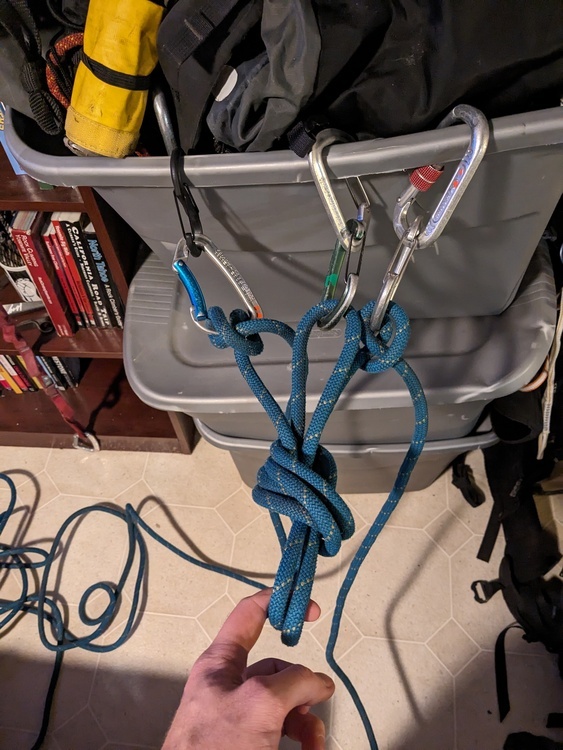 If you want a master point and like to belay off the master point then this is a simple, fast, strong solution. Explained in more detail here. Or just do what Alan and all the far more experienced climbers say. That definitely works. I do like me a good clove clip clove, though. |
|
|
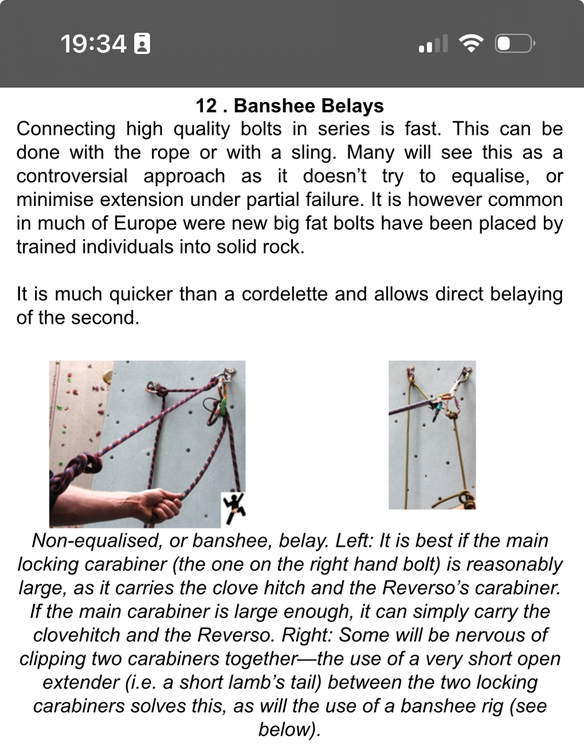 That said, belaying off a figure 8 or overhand and clove to the second bolt gives you some equalization and works super well too. If using the rope, no reason for a bowline on a bite. An overhand or figure 8 is plenty strong enough and much easier to tie. https://people.bath.ac.uk/dac33/high/6TheBelay.htm#:~:text=12%20.%20Banshee%20Belays |
|
|
I wouldn't generally have a problem with the "Banshee" belay, but there is the situationally dependent thing. It's total BS that there is a speed advantage over the cordelette, depending how you carry and deploy it. Even on a 22pitch Grade V IAD. If swinging leads the whole way the Banshee might shave a few minutes. If leading in blocks or one leader the whole route the cordelette is easier and faster. If you know. When swinging leads, I only use a cordelette if there's a particular advantage to it, and that's if I'm carrying one. Otherwise, I just tie the anchor together with the rope. Very simply. |
|
|
Eric Craigwrote: The thing is that the mindset behind pre-rigged or banshee belays carries over to other aspects and altogether you can save a ton of time - provided you also climb efficiently and smoothly. |
|
|
Jeremy Baumanwrote: That's plain silly. I would argue that being enthralled with techno wizardry develops a mindset that precludes efficient climbing. But that's the way of the world today. And it holds people back. |
|
|
I've been using this method when swinging leads for at least 40 years. (An exception is when the belay stance is far from the anchor points, in which case the rigging might use up too much rope.) It is quick, adaptable to any number of anchor points, always done the same way, easily adjusted, does not require guesstimating any lengths, and is efficient in positioning the belayer where they want to be. I'm always open to new approaches, but haven't seen one any better so far. The redirection point is optional; I rarely use it. The rope is just a little slack there. The remark about clipping the free strand to the power point for belay escape relates to methods in which the load is transferred to the strand running down from the anchor. If using that protocol, clipping the free strand to the power point ensures that load is transferred to all anchor points. The butterfly power point gives the option of a guide belay off the power point or a harness belay. The power point is tied before anything else, so the belayer can have it in whatever position they want (subject, of course, to the anchor location relative to the stance). A method that is almost the same when a harness belay is intended eschews the butterfly power point and uses the rope loop tie-in point as the location where strand(s) from the anchor are cloved. I often do it this way with the understanding that a belay escape would be quite a bit more complicated. 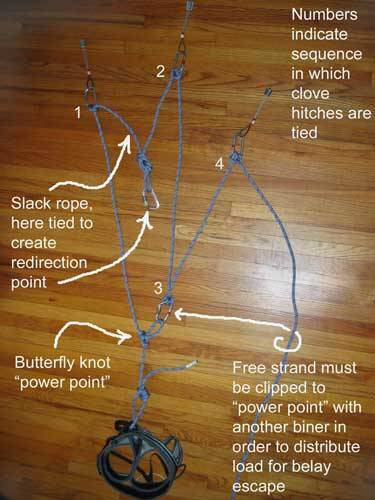 All that said, I think of this as a way of rigging trad anchors. With modern bolts, there are usually only two. The same method works (it ends at knot 3), and you keep the "redirect point" if you want to use a guide belay. |
|
|
Thank you for your kind feedback. English is not my first language. I posted this question, because I saw the A stance(thanks for the correction) in internet and I was wondering why? It take a lot of rope and over done master point (imho) is pretty low, which may cause some discomfort when belaying a second with guide mode. So, I was just playing with few different ideas for the 'rope only stance' and I was curious to know what MP is thinking about those stances. My personal choise is B or C. Its true in C case, the f8 or overhand loop work as well on third bolt. Ps. I started the rock climbing in early 80'ties completly alone. Without any gear, exsisting crags 'n routes, gyms, climbing gear shops and other climbers. |
|
|
Eric Craigwrote: How is clove + clove belay or a prerigged little quad “techno wizardry”? |


