
 Continue with onX Maps
 Sign in with Facebook






New and Experienced Climbers over 50 #39


|
|
Tim K wrote: I drink more than that. Maybe thats the trick? |
|
|
Tim K wrote: Pretty much the entirety of nutrition literature is correlative, but that doesn’t negate the healthfulness of coffee. Here’s one on all cause mortality - it shows nearly linear reduction in all cause mortality, all the way up to 6 cups/day! Inverse associations were observed for deaths due to heart disease, respiratory disease, stroke, injuries and accidents, diabetes, and infections, but not for deaths due to cancer. Results were similar in subgroups, including persons who had never smoked and persons who reported very good to excellent health at baseline. |
|
|
Tim K wrote: Actually, I was curious so Googled 'health benefits of coffee academic papers australia meta analysis' and found this, so there may be something in that statement: |
|
|
Tim K wrote: Again, that's nutrition science - you're not gonna find any study which directly shows food/beverage/nutrient x definitively causes anything. Our diet is too diverse, and most diseases take years-decades to develop. The studies are usually observational and population based, not prospective, placebo-controlled, double blind, randomized controlled trials. Even if studies were the latter design (the gold standard in clinical medicine), causation would not be proven. But if it makes you happy, coffee is associated with more positive health outcomes than any other single food or drink I can think of. The evidence overwhelmingly supports a salutary role from moderate coffee consumption. Per everyone's favorite source, Chat GPT: Overall, a substantial body of observational evidence links moderate coffee consumption with a variety of potentially beneficial health outcomes. Some highlights: All‑cause mortality & cardiovascular health
Metabolic disease / type 2 diabetes
Liver, neurological disease, some cancers
Summary pattern In short: moderate coffee consumption (~3–5 cups/day) appears to be associated, in many (though not all) observational studies, with lower risk of various adverse outcomes including all‑cause mortality, cardiovascular disease, type 2 diabetes, certain cancers and liver disease. ETA Alcohol is a whole 'nother can of worms. It definitely increases risk of several (GI) cancers, but at the same time, moderate consumption (like 1-2 servings/day, max) decreases cardiovascular risk. Since more people die of heart attacks/heart failure/strokes than cancer, on a population level, there is a net mortality benefit to moderate consumption. The issue is, people have trouble with moderation, and there are other ways to improve CV health without cancer/cirrhosis/addiction risk, so the WHO issued the "no amount of alcohol is safe" declaration a couple years ago. |
|
|
just doing a quick google search there is also studies that show that coffee increases hyper tension and leads to insomnia that is really bad for your health. also they call a cup of coffee 8 oz so in American cups that's One cup a day not 4... don't think there is such a thing as an 8 oz cup of anything in America ;) |

|
Health through association with coffee makes more sense, after all one can almost always assume that industry pays for their own studies, especially now that medical research has been chopped by the billionaires party. On another note, has anyone seen these competitions where people are lifting heavy objects with their piercings? It's a thing. God bless America! |
|
|
 Good morning everyone. Thanks to those who replied to my question yesterday/day before. I think that I replied to each of you in yesterday’s sunrise post. I hope everyone has a great day. |
|
|
I’m sitting here this morning, enjoying a great cup of coffee and just reflecting. I am reminded of reading a book by Dr. Deepak Chopra‘s brother, Sanjeev Chopra MD, a liver specialist and surgeon at Harvard. “People who drink coffee have significantly reduced their chance of developing liver cancer.” I read that maybe 20 years ago, but it caught my attention because up to that point everything about coffee was negative. Since deciding to climb in my senior years— which seemed like a ridiculous undertaking – – I have been tackling the persistent question of how to be in stellar good health and climb strong through my 70s. It was just a surprise to me that this is not an area of interest to the medical community, in fact, my doctors view this as an odd question. I do get a lot of affirmation and a lot of curiosity from my docs because aiming to be strong and vibrant at this age is kind of an outlier. But I also didn’t want to become boring (to myself). I didn’t want to be a fanatic. I just wanted enough information to extended my fun a few more years. So the advice on protein intake, overall nutrient requirements, hydration, sleep, strength training— a lot of this we’ve had to piece together from various sources. I can guarantee that this has never come up from any of my doctors, and certainly not from any of the doctors Tony has seen – – I don’t even blame them anymore. They don’t have time and besides, who’s asking? The patient population is showing up pretty darn sick. A few years ago Erika dropped an amazing position paper here on sarcopenia, strength training, and protein for aging adults. One thing mentioned in nearly every study I’ve read is the problem of “anabolic resistance“ and I’m still looking for a good explanation. Is it because of the drop off of hormones like HGH and testosterone? Or would it happen anyway even with optimized hormones?But the really good news seems to be that it can be completely overcome With resistance training – – and that’s from a study this year. —- So I barfed on this route of Jan’s . I don’t know if anyone else gets pukey if you go just a little too hard. It has happened more than once and I’m thinking maybe there’s a lozenge or something for those times when you want to hurl on the rock. I was climbing with Jarad and he kept saying “Lori, you can’t come down now you only have 20 more feet to the top.“  Me, a full 15 minutes of trying to calm down after the climb. 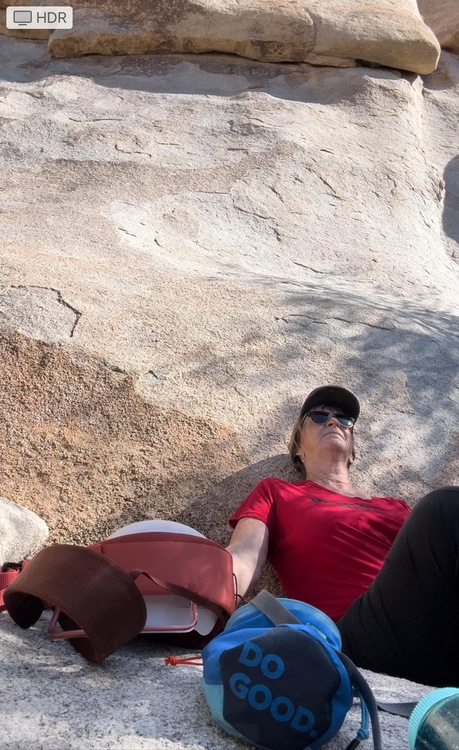 BUT I WAS SO PROUD…. I even wore my Dave tshirt. 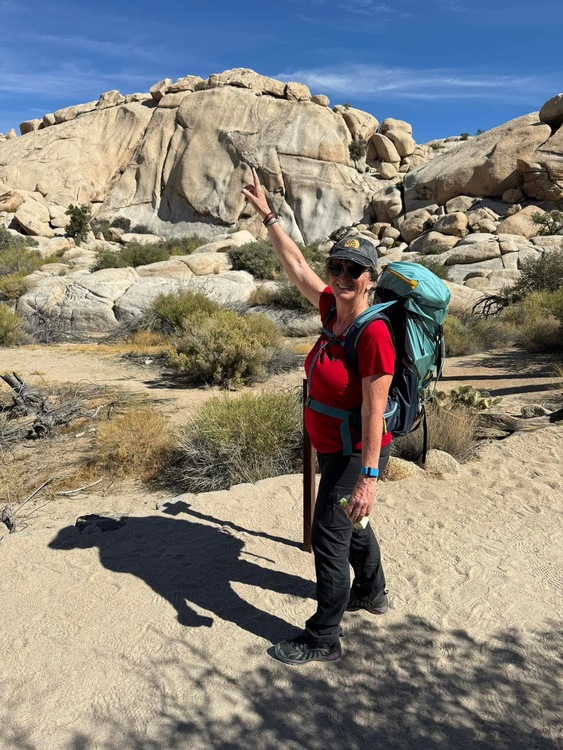 It’s a pretty amazing wall. (An Eye For An Eye And a Route For A Route) |

|
M M wrote: I've not seen that but my wife and I once saw a guy in a back alley in Kathmandu lift a very heavy rock with his penis! I'll try to find the photos! |
|
|
Coffee pop-science: Coffee good! Coffee Bad! No, coffee good! No, coffee bad! Turns out coffee good! Turns out coffee bad! Not a dang one of you - not... one... , knows whether its good or bad for anyone, but you. And even there, you don't know for sure. |
|
|
rgold wrote: Oh Absolutely! Sue Kligerman, who is a full AMGA Rock Guide, is one of the two fulltime West Point employees that works with the Cadet rock climbing and mountaineering teams and also teaches all Cadets basic rock climbing skills. She is also a boxing instructor and is just an awesome person! She asked me to help out with the Marines as she knows that I took the SPI course a few years ago and I'm also current on my WFRer. The other guide is a gent named Dawes Strickler. I don't know him well but he is a very strong climber and works with the national indoor climbing competition team here. I know that Sue also works as a guide at the Gunks and I think that Dawes does as well (or at least he used to). |
|
|
Lori Milas wrote: Hi Lori, I’ve been involved in a few conversations about anabolic resistance, and also read some online info on the subject. It seems to be a hormone related thing that is exacerbated by inactivity. Not consuming enough protein can also be a contributing factor. I started to learn about this when my 84 year old healthy and active dad started to drop weight and muscle mass. He has been a lifelong athlete but mostly endurance oriented. It seems that endurance training isn’t as effective at initiating MPS as resistance training. We got my dad to eat more protein and start adding more resistance training (weight lifting) to his routine and he began to regain muscle tone and maintain weight. This was a wakeup call for me to since I much prefer endurance types of training to resistance. I started adding a few weight lifting days per week to my routine and noticed some pretty immediate benefits. I realize my examples are a small sample and anecdotal, but I hope this can contribute to the topic. As far as being sick from exertion, while I haven’t officially vomited, I have on occasion came close. This usually happens to me when I start to max out physically but also with a mental (fear) aspect involved. For me, it’s one of those things that is unpleasant while it’s happening but after I calm down I’m happy that I pushed hard. I think overall, training and progression requires a good bit of discomfort. I like your photos of Joshua Tree. |
|
|
Citing Chat GPT does nothing for me to instill confidence in quality of information. |
|
|
I have no clue if coffee is good or bad medically. I only know that I like the way it tastes but not how it makes me feel.. |
|
|
Hi Daniel! Thanks for sharing this. Your experience comports exactly with mine and everything I’ve read. And as you said “ I think overall, training and progression requires a good bit of discomfort.” Dog gone it, I wish it weren’t true and right now weight training is difficult – – not to do it, but to drag myself to the gym in the first place. It’s just nonnegotiable at our age. I found myself sitting in a thicket of cat claw this morning just looking up at this big guy and finally saw the line exactly as it is to be climbed. This looks so ridiculously fun and for that I would go to the gym. Cleopatra 511b Sphinx looking exceptionally handsome today. 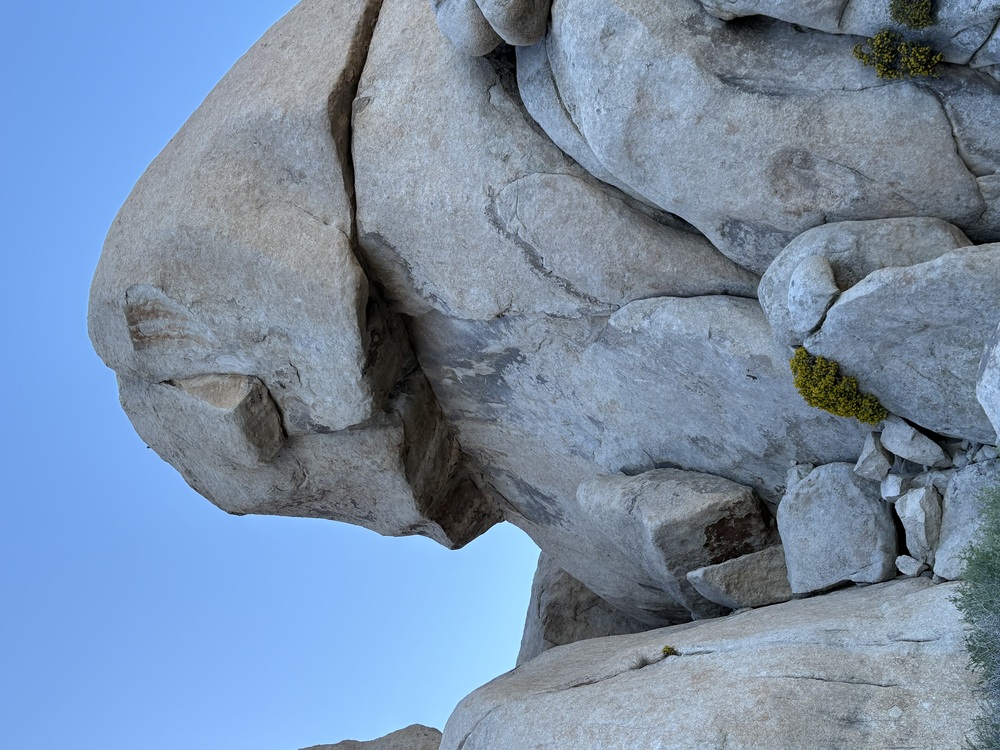 I’m not a 5.11b climber but for this maybe we can make an exception. 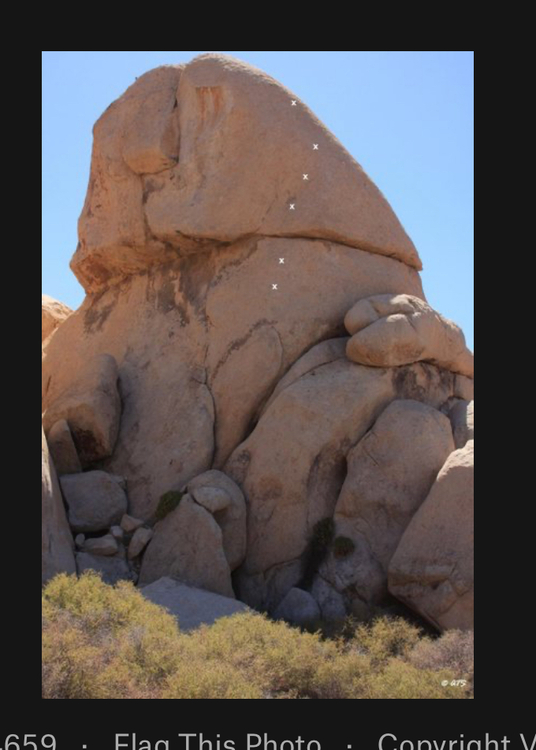 |
|
|
Lori Milas wrote: It’s the same for me with the weight based workouts, I much prefer being out on my bike, running with my dog, or getting mileage on the rock, but like you said, the benefits of moving weight is nonnegotiable. |
|
|
Nick Goldsmith wrote: That’s why meta analyses are done - they compile data from multiple sources, to get a gestalt of the overall findings from well designed studies. A couple negative studies don’t negate the preponderance of the literature. For instance here’s one on coffee and hypertension: Observational studies which assessed the risk of HTN in the highest category of coffee consumption in comparison with the lowest intake were included in the current meta-analysis (registration number: CRD42022371494). The pooled effect of coffee on HTN was evaluated using a random-effects model. Results: Twenty-five studies i.e., thirteen cross-sectional studies and twelve cohorts were identified to be eligible. Combining 13 extracted effect sizes from cohort studies showed that higher coffee consumption was associated with 7% reduction in the risk of HTN (95% CI: 0.88, 0.97; I2: 22.3%), whereas combining 16 effect sizes from cross-sectional studies illustrated a greater reduction in HTN risk (RR = 0.79, 95% CI: 0.72, 0.87; I2 = 63.2%). These results varied by studies characteristics, such as the region of study, participants’ sex, study quality, and sample size. Conclusions: An inverse association was found between coffee consumption and hypertension risk in both cross-sectional and cohort studies. So, no, coffee doesn’t appear to worsen hypertension. It does promote wakefulness, however. But that’s a feature, not a bug, so may those prone to insomnia may want limit consumption to early morning, to allow full metabolism of the caffeine before sleepy time. |
|
|
Quick Google search comes up with many different studies many of which have different results depending on who funded them... |
|
|
Lori Milas wrote: I found myself sitting in a thicket of cat claw this morning just looking up at this big guy and finally saw the line exactly as it is to be climbed. This looks so ridiculously fun and for that I would go to the gym. Cleopatra 511b Sphinx looking exceptionally handsome today.
|
|
|
M M wrote: I certainly haven’t read all the literature, but studies I have claim no influence from “Big Coffee”. FWIW, I don’t drink the stuff, but this isn’t really a controversial topic. This is as close to scientific consensus as you’ll find in nutrition. With the standards you guys are setting, how can one know anything promotes health? I mean, there’s alway potential for bias, outside influence, faulty methodology, individual variability, etc. Pretty nihilistic way to approach nutrition, or any topic, for that matter. And I’ve reached my post limit for the day. Apogee: Regarding sources, I also cited an individual paper, a meta analysis of multiple high quality studies. From arguably the most respected source in clinical medicine, The New England Journal of Medicine. AI certainly has its flaws, but usually lists references. I’ll read the primary literature, when I’m looking for more than a cursory overview. Lori: Dan’s explanation of anabolic resistance is spot-on. But as you’ve probably gathered by now, I think the bro science pendulum has swung too far regarding how much protein and strength training are optimal. While the general population should get all the exercise they can muster, my gestalt is the balance is roughly 10:1 for aerobic exercise to resistance training. A couple half hour sessions a week for strength training + 300-600 minutes of moderate cardiovascular exertion appears to have greatest all cause mortality benefit. Interestingly, one meta analysis showed higher amounts of strength training (than 40-60 min weekly) were associated with increasing mortality. I’m guessing this is probably a substitution effect, as avid weight lifters elected to pump more iron, rather than run around the block. Moreover, the myophiles probably consumed too much protein, at the expense of grains, fruits, and veggies. I won’t regurgitate potential harms of excess protein, other than reiterating consuming 1-1.6 grams/kg body weight daily seems to be the sweet spot, even for older, active individuals. Anything above that is probably unecessary, and may turn out to be unhealthy. While this remains to be seen, I’m fully expecting an uptick in cancer, cardiovascular disease, and kidney stones in the next couple decades, related to gratuitous (predominantly animal) protein being added to everything. Based on population studies, we have a rough blueprint for healthy aging. Consistent activity is a big part of it. High protein intake isn’t. Oh yeah, don’t forget the coffee. Nick: To minimize external influence, you should pay more attention to studies which aren’t funded by industry, published in respected, peer reviewed scientific journals. Perhaps more importantly, you should scrutinize the study’s methodology, and check to see if their results have been observed/reproduced by other groups. Emil: Easier to convince someone in “hard sciences” like physics, but even then, it seems like distrust in experts and institutions is at an all time high. Admittedly, nutrition and medicine are some of the murkier, inexact disciplines, with tremendous financial influence from every direction. |


