|
|
bmdhacks
·
Oct 10, 2025
·
Bellingham, WA
· Joined Jan 2012
· Points: 1,816
Paul Lwrote:
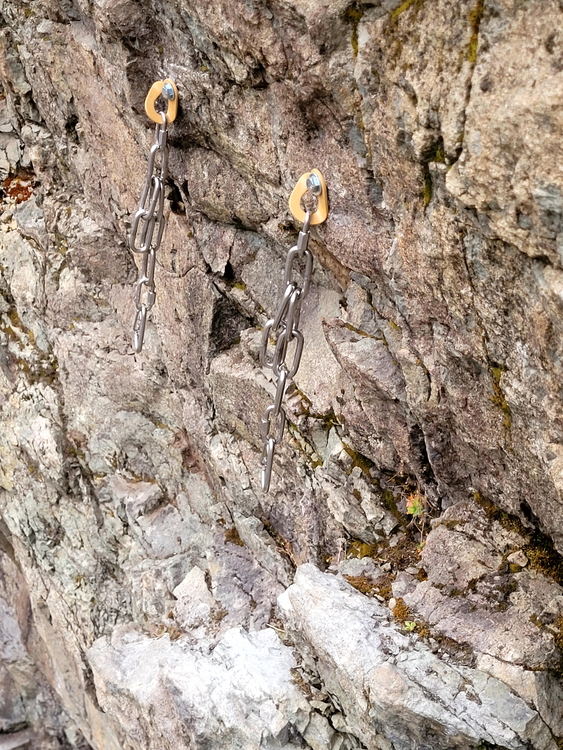
I'm a big fan of at least one extra top link for single-pitch lines that also can be multipitch. Provide lower-offs for the single pitchers, and the top links allow for better belay anchor building if climbers are continuing on. Its not as important with long-link chain but still can be convenient if your chain has tight links.
|
|
|
Cory N
·
Oct 10, 2025
·
Monticello, UT
· Joined Sep 2018
· Points: 1,168
Are those 1/4” QLs on the painted hangers? Not common place in climbing anchors. I know the working load is high, but the way hangers carve slots in QLs could create an issue over time.
|
|
|
Adam W
·
Oct 10, 2025
·
TX/Nevada
· Joined Dec 2019
· Points: 532
Paul Lwrote: namely the Hilti KB2 is a bit too big for the threads to pass through I'm not understanding what material you are using. Your original post said everything is stainless but the KB2 is carbon steel.
|
|
|
Sam Fearer
·
Oct 16, 2025
·
805
· Joined Nov 2015
· Points: 876
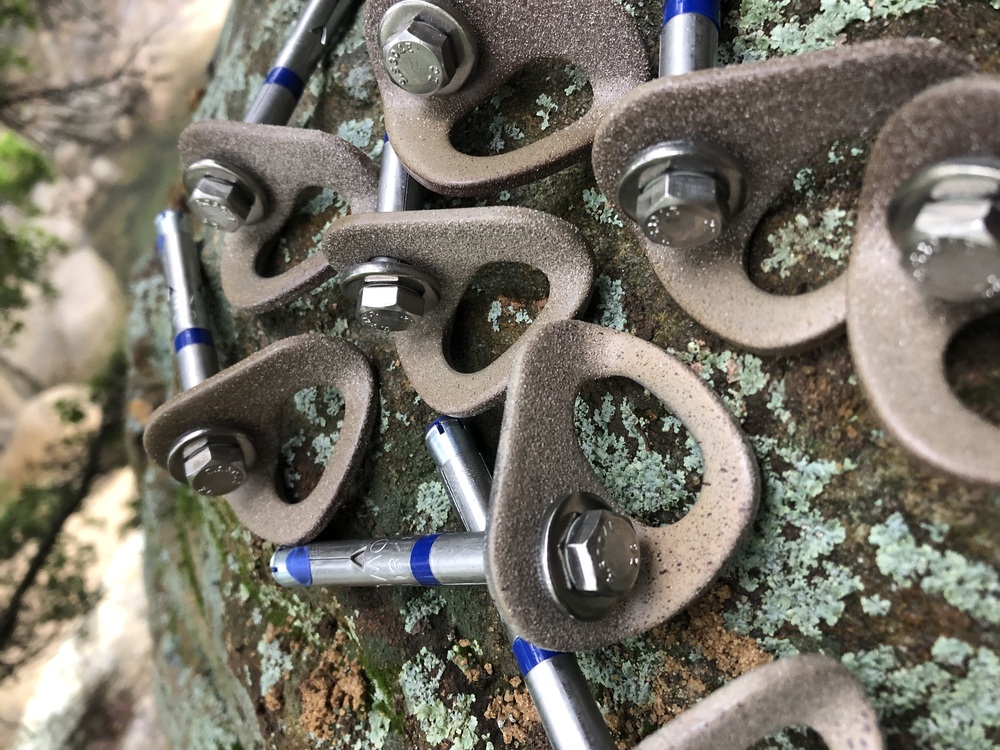
Krylon Satin Khaki, with a dusting of Krylon Satin Espresso, with a sandy-colored texture coat on top. Surprisingly durable if you use the right hangers. Nearly invisible if you color match well.
|
|
|
Tal M
·
Oct 16, 2025
·
Denver, CO
· Joined Dec 2018
· Points: 6,300
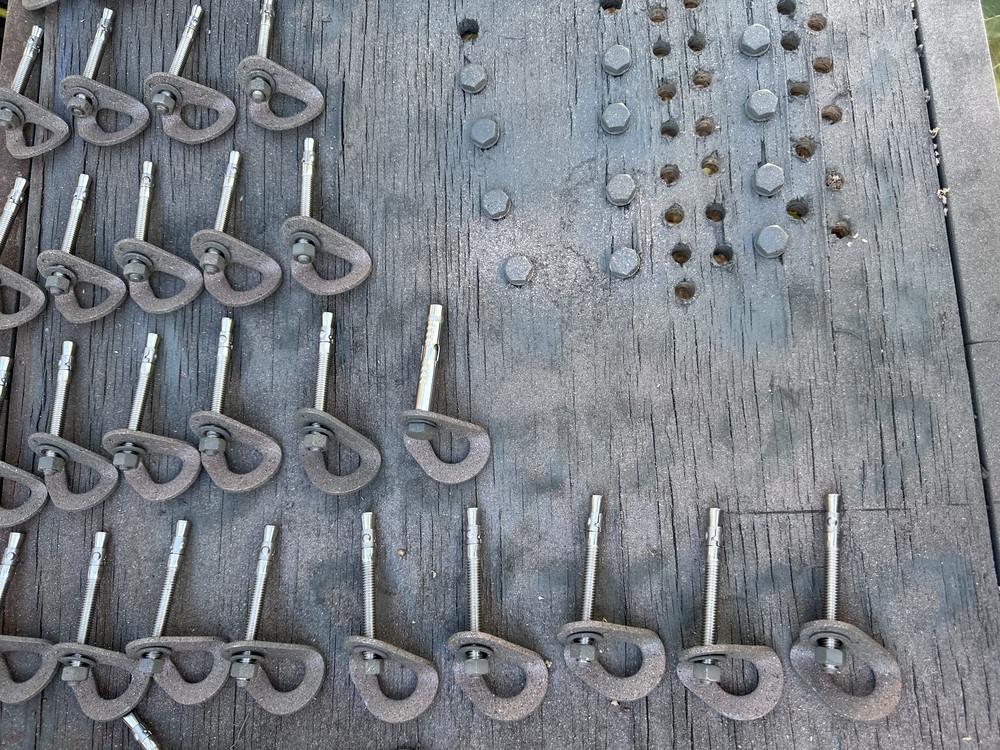
Sam Fearerwrote:Krylon Satin Khaki, with a dusting of Krylon Satin Espresso, with a sandy-colored texture coat on top. Surprisingly durable if you use the right hangers. Nearly invisible if you color match well. I’ve been seeing this method for painting more and more lately - is there a reason you’re not also painting the bolt head and washer?
|
|
|
Peter Thomas
·
Oct 16, 2025
·
Denver, CO
· Joined Jul 2018
· Points: 355
|
|
|
Mr Rogers
·
Oct 16, 2025
·
Pollock Pines and Bay area CA
· Joined Aug 2010
· Points: 77
Sam Fearerwrote:Krylon Satin Khaki, with a dusting of Krylon Satin Espresso, with a sandy-colored texture coat on top. Surprisingly durable if you use the right hangers. Nearly invisible if you color match well. I see no hangers in this image! ;-)
....Nice camo y'all.
|
|
|
Sam Fearer
·
Oct 16, 2025
·
805
· Joined Nov 2015
· Points: 876
Tal Mwrote: I’ve been seeing this method for painting more and more lately - is there a reason you’re not also painting the bolt head and washer? More work / Feels kind of pointless when I’m just going to hammer it off anyways. Plus I find that hammering dulls whatever minimal glint the bolt head might cause. Full camo is obviously a notch above, but I don’t bother.
|
|
|
Drew Nevius
·
Oct 17, 2025
·
Tulsa, OK
· Joined Jun 2012
· Points: 2,699
The last time I put up a new route, I camo matched the hanger and washer but left the bolt head unpainted because (as mentioned above) a lot of it gets chipped off while installing anyway, and also because I wonder if it will make condition assessment easier decades from now.
|
|
|
Josh
·
Oct 19, 2025
·
Golden, CO
· Joined Jan 2006
· Points: 1,365
Sam Fearerwrote: Those hangers look great, Sam. I also haven’t been bothering to try to paint the bolt heads, but maybe I should. I have a different question, through. Those appear to be Powers/DeWalt 3/8” sleeve bolts. Have you placed those much? I used them exclusively in the beginning, and though they are technically strong enough, Peter and I and others ended up replacing all of them at a high use crag last year because they were more prone to loosening over time than the 1/2” ones, or 3/8” wedge bolts. I think it’s the lower torque— the torque spec for the 3/8” 5-piece is only 18 ft/lb (as opposed to 25 for almost everything else), and in stainless steel they just seem to want to loosen if they get a lot of repeated outward or sideways pulls. Anyway, I was doing it in the beginning for cost and to save drill bit wear and battery life, but I think I overestimated those differences; in hindsight I wish I had just placed 1/2” sleeve bolts to begin with. Keep in mind, this was in relatively solid gneiss, so perhaps your rock type is different. I see that yours are all the longer length, so maybe you are contending with some variability in hardness? Just though I’d share my experience vis-a-vis that bolt type. Happy drilling.
|
|
|
DrRockso RRG
·
Oct 19, 2025
·
Red River Gorge, KY
· Joined Sep 2013
· Points: 1,245
Joshwrote: Those hangers look great, Sam. I also haven’t been bothering to try to paint the bolt heads, but maybe I should. I have a different question, through. Those appear to be Powers/DeWalt 3/8” sleeve bolts. Have you placed those much? I used them exclusively in the beginning, and though they are technically strong enough, Peter and I and others ended up replacing all of them at a high use crag last year because they were more prone to loosening over time than the 1/2” ones, or 3/8” wedge bolts. I think it’s the lower torque— the torque spec for the 3/8” 5-piece is only 18 ft/lb (as opposed to 25 for almost everything else), and in stainless steel they just seem to want to loosen if they get a lot of repeated outward or sideways pulls. Anyway, I was doing it in the beginning for cost and to save drill bit wear and battery life, but I think I overestimated those differences; in hindsight I wish I had just placed 1/2” sleeve bolts to begin with. Keep in mind, this was in relatively solid gneiss, so perhaps your rock type is different. I see that yours are all the longer length, so maybe you are contending with some variability in hardness? Just though I’d share my experience vis-a-vis that bolt type. Happy drilling. I wonder when Dewalt updated the 3/8" SS torque spec from 12 to 18 ft lbs. I recall when they updated the 1/2" version form 25 to 30 ft lbs a few years ago. Anyhow, I agree that if the rock is hard enough to use 3/8" bolts you're probably better off using wedge anchors from a price and maintenance stand point. If the rock is in the gray zone (too soft for wedges, but still hard enough for 3/8" sleeves, you're better off using 1/2" if it's going to see significant traffic, since the 3/8" Stainless 5 piece are prone to becoming spinners.
|
|
|
Josh
·
Oct 19, 2025
·
Golden, CO
· Joined Jan 2006
· Points: 1,365
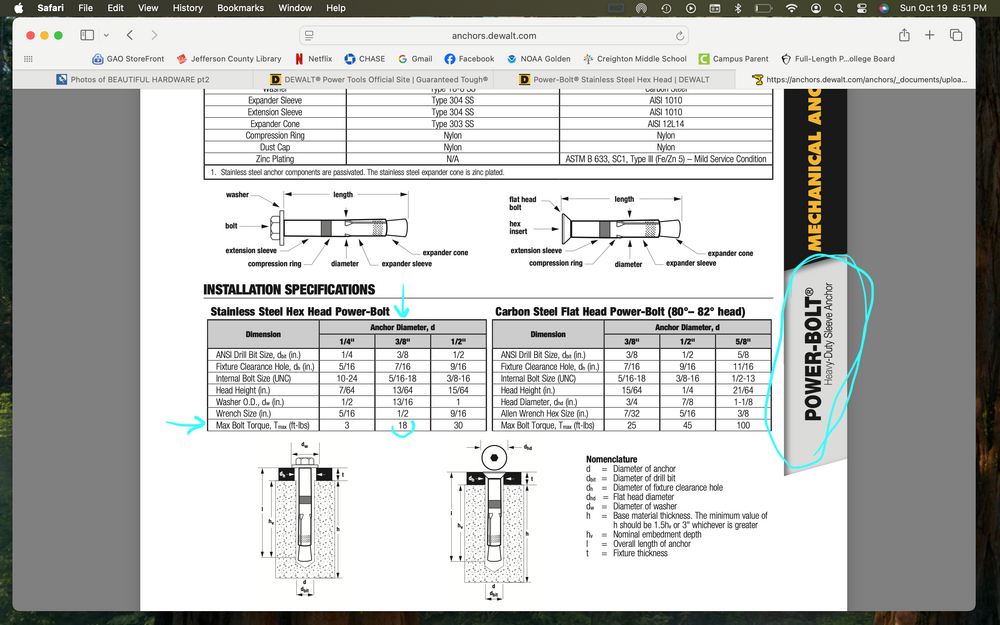
DrRockso RRGwrote: 3/8" SS torque spec from 12 to 18 ft lbs.
Here's what's online as the current spec sheet:
|
|
|
Sam Fearer
·
Oct 19, 2025
·
805
· Joined Nov 2015
· Points: 876
Joshwrote: Those hangers look great, Sam. I also haven’t been bothering to try to paint the bolt heads, but maybe I should. I have a different question, through. Those appear to be Powers/DeWalt 3/8” sleeve bolts. Have you placed those much? I used them exclusively in the beginning, and though they are technically strong enough, Peter and I and others ended up replacing all of them at a high use crag last year because they were more prone to loosening over time than the 1/2” ones, or 3/8” wedge bolts. I think it’s the lower torque— the torque spec for the 3/8” 5-piece is only 18 ft/lb (as opposed to 25 for almost everything else), and in stainless steel they just seem to want to loosen if they get a lot of repeated outward or sideways pulls. Anyway, I was doing it in the beginning for cost and to save drill bit wear and battery life, but I think I overestimated those differences; in hindsight I wish I had just placed 1/2” sleeve bolts to begin with. Keep in mind, this was in relatively solid gneiss, so perhaps your rock type is different. I see that yours are all the longer length, so maybe you are contending with some variability in hardness? Just though I’d share my experience vis-a-vis that bolt type. Happy drilling. That’s interesting to hear. I personally haven’t ever had an issue with them loosening over time but maybe that’s because no one climbs my routes :) I have placed longer wedge bolts in bullet sandstone and never had an issue. These, however, are my go to in medium-density sandstone (ie CA coast-adjacent rock). They hold up, hold tight, and - obviously - hold falls. They’re the area standard and I haven’t seen bolts on other routes in town loosening either, which is nice. *10mm CT bolts are also being used here and there where I am and they seem to be a decent replacement, and much much more affordable.
|
|
|
Josh
·
Oct 19, 2025
·
Golden, CO
· Joined Jan 2006
· Points: 1,365
To be fair, only a few loosened over time; the rest were just fine. And the rock type is variable density, to be sure. And these were among my first routes installed, so perhaps the issue speaks more to my wobbly early-days drilling or something.
|
|
|
Josh Janes
·
Nov 17, 2025
·
Unknown Hometown
· Joined Jun 2001
· Points: 10,294
|
|
|
M Sprague
·
Nov 18, 2025
·
New England
· Joined Nov 2006
· Points: 5,174
Josh Janeswrote: I used to use SS 1/2" Rawls and those hangers. The sharp edges of the Fixes really tear apart aluminum carabiners though, another reason I went to almost exclusively glue-ins. The camo matches well.
|
|
|
Jake R
·
Nov 18, 2025
·
Mt. Shasta
· Joined May 2015
· Points: 865
Josh Janeswrote: This is nice. How’d you paint the bolt like that?
|
|
|
Josh Janes
·
Nov 19, 2025
·
Unknown Hometown
· Joined Jun 2001
· Points: 10,294
M Spraguewrote: I used to use SS 1/2" Rawls and those hangers. The sharp edges of the Fixes really tear apart aluminum carabiners though, another reason I went to almost exclusively glue-ins. The camo matches well. True. Fortunately the newest iteration of the classic Fixe hanger has rounded edges (other changes include slightly reduced weight/thickness and wider positioning of the anti-spin dimples). I also really like the newest version of the PETZL hanger which is similar. These two hangers are well designed. The most poorly designed, commonly used hanger, IMO, is the Mad Rock Sentinel, though it does have a nicely rounded eye to reduce the scoring of aluminum carabiners.
|
|
|
M Sprague
·
Nov 19, 2025
·
New England
· Joined Nov 2006
· Points: 5,174
Thanks for the update on the Fixe Hangers. That is a long needed improvement.
|
|
|
Josh Janes
·
Nov 19, 2025
·
Unknown Hometown
· Joined Jun 2001
· Points: 10,294
Jake Rwrote:
This is nice. How’d you paint the bolt like that? My methods have changed over the years but nowadays it involves these rough principles: - Ideally start with a powder-coated hanger so when the paint eventually flakes off you still have something well-camouflaged. This particular hanger has a "light tan" (almost yellow) powder coating.
- I like to carry a few different basic color hangers depending on the cliff/climb I'm developing: Greys, browns, reds, and yellows. Then I can select from what I have on hand for the particular placement.
- Make sure the metal is clean for better paint adhesion.
- I've learned that the wisdom about applying several *very* light coats of spray paint from a decent distance is absolutely true. Your first two coats should still be showing some metal through or you're applying too heavy. Apply a few minutes apart.
- ALWAYS shake the can WAY LONGER than a minute. And do NOT apply paint below 60 degrees F or super humid days.
- Use flat, or at the very least satin, paints.
- I use a light tan/khaki for my first coat or two. This is often the color of rock when you get at it under the surface. From there I have fun: Usually a coat of darker brown, or a mid-range grey, mid-range tan, or even a flat dark red. Then I usually do a third color: Usually something highly contrasting (black or dark brown on lighter colors, or back to a light tan/khacki or light grey on darker colors)... but usually I find the best effect is going from lighter to darker.
- To get the "splatter" effect (as previously described), you can just barely depress the button on the spray can. This spurts out paint without fully vaporizing it. Hold the can horizontally for this and hit the hardware at a very shallow angle from a distance. It will make a mess on your finger/can so be sure to wipe the nozzle down afterwards.
- This particular hanger had a yellow powder coating, then two very light coats of tan/khaki, then a very light coat of dark brown, then the splatter technique with black paint.
- I generally paint on big cardboard boxes which I turn upside down. This allows me to get at all angles and by having everything elevated I can keep the can more horizontal. If it's windy, you can easily turn the box with each pass to always be painting with the wind.
- For sleeve bolts: I punch a bunch of holes with an awl and sink the bolts into the holes so only the heads are exposed. I put washers on the box with them.
- For glue ins: I do the same as above with only the eyes exposed.
- For wedge bolts: I just do the nuts and washers.
- Let everything cure! Paint when you first get your hardware, not the day before you go out to install it. The longer you can let spray paint cure the better it will adhere. Dry to touch in an hour or dry to handle in 24 hours is not enough.
- For transporting hardware to the crag I usually wrap it in something soft, individually, and keep in ziplocks as much as possible. Jostling in the pack will cause it to chip.
- Installation: If it is a loose fit, tap as lightly as possible. If you have to hit harder, consider bringing a bit of old denim to pad the hammer surface (tape it on) to help prevent chipping the paint on the bolt head... but it's just going to happen anyway.
- Tightening: I use a six-sided, long/deep socket on a 5" socket wrench. I use the long/deep socket to give my knuckles plenty of room. I use the short handled wrench because I know I can't over torque without a lot of effort/breaking the wrench. I try to leave a tiny gap between the end of the socket and the washer otherwise the socket will scrape paint off the washer. I use my left hand over the head of the wrench with my fingers resting against the bolt hanger to provide support and guidance, and my right hand to crank the wrench.
|