Continue with onX Maps
 Sign in with Facebook






Do you have a better single pitch anchor than this?


|
|
The cotter pins in stainless safety shackles are stainless as well, readily available as spares and even (if you are a fanatic) in titanium. It's a meaningless objection. |
|
|
Stiles wrote: Two bolts, two chains converging on one mussy. It would be the most convenient, less cost, and probably just as safe as two separate ones. |
|
|
Alpine Savvy wrote: Probably nothing structurally. I just think it’s fugly, and I’d probably feel compelled to inspect it each time I encountered one. A pear or triangle shaped quick link would improve it aesthetically, and obviously be plenty strong enough. I’m sure at quarries or permadrawed crags nobody would care, but I’d be kinda bummed to see them at the mixed trad and sport crags I tend to climb at. |
|
|
Jim Titt wrote: Stronger/safer: not really needed, and there’s already a quick link at the hanger, so moot point. |
|
|
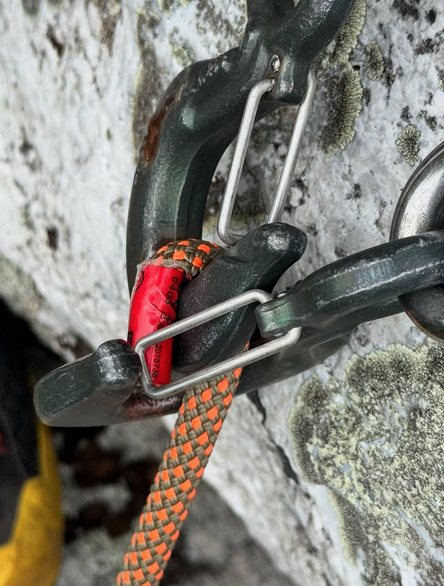
I would consider Greg Barnes the absolute authority on this matter. He has likely spent more time thinking about this question than the rest of the responders combined. Furthermore, he takes the initiative to actually enact change and improve anchors needing upgrades. The many upsides of the simple two bolt, two quick link, two mussy setup vastly outweigh any downsides. Yes a rope CAN get weirdly twisted and stuck at the mussys when pulling… but it is extremely rare and does not in any way make getting down less safe. Sure the single mussy plus chain and opposite opposed stainless captive eye carabiners setup is better in some really narrow aspects, but it is way more high profile, expensive, and obnoxious to use. If/when I encounter that anchor I will curse whoever set it up that way. |
|
|
Gunkiemike wrote: I also have had this happen. (Or some very similar variant) Went to pull rope and the very end got pinched in the hooks. If I recall, it was also a dual hook dual quicklink anchor like in the pictures (one of the anchors at the top of old school wall at ozone for the curious, don't remember which. I could pick it out if I saw it again) We did everything up to and including tying in and jumping off the wall to pull it out; didn't come through. Had to re-lead the route with the tail of the rope resulting in some funny business rope management. Never had this happen with any other anchor type. |
|
|
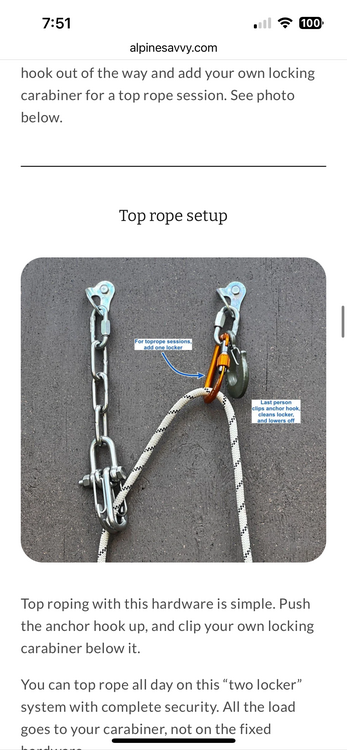 I like this anchor for a couple reasons (TLDR: I like this a lot) 1. Taking out friends who can’t clean - I take out friends and family climbing a few times a year. I lead, they top rope, then we move to the next climb.
I like the setup in the attached picture for the article.
A: (non mussy/carabiners) wear out quicker and need replaced multiple times
I think it’s important to consider the 1 in 1000 times accidents can happen rather than what’s pretty or what you prefer as a probably super competent climbers because you’re on this form. Just by two cents. |
|
|
You can’t instruct your friends or family how to clip two mussys at the end of a top rope session? Hang your draws or anchor below where the mussys hang, this way the cleaner can easily clip and weight the mussys before removing the QuickDraws. I feel like this is a pretty low bar of knowledge to participate in outdoor rock climbing. In areas where the overwhelming norm is to pre clean with a high carabiner I still think chains with rings are still a better solution. Areas where most of the traffic is guided parties but they don’t want people top roping through the fixed gear comes to mind. |


|
Admitedly small sample size here but I feel like most of the crags I have seen have one of 3 options that really mitigate risk with slightly tweaked anchor options. 1) Ground Stations, I have seen these at crags from the gunks to the Urban crag in downtown Richmond. Tbh they deserve their own forum for how useful they are. If I am teaching a new climber, or trying out a new system I can do a lot with these. 2) Examples of rigging in guidebooks, I have seen this in the TAOS climbing book, and I want to say it was also in one of the RRG guidebooks. This is likely a lot more applicable when you have one developer who is doing most anchors in a standard way.. This can also allow the guidebook offer to put a lot of time into doing the information(failure modes, rigging options etc) 3) On mountain project, saying what type of anchors. I am sure this could also be expanded to add Youtube videos as well. I see this in both form pages and protection. Once this thing gets a name, and I see 6 bolts plus Shakled Carabiners( lazy attempt at a name) I know what to expect once I bravely send the pitch. But for a new climber if I saw something I didn't know I could easily google and find relevant information(if its not linked). This is all to say that a lot of infromation is out there, and a lot of mitigation can occur if we look to publicize our bolting choices. Re DrRosckso, in your expirence is it guided parties who TR through fixed gear a big issue. My sense from traveling, and reading MP is its mostly unexpirenced/ lazy partners. I also think intuitively that a guide would have all the gear//expirence to make a TR anchor very easily and quickly. This is obviously discounting areas where guides and companies are paying for the anchors or owned crags. |
|
|
DrRockso RRG wrote: Generally, I'm with you. Easily replaceable stainless steel carabiners would be great, as well as all of us taking greater personal responsibility to replace hardware. There are some problems with the tiny Allen key wire keeper carabiners.
I think a captive eye carabiner ($4.25 each) and a quick link gives similar performance at a much lower cost, and are easily replaced when needed with some channel lock pliers. |
|
|
Bailey Nicholson wrote: I wasn’t saying that guides tr’ing the fixed gear was a problem, as you pointed out some areas are highly maintained by certain users or owned by the guide service and tr’ing the fixed gear is an accepted practice. |
|
|
Generally, I'm with you. Easily replaceable stainless steel carabiners would be great, as well as all of us taking greater personal responsibility to replace hardware. 1. It’s not that big of a deal, tape it onto a carabiner or a leash, they’re very cheap and some manufacturers give you a key with each carabiner (ask me how I acquired 50 3mm allen) the tiny piece that holds in the pin can be dropped but if you're already replacing it you’ll have another one handy. It’s also not the end of the world if there’s no captive pin. 2. In replacing dozens of these I really haven’t found that to be a major problem, they typically still come loose even after plated carabiners start to corrode. An easy but effective solution is to put a tiny dab of anti seize or medium loctite on the threads, this can be done at home in advance. 3. I was referencing using plated biners which would work as the wear component for most climates. (Use wire gates not solid gates, the wire is usually 304ss and lasts longer than the internal spring on solid gates) In theory most would wear out before they became too corroded. They can be purchased wholesale for $5-$6, $8 or $9 retail. Stainless would be great, the actual material cost difference isn’t much different but the manufacturer, I suspect if there was large scale demand a manufacturer would produce a good SS carabiner at a reasonable price. I don’t have experience with the climbing Taiwan snapgates but if they’re anything like the US rigging ones, the gate on them is terrible and much too stiff. I’ve used them on a handful of routes and people definitely prefer mussys to those. If they fixed the gate that’s great, get rid of the overcomplicated setup you proposed and just put one at the end of each chain and replace as needed. What I mentioned was just a pipe dream, I don’t expect climbing culture could change in a way where the majority of users take responsibility for maintaining community hardware, to make a system like that work. The ethic around here used to be to use quicklinks on the bottom of the chains as the wear component, people would carry replacements, and a good number of folks actually did. Unfortunately by the time they needed replacement they were too rusted for most folks to get them off (with or without a wrench) and eventually you’d end up with 3 quicklinks at the bottom of the chain before someone who knew what they were doing came along to fix it. |
|
|
I have nothing to add to the anchor discussion, but lately when I've cleaned single pitch routes that have hooks at the top (as opposed to rap rings) I put some kind of backup blocking knot on the belayer strand and clip it to my belay loop to catch me at the closest piece if the top were to unclip. The klemheist actually seems to work best for my particular cord and ropes. Prusik bites too much and doesn't slide well when pulled by your harness, autoblock won't catch you unless it's really bloody tight. Too many accidents involving mussies for me to trust them. Unfortunately it can be a pain in the ass, as finding the right amount of grip is difficult, and it depends on what type of prusik cord and climbing rope you're using. I've also done this for bailing off a mini biner. I wouldn't teach it to a beginner though since it's just more faff. Doesn't work great for overhanging routes, but if the mussies are hanging freely it sketches me out much less than if they're resting against the rock. At the end of the day, the big realization for me lately has been that it's kind of insane that people go cragging and haven't spent several hours studying up on how to be as safe as possible. There should be NOBODY out climbing that doesn't feel very comfortable cleaning routes, whether they have carabiners at the top or closed rings. Stay at home. Asking a lot, I know, but you're going to be several stories above ground for chrissakes. |
|
|
If a new partner did that on a normal mussy hook anchor, that would be the last route we'd be climbing together. No offense, but it begs the question of 'what other strange stuff are they about to do'. There has only been one documented accident resulting in injury or death with top anchor hooks, and it resulted from one of two scenarios. 1: The climber or at least their rope was positioned above the mussy and they double clipped 1 or both mussys. 2: The climber detached themselves completely and leaned back. It's impossible to know whether the accident was a result of the mussys unclipping, but there have been no cases of an accident being caused by mussys unclipping while the hooks were already weighted and the climber was below. Even in the case of an improperly clipped and twisted mussy it's only possible for 1 mussy to unclip, this can happen on free hanging mussys or mussys sitting on the rock on a single quicklink and usually happens as soon at the system is weighted. What is a mini-biner? Are you bailing off non-climbing rated gear? What you've described is a fine technique for bailing off a single bolt, though often talked about and rarely actually practiced. |
|
|
DrRockso RRG wrote: I can't argue with that. You are free to quit climbing with someone for whatever reason you like.
If I saw someone use a technique I was unfamiliar with I would probably ask them what it is and not deem it "strange stuff" and leave. Unless you know everything about climbing already. Not trying to sound abrasive, I'm here to learn as much as anyone else (and you are much more seasoned than me), but we are talking over text so I can't exactly give you a friendly tone! If you already know it and think it's flat out stupid or increases the level of danger, then that's a different story and can be discussed.
All fair points! I guess for me it's like, if I can take 10 seconds to do something that makes me safer and doesn't significantly slow myself or my partner down then I'm probably going to do it. Why not?
A Metolius FS mini or similar.
Then I'll be the dude that promotes it and annoys people for trying to be annoyingly safe since it could save someone's life. I agree that the chances of your hooks or bail biner failing are very slim. Still, 10 seconds. |
|
|
A bit of a thread drift here but my concern with that line of thinking comes down to the need to focus our attention on things that are actually likely to kill us statistically, (checking your knot, closing systems, placing good gear, double checking systems, weighting systems before committing, giving attentive belays) rather than getting distracted with how can we make this simple and secure system, “even safer”, “what if both the anchor bolts blow”, “what if the 70kn hooks break” etc TLDR: Simple Systems Save Lives. It’s great to play the what if game, but when the result is doing something 99% of other climbers at the crag aren’t doing, then one might question the reasoning and seek advice from more experienced folks. Adding a friction hitch backup to the belayers strand when lowering off a single piece of protection is perfectly reasonable (despite it being rare to see at a sport crag) Doing the same when lowering off two bolts/mussys in good condition seems more like an uniformed fear response to hearing that open systems can be dangerous. |
|
|
Nathan J wrote: FWIW I've had that happen with quicklinks too. Odd, rare, but possible with any two identical things close enough to basically make a garda hitch. |
|
|
I don't have much to add as most of what needs to be said has already been said by folks with a lot more experience than me. But I'm a hard agree with the two musseys being a superior anchor to the proposed solution here. The proposed anchor setup sort of reminds me of folks who like to build TR anchors with a quad or cordalette with a locking biner to each bolt and two lockers for the rope side. There's nothing wrong with doing it that way and it's definitely theoretically safer than the two-draw TR anchor most of us do - but I just don't think it'll ever catch on. Mostly because it makes a super safe and simple anchor system less simple. Which (in my opinion) is moving the needle in the wrong direction. |
|
|
Given that: |
|
|
Alpine Savvy wrote: Your design's getting cooked plenty, so I'll just add one semi-related note: If someone wants to install a new vertically offset anchor and rig it this way, I think the lower bolt with the backup carabiners should be positioned to the right of the mussy bolt. That way the (small) torque on the hanger tightens the nut or bolt each time the system is weighed, instead of slowly causing it to unscrew. I've seen one nut almost all the way unscrewed from the lower wedge bolt on an improperly installed vertically offset anchor (too much horizontal distance, low bolt on the left), though the use of a shackle likely decreases the torque on the hanger somewhat. |