
 Continue with onX Maps
 Sign in with Facebook






RV batteries


|
|
AGM batteries still have a few advantages, mostly from a cost perspective. Taking care of your AGM batteries will greatly extend their life, invest in a trickle charger and occasionally top off the charge, especially in the winter. AGM is probably still king for the dirtbag on a budget. *AGM batteries can tie into your alternator without having to buy a DC to DC charger($) , this also helps you get away with less solar ($) *AGM batteries can be found/replaced at a lot more locations, Costco, Walmart etc *AGM batteries can be installed under the hood of your car, saving interior room, and closer to the alternator, (lithium doesn't like those high engine temps/dangerous) However a lot of modern vehicles will probably struggle to find room for a sizeable AGM battery under the hood. On a budget one could build a simple alternator tied system for maybe $200-$250, 80amp AGM battery Here is the wiring diagram: https://forum.ih8mud.com/attachments/simple-dual-battery-setup-l-jpg.2406974/ I run a really "small" system, My vehicle has a slot for a 2nd battery under the hood. I got a Costco Interstate AGM 27 deep cycle, 88amp hours (44 effective). It is tied to the alternator/starter battery only when the engine is running. I have a narrow 55w solar panel that sits on the dashboard of the car, and only charges the deep cycle. This setup is enough to run a small Dometic 12 liter fridge/freezer (2.5 amp max pull), and a fan (0.8amp), and charge phones for maybe 2 days with minimal solar or starting the car. |
|
|
I will say that there is some stuff in the xiaoXiangElectric app that is self explanitory and some stuff I can not figuer out at all. naturally no instructions... |
|
|
I think I messed up really bad. messing around trying to figure out the app I hit the reset capacity button. the battery instantly went from 67% full to 92% full.. no clue how to reverse this to be accurate or what the reset capacity button is really for??? |


|
Nick Goldsmithwrote: Continue changing the battery until the current drops to 0 or very close. The internal BMS will likely detect full change and reset itself. The idea is to get both batteries at the same no load voltage before you connect them together. The easiest way to accomplish this is to fully change the batteries. The BMS will automatically balance the cells when the charger voltage gets above 14.2 (or the abouts). The actual balancing should take a few minutes and the current will drift down to almost zero. BMS generally reset to full at this point. If not you can hit the reset button. The internal resistance of these batteries is very low so connecting batteries at different states of charge can cause huge current flows possibly invoking the BMS safety systems but unlikely to actually damage the battery but possibly damaging your wires of they are to small or blowing fuses. The BMS measures current in and out of the battery to keep track of the state of charge. With all batteries voltage measurement to determine state is change are only reliable if there is no light and the battery has been at ready for a while, not very useful. BMS battery state of charge are a great step forward. |
|
|
The blue tooth batteries are cool and I can link with the batteries from my living room with the van parked about 10ft from the house. but the app has it's limitations. Mostly in non existant instructions. have not figured out how to turn on the battery protection. I did set my charge controller to lithium and a max of 14.2 volts so should not need the protection at the moment but its silly that I cant turn it on. there was zero info on how to use the app. only instructions on where to find the download. I did run my fridge all last night on a hot steamy night and one battery is at 88% and the other at 91% which seems good to me? its foggy and rather dark still but the charge controller says its charging yet the app is not showing that? perhaps its not pulling in enough charge to register? It will be interesting to see what the numbers are after work today? I have never found any reliable info on which terminals you are supposed to connect your positive line in from the charge controller and your negative from the charge controller. your positive line out to the fuse bank that powers the camper. the negative to the buss bar for the camper system. I also have a Positive and negative that go to a 15 amp inverter that I only use when I am editing and my laptop battery is low. There's a lot of stuff in there..  |
|
|
Nick Goldsmithwrote: I ran into similar problem - no f-ing instructions for something similar. The work-around was YouTube. Sometimes helpful, sometimes not, but definitely cheap. Here is one hit - https://www.youtube.com/watch?v=1T5rzJvWjig |
|
|
It's definitely charging. The fridge ran all day and it's up to 98 percent. |
|
|
Nick Goldsmithwrote: I would be stunned if you could turn battery protection off, it should always be on. In fact I would return batteries where you could turn the battery protection off. That is extremely dangerous. Connect positive to positive and negative to negative just like jumping a car. |
|
|
in the app the battery protection button is grey and not active. I hit the auto ballance button and it tells me it was successful but then when you go to the dashboard that ballance button is gray and not active. just your basic app that comes with no instructions. as far as my other question does it matter which of the two batteries I run my power out to the van from and if I have the positive and negative connected to the same battery or one to each battery? same question for the charging lines coming in. both positive and negative line in to the same battery or opposite batteries? |
|
|
I don't know anything about your batteries but generally battery manufacturers limit the number of lugs per terminal to 2. This allows for the battery to be connected in series or parallel to other batteries and to the load while maintaining the integrity and conductivity of the connection. The fewer threads the lug bolt engages the poorer the connection. For your application which appears to be a low current application it probably does not matter but if you feel any heat you should reconsider. I recommend you getting a couple of bus bars and rewiring like this. It would also be reasonable to put fuses inline with each of the fridge, charger, and solar charger in case one of them shorts but not really necessary. Size the main fuse to be about 50% more than the max(fridge, charger current + solar current). These batteries store a LOT of power and a short can easily start a fire or weld cables, they don't have the voltage to really harm you. Do all the wiring work with the cutoff switch open, this will prevent the scary arcs when you hook things up.  Neatness counts in the long run. At the very least, I would also rotate one battery so they are in the same orientation and wrap you positive wires in red tape. It will make life much easier when you need to work on it. Here is a link to a pair of bus bars for example busbars |
|
|
I do have buss bars and my positive and negative are marked with red and green tape. 15 amp fuse between panels and controller, 30 amp fuse between battery and control. Each appliance and wiring zone has its own fuse. Pat I think I will be able to come pretty close to that set up that you showed by moving the lines coming from my charge controller off the battery to the buss bars. will move the big fat 8 gauge that goes to the inverter to the other positive battery terminal which is not crowded. Reason the batteries are switched the way they are is because those are the shortest 4 gage connectors I could find at the auto parts store.  Nice sunny day the batteries hit 100 percent and the app shows auto balance is now on and protection also came on automatically. The app has a button to turn off discharge which I used in addition to removing the fuses in those lines while working on connections. |
|
|
Nick Goldsmithwrote: Great. I meant to mention that the cells can only be balanced when fully charged. |
|
|
I had them on my battery maintainer rigs that are only 1.5 amps and they only got to 99percent charged after two days and were at 99% for 10 hrs when I decided to put them in the van. yesterday was cloudy and they stayed at 99% today was sunny and they hit 100% I did run that cluster fck on the batteries for 6 years with no issues. two of the connections are really tiny sensors that go back to the charge controller. I can't remember if they are for the renogy BT app that never worked or if they are necessary to the charge controller to read battery voltage? I do know it says they are optional. I am stoked to get the charging cables off the battery and connected to the buss bars. I simply did not know that was a preferred method. |
|
|
Ran the music tent at the art fest off of my van yesterday. 1,000w PA for 5 hours and my fridge was also running all day. batteries stayed at 100% all day. WOW!   |
|
|
I think part of what made my system work so good on Saturday was it was a crystal clear day with no fire smoke and the van was parked at a slight incline that tilted the panels south west towards the sun. today its cloudy and we were parked in some deep dark shade while climbing for 4 hrs. fridge running full time and we had the roof fan going while cooking dinner in the rain. down to 85% |
|
|
sunny today, was at 82% this morning. 100% now :) |
|
|
Nick Goldsmithwrote: One nice things about lifepo4 batteries is they continue to change quickly when they enter the absorption phase, much faster than lead-acid batteries. So they reach full charge quicker with the same solar input. For my cabins power system the difference is almost as if I added another solar panel. |
|
|
Pat. there is absolutely no way I could have run that 1k watt PA system for 5 hrs even on a sunny day with my old batteries. these Lifepo4 batteries Rock!  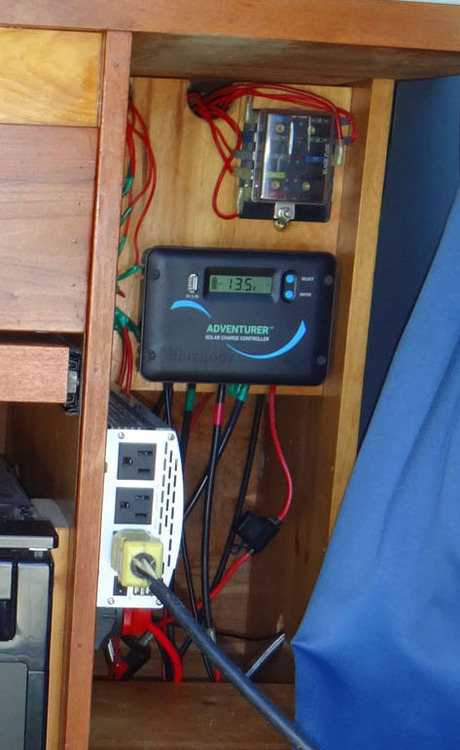 My two panels together look maybe a little smaller than my neighbors single panel?   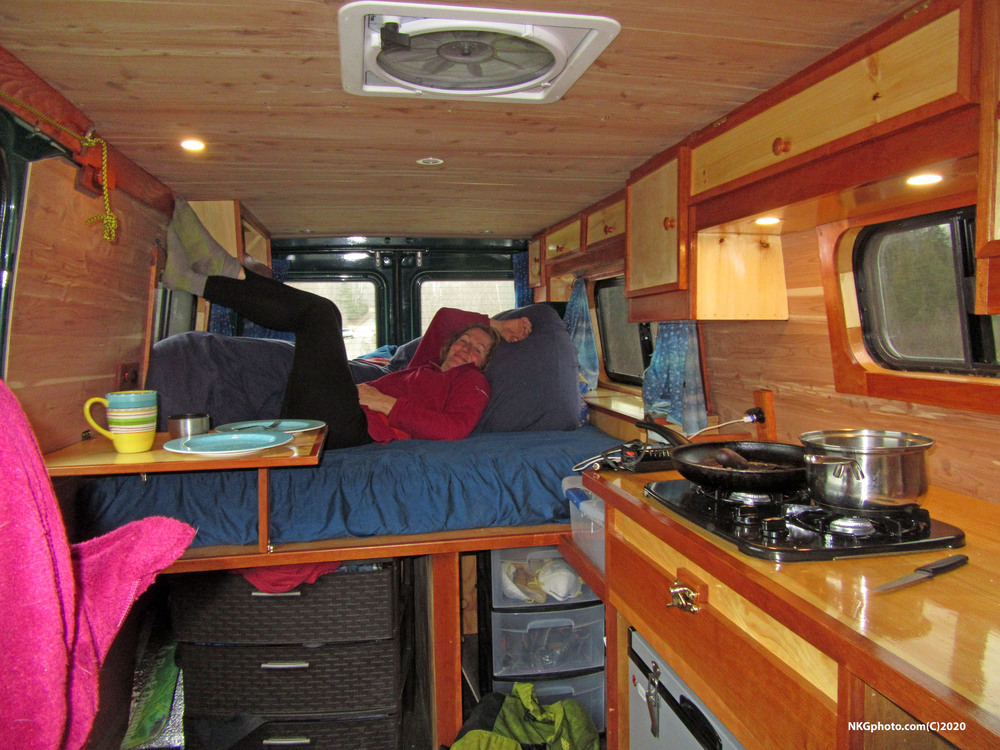   |
|
|
Much cleaner. Thank you for the pointers Pat.  |
|
|
I haven't read the full thread but I have had good luck with Lithium batteries across multiple vans and the prices are certainly coming down. If you have a charge controller that can already support lithium, it should be a fairly easy switch and you can get much more usable capacity per volume and mass, at not that much more cost. |


