Continue with onX Maps
 Sign in with Facebook






Mussy Hook Unclipped While Lowering



|
Thread drift, but very related. I climb in an area where 'ram's horn' lowering systems are quite common. I'm not a big fan. While they are ( relatively ) easy to use, they seem equally easy to misuse and appear very susceptible to situations such as apparently occurred in the Sand Rock tragedy. However, I haven't heard, anecdotally or otherwise, of any incidents involving them ( maybe because their use is relatively rare). Has anyone on here heard of such incidents or has thoughts about these systems? |
|
|
amariuswrote: Frank Stein beat me to it. It's all about ease of use, not failure concerns. |
|
|
During our 2015, Frankenjura trip, ram’s horns were pretty much the only anchors we encountered. For the first few days, I was not a fan. However, by the end of the trip, I was a steadfast convert. The typical set-up was a ram’s horn on a glue-in bolt, linked by a chain to a second bolt in an offset and vertical orientation. If we left a top rope up, we just put in a single draw in the higher bolt. Due to this design of the basket, it did not appear that the rope could travel up and out of the ram’s horn itself. |
|
|
Frank Steinwrote: Frank, I am having trouble visualizing the set-up that you are describing. Is there only one 'horn'--that on the lower bolt--- in the system? Around here there are always 2 horns, each on separate bolts and adjacent to each other for redundancy. Further, if I am understanding you correctly, when you were top-roping from the draw in the upper bolt, was your rope also threaded through the horn on the lower one? If so, that seems that it would create substantial rope drag and risk the rope coming out of the horn. I have had a rope 'release itself' from one threaded horn while I was working to remove the belay draw from below the other one--fortunately I saw it occurring and quickly rethreaded it---but, obviously, this didn't help with my 'ram's horn trust issues'. |
|
|
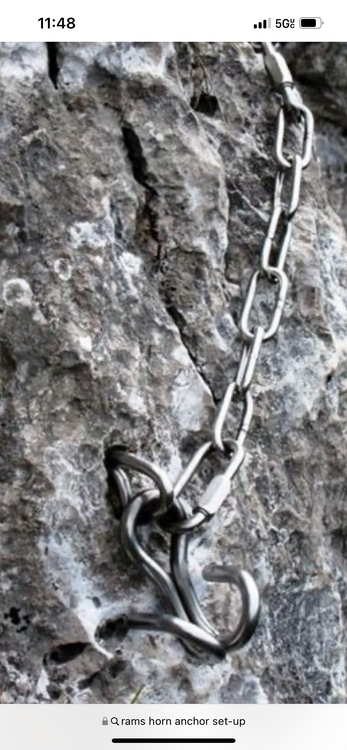 Yes, a single horn, set up like this. Because of the vertical set-up, there was no weird rope drag. I should also note that the Frankenjura horns had a much more complete curve to the basket than in the above photo, meaning that it was unlikely that the rope would be lifted out of it. The curve did make it a little more difficult to just drop in the rope without a little practice. |
|
|
Classic MP. OP’s question is answered within the first 5 posts (user error), and here we are 5 pages in…. |
|
|
Matt Zwrote: Maybe slow down the route development so quality routes are priority |
|
|
amariuswrote: A take home here that wasn't emphasized nearly enough, imo, was that the student/the less experienced should NEVER be the ones to clean an anchor when done. They should only be instructed to never climb above the mussies and only be lowered off. Don't frickin' touch a thing! In addition, there are certain rigid opinions about what climbers should or should not be expected to learn for themselves and we need to shut that shit down. Lives are at stake and flexing about noobs screwing up "basic stuff" is toxic bs. We need the most fool proof set up we can afford. "Never top rope off the mussies" is one such opinion that is counterproductive. It was the addition of gear to the anchor to make it "safer/save wear" on the mussies that introduced complexity that likely contributed to the recent accident (not the OP). We should only say something like "using your own gear to TR is a best practice ONLY if you are absolutely certain all in the group know how to use it and safely clean it". Do not haze newbies by chiding them to use their own gear. Encourage their safest practice commensurate with skill level. 1. Never let the inexperienced among the group clean the anchor if personal hardware was used. We have all seen the clusters that some have created trying to "spare the fixed hardware" and the less experienced should not be expected to figure out something they have never seen before. Emphasize that they should do what they feel is safest but should be open to safer suggestions if they are seen to be doing something unsafe. 2. Always use the mussies alone if there is any doubt as to the competency of those using the anchor. Instruct others to not manipulate the anchor in any way unless separately connected to the anchor via PAS and being properly trained. 3. NEVER climb above a TR anchor regardless of the method of connecting the rope. Bad and unexpected things can and have happened and there is nothing stopping you from a long fall to the deck (like a lower clipped in piece). 4. Only use your own gear only if the entire group knows what they are doing. We cannot guarantee that the least experienced will not be asked to clean a complicated situation at the anchor. If you feel compelled to add that locker, you should be the one to clean it. 5. But, if manipulation is required to clean the anchor, then a PAS must be used to test the system first before lowering. 6. ??? Suggestions welcome. This is not a "do as I say" post but one trying to develop best language around this issue. My 2 cents. |
|
|
Max Tepferwrote: As this bolt orientation is becoming "standard" for a belay anchor then we have to consider this setup for a lower off station as well. If the maillon is 3/8" then it breaks at 10k lbs and is safer by far than the rope itself in nearly every way. The gate is less likely to open than one is to become untied, imo. The inconvenience of clipping due to this orientation is immaterial (it's probably no worse than a ram's horn). Clip in with a PAS first if you are that pumped. Sorry, marc801, don't mean to throw you under the bus. As others have posted, safely using your own hardware to TR off this is not a problem at all. If you independently connected the second mussy to the chain with a separate maillon it might tick all the redundancy boxes for those that require it and the chain should have enough play to prevent a binding that would contribute to unclipping. I more than get that cost is a factor but let's just have a reasonable "best practices" discussion. 2 maillons would be no worse and arguably better than current practice to allow opposition of the mussies. A little tedious to line things up just right when drilling maybe but it's just the cost of one more maillon potentially offset by being able to use 5/16 or smaller maillons. This setup that fixes in place the opposite and opposed configuration does have its' own merit however, imo. I personally would prefer this to a Ram's horn as it would allow newbs/cheapos to TR off it (we know they will and might as well be safe about it). |
|
|
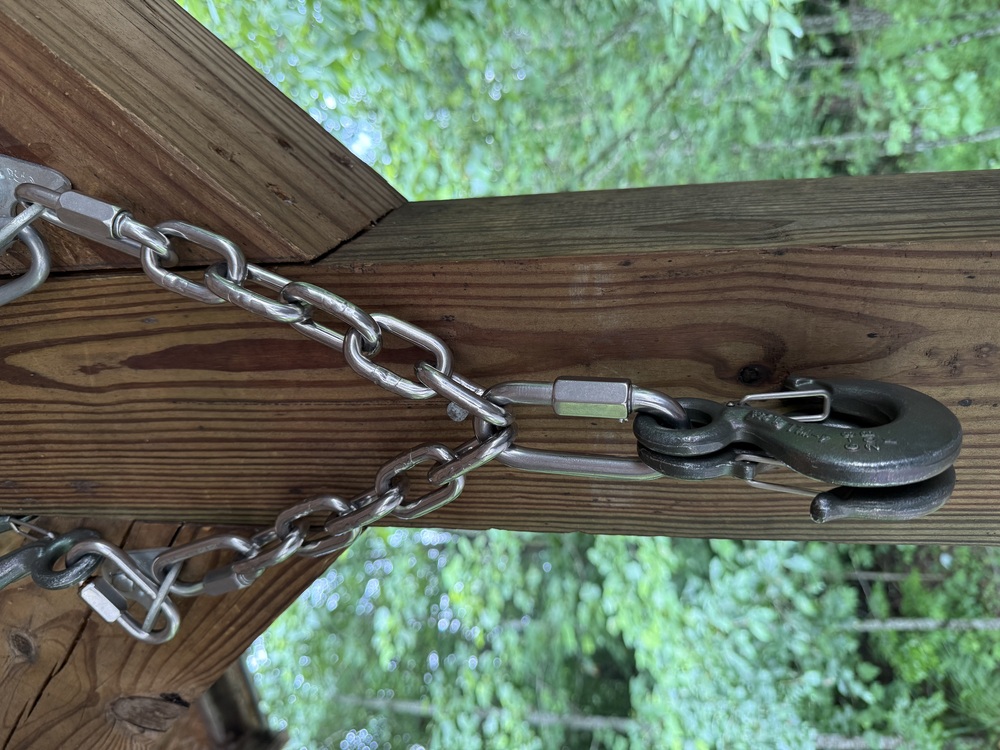
Climbing got in the way of posting for me the past few days, but today's a rest day, so I'll step back in. Hillbilly basically nailed it. It's pretty easy to clip by flicking the mallions apart with your clipping hand mid-clip and dropping the rope in the nearest mussy. The problem with trying to make it redundant is that the eyes of the mussys aren't big enough to accommodate two mallions, so you have to put them on individual mallions to achieve that level of redundancy and in doing so, lose the rigidity that makes the system work well in all the other ways. At least there's more redundancy than the very common euro-system of one mallion, one lowering carabiner! (and more importantly as has been said, redundancy really isn't necessary in this case) Anna, in reply to your comment about how this thread contributes to the confusion around installing and using lowering hooks, I assume that's mostly in reference to my broadcasting the method we've come up with. As has been said, mussy hooks aren't meant for climbing and as a result, don't really have a dedicated SOP in terms of how to install them at anchors that's been researched or studied in any meaningful way. Given that, we're all just trying our best to come up with safe, usable options. (Greggerman's is a slick solution too) There is some degree of guidance from the ASCA on the topic, but I'd be curious to hear from Greg what all went in to generating that information and where it came from. Phylp, to reply to your post, (thanks for the feedback) we're not actually spending our own money nor are we on a mission to retrofit every anchor in this way. Tyler and I manage the High Desert Climbers Alliance rebolting program and each time our crews rebolt an anchor at Smith, we have the opportunity to spruce it up. We used to get a lot of material from Greg and the ASCA, (which was incredible and for which we're eternally grateful) but lately have just been buying mussys and mallions by the hundreds from sportbolting as our fundraising has improved and our need for material has grown. I'd be curious to hear specifically why you don't like the single link, rounded nose, and the gate of the mussy facing the rock? I assume with the gate facing the rock, it's for concern of it opening? If so, it's worth noting that the gate can't be opened easily when they're both under tension because the two mussys come together in such a way that the spine of the other mussy will contact the rock before the gate. Additionally, the gate on the mussy is so deep in the basket that it'd have to be a fairly specific feature to get past the tip of the nose. I suppose there could be 'just' the right feature out there to do this, but if that's the case, than the anchor installer needs to notice it and adjust things around it. |
|
|
Max Tepferwrote: Hi Max I am travelling right now if I was at home I’d set it up and make a little video of what I can imagine could happen. It’s not about the gate of the inward mussy opening, or the one link itself. It’s that I anticipate that opposed gates will lead to more people using the mussys for toproping. I’m imagining with toproping, and people moving around and falling and bouncing around on toprope, that the nose of the gate is going to repetitively bang against the rock. I’m imagining because of the restriction of movement with the single link, that the mussys are going to be banging against the screwlock of the link. The setup is perfectly OK for lowering. I’m not an engineer, so I have no idea if this kind of thing that I’m imagining would even happen, or would even be a problem if it did, but just intuitively, it makes me uneasy. I set up my toprope with alpine draws, so I could get that equalized with your two glueins without too much effort but I know a lot of people who only carry dogbone style quickdraws to use as top anchors. I wouldn’t know until I used it but just looking at the links and the angled, I think it will be harder to equalize with your setup. I’m not strongly opposed to your design, I just feel like I don’t personally like it as well as what people mostly do. Time will tell. Again thanks for what you do. |
|
|
 |
|
|
phylp phylpwrote: Why is being equalized on a bolted anchor important? I feel like two staggered draws with the anchor in your way from unclipping would be safer. |
|
|
T Taylorwrote: In trad terms, i’m gonna guess he meant controlling for extension? If one talks of redundancy, then one must consider failures. And if a failure happens on the top piece, then at least the other piece won’t get shockloaded, or it won’t be so dynamic and crazy that the rope has another opportunity to thwack out of another gate. In my case, my messed up “opposite and opposed” mussies were level, but if it was a top one that popped, it would be a bit freaky to be taking effectively a lead fall onto a mussy. |
|
|
I hear ease of use as an argument against opposing mussys. Just clip one, its easier. We see pros in the videos clip only one draw at the anchor all the time (Though they are leading so they have a bolt clipped below if they don’t clean it when lowering, which you never see in the videos). Oppose the mussys if possible. Personally I don’t mind the difficulty of clipping opposed mussys verses the increased safety. |
|
|
amariuswrote: I have the same question, but I see that after several pages nobody has really attempted to answer it. The anchor that Max posted is a variation of the configuration widely used in Europe, but with added mussy hooks. (As for redundancy concerns, keep in mind that the a steel quick link is much stronger than a typical climbing rope...) Other than clipping convenience, what's the problem with opposed mussies? Opposed carabiners have been the standard for decades, why would mussies be different? |
|
|
Just clipping convenience. In another thread it was gone over recently. For opposed mussies on the same link you need a 3/8" link. This one link's individual strength far exceeds anything else in the system and one is sufficient by far for a lowering station is consensus. |
|
|
musseys are fugly and there have been accidents... Rams horns seem to be much cleaner looking and easy to use. no sure about how hard they are to replace. I really prefer just two screw links on each bolt. simple, bomb proof and plenty of room to clip other stuff into them. Musseys and rams horns are really just about being lazy. people that should not have been put in the position of cleaning the anchor still get themselves killed regardless of which anchor is used.. In fact installing musseys and rams horns may be easy for the beginner to rig but it's just kicking the can down the road. now you can gain outdoor experience and still not know how to actually clean an anchor. The kid who has a season of experience at crags with musseys and rams horns is now the group leader when they encounter their first anchor without a quick clip option.... |
|
|
Well said, Nick. Fugly and kicking the can down the road. |
|
|
Nick, the same could be said by any curmudgeon about any increase in safety since forever. "Just do what I do and you'll be safe" but the fact of the matter is that rappelling/lowering also kills more experienced climbers than anything else. Be complacency or other factors, individuals err and "fugly" is not a consideration, only what works and what doesn't to save lives. |