
 Continue with onX Maps
 Sign in with Facebook






RED ALERT: SENATE BILL INCLUDES MAJOR CLIMBING AREAS FOR SALE



|
Andy Shoemakerwrote: Thanks for adding your references! What you provided does not support the statement you made that logging doesn’t create jobs. It demonstrates that outdoor recreation jobs exist and are numerous. The missing step is that more recreation jobs would be lost than logging jobs created. Maybe I misunderstood your thesis? Maybe you left out the critical reference?
While it’s possible to do a lot of things, including helicopter thinning, that doesn’t mean it’s feasible at scale. I’m seeing one review saying we don’t know the interaction between clearing and fire, and another saying thoughtless suppression also causes problems. That doesn’t prove the statement I heard you saying in your first post. Don’t get me wrong, I want to believe both your statements. But that’s particularly the time I should be doubtful. “Don’t believe everything you think.” |
|
|
Eric Mosswrote: What does “over” mean? It’s like asking if a 30’ rock is “tall.” Pretty tall to boulder. Pretty short for a sport route. Not an option for multi pitch. Tell me what your measurement is, otherwise “overpopulated” just means, “I don’t like it.” If all you mean is that it feels bad man, then that’s fine. But fuck your feelings, right? It’s certainly not a reason for national policy. |
|
|
Eric Mosswrote: It's not though. Most of the west is empty. |
|
|
Sep Mwrote: If I have to explain what overpopulation means, you wouldn't understand it. You want us stacked ear to ear, maybe do that somewhere else. |
|
|
Casey Jwrote: It should stay that way |
|
|
Eric Mosswrote: See this is why facts are fun, because while you feel like we’re overpopulated, we’re actually 180th out of 242 in terms of population density per country/dependency, putting us between Palau and Kyrgyzstan. And I bet you wouldn’t call Kyrgyzstan overpopulated. US has 96 people per square mile averaged across the country (NYC almost 30,000 per sq mile!). Outside of major cities, the US is quite quite empty. The mountain time zone where a lot of us recreate is just 26 people per sq mile. |
|
|
Eric Mosswrote: Oh look, a closed minded NIMBY. Wyoming has a population density of 5.97 people per square mile. That's slightly above mongolia (source: https://en.wikipedia.org/wiki/List_of_countries_and_dependencies_by_population_density). While I don't think "thousands of people per square mile" is the right density for all of the US, plenty of it could stand to move a bit. |
|
|
Casey Jwrote: We get it, you don't want to conserve land. |

|
Eric, this is at least the fifth day that you have posted on this thread, but, as I and others have already mentioned, you have yet to state your opinion, or even address, the actual topic---the effort by at least some Republicans in Congress and in the Administration, to either sell, or otherwise make available to private parties for exploitation, very large tracts of our public lands, potentially including multiple climbing areas. You have actively been trying to divert the discussion to one of general economic theory or, then, to immigration, while totally ignoring what this thread is meant to discuss. I presume that you are doing so because you are embarrassed to present and try to argue in support of your beliefs on this specific issue. |
|
|
Casey Jwrote: Much of Wyoming lacks reliable water sources. Many people who live in developed areas of Wyoming rely on cisterns and haul or have water delivered for household needs. California and Nevada have limited water resources in many undeveloped areas. The actual nature of the land usually dictates population density. |
|
|
Daniel Shivelywrote: You'd think this would be true, but then there's Phoenix. And Las Vegas. And Los Angeles. Ad infinitum. |
|
|
apogeewrote: Los Angeles is a desirable location for commerce but population has far outpaced reliable resources, not sure of the factors that led to Phoenix or Las Vegas. I wasn’t offering a critique of the nature of highly developed urban centers, I was sharing insight regarding the viability for developing areas of the western high desert and prairies. Obviously many people live in areas without regard to the source of the resources needed for survival. Water just flows from the spigot….right? I would speculate that most population centers initially provided abundant resources but succumbed to overdevelopment and population growth. |
|
|
Casey Jwrote: I dunno, getting hit in the face with wind blown snow for 6 months out of the year probably makes a dent in pop. density. |
|
|
Carolinawrote: I never said there wasn't a reason, I'm just saying anyone proposing that the US is "full" is completely full of crap OR has never actually seen a meaningful amount of the country. As to the concerns on water etc. - yep, totally get it, but lets not pretend we couldn't add some density without impacting major wild areas (note that I say this in the perspective of existing non-federal lands, not in support of any dumb sell-off). |
|
|
Casey, More people's means more pollution (we should aim to conserve all land, not just federal land. |
|
|
I'll stick my neck out and make a very qualified argument for the sale of certain public lands. Pan around a land ownership map in the West, and you'll find all sorts of isolated sections of BLM and State lands completely surrounded by private lands. As someone who has spent his career doing fieldwork in the West, I can tell you that many if not most of these isolated parcels cannot be effectively managed by government entities. In many cases, the owners of adjacent private lands control access, and have the political power to lock government employees out. This isn't legal, but it's often how it works in the Wild West, most obviously in Montana. In most cases, nearby ranches lease these lands for grazing, and are the only effective managers of these lands. If we were to sell off any public lands, I'd argue it should be these. They're already privately controlled, and they already have infrastructure for cattle operations. To understand why such lands weren't prioritized in the Big Bill, we should consider the economics. A grazing lease on BLM land costs roughly a third of what it would on private land. If a rancher can turn a profit off of land without a large investment, there's little incentive to buy it. Any lawmaker in a ranching state would catch a lot of flak from ranchers for proposing the sale of these lands. Having worked in Montana, I'm pretty confident that certain big-shot ranchers are the main reason for Zinke's opposition. I don't take a strong position on grazing. I've seen it done badly and I've seen it done well. But I'm convinced that the worst grazing operation is less devastating per acre than the best subdivision. I'm not comfortable with setting a new precedent for public land sales. But to those who believe such sales are justified to shore up our budget, I suggest we start with effectively private lands that have been subject to major resource extraction since the Railroad Era at least. |
|
|
All this banter is interesting but basically irrelevant (unless you have a politician's ear and they're in your back pocket)... Let's keep our eye on the ball people. We need to maintain pressure on our Senators and, really, Reps as well as any new language passed will have to go back to the House for reconciliation. Mike Lee is rewriting the USFS language and BLM land is still for sale. |
|
|
Logan, good points. I remember reading some articles last year about this checker-boarding of land blocking access to public land, where some were even building ladders to cross over the little corners of private land. Talk about gatekeeping! And yes, keep up the pressure. We only temporarily won this one on a technicality. |
|
|
The Gibsmedats on this website are thick. 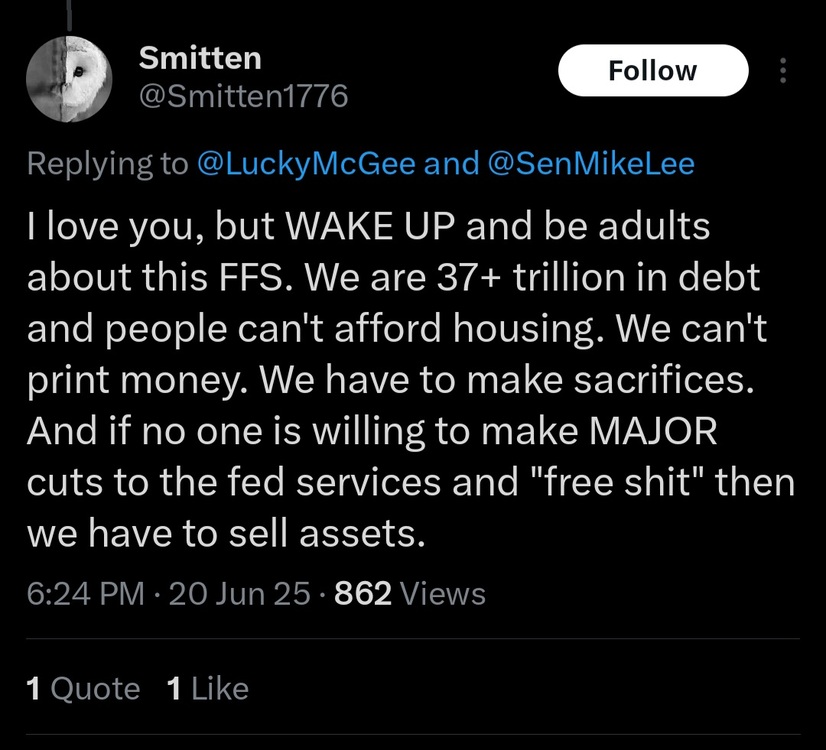 Numbers do not lie. At some point you are going to have to decide on what you want from a Federal state and how you'll pay for it |
|
|
Tax the rich. |


