
 Continue with onX Maps
 Sign in with Facebook






Black Dike NH avalanche and rescue


|
|
Part of the learning curve is knowing that when lower angled thin ice lines are getting or have just gotten fresh snow its impossible to tell what the conditions are without getting on the climb and brushing the snow off as you climb to try and find the ice and cracks. Even if the climb has a decent amount of ice on it the 1st pitch is somewhat of a tedious chore to brush snow off before every swing. otherwise you are swinging blind which is not how I prefer to do it but everyone has their own methods. Certainly climbing in full conditions is a hoot but its a lot less work on steeper climbs that have ice on them. for example at the lake if it's snowing the tablets and Float will be a lot more work than 20 below or Glass . Snow covered dry rock is an absolute nightmare in my book. |

|
Violet Owrote: I identify with this. Ice Climbing on the East Coast, avalanches were definitely not a big concern (at least at the places I went) except Huntington Ravine (where it was a big concern). Definitely chalk it up as a learning experience. What's the say: Good judgement comes from experience. Experience comes from bad judgement. The trick is making sure the bad judgement isn't fatal. |
|
|
the area below the Dike has a history of avalanching Obviously anything on MT washington, Lincolns throat etc. Smugglers notch has very real avy terraine Have wittnessed avalanches in the gullys below some of the climbs @ Willoughby. |
|
|
Nick Goldsmithwrote: I did an avy course at Smugglers Notch once, so yes definitely avy terrain there. If you are going out in the winter where there is steep terrain and snow, a little avy knowledge is definitely advisable. Luckily on the East Coast the snow pack is relatively more stable than say Colorado (where I live now). That makes them less likely and they still happen. |

|
Zephi, Kudos on being open and transparent about your decision-making and experience. I wish more of us would do the same. And kudos on remaining psyched! Hopefully some freeze-thaw will bring P1/2 of the Dike into more fun conditions than they're in now! For all of us, I also think it's worth reflecting on when things didn't go to shit, but really should have and we just got lucky. Backcountry skiers are much better about this than climbers. I know I try to be more open with this when talking with my partners, friends, and even in things I share with the community, but its not the cultural norm in our sport right now. Avy education for climbers, especially in the NE is severely lacking. Willoughby, Webster, Willard, Frankenstein, Cannon, Smuggs, even Cathedral (below Goofers) all have avy terrain to consider. Avy courses here are exclusively geared towards skiing. My Avy 1 was as much a ski tour as it was an educational experience. There are starting to be avy courses specifically geared towards ice climbers offered in the Canadian Rockies. |
|
|
Agreed with Pat Cooke, and thank you Violet for being open to questions. |
|
|
Thank to everyone for the questions, knowledge, history, etc. and thanks for being so nice ⚡️⚡️⚡️ |
|
|
For a long time the primary demographic for avy fatalities was climbers before bc skiing got popular |
|
|
While I’ve never seen anything in writing, I’ve always felt that ” the east coast snow pack is more stable” was a myth. It’s just that in MOST of the east coast back country there are more anchoring trees…often so many and so thick that there’s a lot for the snowpack to bond to, and the thickness of trees ( esp. the 1000-2000 vertical feet just below timberline) is not conducive to people traveling there. Compare to the slopes populated only by aspen, or nothing at all because you’re already above timberline, such as you might find in the West. I don’t think there’s anything special about east coast snowpack. Give it the same conditions to form windslab, or later in the season saturation conditions, and the same slope and terrain, and it will slide just as easily, either spontaneously or if human-triggered. |
|
|
Patrick Cookewrote: I'm a climber and an avalanche educator in the NE, and I think climbers are doing a good job educating themselves. I average about 20% climbers in my avalanche courses, 60% skiers, and 20% climbers who ski. I think that's a great amount of representation! There's no major difference in what is taught in climber-specific avalanche course. (If you're thinking you should use the rope to protect against avalanches, you're probably already cutting your margins too close.) It's easier to incorporate some climber-specific concepts into every avalanche course. Unrelated: I agree that the concept of "moral luck" plays a huge role in how we interpret mountain accidents. |
|
|
Nick, if lets say that you are on boot packed trail up to LHMW and from there to upper Hitchcock and want to have a look at Cauliflower gully but the top of Cinema looks loaded and scary that it would be a bad idea to rope across to the woods on the other side of Cinema? I use this example because I did that once solo and took one look at the top of Cinema and instantly said no effing Way. Turned around and finished up upper Hitchcock. If I had a partner and a rope would I have tried that? I don't know? Probably not but I suspect it could be done? |
|
|
Nick Awrote: Clarifying my statement to mean that ice climbers aren't taking advantage of avy education vs. the availability of avy education. Those percentages are better than I thought, but represent quite small numbers relative to the number of climbers out there. Things are improving, but I think among most climbers, even awareness of the avalanche terrain we play in is pretty lacking. It makes sense why avy courses aren't geared specifically to climbers, but I think that's also part of why climbers aren't taking advantage of available avalanche education. |
|
|
Patrick Cookewrote: In the Canadian Rockies, it seems that climbers have slowly started waking up to the reality of avalanche risk in the last few years, probably in part because of a high-profile fatal incident. I can't understand why it was ignored for so long, but it was, for many climbers. I mean, just think about where the vast majority of ice climbs form: under funnels and gullies - right where the snow collected above is going to run. I still need to push the discussion with some of my climbing partners - avy risk doesn't seem to enter their thinking until I bring it up. If I remember reading it correctly before I got "paywalled," this is a good article: https://www.climbing.com/skills/avalanche-mitigation-ice-climbers/ |
|
|
When i mentioned in my original response that there was a chance inexperience was at play, the lack of avalanche training was my main reason for guessing. Typically with training you would know what to do immediately after a partner gets caught in a slide, and it’s not typically to call 9-1-1. This didn’t create any major issues this time around since the guy didn’t get fully buried, but I’d recommend Avalanche training at even a basic level for anyone getting on many of the climbs in NH. Slopes can randomly build and slide and I’ve seen people post many odd and random areas releasing that they never knew could. Without any training, should a partner get buried, if you don’t know what to do that partner will likely die or be in a bad situation. 9-1-1 won’t be there for hours depending on where you are and what weather is doing. |
|
|
911 was designed for civilization. In a large part of the hiking, climbing areas of the US, especially NH, VT, ME, and upstate-NY there is no signal. While cell coverage covers something like 95% of the population of the US, I believe it covers less than 50% of the AREA, even excluding Alaska. Compare this to places in Europe where, as far back as 2007, we got signal throughout Norway in what I’d call the WAY backcountry. Even when there is signal, the location feature often doesn’t work, in that it gives an erroneous location. I have personally called into 911 on a hike and been told I was 4 miles away from where I was ( I was on an outlook reporting what I thought was a small forest fire ). I know others have had the same problem. I believe the problem is that if there is only one cell tower you are connected to, and thus your position can not be triangulated, the system reverts to “locating” you on the nearest highway or major road. |
|
|
Nick Goldsmithwrote:Climbing it when it's not in and covered in fresh snow is kind of like slamming your nipples in a car door. One of those things where you're not sure what is worse. Slamming the door or opening it again to get them nipples back... I think we should spend some more time figuring out where the fuck this analogy came from? |
|
|
Christian Donkeywrote: Experience?! |
|
|
took this shot last week trying to get to Cold Hearted Hor on Mt Hor 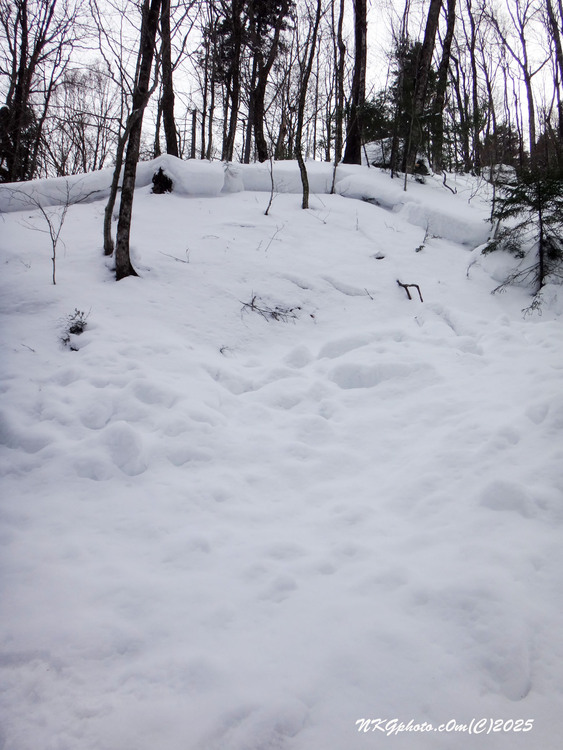 no free pass for being in the trees. I was on the upper leg of the south beach loop trail and this slide had buried the trail. Didn't see any human limbs sticking out. I gave up on the final approach. I got a big Whoomp while I was still in the woods on the marked cliff trail and reversed course quickly. I suspect the final gully would have been too risky. bunch of ski tracks in the gully just before the final one.. they got away with it but 30ft past the line they had skied it whoomped... |
|
|
Rick Charitywrote: Thanks for your input, Rick. The Fish and game post was incorrect about a few of the details. I did not call 911, my partner did after he was carried more than 300 feet over talus. He was injured to the point that he wouldn't have been able to do anything to find me. We got separated and couldn't hear or see each other for a while, and I believe he called because he thought I got buried. |
|
|
I got avalanched approaching Kinsman years ago. Pretty wild. A foot of wet snow, a rapid warm up day and it slid right on top of the oak leaves on the ground. I suspect the ground was not even frozen yet. |


