
 Continue with onX Maps
 Sign in with Facebook






Backing up a PAS on a sport multi pitch climb



|
If you tie a knot for a master point you have isolated strands so if something happens to one side the other side is still intact. |
|
|
Ricky Harlinewrote: Ricky, I hesitate to add to the thread drift at this point, but I will because I appreciate your openness and obvious goodwill in trying to identify the reasons people might reach conclusions different than yours. My first observation is that your breakdown of the guide's e-mail suggests that you take a very step-by-step, methodical approach to your analysis. Without wading into waters that are beyond my expertise, I'll just say that you wouldn't be the first neurodivergent person I've seen with that trait. It isn't a bad trait, and can be invaluable in many contexts, but as others have pointed out, you should try to understand that many people don't operate that way and they use language much more loosely than some of us might. My second comment is that you should remember that most people (at least outside of nasty online forums) will be at least somewhat careful not to offend the person they're speaking with/writing to, and the result may be to blur what they're saying. What I'm getting at here is that your guide may well have avoided saying, "of course a single rope isn't redundant, you dummy!" just to be nice. Instead, he/she redirected by talking about what he/she considered to be the most important factor - the overall safety - without using the word redundancy. My third and last comment is that context is key. In my profession, a document is never analyzed only fragment-by-fragment, but rather in reference to both the overall intent or "gist" of the document as well as the surrounding factual matrix. With that in mind, I'm not sure whether your guide understood you to be asking just the discrete question, "is it taught that a single rope is redundant or not?", but probably took your question as, "given that we usually rely on redundant systems, how am I to understand the use of a single rope... doesn't that break the rules?" I realize that these aren't the words you typed, but my point is that the reader brings a certain context and certain views when reading your question, which may inform the answer given. I suspect that if you asked in a different way ("I understand that a single rope is considered safe, but is it, in the truest technical sense of the word, considered to be redundant?"), you might get a different answer. I hope this is useful! |
|
|
Krank kanwrote: Not necessarily. It would depend on the knot you've tied. There are a lot of options that would not be redundant but could serve as a masterpoint. |
|
|
Sorry to not let this go, but (and this is not beginner info)... I would agree with stating that a climbing rope is itself not redundant, because if it's cut by an edge you would have complete failure. However, a climbing rope is designed and manufactured with some built in redundancy. The kern (core) is typically comprised of multiple strands. Each one of these strands may hold 1,000 pounds. The mantle (sheath) contributes about 20% of the strength, so that could be about the same as one strand. If you had two small cams in a splitter crack each connected to the rope with it's own biner then taped it altogether. It doesn't mean it's now not redundant. Or if you have two bolts 4 feet apart, but they are both on a big loose flake that could pull off in a fall it doesn't mean it is redundant. If you have two separate belay loops on your harness that is redundant. But if those two belays loops are sewn together, one inside the other, it's now not redundant? Just some things to think about how it's perhaps not black and white.  |
|
|
Gloweringwrote: You pose some interesting questions and scenarios. They lead me to posit (with a nod to everyone's favourite YouTube gear breaker) that: (a) Redundant systems are often the best way to achieve "super good enough" safety margins; (b) Systems don't necessarily need to be redundant (or redundant throughout the system) to be super good enough; (c) Systems can be redundant and still be definitely NOT super good enough; and (d) Guides, instructors, and others conducting climber instruction or imparting wisdom generally overemphasize the role of redundancy, leading to confusion. |
|
|
Gloweringwrote: Oh please. That's what started all this. What you are describing is 100% NOT "built in redundancy". As I replied to Ricky on the previous page: "However, the point that you're either missing or ignoring is that all that isn't separate - those strands and the sheath functions as a single unified entity."
No, it isn't. Once you sew them together, they now form a single, non-redundant entity.
No, it is, and every materials engineer will tell you so. (And if they do feel it's redundant, never hire them.) |
|
|
Marc801 Cwrote: I only worked for 10 years as a materials engineer but I agree. I tried to explain above the difference between redundancy and factor of safety but some people do not get it. Your gear is designed to withstand far greater loads than anticipated (factor of safety) but if you only use one of said item and it breaks and you die it is because you did not use a redundant system. We routinely employ non-redundant systems in climbing. Don't freak out. |
|
|
For the beginners, learn what the symbols on rope ends mean. A numeral 1 in a circle means single. UIAA or CE up to European climbing standards. Length and diameter. Useful when purchasing or tying in. |
|
|
Gloweringwrote: Just to throw some extra trash on this fire, it comprises multiple strands. Or is composed of multiple strands. |
|
|
 this from climbing anchors site |
|
|
Well since we're still talking about this, here's a variation of my original post (which I naturally thought already settled the question--ha!). The problem happens because climbing authorities say "redundancy is important" and then some people take the term "redundancy" out of the context of climbing applications and end up with absurdities. The point is that when used in a climbing context, "redundancy" refers to the redundancy of a connection, not the redundancy of the material involved in the connection. Sure, a climbing rope has multiple components and won't fail unless all the components fail, but that's not the point, because If there is but a single rope or sling connecting the climber to something, that's an irredundant connection; it doesn't matter how redundant the connecting material is, (This is a good thing, because all softgoods are made up of multiple fibers, all of which have to fail in order for the softgood to fail, which means that all softgoods are redundant and so there would be no such thing as an irredundant connection with any kind of rope or sling. In that case the concept of redundancy would be of absolutely no use in any climbing context.) Irredundant connections are acceptable when they are judged to be suitably robust. It is not the case that every connection has to be redundant. Redundancy is a concept to be considered, not an absolute law that must not be violated. |
|
|
Yup. Speculations of the sort Glowering is engaging in are not relevant and definitely not helpful. We really should think about this stuff and talk and especially teach about it in ways that foster good decision making. This does not. "My single 'biner has millions of metal molecules so it must be redundant." Clearly absurd, as is all the "single rope is redundant" speculation. |
|
|
Gloweringwrote: I actually had a harness for a little bit that had two belay loops. I would characterize it more as useless. |
|
|
But I've heard that an airbag can kill you, even at moderate speeds, if you're not wearing the seatbelt.. |
|
|
Mike Jwrote: Only if you don't wear a spike on your forehead. |
|
|
|
|
|
Marc801 Cwrote: If you have all the crystal juju nothing can go wrong. |
|
|
Marc801 Cwrote: I'm missing or ignoring despite the fact that I wrote the rope is non redundant. I like how you also omit "some". So if I have two carabiners for a top rope taped together they are now "a single unified entity" I guess the nuance of what I wrote is escaping the understanding of many folks. Never mind. |
|
|
Gloweringwrote: Within the context of what the term redundancy means in climbing, it is black and white. This whole thread is just ridiculous. |
|
|
My point, probably not well communicated, is that you should think through what you're doing and determine if it's redundant or not. Again: note I said the rope is not redundant. Plenty of beginners have posted using a sliding X on two bolts and think it's redundant. 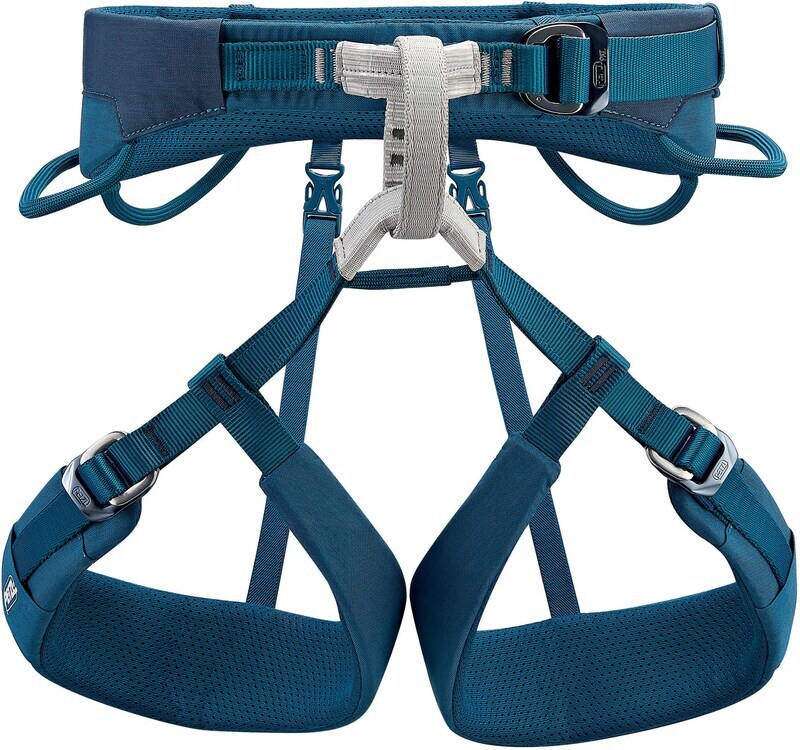 If there's no thing as some built in redundancy someone better get in touch with manufacturers and let them know full strength leg loops are useless. |


