
 Continue with onX Maps
 Sign in with Facebook






What about all-galvanized hardware?


|
|
Forgive me if this has already been hashed out in another 14-page thread of agony--there doesn't seem to be a search function on this forum, the thread titles don't betray a discussion. Given that even 316 SS has crevice corrosion issues in hot, wet, and salty climates, and that mixing metals of hanger and bolt material hastens the corrosion, would it be prudent to experiment with hot-dip galvanized bolts AND hangers? At sea (one of the most corrosive environments), galvanized steel is very common in hardware that goes in and out of water and stays wet. Anchors, chain, shackles--in many cases galvi ones are preferred over stainless, and often last a lot longer. Are there any galvanized bolt hanger options? (I couldn't find any--just "plated" but that's different) Any reason why not? I'd rather encounter a 20-yo galvanized bolt that was weeping rust but not visibly shot (you can tell with steel), than a 10-yo stainless hanger that might be all crevice-corroded and not show it. The only downside to galvi that I can see is if the coating gets knocked off by 'biners or careless hammers when placing. But boat tackle has galvi-on-galvi all over the place, and it's a pretty durable coating, as long as you don't mix in another metal that electrically erodes the zinc. |
|
|
Hot-dipped galvanized hardware does resist corrosion for decades, and is certainly great for marine use as long as it is used with other like-galvanized components. With regards to installing this type of hardware on cliffsides, when precip/ water runs over this type of hardware and it drips, it carries zinc (and other metals?) in the solution and this over time kills micro-lichens on rock faces and leaves ugly aesthetic killing streak scars. 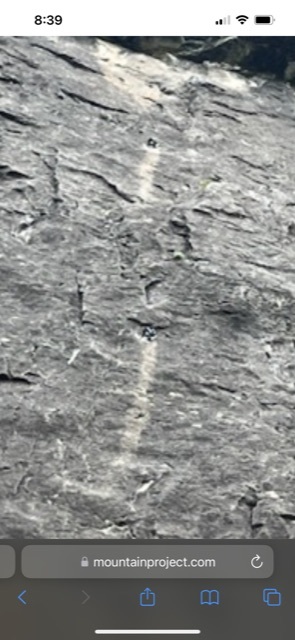 |

|
I think HowNOT2 had a video on this where some developers were exclusively using galvanized for a specific seaside cliff and replacing it every so often. But in this day and age, we should really be installing hardware that will not corrode. If that means titanium for certain sea side environments, then go with Titanium (although I think 316ss should be good enough to not corrode in almost all sea side cliffs). Galvanized may last longer than 304ss in sea side cliffs, but it won't last forever. And the longer it rusts, the harder it is to replace. The easiest time to replace a bolt is before it starts to rust! But nobody replaces bolts that early. So just use hardware that won't corrode, whatever that is for your area. The one exception is if you're in an area with active climbing organizations that regularly check and maintain hardware and is OK with galvanized, but even then, why give them the extra burden? |
|
|
This is the video I was thinking of |
|
|
Jim Daywrote: Thanks, Jim. The video seems to indicate the galvanized is better in every respect in a harsh environment than SS. I've seen enough crevice corrosion in all the stainless flavors (I'm a sailboat rigger, so I see a lot of that stuff), to distrust stainless in any damp environment. Those Portugese ringbolts look awesome, and have enough meat to last a long time before getting too thin. As for galv. eroding the lichen a little: I guess I'd rather see a bit of that impact than find sketchy rustballs. Lichen gets worn off popular routes just from passing climbers anyway. |
|
|
Ben Zartmanwrote: First of all, it's not the salt that is corroding stainless in sea-side environments. Secondly, galvanized steel has a predictable lifetime, measured in years, in any given environment. Once the Zn is consumed the underlying steel starts to rust. Titanium on the other hand, has an "indefinite" lifetime in those same environments, meaning that failure from corrosion isn't predicted or expected to occur *ever*. So, if you want to waste your time and money to replace those galvanized bolts in a decade or two (Perhaps commit your children) go ahead and place it. Of course the Access Fund recommends that NO galvanized hardware be installed anywhere in the U.S.
It's not the same corrosion mechanism out of the water. The video that Jim Day posted, https://youtu.be/SUrEqqMP9C8?si=OZSVbqqK21B7UWwK, is exactly correct. Watch it twice. Stainless bolt corrosion in certain environments, such as seaside, is caused by SRBs, Sulfate Reducing Bacteria. David Reeve's webpage has all the details. (The HowNot2 guys always do an excellent job.) Also, the HowNot2 guy's discussion of the actual cost over time is perfect, and the bottom line: IT IS CHEAPER TO INSTALL TITANIUM. Which is what I've been saying for twenty five years. NOTE: I disagree with the video's "70+ years" contention. My metallurgist expects the lifespan of the Ti bolts in Cayman Brac to be measured in centuries. Currently, the bolts there are 25 years old and exhibit ZERO signs of corrosion or wear.
No. Zn is soft and the Zn coating can be cracked or avulsed in a hard leader-fall. Aluminum from the biner can become embedded in it, possibly creating accelerated corrosion.
You are possibly the 100th person to argue this Marine metal approach, and the 100th person to be wrong. However, I DO agree with you that this shoud be in some sort of FAQ or a sticky topic on this forum. |
|
|
Ben Zartmanwrote: WHAT?! How did you get this from the video? Absolutely WRONG. DO NOT PLACE GALVANIZED!
BULLSHIT. Those bolts are a time bomb waiting to happen. EDIT: Ben, if you don't believe me, contact the Access Fund and/or The American Safe Climbing Association (ASCA). https://safeclimbing.org/ |
|
|
 |
|
|
Ben Zartmanwrote: I think an EN959 certified 316ss glue in would be much preferred over a galvanized bolt in any environment. The video states that 304ss is corroding because of sulfate reducing bacteria (which David Reeves has shared a lot of information on). They mention in the video that they've seen corrosion even on 316ss, but from what I've read on David's blog, it doesn't seem like 316ss affected. Maybe they're seeing 316 wedge bolts with corrosion which were contaminated/installed with non-stainless hammers and wrenches or something. The video says 4x longer life for titanium than galvanized but they're just using that for the sake of argument, there is no life limit for titanium or 316ss (unless a particular event happens to sabotage the material). Epoxy supposedly has a lifespan (I've heard 50 or 100 years) but we still have concrete structures in tact from thousands of years ago, so maybe the glue will still be good until humanity is past the sport of outdoor rock climbing. Edit to add that I do think titanium is better than 316 because there are fewer factors which could compromise it during/ after install. Especially with as many manufacturers who are making titanium glue ins now, it would be my go-to if I developed near the ocean |
|
|
There is also the matter of certification / standards and manufacturing cost. For UIAA 123 anchor certification, any paint or surface layer must be removed to expose the bare metal for corrosion testing. Coatings or surface treatments are plainly therefore not considered integral to the corrosion resistance of the anchor and considering the cost, not worth a manufacturer integrating it in their fabrication process. There is undeniably the lurking issue of longevity once the coating is compromised. As pointed out above already, selecting the appropriate material, material type and fabrication process to the intended environment is fundamental to a longterm corrosion resistant anchor. Titanium is necessary in some locations but not in others. |
|
|
Francis Hadenwrote: I've heard this mentioned, are we talking about the typical alibaba/ ebay false advertising (which is honestly to-be-expected) or are there some name brands we should be avoiding, particularly for sea side cliffs? Also, has there been any affect from the counterfeit titanium in the global market? Or is all that still good enough for rock climbing? |
|
|
I’m super interested to hear everyone’s thoughts regarding the newest Dewalt/Powers 1/2” 304 SS 5-piece bolts actually having a sneaky galvanized cone? I have heard it was to increase the KN’s of the bolt’s tension strength- because the carbon steel deforms and “bites-in”. Cause for galvanic corrosion concern and or avoiding these bolt type? Why or why not? |
|
|
Jim Daywrote: It may seem so but that is not the case. It performs better than 304 but 316 in a seaside environment will also corrode, due to SRB, sometimes in only a few years. What's worse is that the corrosion can be invisible; hidden behind the hanger so the bolt looks fine. The advantage of a galvanized bolt is that you can see the rust once the Zn is consumed and know that it is no longer safe and needs to be replaced, but you'll quickly tire of rebolting routes. A few decades ago in Brazil they used a lot of thick mild-steel "pitons" in their seaside cliffs. The ethic and practice, then and there, was to carry a few new ones with you and replace the ones that were rusted and scary. But the community got really tired of having to constantly replace them. So they used the same design but switched to Stainless expecting to end their rebolting burden. When they switched to stainless steel, they found that the SS bolts would still break, sometimes without warning, after only a few years. They were pissed! They'd spent a lot of weekends and money and STILL had to replace the bolts -- more often than the mild steel ones! So if you want to do it right, and NOT have to do it again, use Ti in all seaside environments and learn from the Brazilians' mistake. 
Even though I believe David's work is excellent, I'm still not convinced about 316 not being affected. For one thing, there has been lots of hardware stamped "316" that, when analyzed, is not!! Secondly, Angele Sjong analyzed a cracked hanger from Thailand that was clearly 316L*.
Having rebolted several dozen stainless steel routes, hundreds of bolts, with Ti on Cayman Brac, I wouldn't consider placing 316 there for a microsecond. 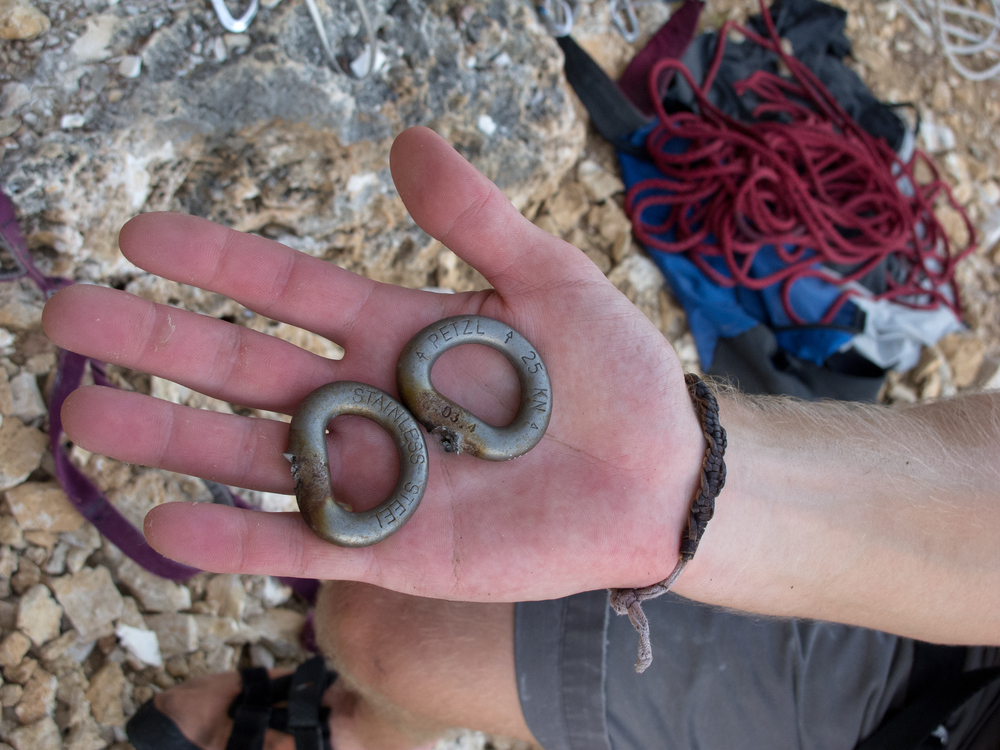 * Journal of Failure Analysis and Prevention, 2008, 8;410-418 DOI 10.1007/s11668-008-9158-1 Peer reviewed. "Marine Atmospheric SCC of Unsensitized Stainless Steel Rock Climbing Protection" |
|
|
Past Userwrote: In some places, climbers would view this as a positive aspect of zinc, not a negative. I am thinking in particular of mossy granite in the PNW rainforest. There is even an experiment underway in which a zinc strip was spread across the top of a perpetually mossing route. Note that when the moss is scrubbed off, such markings as in the above photo do not appear. So, my point is that it depends on the location. |
|
|
I appreciate the discourse, and thank the respondents. I, for one, am a big believer in Ti. But given the cost, and the real dangers of any sort of SS in corrosive environments (sure, it may not be the salt that corrodes, but that wet saltiness sure accelerates corrosion. All the minerals in damp limestone don't help, either), I wondered if galvi had been given a fair shake. |
|
|
Jon Nelsonwrote: Moss and lichen are two completely different issues…HUGE variation exists between and amongst both. I’m referring to micro-lichens. If you want to kill moss, bleach in a pump garden sprayer works amazingly well. A zinc strip sounds…obtuse. I’ll hold my tongue in regards to liverworts. |
|
|
Generalization is useful when you know what you don't know, ie you have a firm grasp on the limits of your knowledge. However, if you don't know what you don't know, generalization is distinctly hazardous. |
|
|
I'm guessing the Brazilian stainless piton-bolts were 304 instead of 316 and/or not properly passivated after cold working/welding, perhaps leading to their early demise. |

|
Past Userwrote: Just another vote that the zinc kill is real. On some rock--I'm thinking of California granite--the white streaks are very obvious, visible from far away, and far more jarring than climber-caused wear. I understand that back in the day we didn't know this would happen, but now we do so we should do our best to stop. |
|
|
Ben Zartmanwrote: For future reference try this using Google: galvenized or zinc site:mountainproject.com |
|
|
Ben Zartmanwrote: Hit the hamburger menu on the home page.  |


