Continue with onX Maps
 Sign in with Facebook






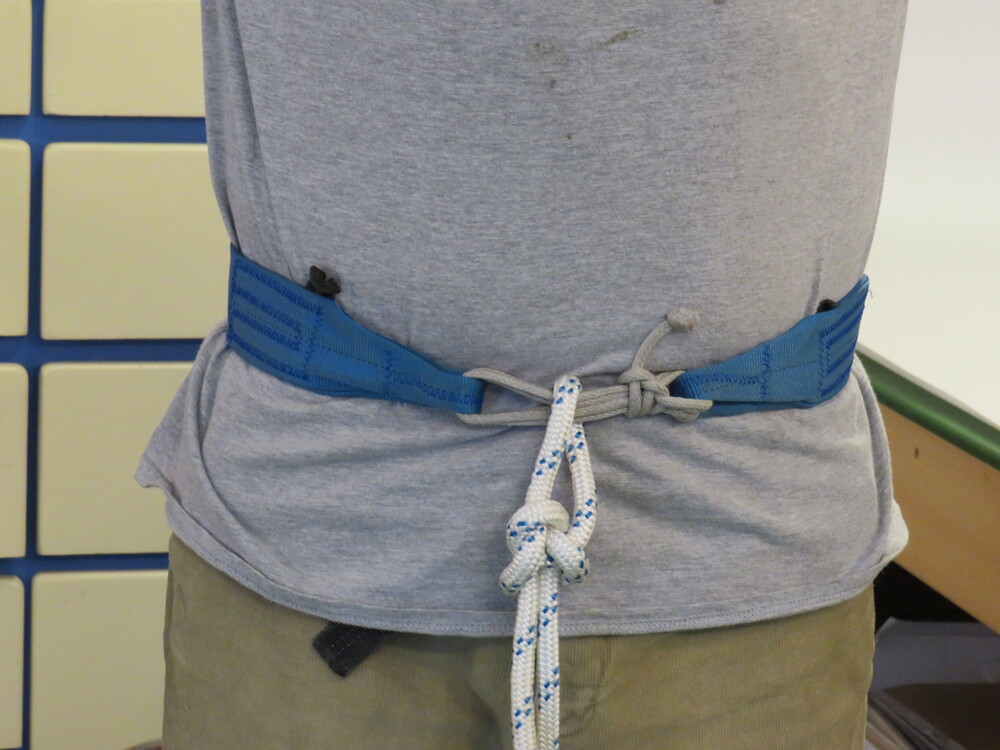
Joining two ropes with a lashing for a rappel


|
|
Ben Zartmanwrote: My man, I doubt you’re going to win a knot debate with mark Gommers. Certainly not by implying he’s young blood when he’s the knot GOAT that contributed so much to PACI…
|
|
|
Mark Gommerswrote: Mark, I think I explained in what the knotlessness consists. I'd change the title to "Joining Two Spliced Eyes to Rappel" if I knew how to edit a title in this forum, just to appease you. Maybe one of the mods can do it. It is because precision in language matters (to some more than others), that I'm careful to call a bend a bend, a knot a knot, and a hitch a hitch. When someone describes splicing as "twisting rope together," I want to leap up and correct them. So, I get (a little) where you're coming from. But seriously, you're entering the realm of the petty when you insist that a swami devoid of the big knot cannot be called "knotless" if there's hitches. It's a swami without the classic big knot! With all the baggage you're dragging, I'd almost think you were trolling, but I can see that you take this very seriously. So, with apologies for the semantic deathblow, "Knotless" is a good descriptor, a killer trademarkable name, and I'm inclined to keep it. @Jared E I had won already, when Mark leaped at a typo because he had no other substance. Incidentally, the argument about bends themselves was in another place: here it is just about semantics. What is a knot? When is it not? |
|
|
I would like to come back to some more essential points: What is the USP of this product? What is the value proposition? From the replies in this thread a lot of climbers, including myself, do not understand the benefit of having a thin line with a spliced eye, especially one that is not a Kernmantel construction and by that loosing strength with every damage to the line. Understanding that would benefit the discussion a lot I think! Best |


|
Ben Zartmanwrote: Awesome. This is the perfect complement to my carbon fiber Alpenstock and titanium hobnailed boots. |
|
|
Ben Zartmanwrote: Go to your original post that started the thread, click on the 'Edit' link, change the title, click 'Save'. |
|
|
Marc801 Cwrote: Correction. It's not Mike Lindell posting. It's Robert F. Kennedy Jr. |
|
|
Pavel Pavelovishwrote: Hi Pavel, A thin line is useful as a lightweight tag line: there's several much-discussed methods of single-rope rappelling with a tagline to pull down the primary rope. A thin line is useful also for toproping; for hauling extra gear up mid-pitch on a bigwall, or the anchor-building and hauling gear at the end of the pitch; it's useful for rappelling from a freesolo; for canyoneering; for alpine climbs where a rope is only used to descend: I'm sure others can list more uses. But skinny ropes still need to be strong. Having a dyneema core allows them to be stronger than other ropes of similar diameter. Now, while a knot weakens every sort of rope, it weakens a dyneema one by a greater percentage than a nylon or polyester one. So one advantage of dyneema is cancelled if it's knotted. It becomes, like Samson without his hair, like other ropes. If it's spliced, it retains more than 90% of strength. So there's a huge advantage to a splice in the end of a Dyneema-cored rope: super light, super strong. The only challenge is figuring out how to easily integrate it into a climbing system where it's not practical to splice every rope, and where rappel devices for fat rope may not be suitable for skinny rope. Not sure why you think damage to the line is a specific disadvantage to skinny ropes: every rope, regardless of sort, loses strength with damage. It's harder, though, to damage the sort of rope I'm working on: a Technora/polyester cover will protect from abrasion and heat (belay devices can generate a lot of heat on a long, fast rappel), and the dyneema core is far harder to cut than a nylon or polyester one. Another neat feature of Dyneema is that it's light enough to float, whereas Nylon is heavy, and if not dry-treated, absorbs water and becomes weaker while doing so. The only real virtue of Nylon is that it stretches. If we could figure out how to absorb shock loads without nylon, we could reduce a lot of weight and bulk. So far, that problem has proved insoluble. |
|
|
Ben Zartmanwrote: In case anyone was curious, I did email Yates and ask about the construction of this product. They replied to me today: Hi Kyle, Thank you for contacting YatesGear.com. The answer to your question is below: Dyneema/Nylon blend I don't think that's a surprise to anyone who looked at the picture, since the weave is clearly a blend, not a 100% dyneema product. But anyway, there you have it, directly from the manufacturer. Presumably Ben will have another red herring or ad hominem retort, but since he hasn't provided any data or evidence for 8 pages of claims, I don't expect anything substantial this time either. |
|
|
Kyle Tarrywrote: What a lot of energy you're devoting to proving yourself right! I ask again, as I did once before: what insecurity have I triggered in you that you've taken this so very personally? This is not an ad hominem attack: I'm genuinely astonished that you're so resolved to prove that my clearly superior products are not, when you've never seen, handled, used, or tested them. Why not keep an open mind? Why not do some comparative engineering? Why not answer basic questions such as, what are the credentials of the testers you're citing? Are they ISO-9000 certified? Are they engineers? Is their testing equipent calibrated? With all your energy to look things up, why not look these up? |
|
|
Ben Zartmanwrote: Is this whole thing just a grade A, 10/10 bit? Or are you genuinely serious. There’s no way you just said “any testing that shows my superior products are worse is suspect” because that’s what I’m getting from your posts. |
|
|
Ben Zartmanwrote: See the comparison table of popular anchor options, including citing multiple trustworthy sources that corroborate the data.
Many of the data sources (BD, Edelrid, Petzl, and DMM) are ISO certified, and are doing testing on calibrated Instron testers, by engineers and other experts. More importantly, there isn't any reason to doubt the data; it's all consistent across multiple facilities on multiple continents, with data spanning several decades of testing. This isn't really about the data, you're being ridiculous. |
|
|
what insecurity have I triggered in you that you've taken this so very personally? Nice pivot - and with just a touch of gaslighting. |
|
|
Do a knotless tie in knot next! |
|
|
@Climbing Weasel: You've misunderstood: I'm all for testing, and for data. But the the testing and data have to come from a level playing field. And, there has to be testing to even have a comparison. I believe the data from manuracturers to be accurate. After all, they have a vested interest in it. But Kyle only began citing them after I called him on citing You-Tubers and other fly-by-nighters as reliable sources when we have no idea how their machines are calibrated or what their testing parameters are. Then he made a spreadsheet, which, while putting my Anchor Extender at its proper place at the top, devolved into pure conjecture on the last column, since his number is a guess, made up in his head, without any testing data to support it. He's throwing shade on a product he's never seen, touched, used, or tested, all because is pride has been injured. Why not at least try it before knocking it? And he calls me ridiculous... @Kyle, dude, you need some help. Please speak to a therapist. Maybe put all your grievances on a spreadsheet or chart. @Jared E It would probably have to be some mechanical camming/jamming device gentle enough that wouldn't de-sheath the rope. Maybe a Technora sleeve arrangement like was suggested up-thread. Food for thought. |
|
|
Ben Zartmanwrote: This is not true. The first time, I cited Moyer, which was conducted on a calibrated Instron at BD and presented at a technical conference. The second time, I cited Moyer (again), BD, DMM, DeBruin/Petzl, and also HN2. The third time, I cited Moyer, Marlow, and HN2. You've created a fictional narrative of what happened.
The "pure conjecture guess...made up in [my] head" was directly from the manufacturer of the material Ben is using.
That isn't very nice. |
|
|
You've created a fictional narrative of what happened. And this was done several times - along with personal attacks. Christ almighty. |
|
|
Kyle Tarrywrote: Kyle, all of your citations you linked to are filled with "may" and "suggests." Suggestion is not engineering. Also, I've pointed out several times, Marlow has not tested the rope in a BFK master point scenario. I suggest you test in in that use case before you start publishing spurious data about it. Doesn't that seem fair? You obviously have the time and energy to ferret out all sorts of information; why not, since you're on this crusade, go the distance? As for being nice--dear me, all the sarcasm, obduracy, and unfriendliness I've encountered here, may suggest that little pushback is allowed. You still haven't said what stake you have in this: what bothers you so much about my statement that the gear I make is better than anything else out there? What makes you want to tear that apart without having once seen or used it? We've fleshed out the engineering arguments at length, but I'm genuinely curious (I've asked three times), what dog do you have in this fight? |
|
|
I know Kyle quite well because we have worked together for several years to develop and instruct a climbing program together. In all of our conversations as we debate the nuances of climbing, including issues of best practices, he has consistently been the voice of reason and rationality. His analysis is always measured and thoughtful. I have also seen this same thoughtful, balanced approach when we have climbed outside. His responses here have been as objective and bias-free as can ever be expected in a forum such as this. Needless to say, I respect and trust his evaluation of issues like this. I can only guess at his motivations for his responses, but I would assume it is the following. Many climbers with limited knowledge and experience are following this thread and trying to glean from it information and best practices. By providing as objective data as possible, I think he is hoping that they will be able to do their own logical and rational analysis of the information. I asked for you to post a photo of your knotless swami, not so that I could mock you or tear down your ideas, but for the same reason, so that individuals could assess your ideas fairly and objectively as well, and with that information come to their own conclusions about the merits of your ideas. It is unfortunate that this dialogue has devolved in the way that it has. |
|
|
Ben Zartmanwrote: I don't know about Kyle, but for me - and I suspect others - you really haven't proven that "...the gear I make is better than anything else out there". You've only 'proven' it by assertion and egotistic chest thumping. |
|
|
Ben Zartmanwrote: Moyer and Edelrid don't even include the word "suggest" a single time, so not only is this a weird argument, it seems to be a fictional one. I genuinely don't really understand the point you're trying to make, because this is such a weird and illogical hill to fight on.
The largest peer-reviewed scientific publications in the world regularly publish articles with the word "suggest" in the title. I think you're barking up a very ridiculous tree here. "Suggest" is a totally normal and acceptable word to use in science and engineering. https://scholar.google.com/scholar?hl=en&as_sdt=0%2C38&as_ylo=2024&q=suggest&btnG=
This was tested for cords with dyneema, vectran, and nylon kernmantle construction in Moyer. The strength reduction in masterpoint knots was about the same as the strength reduction in every other knot. |