|
|
Li Hu
·
Dec 12, 2024
·
Different places
· Joined Jul 2022
· Points: 55
Not Not MP Adminwrote: Don’t forget the part where the little fella made 11/12 look 5.13 “time after time” and the 6’4” guy ”glided“ up climbs with ease lol Pretty much. My takeaway is being taller than average but not 6’4” sucks for climbing.
|
|
|
Lena chita
·
Dec 12, 2024
·
OH
· Joined Mar 2011
· Points: 1,842
Frank Steinwrote:But height does matter…situationally. My 4’11” partner has climbed .12+, but we have encountered .11- routes (in her preferred style, no less) that she has zero chance of ever doing (think very high underclings and long reaches to poor holds with very low feet). I have never seen a competent taller climber encounter a situation where they are out of any options “because the box is too small.” Yes, this. Thanksgiving weekend, a friend and I went out climbing. We are both just a smidge over 5 feet tall. We have both climbed 13a. We both had this one 11a that had shut us down before, back when we were only climbing 12-. So we went out and sent it, and we were really excited about it. Because we were finally able to make this one move. JUST ONE MOVE, that was, for us, harder than a single move on any of the multiple 12s we had been on that week.
This thread is driving me kinda nuts. Everyone talking about this as if if climbing were some kind of absolute objective thing, like the time to run distance X, or ability to throw ball over the netting of Y height.
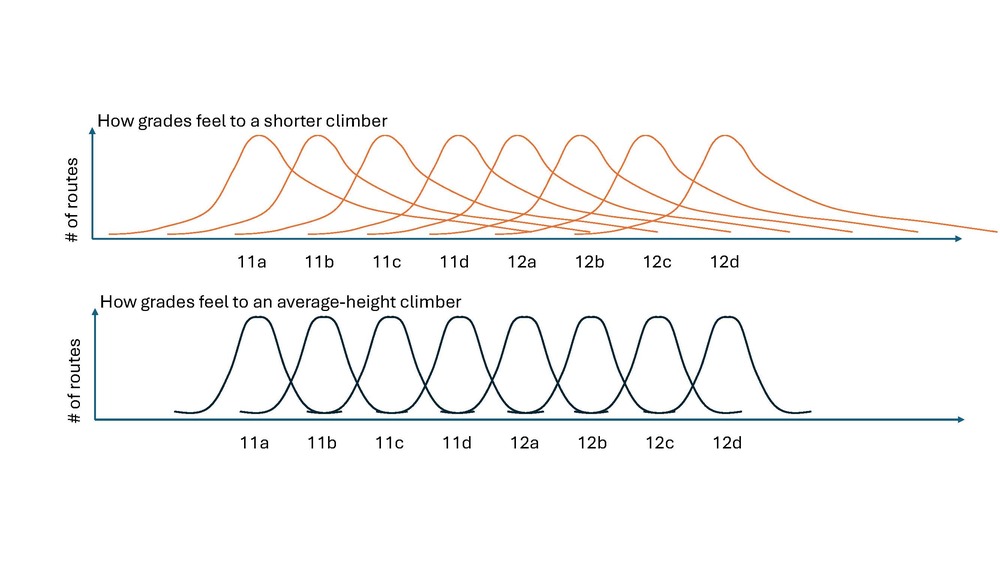
It is as subjective as it gets. Indoors competition climbing: the routes are set FOR the intended audience of climbers. The problems/routes are set differently for women vs men, and for kids vs adults. But still, they are being set by PEOPLE. People who are mostly average height, and who are setting for an average climber in the event, not the outliers. Under these circumstances, you will never see selection towards extremes, only regression to the mean.
Outdoors: most people who bolt routes, and most people who climb their routes, are of median height. Because that is how math works. So the difficulty rating is created by consensus of people of average (median) height. People who fall outside the median by couple standard deviations will occasionally feel very different about those consensus grades, but their outlier opinion will never influence the consensus, because, by definition, they are outliers...
Nor SHOULD they influence the consensus-- that's not what I'm saying at all. For me it all comes down to people wanting a little validation. When your short (or tall, or big-boned, or large-handed, or inflexible, or spine-fused, or leg-missing, or whatever) friend tells you that this route is hard for them because of the reach, weight, fingers not fitting into small pocket, the inability to use the knee bar, the non-heel-hook beta, etc. etc. tell them that yes, you can see that. And then encourage them to try anyway, because the bigger the challenge, the bigger the satisfaction.
![]()
|
|
|
Go Back to Super Topo
·
Dec 12, 2024
·
Lex
· Joined Dec 2010
· Points: 285
Frank Steinwrote:But height does matter…situationally. My 4’11” partner has climbed .12+, but we have encountered .11- routes (in her preferred style, no less) that she has zero chance of ever doing (think very high underclings and long reaches to poor holds with very low feet). I have never seen a competent taller climber encounter a situation where they are out of any options “because the box is too small.” “Situationally” is the key word. There’s a video of Ondra falling off a 5.11c in the Czech because he was trying in in 100 degree heat and it was more polished than glass. Took him like 5 tries before he could send.
Everyone pretending like height definitively does or does not give an advantage to all climbing is just posting things to post them at this point. Your opinion is wrong if you are giving a blanket statement about something with so many variables and is measured by something almost entirely subjective. Anyone who knows anything understands that sometimes it helps, sometimes it doesn’t.
|
|
|
amarius
·
Dec 12, 2024
·
Nowhere, OK
· Joined Feb 2012
· Points: 20
Go Back to Super Topowrote: “Situationally” is the key word. There’s a video of Ondra falling off a 5.11c in the Czech because he was trying in in 100 degree heat and it was more polished than glass. Took him like 5 tries before he could send. Cool anecdote. Was there someone shorter/taller who sent under the same conditions? No? Then you are not contributing to the discourse Adam has commented on multiple videos that he posts on youtube that reaching holds on some of the routes would be much harder for shorter people. He did not use words "situationally", though
|
|
|
Go Back to Super Topo
·
Dec 12, 2024
·
Lex
· Joined Dec 2010
· Points: 285
amariuswrote: Cool anecdote. Was there someone shorter/taller who sent under the same conditions? No? Then you are not contributing to the discourse Adam has commented on multiple videos that he posts on youtube that reaching holds on some of the routes would be much harder for shorter people. He did not use words "situationally", though While I appreciate your contribution, had you taken any time, whatsoever, to even remotely analyze my posting you’d notice that the purpose of that anecdote did, indeed, have nothing to due with height, but was in response to routes being situationally harder. This anecdote was clearly exemplifying how (weather) conditions can make routes situationally harder, similarly to how “reachy routes/moves” can make that route’s grade situationally harder depending on height. Maybe you don’t understand the application, or maybe you’re just rude for no reason, but the “situation” being applied would be that there are holds far away, making it more challenging for shorties. When Ondra (or anyone) says that a route/move would be harder for short, or tall, climbers they are clearly inferring that in that situation it makes those moves harder. Ondra, nor anyone else, needs to explicitly use the word “situationally” for any rational person to understand the concept.
|
|
|
M M
·
Dec 12, 2024
·
Maine
· Joined Oct 2020
· Points: 2
Go Back to Super Topowrote: While I appreciate your contribution, had you taken any time, whatsoever, to even remotely analyze my posting you’d notice that the purpose of that anecdote did, indeed, have nothing to due with height, but was in response to routes being situationally harder. This anecdote was clearly exemplifying how (weather) conditions can make routes situationally harder, similarly to how “reachy routes/moves” can make that route’s grade situationally harder depending on height. Maybe you don’t understand the application, or maybe you’re just rude for no reason, but the “situation” being applied would be that there are holds far away, making it more challenging for shorties. When Ondra (or anyone) says that a route/move would be harder for short, or tall, climbers they are clearly inferring that in that situation it makes those moves harder. Ondra, nor anyone else, needs to explicitly use the word “situationally” for any rational person to understand the concept. Weather, weight, height, reach, width, skills, equipment- what else are we missing here?
|
|
|
Alan Rubin
·
Dec 12, 2024
·
Unknown Hometown
· Joined Apr 2015
· Points: 10
M Mwrote: Weather, weight, height, reach, width, skills, equipment- what else are we missing here? A partridge in a pear tree. It is Christmas season after all.
|
|
|
Andy Shoemaker
·
Dec 12, 2024
·
Bremerton WA
· Joined Jul 2014
· Points: 35
Not Not MP Adminwrote: Valid point, however, basketball is also a skill based activity that is height controlled (though that is because the goal/hoop in basketball is also height dependent, unlike climbing). I agree with everything you’ve said and would like to add that there are also “soft skills” of sorts that are harder to develop, in a sense, such as mobility, motivation, diet/nutrition, etc.. Basketball is certainly also skill based. But it's not a great comparison to climbing. First off, you have opponents in basketball, who, given the height of the basket and task at hand, if taller than you make the game a lot harder, thus making height an advantage. Also, the playing conditions are largely identical- same court, same basket, same ball. The only variation is your opponent. In basketball you' win when you precisely locate a ball, in climbing when you precisely locate your body. I think these differences make basketball's equation different than climbing's. I'm not sure what the best comparison might be to inform this discussion. Golf maybe? Driving and putting are very different mechanics, the course varies from location to location and season to season, you don't meaningfully interact with other people while competing. Or surfing? Is height an advantage in golf? Bigger people can drive the ball farther? But smaller people have an easier time with the precise movements of putting? I have no idea. I've never played a round of actual golf.
|
|
|
Kevinmurray
·
Dec 12, 2024
·
Unknown Hometown
· Joined Dec 2012
· Points: 0
11, count them, 11 pages of a whole lot of not much.
|
|
|
Charlie Kissick
·
Dec 12, 2024
·
Unknown Hometown
· Joined May 2023
· Points: 0
Kevinmurraywrote:11, count them, 11 pages of a whole lot of not much. No kidding. So here’s the final answer: Sometimes being taller helps. Sometimes it doesn’t.
|
|
|
Li Hu
·
Dec 13, 2024
·
Different places
· Joined Jul 2022
· Points: 55
Lena chitawrote: Yes, this. Thanksgiving weekend, a friend and I went out climbing. We are both just a smidge over 5 feet tall. We have both climbed 13a. We both had this one 11a that had shut us down before, back when we were only climbing 12-. So we went out and sent it, and we were really excited about it. Because we were finally able to make this one move. JUST ONE MOVE, that was, for us, harder than a single move on any of the multiple 12s we had been on that week.
This thread is driving me kinda nuts. Everyone talking about this as if if climbing were some kind of absolute objective thing, like the time to run distance X, or ability to throw ball over the netting of Y height.
It is as subjective as it gets. Indoors competition climbing: the routes are set FOR the intended audience of climbers. The problems/routes are set differently for women vs men, and for kids vs adults. But still, they are being set by PEOPLE. People who are mostly average height, and who are setting for an average climber in the event, not the outliers. Under these circumstances, you will never see selection towards extremes, only regression to the mean.
Outdoors: most people who bolt routes, and most people who climb their routes, are of median height. Because that is how math works. So the difficulty rating is created by consensus of people of average (median) height. People who fall outside the median by couple standard deviations will occasionally feel very different about those consensus grades, but their outlier opinion will never influence the consensus, because, by definition, they are outliers...
Nor SHOULD they influence the consensus-- that's not what I'm saying at all. For me it all comes down to people wanting a little validation. When your short (or tall, or big-boned, or large-handed, or inflexible, or spine-fused, or leg-missing, or whatever) friend tells you that this route is hard for them because of the reach, weight, fingers not fitting into small pocket, the inability to use the knee bar, the non-heel-hook beta, etc. etc. tell them that yes, you can see that. And then encourage them to try anyway, because the bigger the challenge, the bigger the satisfaction.
![]()
I’d say this Lena’s post is pretty conclusive. MOST of the responses are that height is not a huge factor once skill is developed. The original poster probably wanted data? Height, max grade attempted, on sight grade, flash grade. But that data is meaningless without factoring all the other factors involved such as age?
|
|
|
Cocoapuffs 1000
·
Dec 13, 2024
·
Columbus, OH
· Joined Jun 2008
· Points: 50
Not sure if this has been touched on in the past 12 pages, but one thing to keep in mind: Many of the disadvantages to being tall are not nearly as obvious to the observer as those for being short. Not being able to reach a hold is easy to see. Having to work harder to keep core tension or pull in a lockoff, dealing with a greater polar moment of intertia when cutting feet, etc... These are less obvious and are generally just associated with being 'weak' as opposed to being tall.
|
|
|
Go Back to Super Topo
·
Dec 13, 2024
·
Lex
· Joined Dec 2010
· Points: 285
M Mwrote: Weather, weight, height, reach, width, skills, equipment- what else are we missing here? Does gates in vs. gates out count as equipment or…
|
|
|
Pete Nelson
·
Dec 13, 2024
·
Santa Cruz, CA
· Joined Nov 2012
· Points: 27
Li Huwrote: I’d say this Lena’s post is pretty conclusive. MOST of the responses are that height is not a huge factor once skill is developed. The original poster probably wanted data? Height, max grade attempted, on sight grade, flash grade. But that data is meaningless without factoring all the other factors involved such as age? The original question, does being taller make climbing easier, is a pretty natural one to ask, but--as evidenced by the ensuing discussion--is actually very complex. Lena's and Li's responses suggest to me that the "real" issue is how we determine how difficult a climb is. Climbing grades, as Lena argues, are mostly a consensus effort, based on some hypothetical "average" climber, so difficulty is determined based on an assumption that most climbers are going to cluster around the population mean for any attributes, including height, that might affect ability. As multiple people have pointed out already, some climbs are likely to be easier if you're taller, some easier if you're shorter. The data that are out there probably aren't going to help: Tall folks are likely to achieve the highest grades climbed on climbs where height is an advantage; shorter folks are going to have greater success on routes where height is less important and power/core strength may be more important. The original survey starts to get at this by asking about climb angles--possibly, you might see taller climbers recording higher numbers on lower angle routes, while shorter climbers climb higher grades on steep routes. So, the answer to the question is (obviously! ;-), NO because "easier" (like beauty?) is in the eye of the beholder.
|
|
|
Pete Nelson
·
Dec 13, 2024
·
Santa Cruz, CA
· Joined Nov 2012
· Points: 27
Not Not MP Admin wrote: That was a pretty long winded response to just say grades are subjective. Ha ha! Fair enough...but the point I was trying to make, perhaps not very well, was that it's the climbing majority (ie those near the average) that makes that subjective determination.
|
|
|
Not Not MP Admin
·
Dec 13, 2024
·
The OASIS
· Joined Nov 2018
· Points: 17
Pete Nelsonwrote: Ha ha! Fair enough...but the point I was trying to make, perhaps not very well, was that it's the climbing majority (ie those near the average) that makes that subjective determination. I very much agree. Though, it seems now we need to examine the average height of each person sending each grade to see what the best height is for each grade. Apparently looking at just the elite grades wasn’t good enough.
|
|
|
Not Not MP Admin
·
Dec 13, 2024
·
The OASIS
· Joined Nov 2018
· Points: 17
Andy Shoemakerwrote: Basketball is certainly also skill based. But it's not a great comparison to climbing. First off, you have opponents in basketball, who, given the height of the basket and task at hand, if taller than you make the game a lot harder, thus making height an advantage. Also, the playing conditions are largely identical- same court, same basket, same ball. The only variation is your opponent.
This isn’t always true. If it were true, every team would be full of 7 footers and players like Tacko Fall would be the best layers in the league. Instead the best layers are the ones with the most skill, just like climbing. There are often advantages to being smaller (comparatively) in basketball such as dribbling, quickness, usually shooting ability. The most recent dynasty (GSW) did so without any meaningful big man, for example (unless you include Bogut). They forced other teams to play to this “small ball” style.
So while physical conditions of the court remain the same, if you look at the opponent as a variable the comparison to climbing becomes more relevant. Shitty teams would be easier climbs, while better opponents would be harder routes. A shitty team might shoot lights out here and there and equate to a harder route that night, just like a route with reachy holds or wet holds. In basketball you' win when you precisely locate a ball, in climbing when you precisely locate your body.
Again, there are to many variables. Additionally, you win in basketball when you score more points than the opponent. This can be accomplished by less than precise ball placement if the teams defense is elite. There are many factors to a successful basketball team and player. Just like in climbing. Lack of strength might be offset with great mobility, just like poor shooting can be offset with great defense. I think these differences make basketball's equation different than climbing's.
Of course, it’s a completely genre of sport than climbing, but it’s not horribly off if you adjust your perspective.
|
|
|
Nkane 1
·
Dec 13, 2024
·
East Bay, CA
· Joined Jun 2013
· Points: 475
Not Not MP Adminwrote: This isn’t always true. If it were true, every team would be full of 7 footers and players like Tacko Fall would be the best layers in the league. Instead the best layers are the ones with the most skill, just like climbing. There are often advantages to being smaller (comparatively) in basketball such as dribbling, quickness, usually shooting ability. The most recent dynasty (GSW) did so without any meaningful big man, for example (unless you include Bogut). They forced other teams to play to this “small ball” style.
So while physical conditions of the court remain the same, if you look at the opponent as a variable the comparison to climbing becomes more relevant. Shitty teams would be easier climbs, while better opponents would be harder routes. A shitty team might shoot lights out here and there and equate to a harder route that night, just like a route with reachy holds or wet holds. Again, there are to many variables. Additionally, you win in basketball when you score more points than the opponent. This can be accomplished by less than precise ball placement if the teams defense is elite. There are many factors to a successful basketball team and player. Just like in climbing. Lack of strength might be offset with great mobility, just like poor shooting can be offset with great defense. Of course, it’s a completely genre of sport than climbing, but it’s not horribly off if you adjust your perspective. I've said it before and I'll say it again: the basketball hoop should be set at a random height between 20" and 15', changing each possession.
|
|
|
Li Hu
·
Dec 13, 2024
·
Different places
· Joined Jul 2022
· Points: 55
Not Not MP Adminwrote: I very much agree. Though, it seems now we need to examine the average height of each person sending each grade to see what the best height is for each grade. Apparently looking at just the elite grades wasn’t good enough. The subset of Elite grades just like every other grade contain climbs that are good for tall climbers and some for shorter. Of all the 9a to 9b climbs roughly an equal number of shorter climbers and taller climbers have sent them.
|
|
|
Aaron Kolb
·
Dec 13, 2024
·
Western Slope CO
· Joined Jun 2022
· Points: 478
I hope you conclude that the optimum height to climb 5.12a is either 5' 4" or 6' 2", either one would explain why I can't do it
|

 Continue with onX Maps
 Sign in with Facebook