
 Continue with onX Maps
 Sign in with Facebook






New and Experienced Climbers over 50 #32


|
|
Li Hu wrote: Flash on TR, Incorrect. |
|
|
If some tells me they flashed something on TR. I know exactly what they mean. On the other hand, if they tell me they flashed something on their third try, I have to think they're confused about what words mean. You can flash a boulder, a sport route, a trad route, can you flash a free solo? (flash or die!). Why can't you flash something on TR? |
|
|
Bob Gaines wrote: You did a good thing there. It's a fun route and a nice addition to Echo. I guess scary is subjective (and the bar seems to be pretty low these days), but it's certainly not dangerous in any way. We just did it yesterday for some Canadian friends that were getting their slab on for the day. Consensus opinon semed to be that Swing Low (5.7) over in Echo Cove was harder than Penny Lane. We also did Sound of One Shoe Tapping and W.A.C., both always fun, but mostly don't fall options. Photo of my wife on Penny Lane yesterday. 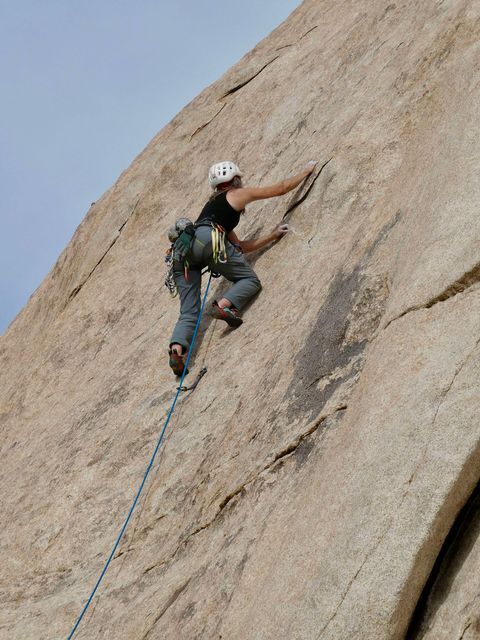 p.s. Count me as a big vote against retrobolting old routes. |
|
|
I can see Nick's view of retrobolting of routes that were never done very well in the first place, esp. if the FA'ist isn't around any longer to provide consent, and they hadn't expressed clearly that they wished their route to remain as it was 'created'. I'm not sure, though, how practical it is to apply such exceptions, since the decision about which route should be 'improved' is highly subjective, and open to interpretation. I am curious about the views of some of the regulars in this thread, especially those with significant FA histories- do you see an erosion in the attitude around preserving the protection style and climbing experience that was established in a FA? This question comes up pretty regularly in the broader MP forum community, and it appears a lot of those opinions come from relatively newer climbers, who have not yet developed deep understanding of how climbing has evolved over many decades. This thread, however, has a perspective that can speak to this with depth and understanding. Is this erosion an issue at all, or am I just fretting needlessly? Is this preservation view important enough to try and perpetuate, and what do you think about the prospect of it dwindling away? |
|
|
FrankPS wrote: Frank- I need to disagree on this one. I think a “Flash” is doing something the first time you touch it. Even if you have witnessed someone climb it previously. I recall a climb named “It’s easy to be brave from a distance” … Lori- the terminology matters. Don’t say Retro-bolting when you mean- Bolt replacement- two altogether different things. Most replacements I have done are done from a rap line. At the Needles when Kris was making the GB some of the bolts got replaced on lead. We clipped in and placed the new bolt, then switched to the new bolt and removed the old bolt and patched the hole if necessary. The thing is not to change the character of a climb, but sometimes we moved it down 6 inches to accommodate folks of shorter stature. And, Lori keep this in mind when thinking about grades. If something isn’t miss graded (sandbag) you take the grade as a consensus of peoples opinion of how it is. So that 5.10a R climbs 5.10 and at the crux, or some other spot, you get handed a “don’t fall- you might get F*+ked up” and X means you will probably die. @Carl …. I think I could go climbing with you. A refreshing adult beverage for lunch can be like a power drink and a good smoke can make you climb your dead level best. :>) Later all-
|


|
apogee wrote: Yeah, I see an erosion. Rarely does someone who puts up an FA go back and removed fixed protection. Although some have swapped out pins and bashies and the like for bolts or less especially when smaller cams became available for reasonable pro and/or pin scars could be used for nuts, etc. But, mostly folks have added fixed pro and/or moved belay stations to facilitate a better experience with regard to safety and convenience for a majority of climbers. Me included and a number of friends who are prolific FA'ers. But...that's different than routes which don't have an agreement from the FA to add fixed protection. See the comments and debate on Book of Hate recently: For me at least, lead climbing a route with the protection options available to the FA has always been more memorable than a "sport route" especially if the route is a more psychological test piece where there's at least the perception of danger or the unknown if I fell. I have strong memories of those types of leads. Good memories. I wouldn't want to deprive other folks of that experience by changing those types of routes. Not everybody should be able to lead every route. And...that's...ok. Big tent. |
|
|
I think that the validity of retrobolting depends a lot on the area. At Rumney NH, pretty much everything except obvious crack lines has been retrobolted since it is a popular sport area. Closer to home, Rose Ledge has maintained its “no bolt” (except anchors) character. I have a 5.12 R first ascent there and actually argued against bolts with someone wanting to retrobolt it. Other areas around here have more of a gear where it is good bolts where it is not ethic. It doesn’t have to be one size fits all. |
|
|
FrankPS wrote: What’s the correct name when you send a climb with no prior knowledge on TR? |
|
|
Li Hu wrote: I'm not aware of any such 'official' designation, though presumably it is a 'TR on sight' ( at least that's what I consider it to be), though a 'true on sight' is generally assumed to be on the lead. |
|
|
Li Hu wrote: Rehearsal |
|
|
Li Hu wrote: The wife alls that a “TRash” |
|
|
Ward Smith wrote: Living and climbing in the same area as Ward, I share his attitude on this. As one who started climbing in the '60s, I 'grew up with' and still generally believe in the ' FA principle', but ( and I guess this is a sign of the 'erosion' being discussed) have now come to accept that there can be some exceptions. In this area ( southern New England--but generally true throughout the east coast, as well as in the Northwest), in many areas, routes that are not regularly climbed quickly become quite dirty--so climbed even less, and in a surprisingly short time 'revert back to nature'. And given how much effort is involved in cleaning routes once they are in this state these routes effectively disappear and are highly unlikely to be climbed on sight in the future ( nor were many of them initially climbed that way). Not surprisingly, it is much more often trad routes that suffer this 'fate'--and rarely routes that are considered to be 'classics' or historic bold test pieces. As the bolted routes at these crags become more crowded, does it make sense to resurrect some of the nearby 'abandoned' ones of similar grades, to be reborn as sport routes? I have very mixed feelings on this; but I am aware of 2 adjacent routes of similar grades at one of our local crags, both originally established as trad routes but then not often repeated. One was subsequently retro bolted ( with FA agreement) and is now one of the most popular routes at the cliff--sometimes with parties waiting to 'go next'. It's neighbor, unbolted, is totally overgrown and no longer climbed ( nor climbable in it's current state). Another situation, that I have discussed on another thread are easy/moderate routes at areas where there are few such routes, that received their FAs as solo ascents by folks who regularly climbed at much higher grade levels---so not really a situation where the routes were 'standard setting' in any way. Such routes are rarely if ever repeated despite the fact that there are many climbers looking to climb routes at that level, but not without protection. If these were crack routes, or with reasonable options for placing decent removable protection, this wouldn't be an issue, but when they are smooth slabs, with bolts as the only protection option, I do wonder if this isn't a situation where the FA principle might need a 'modification' ( though also recognize that this is a 'slippery slope'!!!). |
|
|
Li Hu wrote: It's called a "toprope." |
|
|
Eric Engberg wrote: Basically what Frank(s) had just stated. Hahaha, I’ll go with that then. |
|
|
FrankPS wrote: I love C Miller's word Tronsite, because it has Tron in it. And that was a good movie BITD when special effects sci-fi was a challenge to do. |
|
|
Todd Berlier wrote: No, never. In fact, the new 2023 NPS proposed climbing management guidance prohibits new "bolt intensive face climbs" (ie. sport climbs) in NPS wilderness, favoring "trad face" style, and "rare" bolts. As someone who has done a fair amount of bolt replacement, I can tell you that the policy at Joshua Tree National Park is that a permit is required to replace a bolt (bolt replacement), and that if you wish to add a bolt to an existing route (retro-bolt) you need to provide written permission from whomever did the first ascent. |
|
|
Bob Gaines wrote: Just because that's the current policy there is no guarantee it will stay that way. Government policies can change on a dime - especially these days. I would anticipate major cuts to the NPS in the next 4 years. Given that and the desire to reduce rescue costs, by far the easiest thing would be to just ban climbing |
|
|
Of COURSE one can flash, or onsight a TR route. Think about the definition, ascending a route on one's first attempt without weighting the rope and without prior knowledge of the route. Here is South Australia, in the Adelaide hills, many routes have large metal rings cemented into the ground at the top of route. Seetin gup a TR on this and scrambling down to the bottom (not abseiling down as this gives one some beta) allows one to onsight the route. It's as valid as leading it although it's different. As long as one indicates it's a TR onsight not a lead onsight there's no problem. For me, and for many others, trad climbing breaks the flow of climbing. Sports climbing can do that too in a way having the need to clip. TRing is 'JUST' climbing, uninterrupted by placing gear, clipping etc etc. Was it rgold who says he considers TRing at the most pure form of climbing? Sounds silly but when you think about it it makes sense. People who say you can't onsight or flash a route via TR need to get over themselves. That's like people saying indoor bouldering isn't climbing. There are many flavours of climbing which is what makes it so cool. I find many older people gravitate towards indoor TRing (myself included). It's a great social thing, toilets are nearby for those with bladder issues, you don't need to hike anywhere carrying weight which is appreciated by those with bad knees and you have a lot of options from easy warm up routes to hard routes without needing to setup ropes at all. |
|
|
Hi Carl, I always say that Toproping is the "purest" form of rock climbing, for several reasons, particularly the mental realm. Here's an excerpt from the introduction to my book Toproping: "Toproping is the safest way to practice rock climbing techniques. For many enthusiasts it is the most enjoyable form of rock climbing. It's true that bouldering, with its inherent simplicity, is less complicated than toproping, with a great sense of freedom of movement, unfettered by complicated gear and rigging. The only equipment needed is your shoes, chalk bag, and maybe a crash pad with a buddy to spot you while you push your limits in a relatively safe environment. But bouldering is very limiting in another way: The higher you climb above the ground, the scarier it gets. And one thing is certain: When you fall, you hit the ground. Hitting the crash pad from 10 feet off the ground can be a bone-jarring experience. Many of my fellow climbers sustained the most serious injuries of their entire climbing careers because of a fall while bouldering. Lead climbing is challenging both physically and mentally— figuring out not only the moves but also the complexities of protection placements along the way. The mental focus required to lead difficult trad routes is intense, including the psychological aspect that comes into play when you move high above your protection, risking a long leader fall. Sport climbing is less demanding psychologically, allowing you to push physical boundaries, but stopping and clipping a long series of bolts interrupts the purity of the flow. Free soloing has been said to be the purest form of rock climbing, but there is a fine line between the pure joy of fun-in-the-sun rock climbing, moving and flowing up the climb with nothing but air beneath your feet, and the sudden shadow of fear that can take over as quickly as a dark cloud eclipsing the sun. The free soloist faces the possibility of the ultimate irony: falling and dying as a direct result of being afraid to die, knowingly risking life for the pleasure of pure, unfettered freedom of movement." |
|
|
Todd Berlier wrote: Take a look at the cable route to the top of Angel's Landing in Zion. Doesn't look like the NPS is overly concerned about safety. |


