|
|
Mr Rogers
·
Nov 24, 2024
·
Pollock Pines and Bay area CA
· Joined Aug 2010
· Points: 87
Just playin' on the terms in use for the Gibbs variations, but thanks for the detail!
|
|
|
Serge S
·
Nov 24, 2024
·
Seattle, WA
· Joined Oct 2015
· Points: 683
IMO Zeppelin Bend has no advantages over Alpine Butterfly Bend. The latter is easier to learn, especially if you already use the "jesus fish" method for Alpine Butterfly (as opposed to the 3-wrap method).
But I struggle to imagine wanting either for a rappelling situation. Maybe if you're doing a tandem 120m rappel, passing a knot mid-rappel, and questioning the safety factor of the flat-overhand family for such a load. But then you're presumably postponing the rope rescue until tomorrow and not super concerned about the ease of untying.
|
|
|
Ben Zartman
·
Nov 24, 2024
·
Little Compton, RI
· Joined Apr 2024
· Points: 0
Mark Gommerswrote:Per the original posters question regarding the Zeppelin bend and bound offset overhand bend (incorrectly termed "half Gibbs"): The Zeppelin bend is a very fine end-to-end joining knot. However, it is not 'offset' and so it wont translate around a 90 degree edge (with difficulty).
The Bound offset overhand bend easily translates around a 90 degree edge. This comment is objectively false. The tail orientation is irrelevant. For rope retrieval (where 2 ropes are joined), only offset joining knots will translate around a 90 degree edge from low anchors. The derived 'Butterfly bend' is not offset, and it is vulnerable to slack shaking and cyclic loading (although there is a 'Mobius Butterfly' which has a very tight and compact dressing - and is resistant to slack shaking and cyclic loading - but it still isn't offset). Strength (MBS yield point of a knot) is irrelevant. What matters is security and stability. The use of the name 'Gibbs' and 'Half Gibbs' is meaningless and incorrect (and Kirkpatrick has been notified of his error quite some time ago). The incorrectly named 'Gibbs bend' is actually the Gut bend and was published in 1944. The incorrectly named 'Half Gibbs' was actually discovered and published by myself in 2011 (presented to the IGKT forum - which, sadly just recently went offline - so much historical data has been lost). ... I have to say that there have been some brilliant technical innovators from the USA (Bob Thrun, Dan Lehman, and Scott Safier). Bob Thrun is sadly no longer with us (RIP). Dan and Scott are still very active and play important roles in the knot geek community. Bob Thrun discovered the Zeppelin bend in 1966 (he didn't call it by that name). I guess we're approaching rope-joining from different places: you're only concerned with "good enough for rapelling," where I prefer a bend that retains more of the strength of the rope, and can be untied after significant loading. In the world of professional ropework, a bend from which both legs depart with an abrupt turn is considered gauche. It is weak, inelegant, and prone to jamming. I have never had problems pulling either an AB or Zeppelin over an edge, but I concede that your version of the EDK might be marginally easier in......1% of rapelling scenarios. As for slack shaking and cyclic loading failure, I call BS. A properly tied AB will not shake out or fail with load cycles. Note: properly tied. I've had people send videos where they purposely tied an AB incorrectly to try and prove that a twig could catch in it.
|
|
|
Ben Zartman
·
Nov 24, 2024
·
Little Compton, RI
· Joined Apr 2024
· Points: 0
Mr Rogerswrote: The loops I'm guessing they are talking about are the "wings" of the AB Bushes, crystals, chicken heads, branches, to name a few. It does not take an account of an AB untying when pulled to know that it is a risk. If cinched down waterknots are prone to snagging failure, It's fair to assume the AB could suffer a similar fate as it only takes something snagging one of the "wings" and the knot can collapse relatively easy.... albeit one "wing" will collapse easier than the other (go ahead and try this by tying it, setting it and pulling one wing then reset and try the other). It also will not roll like a other options at a 90 degree edge either since it is not offset as Mark has pointed out with other caveats. The onus of proof lies with you at this juncture I would posture.... to offer evidence that the AB is superior to other knots, Such as the Gibbs/gut, as at this point you have only offered opinion.
I can positively say, I would never use or recommend the AB for the use cases being outlined here as someone who works with ropes in a professional capacity. But thats just MO.
In case your un aware of Mark's deep credentials in knot theory, Mark has literally "written the book" on knot use in Australia for PACI (Professional Association of Climbing Instructors). His work offers clear evidence around why one knot is better than another and knot theory in general. You should read his papers on PACI's website if you like to geek out on knots like me, its a treasure trove of valuable info, and you might find value as well.
Again, show me one time where an AB has caught in a crystal or chickenhead and come untied. I think the onus is on you to prove that it can, or will, happen. As far as bends go, the AB and Zeppelin are superior to the EDK and it's variants because they lead out fairly. They are stronger and able to be untied after a greater load. I, too, work with ropes in a professional capacity, but I see no benefit in a certification-showing arms race. Suffice it to say that I stand behind my claims with good reason, whatever certifications anyone wants to wave around.
|
|
|
James -
·
Nov 24, 2024
·
Mid-Atlantic
· Joined Jun 2022
· Points: 0
Mark Gommerswrote:The incorrectly named 'Half Gibbs' was actually discovered and published by myself in 2011 (presented to the IGKT forum - which, sadly just recently went offline - so much historical data has been lost). Mark, thank you so much for sharing this knot idea. It’s a great innovation in rappel safety IMO. That said, a four-word name is too long to use in everyday life. If you can come up with a shorter name I’d be happy to adopt it. I think Mr Rogers was trying to do you a favor there with “half gut.” Note that climbers don’t even call an overhand bend an overhand bend, most call the EDK. Maybe we could call this the MGK for Mark Gommers Knot?
|
|
|
mike d
·
Nov 24, 2024
·
Montrose, CO
· Joined Oct 2015
· Points: 4,248
I too can't imagine how we would shorten "Bound Offset Overhand Bend."
|
|
|
Mark Gommers
·
Nov 24, 2024
·
Townsville, Queensland
· Joined May 2019
· Points: 0
Again, show me one time where an AB has caught in a crystal or chickenhead and come untied. I think the onus is on you to prove that it can, or will, happen.
Ben, I'll respond to your assertions: With regard to a Butterfly 'bend', the issue isn't what it might get caught or fouled upon after it has translated around an edge. The issue is that it isn't 'offset' - and so it is more difficult to get it to translate around a 90 degree edge from low anchors. Only an offset joining knot will easily translate around an edge (eg a 90 degree edge). Obviously, a climber can try to circumvent the issue of translating around a 90 degree edge by trying to rig the anchor higher. This all boils down to availability of anchors, and where they are located relative to the 'edge'. If the anchors are fixed (eg bolts/chains), then it depends on how the original installer positioned the anchor relative to the edge. As far as bends go, the AB and Zeppelin are superior to the EDK and it's variants because they lead out fairly. They are stronger and able to be untied after a greater load.
The Butterfly bend and Zeppelin bend are not "superior" to the Offset Overhand Bend ('EDK') in the specific role of joining 2 ropes together and where those ropes need to be retrieved by pulling the joining knot around an edge. If there was no 'edge' to translate around, okay - an argument can be made that a Zeppelin bend is a "superior" rope joining knot in life critical applications. However, the Butterfly bend is not as stable and secure as you might imagine it to be. There are ways to achieve a better dressing - eg the 'Mobius' Butterfly would be satisfactory (the Mobius Butterfly has a very tight and compact dressing. If you are well practiced and knowledgeable with the Mobius variant, then fine. Your claim about strength (MBS yield point of a knot) is wrong. In life critical roping applications, 'strength' is irrelevant. What matter most is knot stability and security (and resistance to jamming). In a 1 person abseil descent on joined ropes, the knot isn't being subjected to a dangerously high loading. In fact, the load is negligible. I can go further and state that there is no load that a single climber can produce that will reach the MBS yield point of any knot. This is why context is important - again, in a 1 person abseil descent, what is the highest load that the joining knot will be subjected to? I can't imagine any scenario in retrievable abseil systems where a rope joining knot would be subjected to anything greater than 3.0kN (and that is s-t-r-e-t-c-h-i-n-g the imagination). People who make claims about knot 'strength' are simply parroting what they heard from others, or read in books. Most knot book authors parrot information about 'knot strength' by default, and readers consume their information thinking that the author must be an 'expert' - and so assume that it must be true. I, too, work with ropes in a professional capacity, but I see no benefit in a certification-showing arms race. Suffice it to say that I stand behind my claims with good reason, whatever certifications anyone wants to wave around.
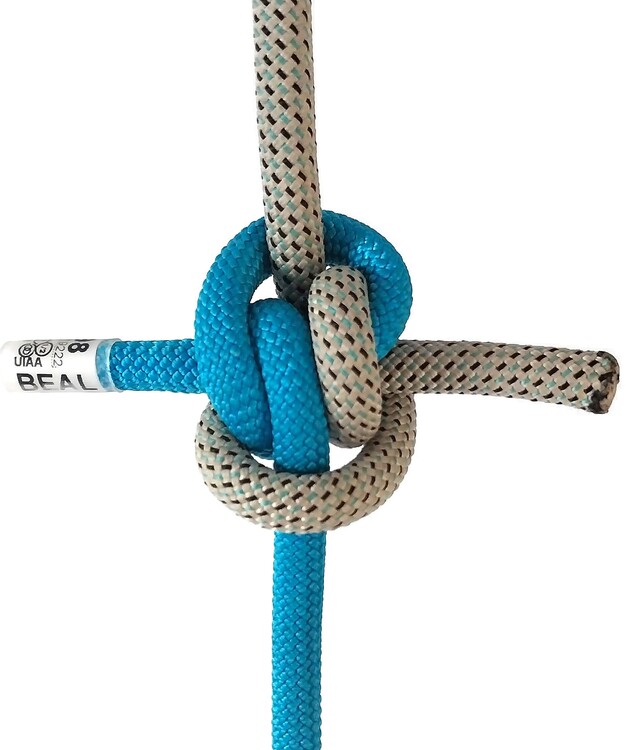
I agree - entering into a knowledge contest is likely to lead nowhere. But I personally would not stand behind your claims - because your claims are only true within a very narrowly defined context. Even the much vaunted Zeppelin bend can work loose given sufficient slack shaking and cyclic loading inputs, and so I prefer the Zeppelin 360 (see images below) which is very resistant to all force inputs in human rated ropes/cordage. But (again) it isn't offset - so you still run into trouble if the knot must translate around a 90 degree edge. Image: Zeppelin 360 bend
|
|
|
Ben Zartman
·
Nov 25, 2024
·
Little Compton, RI
· Joined Apr 2024
· Points: 0
Mark Gommerswrote:Ben, I'll respond to your assertions: With regard to a Butterfly 'bend', the issue isn't what it might get caught or fouled upon after it has translated around an edge. The issue is that it isn't 'offset' - and so it is more difficult to get it to translate around a 90 degree edge from low anchors. Only an offset joining knot will easily translate around an edge (eg a 90 degree edge). Obviously, a climber can try to circumvent the issue of translating around a 90 degree edge by trying to rig the anchor higher. This all boils down to availability of anchors, and where they are located relative to the 'edge'. If the anchors are fixed (eg bolts/chains), then it depends on how the original installer positioned the anchor relative to the edge. The Butterfly bend and Zeppelin bend are not "superior" to the Offset Overhand Bend ('EDK') in the specific role of joining 2 ropes together and where those ropes need to be retrieved by pulling the joining knot around an edge. If there was no 'edge' to translate around, okay - an argument can be made that a Zeppelin bend is a "superior" rope joining knot in life critical applications. However, the Butterfly bend is not as stable and secure as you might imagine it to be. There are ways to achieve a better dressing - eg the 'Mobius' Butterfly would be satisfactory (the Mobius Butterfly has a very tight and compact dressing. If you are well practiced and knowledgeable with the Mobius variant, then fine. Your claim about strength (MBS yield point of a knot) is wrong. In life critical roping applications, 'strength' is irrelevant. What matter most is knot stability and security (and resistance to jamming). In a 1 person abseil descent on joined ropes, the knot isn't being subjected to a dangerously high loading. In fact, the load is negligible. I can go further and state that there is no load that a single climber can produce that will reach the MBS yield point of any knot. This is why context is important - again, in a 1 person abseil descent, what is the highest load that the joining knot will be subjected to? I can't imagine any scenario in retrievable abseil systems where a rope joining knot would be subjected to anything greater than 3.0kN (and that is s-t-r-e-t-c-h-i-n-g the imagination). People who make claims about knot 'strength' are simply parroting what they heard from others, or read in books. Most knot book authors parrot information about 'knot strength' by default, and readers consume their information thinking that the author must be an 'expert' - and so assume that it must be true. I agree - entering into a knowledge contest is likely to lead nowhere. But I personally would not stand behind your claims - because your claims are only true within a very narrowly defined context. Even the much vaunted Zeppelin bend can work loose given sufficient slack shaking and cyclic loading inputs, and so I prefer the Zeppelin 360 (see images below) which is very resistant to all force inputs in human rated ropes/cordage. But (again) it isn't offset - so you still run into trouble if the knot must translate around a 90 degree edge. Image: Zeppelin 360 bend I think your claims are only true within a "narrowly defined context," because you're only concerned with rappelling over a 90 degree edge. In any other context, where bends must be loaded far more and then untied, with far more varieties of rope than what is commonly rapelled on, the offset knots that, sure, render easily over rock ledges, are not even considered as options, because of all their other weaknesses. Again, in the narrow world of rapelling, an offset bend may have a slight advantage, but it is "superior" only in that one scenario. But since you accuse people of parroting information, how much actual testing have you done? Have you shaken loose an AB or a zeppelin halfway down a cliff? Have you put them onto a test bench to see where they broke? How many samples did you break? How many samples did you load to 30% and then untie? And if you want to put published material out of court, why did you reference the ABOK above?
|
|
|
Mark Gommers
·
Nov 25, 2024
·
Townsville, Queensland
· Joined May 2019
· Points: 0
Ben, To answer your question: I stopped counting after 1000 knot tests 25 years ago. In the 25 years leading up to the present day, I estimate another 5000 or so knot tests. Is that sufficient? Again, in the narrow world of rapelling, an offset bend may have a slight advantage, but it is "superior" only in that one scenario.
But this is the title of this thread - its the point in question. The original poster also mentions the book "Down". The title of that book strongly implies the use of ropes to get 'down' using abseiling/rappelling techniques. Were you thinking that this topic thread had a different subject matter? And so within the narrow context of choosing a rope joining knot for uniting two ropes - and then to abseil/rappel - I strongly recommend an offset joining knot. In a different context - eg a joining knot to form a round sling in accessory cord (eg a 'Prusik loop') - I wouldn't recommend an offset joining knot. Have you shaken loose an AB or a zeppelin halfway down a cliff?
I don't use a Butterfly bend to join 2 ropes for abseiling/rappelling because it is a poor choice. I do use a Zeppelin bend and the Zeppelin 360 bend - and no, I've never managed to "shake it loose half-way down a cliff" (I'd probably be dead if it did shake loose). Joining knots in ropes used for abseiling/rappelling aren't generally subjected to slack shaking once loaded - the load remains fairly constant throughout a descent. How many samples did you break?
Gosh, as stated, I stopped counting a long time ago (likely thousands of test articles). How many samples did you load to 30% and then untie?
I usually load to more than 30% of the ropes MBS yield point. We tend to go to at least 50% of the MBS, but more often than not - we go to the point of failure in a dual-end sample. This is so one knot at one end fails, and you have a 'survivor' specimen to study (the knot at the other end). I've personally done this type of testing thousands of times in many different test articles. And if you want to put published material out of court, why did you reference the ABOK above?
Not sure about the relevance of this question? 'ABoK' is a primary reference source - and knot geeks routinely refer to illustrated knots to reduce confusion about knots in discussion. The 'Gut knot' (bend) was published in 1944 at illustration #292 in 'ABoK' (this is a factual statement).
|
|
|
Ben Zartman
·
Nov 25, 2024
·
Little Compton, RI
· Joined Apr 2024
· Points: 0
Mark Gommerswrote:Ben, To answer your question: I stopped counting after 1000 knot tests 25 years ago. In the 25 years leading up to the present day, I estimate another 5000 or so knot tests. Is that sufficient? But this is the title of this thread - its the point in question. The original poster also mentions the book "Down". The title of that book strongly implies the use of ropes to get 'down' using abseiling/rappelling techniques. Were you thinking that this topic thread had a different subject matter? And so within the narrow context of choosing a rope joining knot for uniting two ropes - and then to abseil/rappel - I strongly recommend an offset joining knot. In a different context - eg a joining knot to form a round sling in accessory cord (eg a 'Prusik loop') - I wouldn't recommend an offset joining knot. I don't use a Butterfly bend to join 2 ropes for abseiling/rappelling because it is a poor choice. I do use a Zeppelin bend and the Zeppelin 360 bend - and no, I've never managed to "shake it loose half-way down a cliff" (I'd probably be dead if it did shake loose). Joining knots in ropes used for abseiling/rappelling aren't generally subjected to slack shaking once loaded - the load remains fairly constant throughout a descent. Gosh, as stated, I stopped counting a long time ago (likely thousands of test articles). I usually load to more than 30% of the ropes MBS yield point. We tend to go to at least 50% of the MBS, but more often than not - we go to the point of failure in a dual-end sample. This is so one knot at one end fails, and you have a 'survivor' specimen to study (the knot at the other end). I've personally done this type of testing thousands of times in many different test articles. Not sure about the relevance of this question? 'ABoK' is a primary reference source - and knot geeks routinely refer to illustrated knots to reduce confusion about knots in discussion. The 'Gut knot' (bend) was published in 1944 at illustration #292 in 'ABoK' (this is a factual statement). Soooo, you haven't actually tested the AB, but reject it as a bad choice. With no reason to do so. Cool. You accused people of parroting what they hear, and then reference the ABOK. I'm just saying, you can't put reference material out of court and then say it's a standard reference. I tap a lot of reference resources in my work--it's useful for the engineering of loads and things, if it's from a trusted source. Published data is how science works. You also admit that a shaking-out tests are irrelevant because shaking doesn't happen when the ropes are being rapelled on. So why bring that up at all? The topic of the thread was a book about rapelling. I mentioned that the perfect rapelling bend is the AB, followed by the Zeppelin. It's my opinion, of course, and you're free to disagree if you wish. But there's no need to smear two perfectly good bends with no real reason other than that you didn't "invent" or "discover" them. Not trying to be unkind here, but you're not really sounding persuasive. Sure, you're tested your favorite bend thousands of times and seen that it's adequate for your purposes. But you haven't tested the one you're comparing it to. There is no basis, then, for the comparison. Can you see that? If not, I'm not sure how much further this discussion can go. Again, I hope I don't sound like a jerk--it's hard to express goodwill and argue on the internet at the same time.
|
|
|
Mr Rogers
·
Nov 25, 2024
·
Pollock Pines and Bay area CA
· Joined Aug 2010
· Points: 87
My take, and coming from a position that the AB is one of the best knots in terms of depth of uses. Just not this use.
And I will not bring certification measuring into this, apologies for setting a scene. Ben Zartman wrote: I guess we're approaching rope-joining from different places: you're only concerned with "good enough for rapelling," where I prefer a bend that retains more of the strength of the rope,
Splitting hairs.
All the knots are all strong enough for rappelling, the advantage is not in strength concerning knots in climbing rope. They are all strong, how they behave and what kind of situational functionality do they have is of higher importance. and can be untied after significant loading. In the world of professional ropework, a bend from which both legs depart with an abrupt turn is considered gauche. It is weak, inelegant, and prone to jamming.
Again, situation dependent. I'm not worried about untying most knots that see maybe 3kn, including the gut/gibbs/whatever it's supposed to be called.
As is this topic pertaining to rock climbing and not rope access. Arborists tend to use knots and techniques that RA folks wouldn't....because its a different set of circumstances, and other industries different than arborists, etc, ad nauseam. I have never had problems pulling either an AB or Zeppelin over an edge, but I concede that your version of the EDK might be marginally easier in......1% of rapelling scenarios.
I'm glad you never had issue pulling those knots over edges, it not a problem til it is. Really gonna suck if it happens the 1000th time when your really needing to GTFO. Also you're pulling that 1% number out of thin air. As for slack shaking and cyclic loading failure, I call BS. A properly tied AB will not shake out or fail with load cycles. Note: properly tied. I've had people send videos where they purposely tied an AB incorrectly to try and prove that a twig could catch in it.
The discourse is over known knot structures and their weaknesses and how they may apply to rock climbing and pulling your rope after abseiling. As mentioned the AB is dope, just not for this application compared to other options.
You also call mark out on the amount of testing he has done....how much have you done since I guess stats do matter at least a little to you...again, you have offered opinion but no evidence to back it up in a meaningful way.
Onward..... Soooo, you haven't actually tested the AB, but reject it as a bad choice. With no reason to do so. Cool.
I dont see where he said he has not tested it. Have you tested it compared to other knots? or just because it has not been an issue yet you claim superiority? You accused people of parroting what they hear, and then reference the ABOK. I'm just saying, you can't put reference material out of court and then say it's a standard reference. I tap a lot of reference resources in my work--it's useful for the engineering of loads and things, if it's from a trusted source. Published data is how science works. You also admit that a shaking-out tests are irrelevant because shaking doesn't happen when the ropes are being rapelled on. So why bring that up at all?
because when you pull a rope you're not rappelling.....You might have to shake it on its way down.... Dont know how much abseiling you've done, but this sure is a real deal scenario. The topic of the thread was a book about rapelling. I mentioned that the perfect rapelling bend is the AB, followed by the Zeppelin. It's my opinion, of course, and you're free to disagree if you wish. But there's no need to smear two perfectly good bends with no real reason other than that you didn't "invent" or "discover" them.
He is not "smearing" them. He is explaining they are not good for the intention of this discussion. They are perfectly good bends for many use cases outside of the one in question here which has been said. This isn't saying the AB or zep is unsafe, just not as functional in this context. Not trying to be unkind here, but you're not really sounding persuasive. Sure, you're tested your favorite bend thousands of times and seen that it's adequate for your purposes. But you haven't tested the one you're comparing it to. There is no basis, then, for the comparison. Can you see that? If not, I'm not sure how much further this discussion can go. Again, I hope I don't sound like a jerk--it's hard to express goodwill and argue on the internet at the same time.
I would argue the evidence brought to the table is quite more persuasive than what you have brought forth. Mark has offered the why certain bends/knots are good or bad along with plenty of literature you can read if you're so inclined. You have not offered much on why the AB is the bee knees other than your feelings and that you have used it successfully before, which is not much to go on honestly. Sample size of you is not enough for me.
Again, this is not to say the AB or zep are bad knots for joining ropes, just not the best choice in a rock climb abseil scenario when things like the gut/gibbs exist. I just don't get the defense you putting up, I'm sure you use different knots for different situations, or will you only use a zep or AB to join ropes? In the end, use whatever knot you like, but the bold claim that it is superior is what does not sit with me. Safe to use yes, best for this application? Full disagreement.
If you really feel you're so correct, why not do some testing of various knots against the AB and share the results? This would offer the evidence necessary to justify you claims and cause the change you'd like to see in this world...
Its all fucking around until you take copious notes, then it's science. - Abraham Lincoln
|
|
|
Cosmic Hotdog
·
Nov 25, 2024
·
California
· Joined Sep 2019
· Points: 459
This seems Iike such an odd hill to die on. If you prefer an AB, use it. It is of no consequence to anyone else although it's interesting to observe the raw passion one has for a knot. Carry on sir.
|
|
|
Mr Rogers
·
Nov 25, 2024
·
Pollock Pines and Bay area CA
· Joined Aug 2010
· Points: 87
Bb Cc wrote: Ben, Have you done what you’re asking? Eidt to add: An obviously superior solution;) Sexy.
What do you call it?
|
|
|
Ben Zartman
·
Nov 25, 2024
·
Little Compton, RI
· Joined Apr 2024
· Points: 0
Too many posts above to quote, so I'll just summarize: I said that the AB is the best bend for joining two ropes, whether rappelling or not. There are some scenarios where a different bend is better: with stiff hawsers perhaps a carrick bend; with thin-to-thick rope, a double sheet bend (yes, I use this professionally to climb masts). The concensus here seems to be that there's a danger of the AB catching on things that the Gibbs would not. No one has yet shown a single instance of that. It's the bend I use for rappelling when either climbing rocks or any other structures. I have never had it catch on anything. It's a superstitious fear born of...I don't know. I keep being asked to prove my claims. How? By not getting it stuck more times? How many times must it not get stuck for you all to believe in its unlikelihood? Considered as a bend, the AB is superior to the offsert variety in that: 1 it retains more of the rope strength than the other sort. 2 It is easier to untie after heavy loading. 3 It leads "fair" No one who has used these bends and/or tested them (I don't need to personally test bends: there is published data available, if I can refer to it without being accused of "parroting") can dispute those three points. I don't even need to see the testing on the gibbs or whatever to know--because I understand the science of ropework--that it is weaker and tightens up more. Dispute that if you like, after testing or seeing the data. You may all prefer the offset variety for whatever reason. The Gibbs is not an evil bend, for what you're using it for. I'm not claiming it's dangerous. I just prefer my bends to be elegant. Use the Gibbs! That's fine--we all climb differently: there's lots of right ways to do the same thing. I prefer the AB for the reasons hashed out above. I have not seen a convincing statement to show me my reasons are wrong. I wish you all joy of your rappelling, and however you go about it, let there be peace among us.
|
|
|
Mr Rogers
·
Nov 25, 2024
·
Pollock Pines and Bay area CA
· Joined Aug 2010
· Points: 87
Ben Zartmanwrote:Too many posts above to quote, so I'll just summarize: I said that the AB is the best bend for joining two ropes, whether rappelling or not. but its not the best for rappelling when you go to pull your rope.....again in climbing context. There are some scenarios where a different bend is better:
Yes, and this is one of those times. lol. with stiff hawsers perhaps a carrick bend; with thin-to-thick rope, a double sheet bend (yes, I use this professionally to climb masts). The concensus here seems to be that there's a danger of the AB catching on things that the Gibbs would not. No one has yet shown a single instance of that. It's the bend I use for rappelling when either climbing rocks or any other structures. I have never had it catch on anything. It's a superstitious fear born of...I don't know. I keep being asked to prove my claims. How? By not getting it stuck more times? How many times must it not get stuck for you all to believe in its unlikelihood?
you ask us to back up our claims, and there is plenty of data to support the fact offset bends do better when being pulled over an edge, all which have been presented to you.
The AB is not an offest bend, but keep yelling at the clouds if you must because clearly you ignoring the large amount of data that backs this claim despite that you have not had your rope stuck yet. Its like saying seatbelts don't matter because you've never been in an accident. That can change and when it does maybe you'll finally open you mind to the issue.
But yeah, Ben from MP swears the AB will handle edges better....got it. Considered as a bend, the AB is superior to the offsert variety in that: 1 it retains more of the rope strength than the other sort. 2 It is easier to untie after heavy loading. 3 It leads "fair"
jeebus. Rope strength is irrelevant in this context. how do you gymnastics your way into it being relevant, I would like to know.
And yes its easy to untie....so has every Gibbs I've tied....must be fact then right cause its been the case for me considering that's how you're approaching the situation. Works for me so it's G2G. No one who has used these bends and/or tested them (I don't need to personally test bends: there is published data available, if I can refer to it without being accused of "parroting") can dispute those three points.
we dont have to because were not talking about just how best to tie ropes together. I don't even need to see the testing on the gibbs or whatever to know--because I understand the science of ropework--that it is weaker and tightens up more. Dispute that if you like, after testing or seeing the data.
This tells me how you approach discourse enough to know this has most likely been an exercise in futility to engage with you. Cest la vie. You may all prefer the offset variety for whatever reason.
The reason which has been beat to death is they are less prone to getting stuck. How many way do we have to say it. OFFSET BENDS ROLL OVER EDGES BETTER, this has been tested against a ridiculous amount and you too can read the results of those tests =)
Do you agree offset bends go over edges better than pother bends?(ignoring the infallible AB you love so much) The Gibbs is not an evil bend, for what you're using it for. I'm not claiming it's dangerous. I just prefer my bends to be elegant. Use the Gibbs! That's fine--we all climb differently: there's lots of right ways to do the same thing.
correct. I prefer the AB for the reasons hashed out above. I have not seen a convincing statement to show me my reasons are wrong. I wish you all joy of your rappelling, and however you go about it, let there be peace among us.
Can take a horse to water, but can't make em' drink.
God speed Ben Z.
I expect a follow up if you ever get a AB stuck on an edge.
|
|
|
Cosmic Hotdog
·
Nov 25, 2024
·
California
· Joined Sep 2019
· Points: 459
I know some people like to hate on MP and how we go way too deep into topics like belay technique, knots, what have you... but this thread is part of what gives the site its charm. I have never seen somebody figuratively scream until they're blue in the face about the superiority of an alpine butterfly as though it's a national debate competition. At first read, I thought a lot of this thread was pretty nuts but you know what, you keep doing you Ben, you crazy son of a gun. I respect the absolute passion that is your feelings on the alpine butterfly and now when I tie one in the future I'm going to think to myself, "that crazy guy from Mountain Project would be so proud of me right now" and I will genuinely smile. Hell yeah brother.
|
|
|
Ben Zartman
·
Nov 25, 2024
·
Little Compton, RI
· Joined Apr 2024
· Points: 0
Mr Rogerswrote: but its not the best for rappelling when you go to pull your rope.....again in climbing context. Yes, and this is one of those times. lol. you ask us to back up our claims, and there is plenty of data to support the fact offset bends do better when being pulled over an edge, all which have been presented to you.
The AB is not an offest bend, but keep yelling at the clouds if you must because clearly you ignoring the large amount of data that backs this claim despite that you have not had your rope stuck yet. Its like saying seatbelts don't matter because you've never been in an accident. That can change and when it does maybe you'll finally open you mind to the issue.
But yeah, Ben from MP swears the AB will handle edges better....got it. jeebus. Rope strength is irrelevant in this context. how do you gymnastics your way into it being relevant, I would like to know.
And yes its easy to untie....so has every Gibbs I've tied....must be fact then right cause its been the case for me considering that's how you're approaching the situation. Works for me so it's G2G. we dont have to because were not talking about just how best to tie ropes together. This tells me how you approach discourse enough to know this has most likely been an exercise in futility to engage with you. Cest la vie. The reason which has been beat to death is they are less prone to getting stuck. How many way do we have to say it. OFFSET BENDS ROLL OVER EDGES BETTER, this has been tested against a ridiculous amount and you too can read the results of those tests =)
Do you agree offset bends go over edges better than pother bends?(ignoring the infallible AB you love so much) correct. Can take a horse to water, but can't make em' drink.
God speed Ben Z.
I expect a follow up if you ever get a AB stuck on an edge. You're starting to sound emotional here, which seems a bit extreme for a discussion about bends. I just ask, one more time: how many times have you gotten an AB stuck on an edge? I never have. Nobody has ever stepped forward and admitted that they have. I have even conceded that the one scenario in which an offset knot may be better is in the small amount of times a rappel is set far back on a ledge. In my experience, about 1% of the time, or one for every hundred rappels. What more do you want, Mr Rogers? Why get so worked up about what bend other people prefer? What is it to you that others have had different experiences (or in this case, that no one has had an experience which you have an almost superstitious fear of)?
|
|
|
Nick Budka
·
Nov 25, 2024
·
Adirondacks
· Joined Jul 2020
· Points: 217
In fly fishing we use the gut knot but call it the surgeon’s knot and the working ends are opposite.
|
|
|
Mr Rogers
·
Nov 25, 2024
·
Pollock Pines and Bay area CA
· Joined Aug 2010
· Points: 87
Ben Zartmanwrote: You're starting to sound emotional here, which seems a bit extreme for a discussion about bends. I just ask, one more time: how many times have you gotten an AB stuck on an edge? I never have. Nobody has ever stepped forward and admitted that they have. I have even conceded that the one scenario in which an offset knot may be better is in the small amount of times a rappel is set far back on a ledge. In my experience, about 1% of the time, or one for every hundred rappels. What more do you want, Mr Rogers? Why get so worked up about what bend other people prefer? What is it to you that others have had different experiences (or in this case, that no one has had an experience which you have an almost superstitious fear of)?
|
|
|
wivanoff
·
Nov 26, 2024
·
Northeast, USA
· Joined Mar 2012
· Points: 714
I don't see myself ever using the Zep or AB for rappelling. Especially when there is an easier and more recognizable alternative that is more than sufficient. As far as naming? "Bound Offset Overhand Bend" doesn't quite roll off the tongue and a lot of people won't recognize that name - even if it is correct and I like the acronym. "MGK for Mark Gommers Knot" won't work because I suspect there are other knots that would qualify for that title. So, which one is it? Gibbs and Half Gibbs show up nicely in Google searches because of what Andy wrote and people have copy/pasted. While not technically correct, those names seem common. Though I admit that "Bound Offset Overhand Bend" also shows up in Google searches. So, I will probably continue to use the name "Half Gibbs". Although, I kind of like "Bound EDK". Other climbers might hear that and think "Oh, it's an EDK with an extra turn. Cool."
|

 Continue with onX Maps
 Sign in with Facebook