
 Continue with onX Maps
 Sign in with Facebook






Kirkpatrick’s Down & two knots of note


|
|
Have been reading and attempting to digest Andy Kirkpatricks Down book. There’s a lot of really solid and interesting information in there. 2 knots I thought were interesting where the Gibbs bend and the Zepplin bend. I’m not really sure where I’d ever use the Zepplin, but the Gibbs looks really nice for rappelling. Supposedly it’s a simple riff on the EDK that stops it from rolling. The zeppelin looks great for ease of untying after super heavy loads. Anybody familiar with that book or knots? Thoughts for or against the Gibbs? Situations in which you’d use the Zeppelin? Also if there are any fellow knot nerds out there Philippe Petit has a wonderful book called “why knot” - it’s knot climbing related but just general rope wizardry. |

|
Zeppelin bend is a great knot, I used it all the time doing tree care. I stick with the flat overhand for rappelling. Easy to tie and to check, clears obstacles well, and your partner will be familiar with it. |
|
|
Gibbs bend should be standard practice. It’s offset and compact, so you get the pluses of an offset overhand. It handles higher loads and unmatched rope diameters better than an overhand. It’s easy to learn and simple to tie. Zeppelin bend seems too tricky to tie to be of practical use. “Down” is a great book. Sometime hard to find what you’re looking for though. |
|
|
"Gibbs bend" is what I've been using instead of the EDK for a few years now, but I simply called it double overhand. |
|
|
Full Gibbs or half Gibbs? |
|
|
Yoda Jedi Knight wrote: I like the full, but the half is also interesting. Xtra security for a little more bulk- why not? Any thoughts as to one over the other? |
|
|
Climbing Weasel wrote: I was gonna ask you that. This is the first I’ve heard of them but both came up when I searched for the Gibbs bend. Personally, I just use an EDK. |

|
I've been using the half Gibbs for years as my standard rappel knot. I don't see much use for the Zepplin bend, and I think the somewhat intricate tying protocol (whichever one you use) makes it a bad choice for stressful situations. The only application I can think of is as a cordelette knot. |
|
|
I've never used the Zeppelin Bend. I have used the Double Fisherman's Offset but abandoned it as too complicated (I disagree about it's "supposed" failure mode and think it highly unlikely) I used the Offset Overhand (EDK) for a while but switched to the Half Gibbs several years ago. It's now my standard. The only issue I've had is a few people who are unfamiliar with it added a second overhand knot in the tails before they rappelled. |
|
|
Awesome! I’m glad to hear it is in use. 99% of my Climbing is single pitch sport, so I haven’t had much chance to really hone any of those skills. I do practice a lot on the ground and in trees but haven’t done any serious multi pitch stuff before. May I ask why you use the half instead of the full? |
|
|
I use the half because it is less bulky and I think it is just as good for protecting against rolling (which is the purpose of any modifications to the EDK). Kirkpatrick, by way, says it is the knot "we probably all should be using." If ropes are a different diameter, the thinner rope should be the base strand in the knot and the one that also does the extra wrap. |
|
|
rgold wrote: While I agree with you completely, is Gibbs the correct name or is it one of those that because Andy (in this case) called it that it becomes gospel? |
|
|
aikibujin wrote: But it's not a double overhand |
|
|
I don't know why, having found the Holy Grail of knots (bends, actually) in the Alpine Butterfly, people keep searching for other options. The AB, used to tie two ropes together, is offset, like the EDK or Gibbs, but requires a lot less tail, and can be easily untied even after being heavily loaded, more so than the EDK. It's no harder to tie than any other knot, after a tiny bit of practice. "Stressful situations" someone said. How is setting up a rappel a stressful situation? If you can't be trusted to tie a simple bend because it's cold/dark/wet/ whatever, how will you deal with the torment of having to properly engage a rappel device? It seems worthwhile to invest the time to learn the AB well, and practice it. Where the EDK and Gibbs are abject failures is that the loaded lines don't enter fairly into the body of the bend, but emerge from it at 90 degrees. That is of supreme importance for ultimate strength and untie-ability. And there the Alpine Butterfly shines. The Zeppelin Bend is second only to the AB, and only because the tails come out in opposite directions. |
|
|
Ben Zartman wrote: Sincere question - is the AB not more bulky than an EDK? I feel like it is. Being easier to untie is a major plus, but added bulk and even the small loop created by an AB would seem to increase chances of the knot catching when you pull the rope down |
|
|
I agree with Cosmic Hotdog. I’m unsure how to explain it nicely, but the overhand knot is clean on one side, while the AB does have obstacles on every side of the knot around the rope. I do see a change of that catching on a lip where the overhand would not. I also disagree with your opinion on the ease of tying. The overhand is dead (no pun intended) simple to tie, while the AB is more complicated to tie and to check even by a proficient partner. While I do back up my rappel device with a third hand even in stressful situations or if cold and tired I have to rely on the rope joining knot and I trust a well dressed overhand knot not to loosen, change or anything over the course of multiple rappels. But as always, that is certainly an opinion as well and I‘m looking forward to a good discourse! Best |
|
|
Per the original posters question regarding the Zeppelin bend and bound offset overhand bend (incorrectly termed "half Gibbs"): The Zeppelin bend is a very fine end-to-end joining knot. However, it is not 'offset' and so it wont translate around a 90 degree edge (with difficulty).
This comment is objectively false. The tail orientation is irrelevant. For rope retrieval (where 2 ropes are joined), only offset joining knots will translate around a 90 degree edge from low anchors. The derived 'Butterfly bend' is not offset, and it is vulnerable to slack shaking and cyclic loading (although there is a 'Mobius Butterfly' which has a very tight and compact dressing - and is resistant to slack shaking and cyclic loading - but it still isn't offset). Strength (MBS yield point of a knot) is irrelevant. What matters is security and stability. The use of the name 'Gibbs' and 'Half Gibbs' is meaningless and incorrect (and Kirkpatrick has been notified of his error quite some time ago). The incorrectly named 'Gibbs bend' is actually the Gut bend and was published in 1944. The incorrectly named 'Half Gibbs' was actually discovered and published by myself in 2011 (presented to the IGKT forum - which, sadly just recently went offline - so much historical data has been lost). ... I have to say that there have been some brilliant technical innovators from the USA (Bob Thrun, Dan Lehman, and Scott Safier). Bob Thrun is sadly no longer with us (RIP). Dan and Scott are still very active and play important roles in the knot geek community. Bob Thrun discovered the Zeppelin bend in 1966 (he didn't call it by that name).  |
|
|
So your version of the gut knot is the half gut. |
|
|
Cosmic Hotdog wrote: More bulky? Not by much, if at all. And certainly using less rope, if you count the obscene amount of tail required for safety on the edk. As for a "small loop," there is no small loop. When tied correctly there is as much to snag on (what? what do people fear will worm its way into a tight bend in a rope that will untie it?) than any other bend. If someone shows me once, just once, where an AB caught on something on the way down that managed to untie it, I'll take it all back. But no one can. Because it hasn't happened. |
|
|
Ben Zartman wrote: The loops I'm guessing they are talking about are the "wings" of the AB
Bushes, crystals, chicken heads, branches, to name a few.
It does not take an account of an AB untying when pulled to know that it is a risk. If cinched down waterknots are prone to snagging failure, It's fair to assume the AB could suffer a similar fate as it only takes something snagging one of the "wings" and the knot can collapse relatively easy.... albeit one "wing" will collapse easier than the other (go ahead and try this by tying it, setting it and pulling one wing then reset and try the other). It also will not roll like a other options at a 90 degree edge either since it is not offset as Mark has pointed out with other caveats. The onus of proof lies with you at this juncture I would posture.... to offer evidence that the AB is superior to other knots, Such as the Gibbs/gut, as at this point you have only offered opinion.
|
|
|
No. By definition, a 'half' of something means 50%. 50% of a Gut knot (bend) = Offset overhand bend (#1410, also known as 'EDK'). For clarity, I've extracted some images from 'ABoK' which was published in 1944 (by Clifford Ashley). 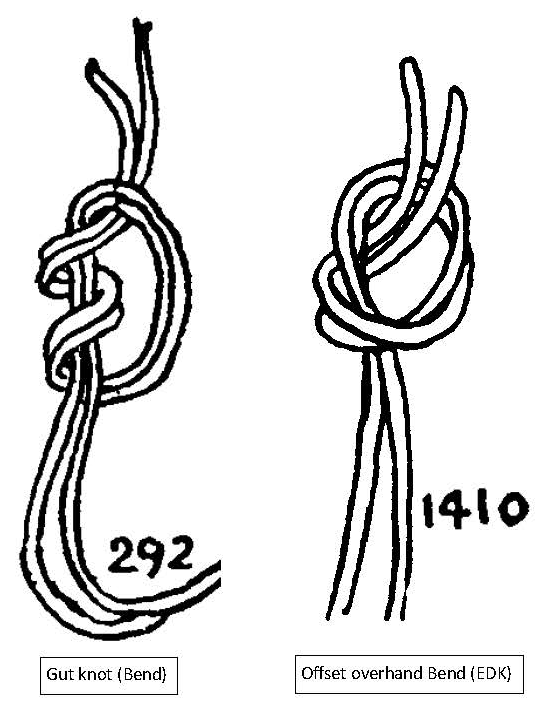 |


