Continue with onX Maps
 Sign in with Facebook






Are rescue skills necessary?



|
BTD, we almost always did a test pull to make sure that rappel ropes could be retrieved. I once paid a high price once for skipping this precaution. Nowadays I think that step is a rarity. One reason is that a lot of rappelling now is from bolted stations with rings installed for the purpose, and it is natural to assume that the pulls must be manageable. Another reason is that it is becoming much more common to pre-rig the entire party before anyone descends, which makes it impossible to test the pull. |
|
|
James Mwrote: You are describing rescue skills. Just for example, when someone falls climbing and breaks a leg, they rarely land exactly AT the belay. So one good rescue skill is knowing how to either LOWER your partner back to you, secure and stabilize them, and then go seek help. If they're more than half a pitch away or on wandering terrain you're going to need to figure out how to climb up to them, secure and stabilize them, and then go get help. "Rescue" does not mean carrying your partner on your back all the way to the hospital. |
|
|
Sam Mwrote: This is two 3:1 z-pulleys in series. With 50% carabiners it multiplies the force 1.75 * 1.75 = about 3x, so it can work. My biggest concern is how much rope and room (length) there is to build it. If it's short, the hauler will run out of "throw" stretching all the rope before the load starts moving. Even if it's long enough, the mechanical work of stretching all that rope every time can make the system very inefficient (depending on where one places the progress capture, which isn't shown in the diagram). So I can believe it's been used successfully, especially if built out of semi-static cord, but I can also believe it would be a disaster in most people's hands if built based on this diagram alone. Anyone care to find the 10-15-yr old MP thread about hauling systems that actually work ? I really liked the one where the hauler uses their own weight as counterbalance to the haulee (over a 1:1 redirect pulley) and pulls up with their hands on the haulee's strand. It probably won't work with friction over a carabiner (unless the haulee is lighter), and there isn't always room for the hauler to move vertically, but with 1 good pulley, and a load similar in weight to the hauler, it's really good. My shaky recollection is that the thread was started by one of { 20kn, bearbreeder, David Coley } and the 1:1 was described in detail by a username close to "ptkinst" |
|
|
Serge Swrote: https://www.mountainproject.com/forum/topic/109130468/self-rescue-hauling |
|
|
Mark Websterwrote: The "best" solution would likely be to down climb on prusiks on the loaded rope and teach the person how to prusik. I really make sure that the person going down first on a multipitch knows how to prusik. This type of thing will happen sooner or later. It also sucks to down climb the loaded rope since you cant simply back yourself up by tying into the rope. It gets important to clip the rope as well as the prusiks and sketchy stuff like that. |
|
|
Any interest in getting some groups together in person to practice stuff this season? Not under a guide permit or insurance coverage. Just folks getting together to practice stuff. ( I usually am the one posting with the Desert Rock Sports acct ) |
|
|
rgoldwrote: That's exactly what I had to do on Zowie. |
|
|
|
|
|
|
|
|
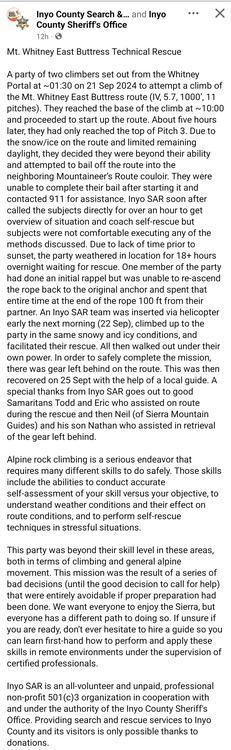
I feel pretty confident that the person who spent the night hanging in a harness for 18 hours in the freezing cold never makes this same mistake again...
|
|
|
I highly doubly someone spent 18 hours free hanging in their harness. Suspension trauma is real… |
|
|
curt86irocwrote: Read carefully - they only said "...at the end of the rope..."; nothing about free hanging. |
|
|
Marc801 Cwrote: This ^. |
|
|
I was hoping someone would post up that recent story. I really want to know the detailed instructions SAR gave them over the phone that they couldn't mentally handle. In any case, it was good to call for help. |