
 Continue with onX Maps
 Sign in with Facebook






Research on mountaineering terminology



|
Martin le Rouxwrote: Not ironic, deliberately ironic. Don’t underestimate or misconstrue my genius. Back to the issue of calf-roping (a mistake of improper rope/leg orientation) being erroneously called “backstepping “…. It is similar to the illogical phrasing of could/couldn’t care less. Backstepping doesn’t even make sense as a description of the error situation. You would more logically call it “forestepping”…your leg being in front of the rope. |
|
|
Mark Pilatewrote: Depends on your reference frame. From the reference frame of the belayer, which seems to me to be the appropriate one since they are the one likely to call it out, you are stepping behind the rope, the same way you might be stepping behind a curtain or a door, or heel hooking back and behind a massive chicken head, or going into the back of a crack with your hands (with this last one it seems like it matches the common perspective of the climber too). Also, how old is the reference to “backstepping” as a climbing technique? 50-100 years max? I alone have been using the word under a different definition for 7 years, someone else said for over a decade. What percentage of the usages and what duration of time as a ratio to other usages would you consider a new definition acceptable? Also, if you ever read through dictionaries, there are so many words that have multiple meanings that have no logical connection. Kind of like an old school climbing wall that reuses the same hold for many routes, with disorganized pieces of tape all over the place. Thats the english language in a nutshell. |
|
|
Mark Pilatewrote: Relative to the climber, the leg is behind the rope. Behind, as in back. Not the front. Now explain why “backstepping” makes sense to describe the outside edge technique. If anything, a “backstep” climbing technique should refer to using your leg behind you in a chimney. In fact, I think I’ll start referring to it as such. |
|
|
Mark Pilatewrote: Great term, I’m going with this! Having been born a stone’s throw from the Cheyenne (Wyoming) Frontier Days rodeo arena, I see a remarkable similarity between what happens to the calf in the roping event and what happens to the climber when they fall with their leg behind the rope: a very similar turbulent, even violent, discombobulation. So, let’s all call it “calf roping” from here on out. Now, I’ll go back and do yet another survey… |
|
|
Hson Pwrote: C’mon Hson, you’re from MN. I expect better from you. I assume you learned your right from left, front from back, top from bottom at some point. 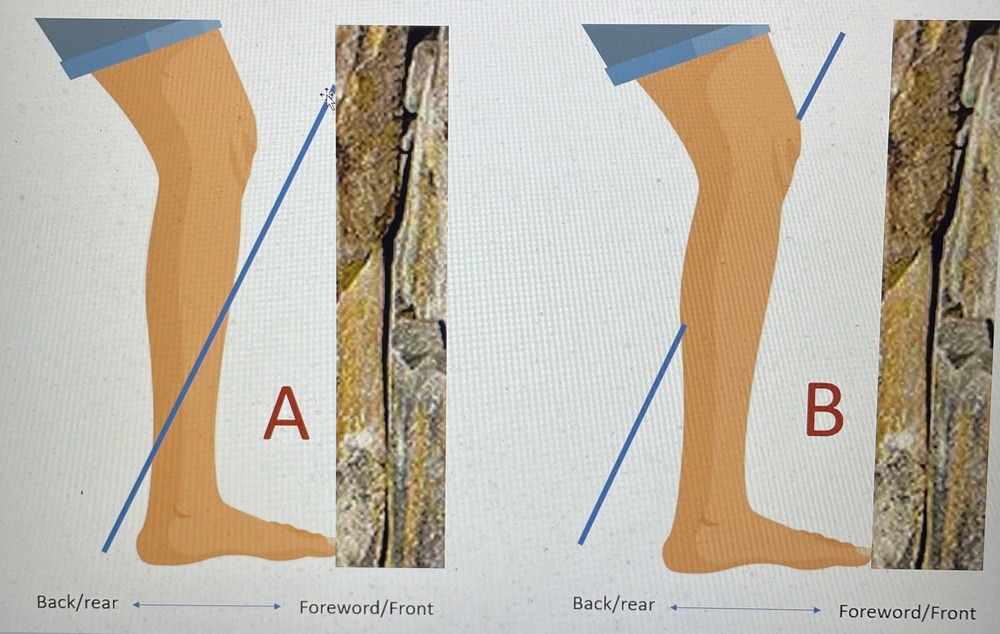 Now in pic B, the rock is still in front of the climber, but the rope is now behind the climber’ leg. A clear “calf roping” scenario. The climber’s leg is now forward of the rope, or it could be said that he is “forestepping” the rope, and he would “back step” to correct the issue Pick an axis and orientation and stick with it.
You described the same technique. It can be applied in a chimney or on a face. THAT is what backstepping is. |
|
|
Mark Pilatewrote: Rope behind the leg. Or, leg behind the rope. As in, if you stuck your leg in a jail cell, it would be “behind bars.” Doesn’t really matter how you say it. You’ve made a step and now something is “back” when it should be “front”. Hence “back step.”

|
|
|
Why don't we describe a drop knee and how its related? Egyptian anyone? |
|
|
Hson Pwrote: It does matter. You can’t arbitrarily change common references or orientations from A to B. You yourself said “relative to the climber” so stick with directions relative to the climber Here is what you’re saying…(let’s change the scenario to make it even more obvious ) You are standing in a line of people. Instead of two things in front of you (rope and rock) you have two people in front of you —> replace the rope in front of you with person A (representing the rope) and person B (representing the rock). Now, hopefully just due to not paying attention, you accidentally cut the line in front of person A. According to your logic, you are now behind person A and you back stepped in front of them. Good job. With that line of thinking, please stay in the gym where it’s safer. And that is the problem in a nutshell. Newer climbers, especially in gyms, are caring less about understanding what they say and do, versus just saying and doing it with minimal understanding. There is a divide between climbers (mostly pre-gym proliferation) whose lives depended on knowing what they were doing before doing it, and climbers who just do it, and likely never really need to know what they are doing (just buy a Gri-gri, stay mostly in the gym, and avoid trad like the plague) It is what it is. Things change and evolve, and throughout human history, people generally only do what they HAVE to do to accomplish something. I’m not blaming anyone. You do you. But by the same token, don’t come from the inexperienced, garbled knowledge end of the spectrum and try to tell the other end what’s what. |
|
|
Marc801 Cwrote: Here's some information on the same issue from a linguist (John Lawler of the University of Michigan, lsa.umich.edu/linguistics/p…): https://websites.umich.edu/~jlawler/aue/giveadamn.html However, don't let me get in the way of a couple old guys who think they're authorities on the entire English language, I know you guys really enjoy such things. |
|
|
Kyle Tarrywrote: Kyle, did you read the article? Couldn’t care less and “don’t give a damn” are examples of NPIs. They only make sense in the negative. (The correct and intended original formatting). Laziness, ignorance and/or just plan ease of elocution of syllables has led some to drop off the “…n’t” at the end with no intended change of meaning Your posted article does not align or agree with Pinker’s exegesis on the situation. |
|
|
Mark Pilatewrote: Back step never made sense as a description of technique. It’s called outside edge. Meanwhile, there never was an adjective to describe getting your leg behind the rope, so newer climbers co-opted it, and it stuck. Too bad for you, language changes. Get used to it. You can’t try to use logic to explain why it’s wrong, because it depends on your perspective. Is your leg behind the rope or in front of it? It depends. |
|
|
I usually just yell ... "hey maroon, the ropes gonna fuck you up if you fall right now" ....I haven't really had a partner misconstrue yet |
|
|
Redacted Redactbergwrote: There really wasn’t any need for further comments after this opening statement. |
|
|
David Weisberg wrote: And back clipping is when you clip with the lead side of the rope between the biner and the wall. However I wouldn't say you're back clipped because of the orientation I would say it because you've clipped the thing backwards. Similarly you could assert that the backstepping technique is stepping backward from the norm. Further, there's many times that people are climbing and they step above the rope line putting them in a compromised position where the rope may easily catch their leg in a fall or a move puts the rope behind their leg. Would you call this backstepping because you're stepping above the rope? Would it be a revealed backstep like a revealed check in chess? Or would you just clearly yell up and tell your partner to watch their feet/the rope. |
|
|
Hson Pwrote: This thread explains why some can’t seem to find their ass with both hands….they’re not sure if it’s in front or in back |
|
|
Redacted Redactbergwrote: You make it sound like you think that's a long time. |
|
|
I know a few things about lexica and glossaries, as an accident of my profession. If you want help or context for those issues, let me know. |
|
|
Marc801 Cwrote: Using a word for over a decade with a singular, specific meaning isn’t a long time? That’s probably 20% of the lifespan of the other meaning of the word that you are so passionate about. There are way more slang words that have developed off of other words in the last 5 years alone. |
|
|
People use all kinds of words incorrectly for decades…often all of their lives, in spite of clear information that corrects them. It becomes some kind of odd point of pride to them. |
|
|
Redacted Redactbergwrote: You're just upset to discover you've been wrong for a dozen years. |


