Mountain Project Logo

Public comment on wilderness area fixed hardware

willromano · · Unknown Hometown · Joined Aug 2015 · Points: 20
J Ewrote:

I complained about the Access Fund because I personally get annoyed that climbers feel special. There are a lot of other advocacy groups for other outdoor pursuits that don't advocate for exceptions to rules for their users. This anchor argument, to me, is the Access Fund saying that's they deserve a wilderness carve out that they government doesn't even give itself for things like firefighting or research. 

Climbing in my mind is not some supreme wilderness activity. It concentrates users in very specific areas who often rely on fixed hardware and thousands of pages of guidebooks for their activity. Contrast that with hunting or backpacking where the more experienced users often try to find the most remote parts of Wilderness areas with no infrastructure or people. I'm not saying that climbing isn't a wilderness activity. I'm just saying it's not special compared to the rest. It's certainly not special enough that The Wilderness Act would be silent on it, especially in settings like Joshua Tree or Yosemite where fixed anchors are extremely noticable and have a clear impact on the perception of Wilderness. 

Climbers self regulating will never consider every public land user's point of view. I don't inherently trust bureaucrats either, but isn't considering things like the appropriateness of fixed anchors on public lands exactly the point of the NPS and USFS? 

That, and the Access Fund is arguing over semantics and using all kinds of clickbait tactics to get people fired up about this. Which isn't to say it's not important. It annoys me that they are saying they want the government involved in managing fixed anchors, but they don't want the government to use processes they use for literally everything else.

Etc. etc. etc. 

I think you should explore some more wilderness areas and expand your understanding of how user groups seek to carve out exceptions for their particular pursuits. Using your example of hunters, who do you think are some of the most vocal proponents of wolf control in wilderness areas? Also, while this is just my experience, it is a very small percentage of hunters who actually pursue animals deep into the backcountry. The vast majority of hunters I know and have encountered hunt in proximity to roads or use ATVs and UTVs to hunt, all of which is prohibited in the wilderness of course. Because it takes a lot of commitment to pack out an animal 10 miles from your truck.. Also much of the hunting I've encountered in the largest contiguous wilderness area in the lower 48 is commercial, guided, based out of temporary camps, horse pack operations in the Frank Church. There is nothing low impact about that sort of operation. Even most of the non-commercial hunters in the Frank fly in. Also, the idea that backpackers don't congregate in wilderness areas is laughable. 

Which gets to my final point. The Frank Church, again the largest contiguous wilderness area in the Lower 48, has numerous air strips, bridges, trails, signage, ranches, houses, etc. The forest service even dynamited a log jam in the early 2000s so rafters could continue to float the Middle Fork. So where do we draw the line. Because I am all for pristine, untarnished wilderness, but if we're going to go that route, do we have to insist that there should be no more backcountry flying, rafting, hunting, backpacking, fishing, etc. BTW all of these other groups 100 percent advocate to ensure their access to the resource is not jeopardized. Really bizarre to see so many supposed climbers act as if climbers are the most selfish wilderness users totally devoid of evidence. The idea that a hand drilled bolt on a remote peak that can't be seen until its within hand reach is more obtrusive than a pack bridge over a world renowned river in a wilderness area is mind boggling. 

Alan Rubin · · Unknown Hometown · Joined Apr 2015 · Points: 10
Joy Bastet wrote:

same ol' same ol''. cop is cop and we will continue to keep our secrets 

What the....does this mean?  Not at all useful.

TJ Bindseil · · Lakewood, CO · Joined Apr 2020 · Points: 0
J Ewrote:

Climbing in my mind is not some supreme wilderness activity. It concentrates users in very specific areas who often rely on fixed hardware and thousands of pages of guidebooks for their activity. Contrast that with hunting or backpacking where the more experienced users often try to find the most remote parts of Wilderness areas with no infrastructure or people. 

I think this could actually be used as an argument to have less restrictions on fixed anchors.  

This is a gross over simplification, but no more fixed anchors means that, assuming climber numbers increase, there will be more concentration.  new lines in new areas will spread crowds. 

Devin Pendas · · Unknown Hometown · Joined Mar 2018 · Points: 0
J Ewrote:

I complained about the Access Fund because I personally get annoyed that climbers feel special. There are a lot of other advocacy groups for other outdoor pursuits that don't advocate for exceptions to rules for their users. 

And there are a lot of non-climbing outdoor advocacy groups that do advocate for specific rules for their users. See, for example:

https://united4wd.org/advocacy-groups

https://www.imba.com/advocacy

https://swimba.org/what-is-advocacy/#:~:text=Mountain%20biking%20advocacy%20refers%20to,and%20access%20to%20riding%20areas.

https://www.nrahlf.org/articles/2020/11/19/what-are-public-land-advocates/

etc. etc. 

Salamanizer Ski · · Off the Grid… · Joined Sep 2005 · Points: 21,334
Nathan Pwrote:

Interesting fixed anchor memo from the Wilderness Watch back in 1990! They are consistent, I’ll give them that!

Oh, they’re consistent all right. It’s precisely these kinds of organizations that have consistently pushed to allow tens of millions of forested lands to become scrub brush wastelands. Look at their ignorant views on prescribed fires and fuel reduction efforts. Read their statements they make on their website. They’re either guilty of malevolent lies, blissful ignorance, or both. These people don’t care about the environment or what’s best for it, they care about keeping everyone out of it, or doing anything to manage it. They don’t understand the world around them. 

J E · · Sacramento, CA · Joined Dec 2023 · Points: 0
willromanowrote:

I think you should explore some more wilderness areas and expand your understanding of how user groups seek to carve out exceptions for their particular pursuits. Using your example of hunters, who do you think are some of the most vocal proponents of wolf control in wilderness areas? Also, while this is just my experience, it is a very small percentage of hunters who actually pursue animals deep into the backcountry. The vast majority of hunters I know and have encountered hunt in proximity to roads or use ATVs and UTVs to hunt, all of which is prohibited in the wilderness of course. Because it takes a lot of commitment to pack out an animal 10 miles from your truck.. Also much of the hunting I've encountered in the largest contiguous wilderness area in the lower 48 is commercial, guided, based out of temporary camps, horse pack operations in the Frank Church. There is nothing low impact about that sort of operation. Even most of the non-commercial hunters in the Frank fly in. Also, the idea that backpackers don't congregate in wilderness areas is laughable. 

Which gets to my final point. The Frank Church, again the largest contiguous wilderness area in the Lower 48, has numerous air strips, bridges, trails, signage, ranches, houses, etc. The forest service even dynamited a log jam in the early 2000s so rafters could continue to float the Middle Fork. So where do we draw the line. Because I am all for pristine, untarnished wilderness, but if we're going to go that route, do we have to insist that there should be no more backcountry flying, rafting, hunting, backpacking, fishing, etc. BTW all of these other groups 100 percent advocate to ensure their access to the resource is not jeopardized. Really bizarre to see so many supposed climbers act as if climbers are the most selfish wilderness users totally devoid of evidence. The idea that a hand drilled bolt on a remote peak that can't be seen until its within hand reach is more obtrusive than a pack bridge over a world renowned river in a wilderness area is mind boggling. 

I've got a bunch of personal experience with climbing, backpacking, and hunting in the wilderness. I think it is somewhat telling how quick you are willing to say that hunters, for example, are not great wilderness users. 

There are hunters who all go to the same place for sure, and backpackers who do too. The point I was making is that climbing is not special. It's just another Wilderness activity. 

The comparison of impacts isn't my argument, and it isn't what the fixed anchor argument will be about in policy or courts or acts passed by congress. The point is, other man made things in Wilderness are considered installations or some other wilderness act prohibited thing. If those things are in wilderness, they are either there illegally or because they were justified by an MRA. Anchors shouldn't get a special carve out of the Wilderness Act, which is kind of a silly law, but the law of the land none the less. 

Obviously the Access Fund should be advocating for climbing, that is literally the point. I just find their approach to this argument to be amateur, which is bad for relationships, and in the end, not the best representation of climbing. 

Alan Rubin · · Unknown Hometown · Joined Apr 2015 · Points: 10

JE ---in multiple posts you have been highly critical of the Access Fund's approach---now calling it "amateur", but you haven't provided an alternative 'professional' strategy to protect the existence of any fixed anchors on Wilderness Areas. If, as some of your posts strongly suggest, you believe that the Wilderness Act requires that fixed anchors be considered to be installations and, therefore illegal in Wilderness, just say that and move on. If that is your position, then what is your purpose in continuing to criticize an organization that views this issue from a different perspective. I believe that the vast majority of climbers with an interest in maintaining climbing in Wilderness Areas support the AF's goals, even if they may question specifics of their current approach. Over decades of climbing I have done many routes in designated wilderness, few, if any, of them heavily bolted sport routes, but many relying at least to some extent on fixed anchors ( especially for descent). I would like to see those routes, and others like them, remain available for future generations. If you feel differently, state that, or, if you believe that there is a different method to achieve this goal, please share it.

Bill Lawry · · Albuquerque, NM · Joined Apr 2006 · Points: 1,821
Frank Steinwrote:

I think I met you a couple of times. Aren’t you an attorney for the State Engineer?  You should be very familiar with the above, if so. 

I’m not a lawyer. And not that person unless you owe them a boat load of cash. ;)

Chemical / Software Engineer, …. your typical tech-y who climbs in the wilderness. 

Frank Stein · · Picayune, MS · Joined Feb 2012 · Points: 205

Sorry, wrong Bill then. Your profile kind of looks like the other Bill. 

Bill Lawry · · Albuquerque, NM · Joined Apr 2006 · Points: 1,821
Frank Steinwrote:

Sorry, wrong Bill then. Your profile kind of looks like the other Bill. 

Lots of climbers named Bill.  Good luck keeping them straight, Frank. 

J E · · Sacramento, CA · Joined Dec 2023 · Points: 0
Alan Rubinwrote:

JE ---in multiple posts you have been highly critical of the Access Fund's approach---now calling it "amateur", but you haven't provided an alternative 'professional' strategy to protect the existence of any fixed anchors on Wilderness Areas. If, as some of your posts strongly suggest, you believe that the Wilderness Act requires that fixed anchors be considered to be installations and, therefore illegal in Wilderness, just say that and move on. If that is your position, then what is your purpose in continuing to criticize an organization that views this issue from a different perspective. I believe that the vast majority of climbers with an interest in maintaining climbing in Wilderness Areas support the AF's goals, even if they may question specifics of their current approach. Over decades of climbing I have done many routes in designated wilderness, few, if any, of them heavily bolted sport routes, but many relying at least to some extent on fixed anchors ( especially for descent). I would like to see those routes, and others like them, remain available for future generations. If you feel differently, state that, or, if you believe that there is a different method to achieve this goal, please share it.

Prohibited and illegal aren't synonymous in this case. Man made things are prohibited in Wilderness. Millions of (completely legal) man made things exist in Wilderness none the less. They need to be approved either "programmatically" or case by case. This is how it is for basically everything man made. Access Fund suggests that fixed anchors should be the only man made things that aren't prohibited, which I think is silly, and somewhat offensive, since I also do things other than climbing and can see those communities' perspectives. 

To rally climbers, the Access Fund uses inflammatory language like illegal, ban, etc. even though none of the agencies propose that, or could even do that on a national level. 

I think bolts in Wilderness should, and will, continue to exist. Probably places like Yosemite could use more regulation, and places like some of the areas mentioned in this thread could use less. 

I think the Access Fund should have been working to shape the future permitting processes for placing/replacing bolts and fighting against route closure/removal generally. They should have been fighting to establish an agreed upon definition of "sport climb" or "bolt intensive climb" that isn't arbitrary since those will almost certainly actually be banned in Wilderness by national policy. 

Instead, they chose to fight to make climbing anchors exempt from the Wilderness Act. Since they chose that battle, they seem to neglect any efforts to shape particulars of regulations that seem certain to be enacted. 

They state they want to work with the government, but continually misrepresent the policy and the agencies' positions, which I don't think is an effective way to get things done. 

So much confusion on this topic. 

willromano · · Unknown Hometown · Joined Aug 2015 · Points: 20
J Ewrote:

I've got a bunch of personal experience with climbing, backpacking, and hunting in the wilderness. I think it is somewhat telling how quick you are willing to say that hunters, for example, are not great wilderness users. 

There are hunters who all go to the same place for sure, and backpackers who do too. The point I was making is that climbing is not special. It's just another Wilderness activity. 

The comparison of impacts isn't my argument, and it isn't what the fixed anchor argument will be about in policy or courts or acts passed by congress. The point is, other man made things in Wilderness are considered installations or some other wilderness act prohibited thing. If those things are in wilderness, they are either there illegally or because they were justified by an MRA. Anchors shouldn't get a special carve out of the Wilderness Act, which is kind of a silly law, but the law of the land none the less. 

Obviously the Access Fund should be advocating for climbing, that is literally the point. I just find their approach to this argument to be amateur, which is bad for relationships, and in the end, not the best representation of climbing. 

There are good and bad apples in every group. And yes I am more than willing to hold hunters accountable. There are thousands of cases of poaching around the country every year. Why place any group on a pedestal when it comes to preserving wilderness whether they're climbers or hunters or backpackers or whatever?

Backcountry flyers literally got a carve out for using Frank Church airstrips. This isn't black and white. There are all manner of exceptions to the wilderness act occurring within wilderness areas that are allowed to persist. I personally think bolting in a way that is compliant with other aspects of the wilderness act (i.e. without the use of power tools) should be grandfathered in as well since climbing with fixed gear has occurred in many wilderness areas before those places were officially designated as such. 

User groups advocate. You clearly agree with the government position so of course you don't appreciate AF's approach to the issue. This is what backcountry fliers did to maintain access to an airstrip in the Frank Church:

"The USFS has already closed airstrips and attempted to close others within the wilderness. A consortium of users has pushed
back on the USFS over the years and continue to do so. One example of this was when the
forest service attempted to close Cabin Creek airstrip after it washed out in a flood, and a
concerted effort was launched by volunteers and commercial operators to lobby against the
forest service until they agreed to repair the strip and reopen it."

Where's the difference?

J E · · Sacramento, CA · Joined Dec 2023 · Points: 0
willromanowrote:

There are good and bad apples in every group. And yes I am more than willing to hold hunters accountable. There are thousands of cases of poaching around the country every year. Why place any group on a pedestal when it comes to preserving wilderness whether they're climbers or hunters or backpackers or whatever?

Backcountry flyers literally got a carve out for using Frank Church airstrips. This isn't black and white. There are all manner of exceptions to the wilderness act occurring within wilderness areas that are allowed to persist. I personally think bolting in a way that is compliant with other aspects of the wilderness act (i.e. without the use of power tools) should be grandfathered in as well since climbing with fixed gear has occurred in many wilderness areas before those places were officially designated as such. 

User groups advocate. You clearly agree with the government position so of course you don't appreciate AF's approach to the issue. This is what backcountry fliers did to maintain access to an airstrip in the Frank Church:

"The USFS has already closed airstrips and attempted to close others within the wilderness. A consortium of users has pushed
back on the USFS over the years and continue to do so. One example of this was when the
forest service attempted to close Cabin Creek airstrip after it washed out in a flood, and a
concerted effort was launched by volunteers and commercial operators to lobby against the
forest service until they agreed to repair the strip and reopen it."

Where's the difference?

The Bernard airstrip in the frank church is prohibited in Wilderness but approved by the MRA process. I'm not sure if the rest are the same. Some aren't in the wilderness boundary.

Those airstrips didn't get a carve out, they were approved in the exact same way the USFS and NPS propose to approve bolts, despite being generally prohibited. 

Again, no group is on a pedestal. That's exactly what I'm arguing. 

I do agree that the policy proposed by the USFS and NPS is the most logical way to do things. Manage fixed anchors like everything else. They are nothing special, just another thing in wilderness. 

willromano · · Unknown Hometown · Joined Aug 2015 · Points: 20
J Ewrote:

The Bernard airstrip in the frank church is prohibited in Wilderness but approved by the MRA process. I'm not sure if the rest are the same. Some aren't in the wilderness boundary.

Those airstrips didn't get a carve out, they were approved in the exact same way the USFS and NPS propose to approve bolts, despite being generally prohibited. 

Again, no group is on a pedestal. That's exactly what I'm arguing. 

I do agree that the policy proposed by the USFS and NPS is the most logical way to do things. Manage fixed anchors like everything else. They are nothing special, just another thing in wilderness. 

That doesn't appear to be the case for the originally approved airstrips. MRAs are subject to review. What part of this sounds reviewable to you?

"In 1980, the Congress allowed the continued landing of aircraft at airstrips within the
River of No Return Wilderness, in cases where that was a pre-existing use, subject to
regulation by the Secretary. However, the act also prohibited the Secretary from closing
airstrips, except as a result of extreme danger and with the state 's written concurrence."

Again, a carve out. For a specific user group. Look, I'd love to hear how you propose one would go about getting a bail anchor on a remote wilderness peak preapproved through a MRA process.

J E · · Sacramento, CA · Joined Dec 2023 · Points: 0

Not a national policy carve out. That was part of the act that designated that Wilderness, a concession to get it through Congress. Most individual Wilderness areas have something like that. Despite that, the USFS still justified those airstrips with an MRA (Google it). 

The policies we're arguing about don't require MRAs to place fixed anchors in emergencies, but the language for that exception is pretty silly and could use some revision. That'd be a great public comment! 

willromano · · Unknown Hometown · Joined Aug 2015 · Points: 20
J Ewrote:

Not a national policy carve out. That was part of the act that designated that Wilderness, a concession to get it through Congress. Most individual Wilderness areas have something like that. Despite that, the USFS still justified those airstrips with an MRA (Google it). 

The policies we're arguing about don't require MRAs to place fixed anchors in emergencies, but the language for that exception is pretty silly and could use some revision. That'd be a great public comment! 

I don't really feel like beating a dead horse much longer but what do you call an analysis which can only result in one outcome? 

"The Frank Church-River of No Return Wilderness has released a draft management plan that addresses alternative
management schemes for the Wilderness’ twelve airstrips. The Forest
Service has interpreted the Central Idaho Wilderness Act as requiring full use
of all airstrips and has so far rejected alternatives that would emphasize wilderness values over air access."

Also I've found plenty of MRAs for upkeep of the 12 federally owned airstrips in the Frank but nothing from when the area was designated wilderness. I.e. the actions under review are not whether backcountry flying or airstrips are in keeping with wilderness values but whether installations like wind socks or pit toilets or fencing are in need of updating at specific airstrips. Please send me the MRA for Indian Creek where one of the proposed options is closing the airstrip... 

J E · · Sacramento, CA · Joined Dec 2023 · Points: 0
willromanowrote:

I don't really feel like beating a dead horse much longer but what do you call an analysis which can only result in one outcome? 

"The Frank Church-River of No Return Wilderness has released a draft management plan that addresses alternative
management schemes for the Wilderness’ twelve airstrips. The Forest
Service has interpreted the Central Idaho Wilderness Act as requiring full use
of all airstrips and has so far rejected alternatives that would emphasize wilderness values over air access."

Also I've found plenty of MRAs for upkeep of the 12 federally owned airstrips in the Frank but nothing from when the area was designated wilderness. I.e. the actions under review are not whether backcountry flying or airstrips are in keeping with wilderness values but whether installations like wind socks or pit toilets or fencing are in need of updating at specific airstrips. Please send me the MRA for Indian Creek where one of the proposed options is closing the airstrip... 

If Congress passes a law to override the Wilderness Act, then the supreme Court can decide what to do with that legal mess. If that's what you want, you should be writing your congressman instead of public commenting on the proposed policy. Policy from the executive branch can't override the Wilderness Act, no matter how much access fund says they should.

I see your looking for wilderness act carve outs, and sure I guess Congress can maybe make them, but in this example you found, the executive branch still argues it's not a carve out. Soooooo... This is a waste of time. 

willromano · · Unknown Hometown · Joined Aug 2015 · Points: 20
J Ewrote:

If Congress passes a law to override the Wilderness Act, then the supreme Court can decide what to do with that legal mess. If that's what you want, you should be writing your congressman instead of public commenting on the proposed policy. Policy from the executive branch can't override the Wilderness Act, no matter how much access fund says they should.

I see your looking for wilderness act carve outs, and sure I guess Congress can maybe make them, but in this example you found, the executive branch still argues it's not a carve out. Soooooo... This is a waste of time. 

Lol so there are carveouts for specific user groups in the Wilderness Act! We've drifted a bit from where we started but you didn't seem willing initially to acknowledge climbers are not alone in asking for exceptions to the wilderness act to be made on their behalf. Also the executive branch here i.e. the Forest Service explicitly recognizes the carve out for backcountry fliers enshrined in the Central Idaho Wilderness Act. The blurb I quoted from is them acknowledging the CIWA takes precedence over the Wilderness Act in the case of backcountry airstrips -and jet boating for that matter- in the Frank Church. 

The lesson I've learned from this back and forth is if you advocate forcefully enough, you too can receive a carveout in the wilderness act for your chosen activity. Thanks for making my point!

J E · · Sacramento, CA · Joined Dec 2023 · Points: 0
willromanowrote:

Lol so there are carveouts for specific user groups in the Wilderness Act! We've drifted a bit from where we started but you didn't seem willing initially to acknowledge climbers are not alone in asking for exceptions to the wilderness act to be made on their behalf. Also the executive branch here i.e. the Forest Service explicitly recognizes the carve out for backcountry fliers enshrined in the Central Idaho Wilderness Act. The blurb I quoted from is them acknowledging the CIWA takes precedence over the Wilderness Act in the case of backcountry airstrips -and jet boating for that matter- in the Frank Church. 

The lesson I've learned from this back and forth is if you advocate forcefully enough, you too can receive a carveout in the wilderness act for your chosen activity. Thanks for making my point!

Ugh. You're killin' me smalls.

apogee · · Unknown Hometown · Joined Nov 2009 · Points: 0

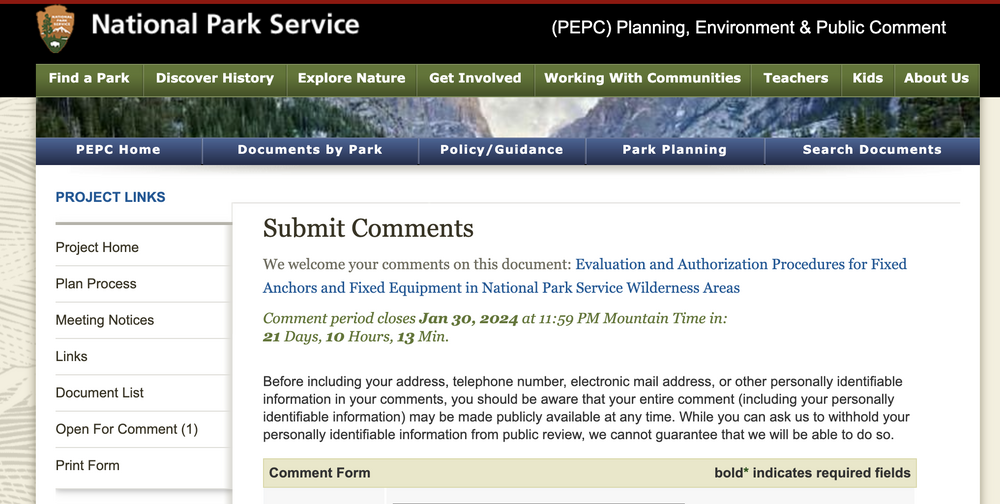
Looks like the NPS has extended the comments deadline to January 30 (USFS has followed with the same)...we got that going for us, anyway....

Guideline #1: Don't be a jerk.

General Climbing
Post a Reply to "Public comment on wilderness area fixed hardware"

Log In to Reply
Welcome

Join the Community! It's FREE

Already have an account? Login to close this notice.