
 Continue with onX Maps
 Sign in with Facebook






Can we please stop the carnage at fixed anchors with steel biners or mussys?



|
Another heartbreaking post. Climber cleaning anchors which were mussys but party also placed a locker. Fell and died. Delete the locker and she is alive. I am so sad to read about another such accident. These should never ever happen. Either hang two draws and then have someone experienced run up and clean them on TR or please just wear out the steel if you must. It is just not worth it. Could this be one post where we all agree? Somehow I doubt it. But I just don’t want bodies hitting the ground for this reason anymore, and I have to try. I’m so tired of all the weird cordelette, quad, added cord and biner anchor stuff going on at heavily trafficked areas with good steel. Give your climbing organization $100 every year!!!! I get some cannot do this. Then- Volunteer. But stop all the quad cordelette additions to sport anchors. |
|
|
Seems like the climber was incompetent cleaning the anchor to begin with. No matter the anchor setup (two draws, quad, etc..) it requires some sort of cleaning. Rather it be going through chains, or mussy hooks, the climber should know how to handle different types of anchor setups. Curious how just one locker caused this issue, was it place higher than the preclipped mussys? |
|
|
J mo are you familiar with the mechanics of this type of accident. My buddies and I have been having a dialog about this for the last bit and we are trying to determine the order of events that took place up at the anchor. My thought is the locker was placed above the mussys and the climber went above the mussys and likely called down that the locker was removed. Belayer took, felt momentary tension and a back-clipped like event took place on the musseys. The belayers story includes momentary tension, an abrupt loss of tension that caused a fall (on the belayers end) and of course the very unfortunate climbers fall. From what I gathered there wasn’t a complete lack of tension on the rope and there also wasn’t a longer duration weighting of the system where there might have been some classical cleaning taking place. |
|
|
Reminds me of this thread where an accident occurred due to the scenario Nathan mentions above: https://www.mountainproject.com/forum/topic/124636099/why-are-mussy-hooks-not-installed-oppositeopposed Who knows what happened in the most recent tragedy, but perhaps these large-nose mussies have too high of a chance of catching the rope and coming unclipped. |
|
|
Nathan- yeah that makes sense. I was hopefully speaking to a much broader point. |
|
|
Big red the mussys included in that one image where the tail of the rope drapes over lips of the unopposed mussys looks like that could easily induce a catastrophic failure. I’m tediously thinking about what could have happened. This incident is close to home, literally and figuratively. I really hate it for everyone involved. |
|
|
Anchor hooks have a known failure mode. https://safeclimbing.org/lower-off-initiative
The failure mode is when the rope is above the anchor hook it is possible for the rope to cross over the gate and become unclipped. Though there may be two anchor hooks, when the two hooks are able to come together "side-by-side" there is no longer any redundancy in the failure mode. As such, one question to research is whether placing anchor hooks a minimum distance apart could reduce this failure mode? That is reduce the chance of the rope crossing over both gates and become unclipped. Given the ability for one to climb above anchor hooks in many scenarios one could argue that they not appropriate. |
|
|
Big Red wrote: Everyone is saying don't climb above the mussy hooks but the picture in that linked thread seems to show that the belayer side strand was pulled above them and caught on the noses as it was released. Unless I'm missing something that scenario would probably happen if you clipped a carabiner or draw above the chains from the outside of the hooks (presumably to avoid wear while top roping). It seems unlikely to happen if you clipped the strand from in between the hooks as your redirect, but these accidents still make me question ever using that redirect method on mussy hooks. |
|
|
Jason wrote: Agreed, with the biner above and outside the hooks, unclipping the rope and dropping it could conceivably hook it on the mussy nose. Also a beginner trying to take the locker off the anchor could easily climb above or tangle with the mussies without realizing it. Seems to me the standard should either be to oppose mussies or use less snaggy fixed biners like these |
|
|
Big Red wrote: The belayer wrote: " Last climber to go up. Everyone else lead the climb. She was cleaning draws as she went up. We had an extra locker on the top anchor we left for her to take off when she got to the top. " I'm picturing something like what's pictured below, but with Mussy hooks as the bottom point of the system, and the locker possibly on the outside of the chain. I'm not familiar with the area other than reading the description on mountain project so someone please correct me if I am wildly off. Edit: Please see follow up responses by rgold and Adam Fleming. As others have mentioned the pictured method, which seems likely to have been used regardless of intention of precleaning or not, should not be used for Mussy hooks or other similar systems. 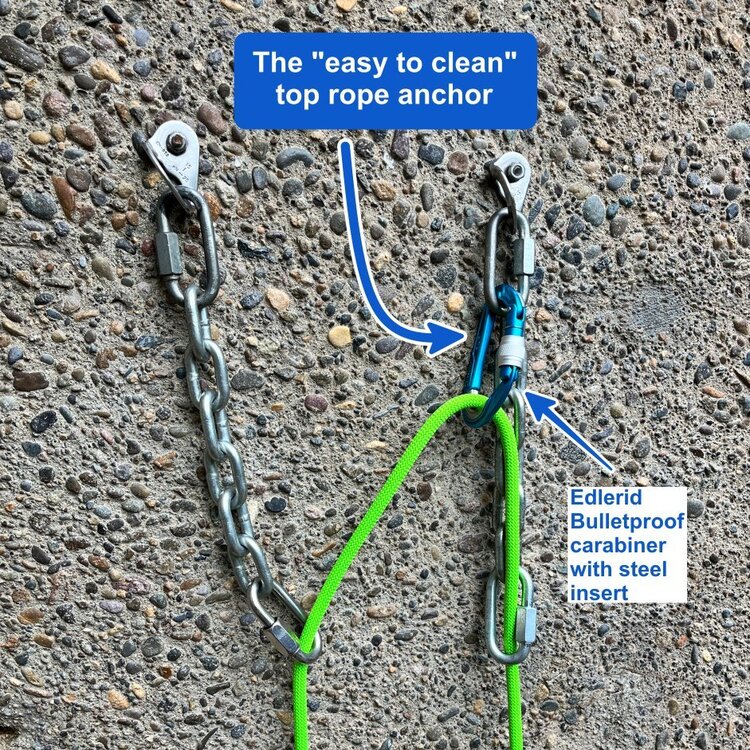 |
|
|
Lowering hooks on outside climbs are not installed for toproping, they are installed so the last person can lower off the climb at the end of the day instead of rappelling or untying and threading through to lower. The hooks are purposely oriented with both gates forward which doesn’t offer protection from them becoming accidentally unclipped if the rope is above them. Adding a locking carabiner above the hooks as the toprope anchor positions the rope above the mussy gates and is absolutely less than ideal. In addition to the scenario described above where the hooks could have backclipped during the “take”, the rope could have also become unclipped from one or both lowering hooks during the day while the group was climbing. Ropes get crossed/twisted all the time when toproping. If both hooks became accidentally unclipped prior to her arriving to clean the anchor, she would have executed the cleaning instructions without knowing enough to recognize that the rope was not where it should be. Or a combination of both scenarios could have happened where maybe one hook had unclipped and the second unclipped during the “take”. The toprope anchor setup in the above image, where a single carabiner is attached above, is very specific to anchors that have closed chain links or rappel rings, not lowering hooks. The rope is threaded through the chain link or rings and cannot detach in any way. |
|
|
the sport community has argued rather forcefully for mussy hooks and pig tails to make it safer for incompetent people to clean an anchor. Now we are dealing with a whole new failure mode due to not having closed anchors. A better solution would have been to install ground anchors for teaching purposes and use them. |
|
|
Every anchor has the potential for misuse, the ASCA link mentioned upthread not only lists best practices for using mussys, but also points out failure modes that might be less than blatantly obvious for everyone. I think it's important that as mussys become more prevalent people educate themselves on these somewhat unlikely but nevertheless not a fluke type of failure modes. Whether lowering or rappelling, lowering via untying, or by clipping the mussys there is skill involved in safely performing this act, most accidents involving cleaning could have been avoided had the new system been weighted prior to removing the old system. The carabiner above the mussys doesn't allow for this without also attaching a pas before hand, with rings this is okay because there's no way to become detached. It breaks my heart for all those involved in this incident, it was an easy mistake to make, and one I've seen many climbers with years of experience make without such devastating consequences. These kinds of posts always seem to come up after a tragic accident, looking to blame the equipment rather than the way it was used or setup. As much as we try, there is no perfect setup that is free from all types of user errors. I think more developers these days are thinking about how their anchors are going to be used, and striving to make them as user friendly as possible. Nonetheless it's impossible to account for all factors when you're dealing with humans. TLDR: Mussys remain a really good option, the accident this past is in response to remains beyond tragic, please share the ASCA article outlining proper use and failure modes of mussys to all your climbing friends. |
|
|
I don't see the point of pre-rigging the anchor to be cleaned when there's mussy's. Either way if someone doesn't know how to clean an anchor they shouldn't be the last one up the climb.. |
|
|
Attaching the link on how to correctly use mussy hooks for quick reference: |
|
|
When I originally was trying to come up with a workable hypothesis I had completely forgotten what the anchors of Misty looked like. Let me provide a screenshot I got from a YouTube video of a guy climbing the route with go pro.  My original hypothesis was that the locking biner was considerably higher than the mussys, requiring the climber to climb above the mussys. With the short length of this system I doubt that was the actual series of events. In this photo you can see two quick draws hanging below the mussys in an opposed fashion, I think we can all agree this is an acceptable top rope setup once clipped. However, likely more cumbersome for a very new climber to clean. Also, going back to the event description there were a few events that were described that are perplexing to me. 1. Belayer felt tension in the system 2. Tension was suddenly released causing the belayer to fall. (I’m assuming the belayer was leaning back or absorbing a reasonable amount of body weight vertically) And climber also subsequently fell. If the description noted that the climber fell without any FELT tension it would create the possibility of a two scenarios I can think of. 1. Climber goes up, unclips mussys because she is in the rythym of cleaning the draws. Unclips the locker as instructed, leans back, falls. 2. Previous climber who lead, clipped the locker ONLY. Last climber cleans draws on top rope, cleans the locker as instructed, leans back, falls. These scenarios do not match the description unless of course the climber called for a TAKE after one of these two scenarios. The belayer would have potentially felt momentary tension while taking and then a subsequent release once the climber let go of the wall. Scenario 2 definitely gives me pause because it would place some level of responsibility on the last person to climb before Faye. And of course, I have no suspicion of foul play but I would hate that for the second to last climber. In this whole event the most safe way to handle the inexperienced climber would have been to have the climber top rope through two opposing quick draws like the ones shown in the image above and allow the climber to lower off with no responsibility of cleaning gear. This requires an additional pitch of climbing and depending on the relative difficulty to the group this may have been a large ask. I do have sympathy for the whole situation because it sounds like the climber was very psyched, the methodology was explained from the ground and the climber was up for it. I find it impressive for a relatively newer climber to send misty because there is notable pump factor and the line is proud relative to the area. I also sympathize because I have had completely new climbers clean anchors before. But not without diligent instruction both on the ground and at the anchors. In those scenarios however, a traditional method of cleaning was used that required the climber to go in-direct (allowing for multiple checkpoints of testing the system without the need for a blind commitment). I’d love to hear y’all’s thoughts on anything I could be missing with the event at sand rock. I definitely will approach cleaning anchors with a new set of lenses for new climbers. And of course I hate that this event happened and I feel bad for everyone, the family, the friends, the climbers nearby, first responders, park staff, and the climbing community as a whole. Most of us are fortunate enough to move on from this relatively quickly but for some this will remain a source of deep pain for a very long time, if not indefinitely. My condolences. |
|
|
"Can we please stop the carnage at fixed anchors with steel biners or mussys?".  |
|
|
there is no excuse to not have ground stations for teaching anchor cleaning at major sport areas. they have them at Rumny but they do not include musseys because musseys were supposed to be fool proof. |
|
|
I have never, ever heard of a climber dying because a rope 100% sawed through both rap rings while someone was toproping or lowering. Yet over and over I read about climbers dying while cleaning anchors. I can only conclude - based on the facts - that the climbing community at least theoretically values fungible metal rap rings over human lives. These accidents are happening at popular crags a short walk from the car. The anchors are used and observed almost daily during good weather. It is incredibly simple for any local climber to carry up a wrench and replace any gear that looks even remotely worn. Most cities of any size have some kind of nonprofit that raises money to replace hardware. No to mention ASCA literally gives away replacement hardware. And yet we continue to value the rap rings over human life. I've personally put in over 50 anchors and I could give a shit if someone topropes or lowers through them. You know, like a gym, which is just a facsimile of a local crag. It's crazy that people die to keep stainless steel marginally less used for its intended purpose. When i take my kids climbing, you can bet I run the rope through the rings so they don't have to clean an anchor, no matter how "simple" it ought to be. Sorry to hear about this accident. |
|
|
Yes wear em out. The broken hearts can't be fixed. If people come from the gym OK. If people have a group OK. If people want convenience OK. Accept it. It's not how it was before. |
|
|
I've seen these types of accidents happen to many times. I even once saw a beginner unclip both draws protecting her toprope. Whenever I get lowered I try to stay clipped in with a long sling or a couple of draws until I am certain that the rope is coming tight. I try to leave enough slack to unclip when I weight the rope. I wrote a piece (linked below) that was published on Evening Sends a while back. I don't think it will ever not be relevant to climbers. Climbing is dangerous. ALL climbing. Always keep this in mind. |


