
 Continue with onX Maps
 Sign in with Facebook






Don't throw away worn ATC Guides - they're as smooth as Kong Gigi for most ropes
|
|
If your ATC Guide looks like this, don't throw it away because what you have (besides potentially a perfect rap device) is a guide mode device as smooth as a Kong Gigi.  The Gigi's taller slots would still win with a thicker/stiffer rope, but probably not one that anybody would tolerate for lead belaying these days. |
|
|
In my experience, the wear that requires retiring an ATC (or similar tubular device) occurs on the other end of the tube slot. I’ve found sharp edges where the rope to the climber/anchor exits. This photo shows the area of concern. The edges I’ve seen were sharper than this 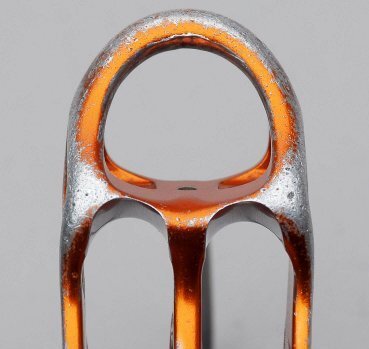 |
|
|
Somehow my ATC Guide has escaped the problem of sharp top edges (and I remember reading from others that the Reverso is more prone to that). But also those edges are not involved in guide mode belaying anyway. |
|
|
I’d guess the top area of the slot gets worn mostly from rappelling. |
|
|
Anna Brownwrote: Rapping and lowering. The sharp edge can be rounded off / avoided longer if you turn the device around backwards to rappel. AKA Low/normal friction mode as opposed to high friction mode. I wouldn’t suggest using your equipment past its designated lifespan. Our company PPE inspections dictate retiring the device upon development of any sharp edges, burrs, or loss/connecting of the teeth. Carabiners are retired after 1mm of grooving. Conservative? Yes. Legal liability for a guide/company? Yes. I have to retire a worn ATC about every 4-6 months. I switched to the Mammut Bionic atc which has steel wear points and weighs the same as the Black Diamond version. |
|
|
Serge Swrote: If you think work "teeth" are cause for retirement or make it unsuitable for lead belaying, you're going to sh:t your pants when you see the original ATC, Lowe Tuber, Sticht plate etc. |

|
Gunkiemikewrote: Aren't the slots on the original ATC a bit less wide or long? I remember reading that somewhere that the ATC guide/XP have wider slots than the original ATC as they can generate as much braking power with wider slots because of the teeth. Also, even if this is not correct, the teeth being worn does mean that you may not have enough friction with skinny ropes. The ATC guide is rated to work with much thinner ropes than the original ATC and even more so than a sticht plate. |
|
|
ATC slots are 15 mm wide. ATC-Guide slots are 14.3 mm wide. I can't find any BD info about the range of acceptable rope diameter for the ATC, and I still have the little booklet that came with my first ATC in 1994. There's nothing in there re. rope diameter. Of course back then a "skinny single" was probably 10.0 mm and doubles were 8.5 - 9 mm. |
|
|
Gunkiemikewrote: The "original" (non toothed) ATC seems to create a tighter bend in the rope and isn't as terrifying to lead belay with as a really worn ATC guide. "Toothed" ATCs really need their teeth. Only the petzl reversos seem to have the "sharp edge" problem. I keep a few booty reversos around because they're light and work well with skinny doubles but they're otherwise inferior to other options. |
|
|
Idk the teeth in my atc guide are worn out and I havent dropped anyone yet. You guys dont happen to work for BD or petzl, do you? |

|
Anyone want to buy my worn down atc guide? I hear they’re as smooth as a Gigi… |
|
|
Ben Kraftwrote: Eeh, ... nope. I have one of these ultra-rare sharp-edge BD ATC guides. I call this added feature "cut-cordelette-for-shoring-up-tat" and I'll let it go for $47 + shipping.
The teeth gets worn down for a reason. This is actually a design feature by all ATC manufacturers. As the belayer gets more experienced with mileage, the teeth gets worn down. It is assumed that with more experience, a belayer is more likely to desire a softer catch. Less teeth -> softer catch -> everyone happy. |


