
 Continue with onX Maps
 Sign in with Facebook






A Detailed Guide to Flashing Sport Climbs
|
|
Flashing a climbing route is when a climber sends a route on their first attempt with prior knowledge about that route. This means that they may know what the holds are like, what moves are the most difficult, where the resting positions are, etc. Flashing is distinct from onsighting, where the climber still sends the route first try, but they have essentially no information about it besides what they are able to gather from simply looking at the route. Despite these disciplines seeming very similar on the surface, they are quite different if approached properly. This is due to the amount of work that can be done before a flash attempt, and how well a route can be learned before ever getting on it. Many climbers just learn a tiny bit about a route before trying to flash it, perhaps reading Mountain Project comments and checking out the pictures. This is a fine approach if you are not very serious about your flash attempt, but there is much more that can be done if you want to tilt the odds in your favor as much as possible. This article will focus on my personal approach to flashing sport climbs that are at the limit of what I am able to do on my first attempt. Part 1: Gather Beta Once you have chosen a route that you want to flash, the first step is to gather as much beta as you possibly can on it. This is a crucial step, and no stone should be left unturned. If you are going to give your best attempt at a flash go, you must learn everything that you can about the route. A great first step here is to read about the route in the guidebook, as well as scour the internet for information on the climb. This includes visiting websites such as Mountain Project and 8a.nu, along with any other website that lists the climb. Read the route descriptions, read every single comment, read the ticks for the route (these often include beta), and study every picture that you can find. I will even go so far as to check the Instagram accounts of people who have ticked the route to see if they have any videos of it. You want to gather all of the information that you possibly can. Studying this information will ideally give you quite a bit of knowledge on the route. A non-exhaustive list of things that you should be paying attention to when gathering this information is:
Gather as much information as you possibly can, and consider making notes of the most important things that you find.  Once you have gathered all of this beta, you want to start zeroing in on the finer details. In particular, you need to figure out exactly how people are climbing the route — especially the cruxes. If you were able to obtain videos of the route, screen record the videos so that you can watch them in front of the route on the day of the attempt in case there is no service at the crag. Watch these videos over and over, first taking note of the holds that are being used and the general movements that the climbers are doing. As you become more acquainted with the movement of the route, take a closer look. Where exactly is that person placing their foot for that move — how far does it seem to be from their hands, does it look like a smear or an edge, do they appear to be getting a lot of weight on it? Get down to as fine of detail as you can. Knowing the dimensions and the climbing styles of the climbers you are getting beta from (whether it be from comments or videos) is also very helpful, as it will give you a more clear picture of moves. Another great way to get detailed beta is to talk to people who have sent the route. Of course, if you know someone that has done it, that’s wonderful. Gather as much information from them as you can. Ideally, watch videos with them and talk through the moves, or even get out to the cliff to look at the route together. A lot of the time, however, you won’t know someone who has climbed your flash project. If this is the case, reach out to people online who have sent that route. Look at the tick lists on Mountain Project, 8a, and other websites, and send emails to the people who have redpointed the route. Ideally, you want to talk to people who really had to session on it, since they will generally be the ones who know the beta with the most detail. Ask them any questions that you have, be it what certain holds are like, how good a rest is, if there is anything tricky to look out for, etc. Having a written description of how to climb a route along with a video of someone doing it can be very helpful. Perhaps the best way to get detailed beta on a route is to go out and climb it with someone whose climbing style you know, and who also knows your climbing style. Belay them on the route and have them hang and talk to you about certain holds and sequences. This should give you a very clear picture about what to expect, especially if this climber knows your strengths and weaknesses well. Be sure to take notes (they can just be audio recordings), or videos of your partner explaining the sequences. For the most serious flash attempts, this is a step that you should strongly consider taking up. However if this is not possible, the aforementioned ways of gathering beta will oftentimes be sufficient. Once you have gathered all of the beta that you can, you want to decide on what sequences you will use in the cruxes. Based on the people that you have talked to, the videos you have seen, and the comments on the route, you should come up with a plan that will best play to your strengths. I generally like to choose one way that I will plan to do each crux, but if there are other betas I still want to memorize those so that I am aware of different opportunities if my chosen beta does not feel like it will work. On less pumpy routes, or routes where you can go feel holds and then down climb to a good rest, you may have more leniency in hanging out and deciding on which beta to use while on route. Generally though, you want to choose one method before getting on the climb and stick with it, with little to no variation. You often don’t have much time to play around with beta on a flash attempt at your limit, so choosing one method and committing to it is typically going to be your best option. One final consideration is getting beta for sections besides the crux(es). This is a personal choice that I think comes down to a few factors, primarily how hard or insecure those sections are. If the easier parts of the climb are still fairly difficult, you are going to want to get beta for those as well. However, if they are easy for you, you may choose not to. The more beta you get, the more you will be climbing from memory as opposed to intuition. This can cause some problems if you are not diligent enough with memorizing these sections. Knowing most of the moves on a section but not knowing all of the sequences perfectly can take you out of intuitive climbing and can increase the risk that you will make a mistake. My general approach is to memorize all sections that are hard, and for sections that are well below your limit, get some information on them (especially any key holds or beta), but don’t worry about trying to memorize the exact sequence. On terrain well below your flash limit, it is better to climb intuitively than to try to follow some beta on the fly that you only kind of remember. For extremely serious flash attempts, you may choose to memorize almost the entire route, but this will be a personal choice based on the individual and the climb. 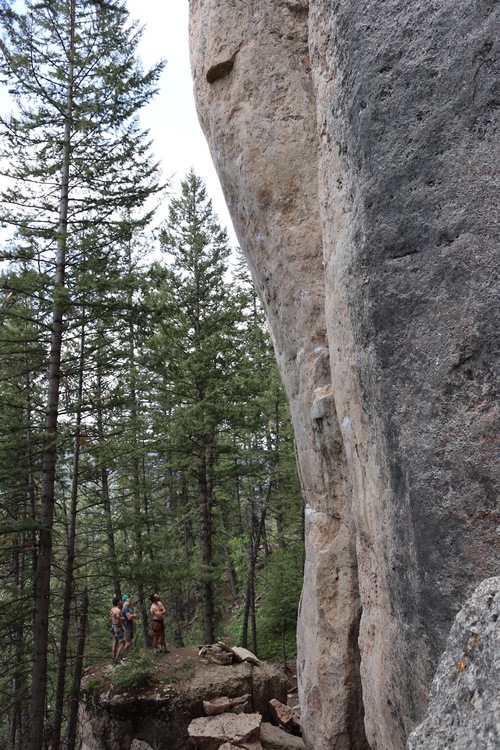 (discussing beta at Ten Sleep) Part 2: Visualize The visualization process is just as important (if not more so) than the process of gathering beta. This is a step that is often overlooked or underdone, but it is crucial if you want to give yourself the best chance at flashing a route. The first step of my visualization process is memorizing the moves. In the beginning, this is more general and it need not involve very fine details. When I do this, I lay down, close my eyes, and imagine that I am watching someone climb the route. It’s almost like I’m replaying one of the videos that I have seen of the route in my head, but with the beta that I intend to use. I can’t produce an actual video-quality image in my mind, but that’s the idea. For me, this process involves many repetitions. I watch the cruxes over and over. As this goes on, you start to get into the more minuscule details of each move. I often am visualizing a sequence and then stop when I realize I’m not entirely sure of something — be it when a foot switch occurs, what part of the hold I should use, etc. When this is the case, I go back and check the videos of the route or the notes I have taken. Then I see how the move is done and I return to visualizing. Most of us will want to do many repetitions of this visualization step — likely more than you would first deem necessary. As discussed above, having a decent but not great understanding of how to climb the route will not cut it, and it can even hurt your chances. You want to get to a point where you can visualize the crux from start to finish on command, without making any mistakes. This may take a few days of several 10-30 minute visualization sessions per day, possibly more. (continued in comments) |
|
|
The next step is to alter your visualization process to a first-person point of view. This does not have to be entirely separate from the visualization process of “watching” the route be climbed, but I often find that memorizing the moves from a third-person perspective is easier because it is more purely mental, while visualizing from a first-person perspective involves more visceral feelings. Once you have the moves memorized, it’s time to start to feel what it’s like to actually climb the route, to the best of your abilities. This means that you are now visualizing yourself climbing the route, and you are pantomiming the moves while laying on the ground. You want to do your very best to match the timing and the sensations that you will be feeling while climbing. Time your breathing with the moves, get your foot up really high if the move you’re visualizing has a high foot, rotate your body with the moves. Do everything that you can to match your body to the positions that you’ll be in while on the route. The aim here is to go beyond just memorizing the moves — you want to literally feel yourself climbing them. Again, do many repetitions of this process. When you’re actually climbing the route, you want it to feel familiar and you want to be consciously thinking about what move to perform as little as possible. First-person POV visualization helps to engrain the moves into your body and mind, especially if done well and with many repetitions. Perform these visualizations over and over, again over the course of multiple days. One thing that I want to note is that most people will feel weird doing first-person POV visualization when starting out. It’s pretty silly — you’re laying on the ground, breathing hard and doing seemingly absurd movements. I suggest doing it alone in a room, perhaps even when no one else is in your house. This will make you as comfortable as possible and will allow you to devote maximum focus to the visualization.  (channel your inner Ondra) The final step when visualizing is the emotions that you may experience while on the route, especially while in the rests. Oftentimes resting positions are when we can be captured by emotion on a route. While actually climbing, we tend to be so focused on the movement that we’re not actively processing our emotions. However, our minds can become more active while we are in resting positions, and they tend to meta-analyze the process. This is not inherently bad, but it is something that we need to be aware of. You want to ask yourself how you will feel before each crux section. Will you be scared of failing? Scared of falling? How about at the rest before the final easier section. You’re done with all the hard climbing, now you have to just not blow it — how would that make you feel? Consider the above questions well before getting on the route. If you think you may be scared while climbing a certain section, or while in a rest, do your best to feel that fear as you visualize yourself climbing it. This may at first sound counterintuitive. You might think that it would be better to visualize yourself as not scared at all — confident and flowing perfectly up the wall. This type of visualization has its place, but you must be realistic with yourself. Do you actually believe that is how you will feel in a certain section? If so, then great. But for most of us, there will be some sort of fear or doubt creeping in when we are trying to flash at our limit. Fear of failure is almost certain to come up at some point during a hard flash attempt. Rather than ignoring this fear, we want to dance with it. If we’re prepared to be scared, fear won’t be such a shock when we’re on route and actually feeling those emotions. When we include emotion into our visualization process, we make the experience more realistic, and we are better able to deal with those emotions when they come up because we’ve imagined feeling them many times over. I have been harping on fear, but there are a number of other emotions that you may feel on route — be sure to consider these as well. Once you have done the previous steps of the visualization process, walk through the entire route in your mind, consider what emotions you are likely to feel in certain spots, and then add those emotions into your first-person visualizations as best as you can. You may not be able to feel the emotions like you would on the wall, but do your best to imagine them and feel those sensations in your body.  Flashing sport climbs is an art. From gathering information, memorizing the beta, visualizing the route, and ultimately executing, there are a number of ways that we can prepare ourselves for a flash. This is something that takes time. I recommend budgeting at least a week for the entire process, putting work in every day leading up to the attempt. In certain instances one may choose to spend more time on prep, depending on the individual, the route, and how important it is to them. Happy sending! |
|
|
You forgot the four-plan, buckets of fish heads, and ample neck meat. For the making of glorious flash. |
|
|
JCMwrote: lol beat me to it |
|
|
Joel Maywrote: Quoting for posterity. |
|
|
You present a very thorough approach for flashing routes. I have not delved into this sort of preparation ever in my career, and I think the disparity of my red point verses flash grade really shows (a full number grade plus one letter grade). I have spent endless hours projecting hard (for me) routes, filming sequences, making beta maps, doing specific training for cruxes, etc., ad nauseum. I guess my only question would be how this sort of preparation plays out in real life. Do you (or other folks who apply similar methods) consistently flash climbs that are pretty close to your hardest red point grade? I would really like to explore this facet of sport climbing and would be excited to implement this if it could mean bringing my flash level up a couple of letter grades. |
|
|
Tom Rangitschwrote: Hey Tom, I think flashing towards your limit redpoint grade is unrealistic, but 3-4 letters away is reasonable imo. I have only gone this in depth with my flashing preparation twice. Once I flashed a 13a, the other time I got very close to flashing another 13a but fell at the end after messing up the beta. This is partially because I was quite pumped, but also because I didn’t prepare enough. I didn’t get beta for the easier outro climbing, and it turned out to be tricky enough that I messed it up. My max redpoint is 5.14a, and it was a mega project that took a year. @Kevin, good question. I think this really boils down to “What is the value in flashing a climb?” We already define flashing as doing a climb first try with beta, and this process just shows you a good way to prepare for that. No matter how much prep you do, flashing a climb is still an extremely different experience from trying to redpoint a climb that you have dialed. I would consider it closer to an onsight, but others may disagree. You’re correct that there is a lot of skill here in the preparation process. It takes practice. That’s something that is unique to the experience of flashing, and part of what makes it fun. To answer your question, I think the value of flashing is personal. Some people may not care about it at all, and for others it may be a main pursuit in their climbing. Personally I really enjoy the added pressure that comes from only getting one try ever to flash a route. There is a unique sense of accomplishment that comes from flashing specific climbs or certain grades, and knowing where your flash level is at is another way that you can gauge your progression as a climber. I’m sure others have different reasons. For me, onsighting, flashing, and redpointing are all unique experiences in climbing, and each has its own value.
|

|
My 2c: Max redpointing is about working slowly but incrementally toward a limit performance. Time is by definition not a factor - if it's truly limit it's going to take many, many, many sessions. On the other hand, I like to minimize attempts on every route I try that's easier than limit. The obvious motivation is logistical: I don't have a lot of local sport climbing, so most of my sport climbing is on trips. It's nice to be able to send in fewer long drives or flights. It also creates a fun and engaging test different from max redpointing. How quickly can I learn beta that works for me? How well do I know my own capability, such that I can correctly judge whether I need to try a different sequence vs. being ready for real redpoint attempts? These are all questions that are thrown into a different kind of relief when doing "minimum attempt redpoint" climbing. I view flash climbing as the natural extension and ultimate test of this style and have employed a lot of the techniques that OP mentioned. My current max RP is a flash, lol |
|
|
szhengwrote: I have sort of the opposite problem- many local routes and enough limit projects to last me the rest of my career. I have done basically all the local routes that I could conceivably flash so I would have to travel more to get the opportunity to do so. |
|
|
Joel Maywrote: I have the same max redpoint and my max flashes at 12d have actually been onsight. I will likely employ some of your techniques to see if I can eek out a slightly harder flash, but if it doesn't get me a realistic chance at flashing 13b or c then I probably won't devote much time to it. Would be curious if others have different experiences and what the average level of flash vs redpoint is for most climbers. At the elite level, I know Ondra at least has flashed 15a and redpointed 15d. He's pretty good at both disciplines, so maybe 3 letter grades difference is something to shoot for. Gotta find a 13b that fits me I guess. |

|
Kevin DeWeese wrote: It's different. Try flashing anything near or above your falling grade and you'll quickly realize how much easier it is to do something hard second or third go even with perfect beta. There's understanding what you need to do on an abstract/intellectual level and then there's actually doing it. When it's actually hard for you, actually doing it without ever having done it before is pretty difficult. Trying to 'derive value' is a pointless exercise as the entire pursuit of climbing is inherently valueless. These are all just different games with different rule sets. I might find some fun and others silly, but that doesn't mean they don't mean a lot to someone else. |
|
|
Tom Rangitschwrote: I've generally seen that for a climber with a balanced skill set, max OS is 4 letters below max RP, and max flash is 3 letters below max RP. This is about where I've ended up, with max RP at 13c, max flash at 12d, and max OS at 12c. For someone with a 14a max redpoint, a 13b flash is a good goal to aim for. If you have a wider spread, that probably means you have room to improve OS/flash skills, and a narrow spread means you could improve your RP skills and try some harder RP projects. What you have access to plays a major role, of course. The flatlands climber who only climbs on short trips and never gets to long-term redpoint, vs the local to a crag who has multi-season projects. Speaking of multi-season projects, these can kinda skew the calculation. For my grade spread noted above, it is worth nothing that although 13c is my max RP, I've done a decent number of them, in a range of styles, and all but one were in a single season or less. So it's also my "max repeatable" RP. But let's say I skip 13d altogether, found the perfect 14a that suits me, projected it for 4 seasons, and sent. I would then have a 14a max RP, but has my general level increased 2 grades; could I expect my OS level to come up that amount also? Probably not. Worth considering in calculations, and the "max repeatable" grade for OS/flash/RP (i.e. the highest grade you done at least 2 or 3 of) could be a better reference point since it smooths out the outliers caused by multi-season mega projects or by super fluke onsights. |
|
|
This post violated Guideline #1 and has been removed.
|


