
 Continue with onX Maps
 Sign in with Facebook






New and Experienced climbers over 50 #22


|
Thanks for the discussion about the rope lengths. For trad lines I feel like double 60’s work great and that’s our go-to, so many advantages there also with traverses and wandering terrain, redundancy for potential rope damage etc. I really was thinking more about sport lines - I’m starting to encounter more routes that are > 35 m. Developers are great about emphasizing when a 60 or 70 is insufficient for getting down - of course the onus is still always on the climber (close your systems people!). For this route we planned a single line rappel with a biner block and carried a bunch of long slings/cord to extend, but it would have been easier to just have a long enough rope. I do think I’ll invest in an 80 this year, even though it might not get used a ton. It sure was handy to have access to an 80 in COR this summer (thanks Anders!) |

|
S. Neohwrote: I have 60, 70 and 70 twins. Rope choice depends on the route. There are some "adventure" routes at Red Rock where the 70 twins just make it on rappel. Good luck on those with a 80 or 100! |
|
|
Woke up this morning to snow on the hills behind my house! 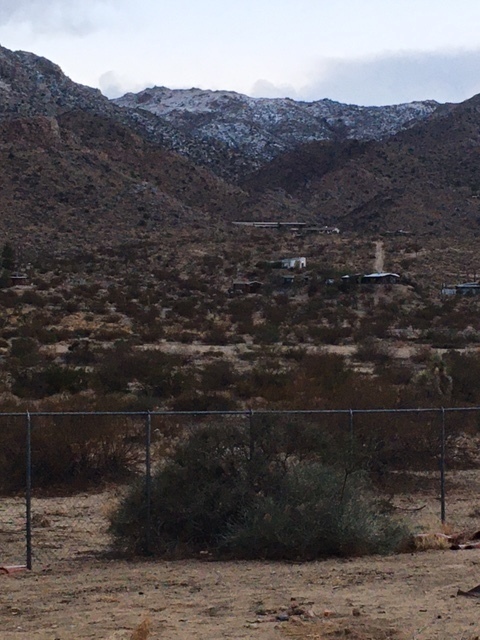 Brutal conditions here in Joshua Tree. Might be stuck inside for a few days. |
|
|
Carl Schneiderwrote: That is one tough looking .10/.11a, Carl. Gets progressively steeper. Our gym routes tend to "slab out" towards the end. |
|
|
Idaho Bobwrote: What routes at RR have full 70m raps? |
|
|
I've seen a personal pattern repeat itself as the rope lengths have become longer. At first, a 70 seemed a little excessive, but there were a few routes that really needed one so I decided I would have one available even if infrequently used. Eventually a 70 was all I was using. Now repeat the same two sentences replacing 70 with 80. If I do get a 100, could history repeat itself? I sure am glad it's not like when I started climbing anymore. Now we have all this cool stuff to choose from; harnesses, belay devices, sticky rubber, cams, light-weight draws/biners, etc... But to me one of the nicest things is how rope technology has advanced giving us options for longer and smaller diameter ropes that are a manageable weight without sacrificing safety/quality/durability. Remember when 11mil 50m ropes were basically the only option? Unfortunately I do. And some of my elders are going to have even older/worse rope memories. |
|
|
Darrell Henselwrote: Exactly!!!! //end topic |
|
|
Back when I had been climbing for a year or two, a friend, even more of a beginner than me, bought a 10.2 mm rope. When it arrived, we looked at it long and hard wondering if such a skinny rope was safe. |
|
|
S. Neohwrote: Ha ha yeah the heel hook was useful. The very end is completely horizontal. |
|
|
My first ropes were 120 ft 7/16 inch diameter nylon (a bit over 11 mm) Such ropes (probably 150 feet, not 120 feet) got people up the first continuous ascent of the Nose, 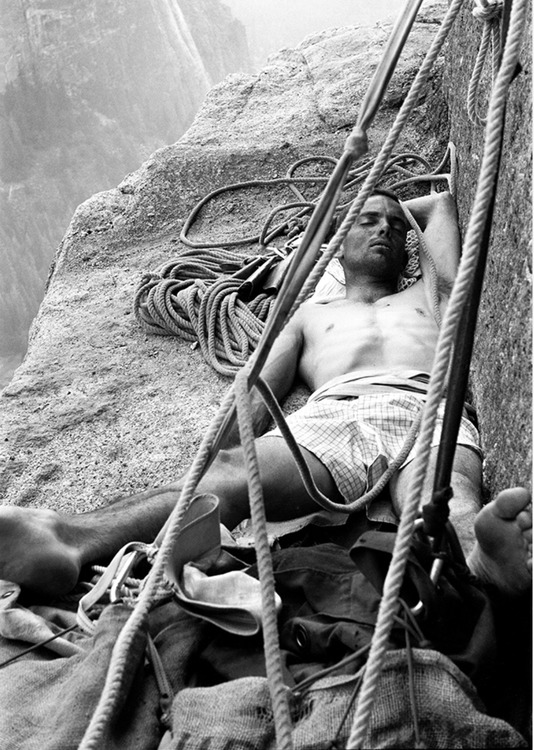 and the first ascent of the Salathe Wall in 1961 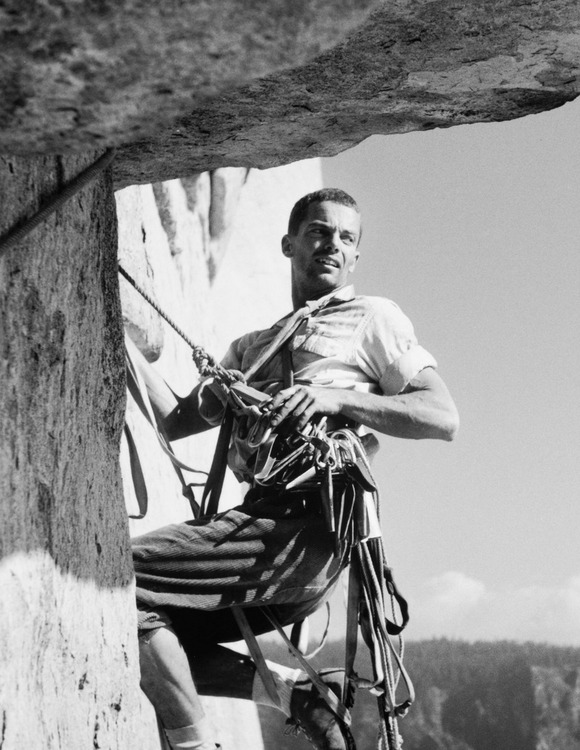 They were heavy, stiff, and kinky. But the overall success of the 150 ft length (about 46m) suggests that longer and longer ropes have little to do with most crag and mountain features. Of course, sport climbs are only partially defined by what the rock provides; the developer decides where to put the anchors at the top, and so there is ultimately no limit to how long a rope will be needed to get up and down such routes, Certain big wall free pitches became more pure when longer ropes eliminated intermediate hanging belays that provided rests where there should be no rests. But by and large, I think the longer ropes provide extra weight, poor communication, and unpleasant and possibly dangerous rope stretch for the second should they be so ill-advised to fall off early in a pitch. |
|
|
Darrell Henselwrote: Pine Creek and the Gorge are two places where I sometimes use the 80. I used it two days out of 6 climbing days on a recent Red Rock trip. The whole rope thing has been discussed ad nauseum and it's really just personal preference. With my own use over the past 10 years the rope that gets replaced the most often is the 70 meter, which I usually buy in 9.2mm. That gets worn out about every two years. BTW, all my old ropes when retired are given to my partner in Bishop, who often doesn't understand why I'm retiring it! Once there they end up on new routing projects or sometimes a local route with fixed ropes that shall remain unnamed. |
|
|
Since we're strolling down rope memory lane...Anybody climb on Goldline ? I never climbed on it but I did go caving with it. Spin...spin...spin...spin T |
|
|
rgoldwrote: I think heavy, stiff, and kinky is pretty much where I'll be, by the time the surgeon releases me to do....anything. Anything at all. Saw her today, next appointment is the end of November. I'm expected to behave myself until then. Always fun to have the "bitd" stuff pop into the thread! And pics, vids, stories of what you guys are up to. Maybe I need to check out bingo at the senior center? H. |
|
|
My ropes are 70, specifically with COR in mind. Even then, we've had a few rope stretchers there, that weren't expected (Fenceline). Interestingly, I also had 2 different 70s reach differently on the same route (Mystery Achievement). The shorter one was still good enough, but that emphasized to me the need to pay attention. I actually like that about City, the variability, old school/new school, even "adventure" routes still there! Best, Helen |
|
|
Tim Schafstallwrote: Some of the 7/16" ropes I mentioned using were Goldline, made by Plymouth. Their ropes had a special "climbing lay." Other ropes we used were made by, I think, Columbia, and were probably yachting ropes. Kernmantle ropes were introduced, at least in Europe, in 1953, but were viewed as quite experimental. The pictures I posted indicate that kenmantles had not made their way into elite US climber's kits as late as the early 1960's I do think that sometime in the mid-sixties we were using 150' 11mm kernmantle ropes. The 1965 REI catalog listed both Goldline and Kernmantle ropes. A 150' 7/16" Goldline rope cost $24. |
|
|
Tim Schafstallwrote: Tim Our first rope was a Goldline back in the mid 70s. No harness. Did the 3 wraps around the waist and tied off with a bowline knot. When you feel, no matter hard you tied it around your waist it road up to your chest. Painful and hard to breathe. We used a figure out to belay and rap. I do remember that it did kink the rope. First real rope was, I believe, 11 mm 50 or 55 m Edelweiss. We used it for years at Seneca Rocks when we lived in Maryland. Stiff rope and did not wear out. John |
|
|
Like Rich my first rope (1963) was a 7/16, 120ft. Plymouth Goldline and like John and Rich we tied in directly via a bowline on a coil. Also hip belayed and body rappelled—though fairly soon adopted the webbing ‘swami belt’ and Swiss seat for rapping. My second rope ( I’m pretty sure) was a ‘perlon’ , so that fits in with the mid/late ‘60s timeline for the ‘rope transition’ that Rich recalls. |
|
|
80m for Kalymnos, 70m for Potrero, 60m for Josh, and 16m for Spy. Usually in the 9.1 range. |
|
|
Alan Rubinwrote: Still doing it that way in 1970. |
|
|
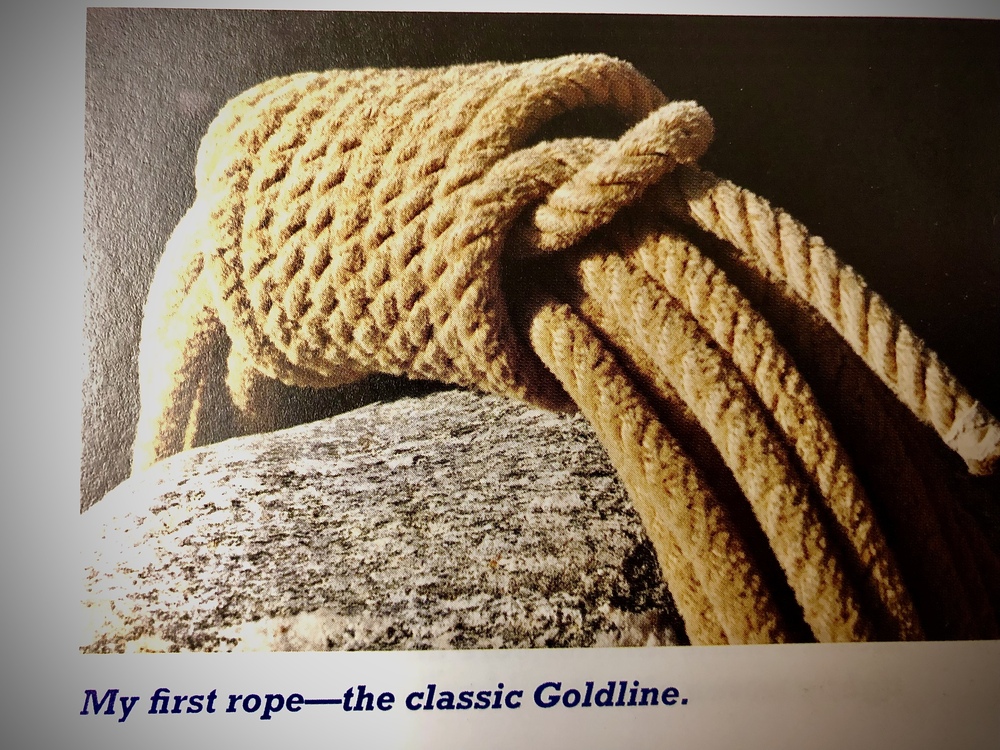 I still have the first rope I ever bought- the classic 120' 7/16" Goldline, and I've used this photo of it in some of my books. As I recall, it was very stretchy when you fell on it. |


