
 Continue with onX Maps
 Sign in with Facebook






Photos of BEAUTIFUL HARDWARE



|
DrRockso RRGwrote: I don't think you watched the whole video or looked at the tests by Jim Titt that it referenced. Both had samples where there was nothing structural in the "old bolt hole". In both Jim's and the hownot2 tests the placements were full strength. |
|
|
Exactly. |
|
|
Nathan Doylewrote: Not necessarily. “Wouldn’t even know the metal was still in there” could just imply a really good hole patching job. |
|
|
Josh Janeswrote: Na, stud is still in its hole with the glue in over the top. Since I couldn’t go 1:1 on the hole this seems like the next best way to minimize impacts. Given the dry climate and amount of rust we are finding on the 30 year old studs we pull I’m not particularly worried about the old stud rusting away to nothing during the glue-ins lifespan. Even if it did there is plenty of glue and surface area left to hold the bolt. |
|
|
Do you worry about the integrity of the hole and thus security of the new bolt? I've of course had similar situations where I couldn't get a bolt out for whatever reason. I always understood it to be best practice when this happens to drill a new hole nearby (but not directly on top of) the existing bolt. I know these are different beasts because they are Wave bolts, but Powers even has recommended distances two bolts should be placed from one another to ensure they retain their strength ratings. I'd be worried that two "moving parts" - the old stud and the new Wave bolt - right next to each other, might not be as strong as we'd expect them to be. In an ideal world, the epoxy would fill all the gaps between the two perfectly, and the old stud would never rust away, but it's easy for me to imagine the forces of a lead fall loosening up that old stud, breaking rock and epoxy, and resulting in a low-strength placement. Don't get me wrong: I love the idea of *almost* reusing the hole, hiding the old bolt perfectly, and keeping the new bolt in nearly the same spot. I've just never seen this before. New bolts are always placed either IN the original hole (drilled out to accommodate a larger bolt) or a little ways away. I'd think if this practice was acceptable, we would always drill second holes right up against the original bolts (when we can't get them out). |
|
|
Josh Janeswrote: Josh, click Bobby’s link a few posts up… Jim’s test demonstrates even with a vacant space (representing the old bolt completely rusting away) still pull tests to 30+ kn. |
|
|
Nathan Pwrote: A really interesting link. But some cautionary observations: In granite. Not a Wave bolt. A sample size of one. A super experienced installer making "perfect" placements in a controlled environment... Nathan, I'm sure it's fine. And I appreciate your attention to detail and desire to minimize impact. I'm just not sure I'm ready to start doing this (nor about taking whips on bolts I know have been replaced this way) especially in softer/porous rock.... but I'm intrigued by the idea. |
|
|
Also, to point out the single factor that Jim has mentioned every time this comes up, is that the new bolt needs to be longer than the old bolt/hole. If you don't have a new bolt that goes in and glues deeper than the old bolt, I don't imagine his recommendation would be there for this method. |
|
|
Josh Janeswrote: Elsewhere there is the testing done in a fly-ash building block so soft you can scratch into it with your fingers, in fact I think it's still lying in my yard. I've also tested in a standard concrete block. And also Bobby did the same tests, may have been a twist bolt but from memory it was a single leg one. As far as I am concerned it is a perfectly valid technique. |
|
|
Matthew Jaggerswrote: Indeed, while the tests were done with bolts shorter than the empty hole as a worst-case scenario I also know that 3cm deeper and the old hole is completely irrelevant so recommend a longer bolt. |
|
|
Jim Tittwrote: Also, a sample size of one. I have never seen or heard of this technique until now. Almost every installer I have worked with would never consider this to be a viable method. Sure it might look better, but I really like it when it holds falls better. |
|
|
Josh Janeswrote: The 2x bolt length spacing between bolt holes is for when both holes are being used. Why? Because if one bolt pulls out the rock, it pulls a cone of rock around the bolt with a radius equal to the bolt length. In order for the 2nd anchor bolt to remain unaffected, it should be at least 2x the bolt length so that for each bolt their “cone of pull” is independent from the other. That being said, if you can’t remove an old bolt and have to chop it, the replacement could be as close as 1x bolt length away since the old bolt hole is no longer a consideration. If the hole isn’t being used, it doesn’t need its own “cone of pull”. EDITED TO ADD: I was speaking about the general rule for mechanical bolts. I’ve used the adjacent hole method discussed in this thread when a broken bolt cant be removed and the replacement will be a glue in, and had good results. I do like that this hides the old bolt easily and keeps the original bolt location |
|
|
Luke Bertelsenwrote: We would love to see you or anyone else do more testing. Or find any evidence of this method being weaker or failing below any of the applicable standards. All of the testing to date suggests that this method provides full strength placements. It sure is a clean way to camoflauge the rare removal that just doesn't go right. |
|
|
Luke Bertelsenwrote: That you haven't heard of this technique merely tells us about you, in other countries it's common practice. We have done the testing with a 100% success rate, what failures have you observed? |
|
|
The forum on softer rock |
|
|
Well done, I was too busy to search but I knew I'd tested it. |
|
|
Jim Tittwrote: Jim, as I mentioned, I have not seen any any failures with this method as I have not seen it used. I have always moved the new bolt to a practical location and masked the area when I could not extract a bolt. I'm simply not willing to jump on board at this point. This method seems to really stress solving a cosmetic problem and leaves a lot of variables unknown regardless of all of the testing data you are getting at a moment in time. Using an old bolt, that we want to replace and no longer trust in the climbing system, as a bonding surface doesn't make a lot of sense to me. |
|
|
Developers and bolt installers should do installations according to the best of current worldwide understanding and strive for the minimum accepted standards. There's a lot in the past previous installers did to the best of the current knowledge/understanding. But there were (and still are) some that have their ostrich head in the hole regarding striving for more updated understanding and methods, and are: Installing cheap hardware store bolts when perfectly affordable rated bolts are available. Poor choice of hardware material/metal. Mixing metals. Not understanding their tools, expansion bolt limitations, too big or too small of holes, over and under torquing, screw ups with epoxy setting too quickly/not mixing well enough, choosing crappy rock to install in, etc. There's a lot of ways to screw up an ideal installation. But they're pretty simplistic to install by following the correct procedure and understanding your tools/hardware/rock. So yeah, things are done differently across the pond. As long as those developers/installers do work according to the best understanding/testing/knowledge/procure/strength standards, we should be happy. There's pros & cons / disadvantages/advantages to everything. With rebolting: -Pull out old bolt, reuse properly prepared hole for a new bolt -Chop old bolt, patch, drill new nearby bolt -Core drill old bolt, properly install new bolt according to procedure for smooth core-drilled holes *All proven to work and be fine. -Chopping old bolt, installing new glue-in bolt directly above old bolt with +20mm depth longer than old bolt. *Tested and proven to be fine. For anything, time will tell. But us developers/installers stand by our work and acceptance of accountability for our decisions. (As pictured) : For this anchor rebolt, I decided to install a 80mm long Twist Bolt on top of the rightmost old hardware-store 304 50mm long sleeve bolt that I had trouble getting out. Previous distance between the two anchor bolts was only 10cm. Decided it was best to install a new glue-in at a more ideal distance where the cones weren't intersecting. Was able to pull out the old left sleeve bolt and patched up the old hole later on. For the glue-in I installed on top of the old bolt, that's 3/4's of 50mm of the bolt that's in new rock, and 100% of 30mm+ that's in fresh deeper rock. 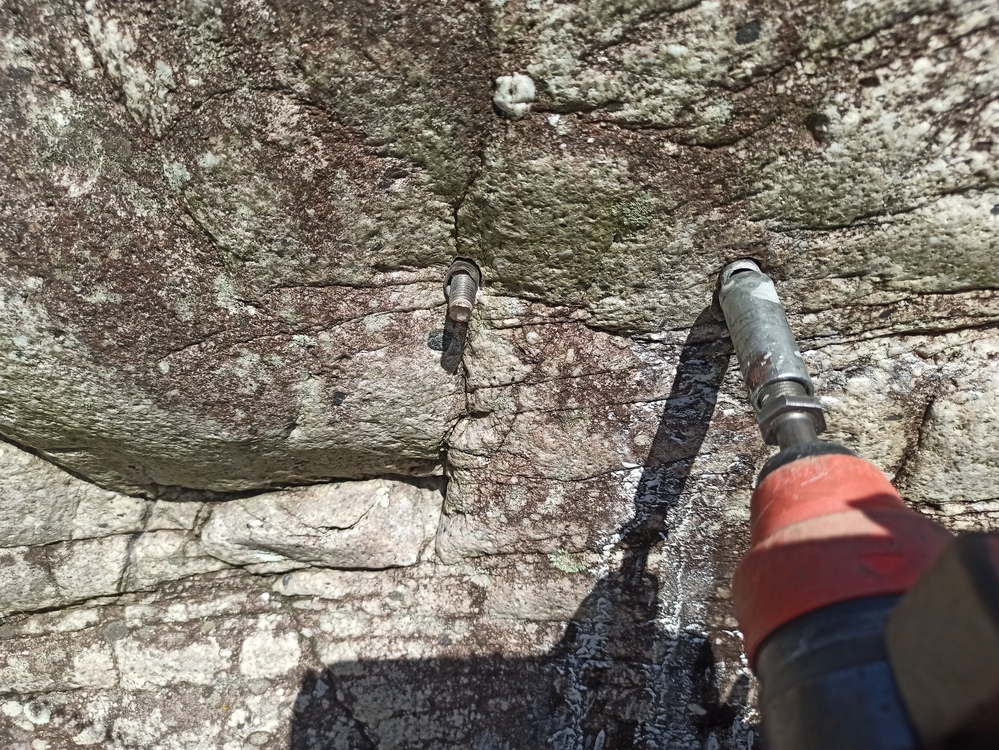 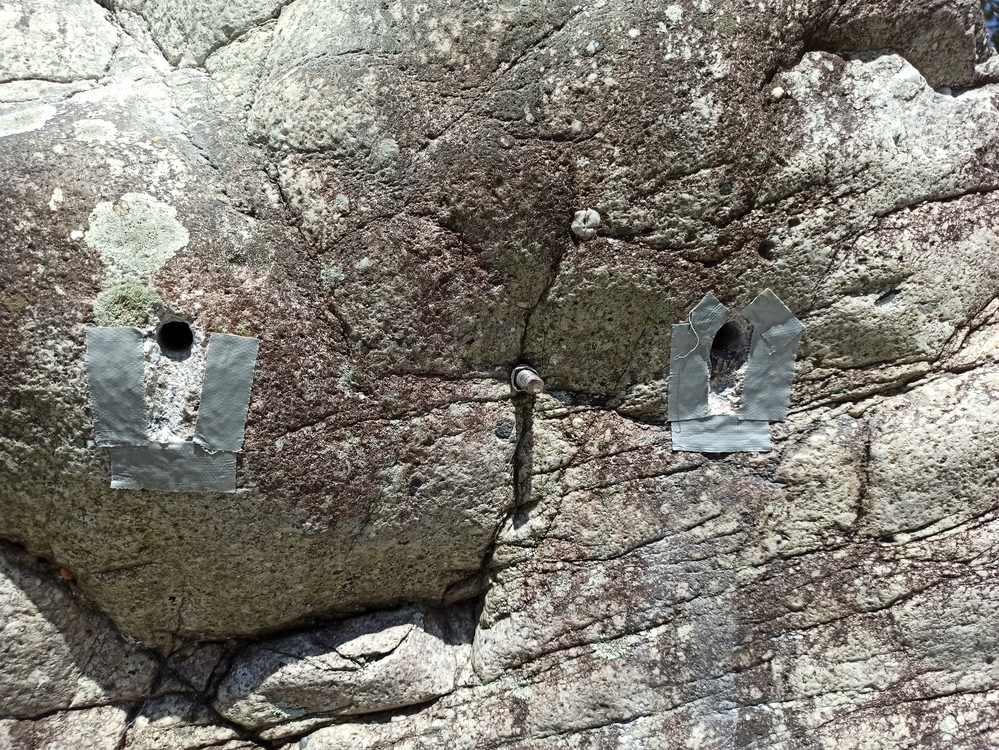 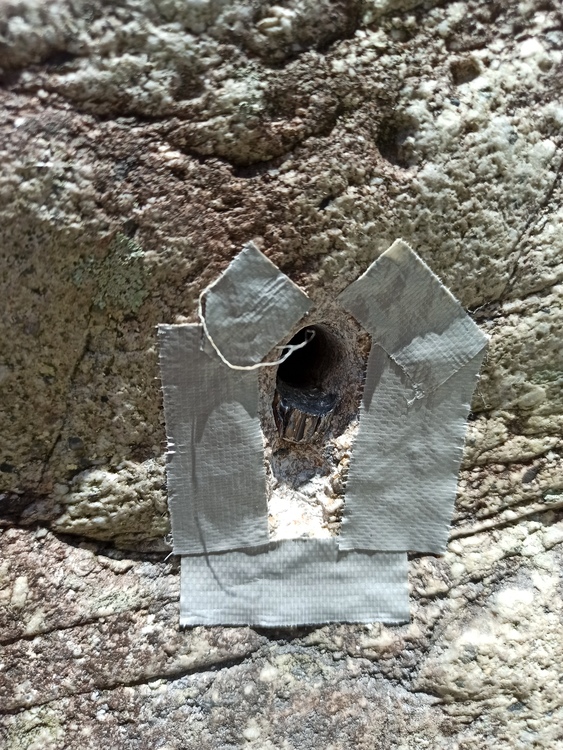 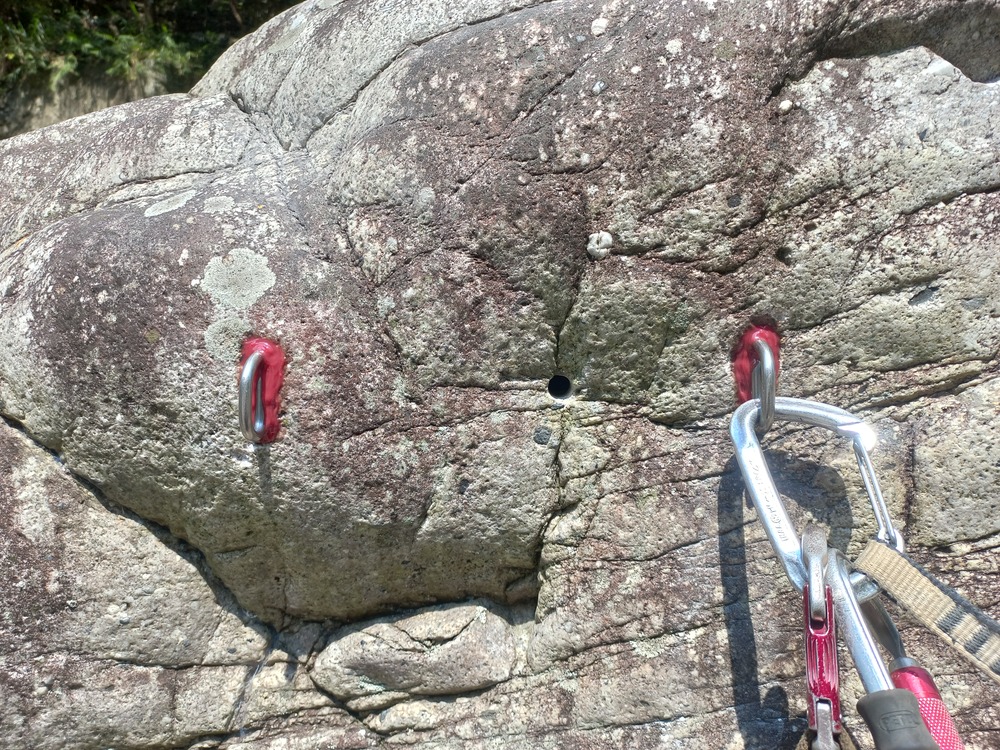 For any complainers: I wouldn't call this "beautiful hardware", but it sure as hell is safer than what previously was there. Yes, I did a slight recess on them, they're expected to get loads from different directions. And it's not an issue at this small crag to have bright red epoxy, and I intentionally wanted them to be a bit more visible from the ground. Besides, they're not at YOUR crag or in YOUR country anyways. So rest well. |
|
|
For "Beautiful Hardware", here's a short terse installation video of mine of a Bolt Products 6mm rod × 80mm 316 Stainless Steel Twist Bolt with Hilti HIT-RE 500 V3 epoxy I take pride in. https://www.instagram.com/reel/ChujaVKpLlA/?utm_source=ig_web_copy_link 2.4 million views. (The IG algoritum doesn't make sense to me, it was an esoteric video) Stay out of the comment section, it'll give you a brain aneurysm. 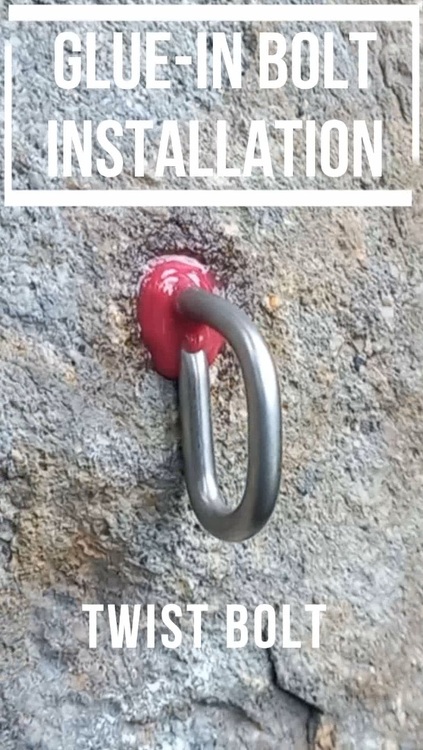 |
|
|
Kevin Maliczakwrote: Thats some very nice epoxy management there! Bravo. |


