Continue with onX Maps
 Sign in with Facebook






Is it really a bowline?



|
amariuswrote: The wiki also calls it an "anti-bowline" which is somewhat unsettling. I don't want to use anything that is the anti-knot of anything, haha |
|
|
Ian Lauerwrote: It's bomber. I use it all the time. It works better than a traditional bowline at catching loads and cinching. That wiki page even agrees with me that its a better knot lol. |
|
|
Erik Strandwrote: Yeah, I stand corrected, I guess it is a version of the bowline. No offense though, I'm dubious of anybody claiming a knot is bomber without seeing it load tested in both intended and unintended orientations. Not sure I understand your point about dressing the eskimo bowline. What you said seems to indicate that it would be liable to the exact same issues that cause standard bowlines to fail, no? I'll have to try it and get back to you |
|
|
The problem with the Eskimo / Anti / Cossack bowline is it is not widely tested. If a new slippery rope comes out on which it doesn't hold, anybody using it with such a rope will have to learn the hard way rather than by reading others' reports. |
|
|
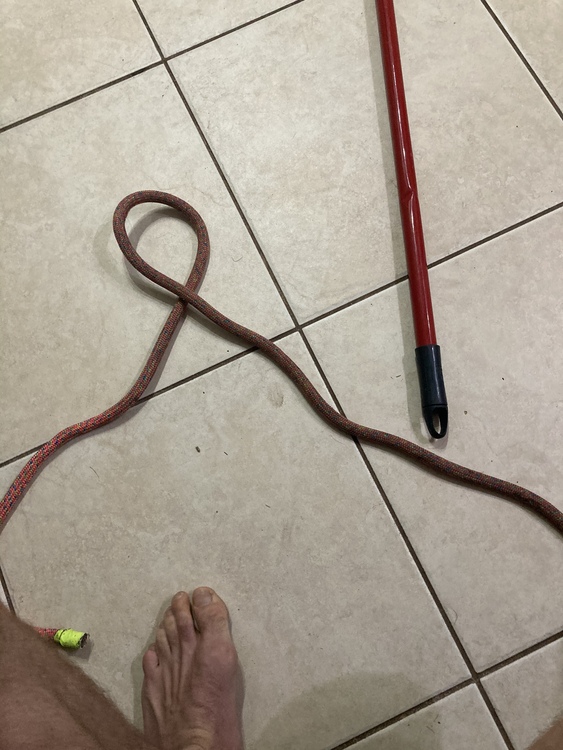
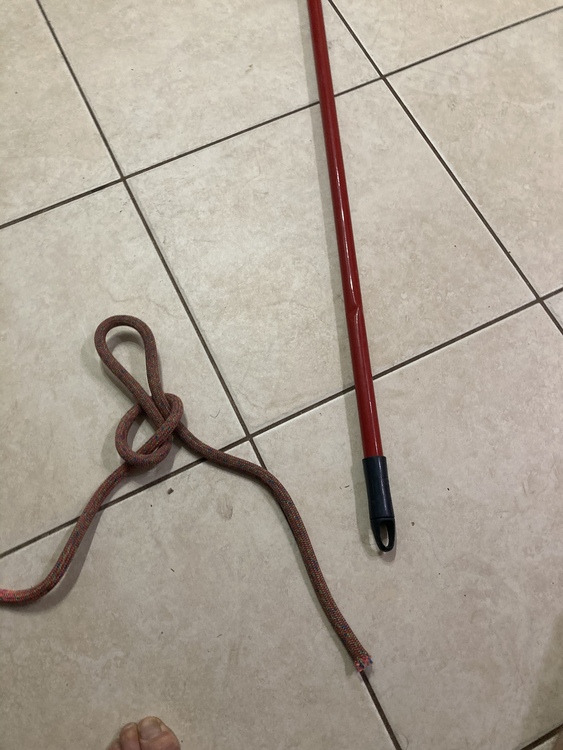
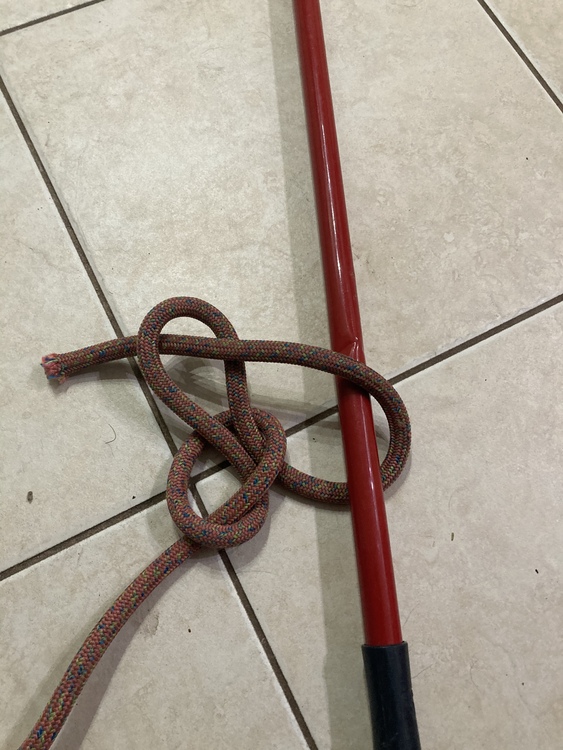
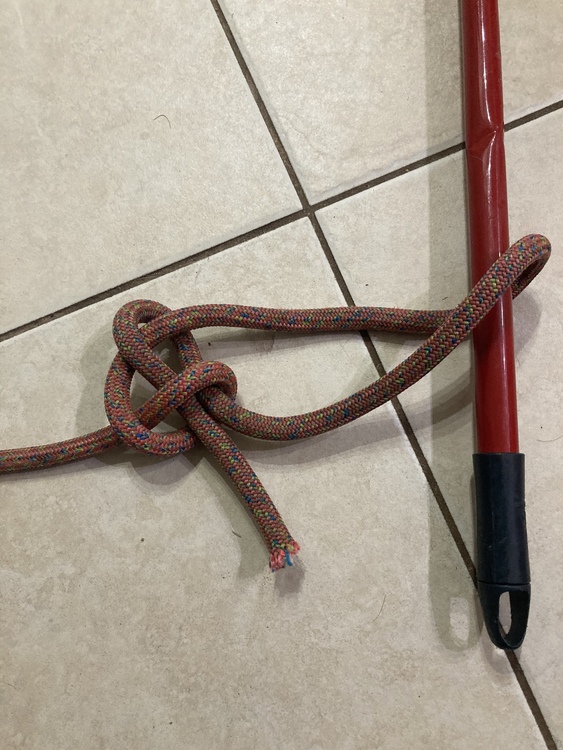
Daniel Joderwrote: In reply to your original post: Answer: The top image is a #1013 Double Bowline (and you added a strangled double overhand backup knot on the returning eye leg) The bottom image is a #1010 Simple Bowline. The #1013 is a universal way to identify a 'Double Bowline' (referenced in the Ashley Book of Knots - 'ABoK'). At illustration number one thousand and ten, you will find the simple Bowline. At illustration number one thousand and thirteen, you will find the 'Double Bowline'. ABoK was published in 1944, so its old news. Link to ABoK: https://archive.org/details/TheAshleyBookOfKnots/mode/1up?view=theater ABoK is now free in public domain because more than 70 years has passed since Clifford Ashley's death. ... Commentary: I noticed that you tie your Bowlines with 'S' chirality. This suggests that you might be left-handed. Most right-handed people tie their 'Bowline' knots with 'Z' chirality. There is nothing wrong with 'S' chirality - it is equally valid as 'Z' chirality. Or; it could also be simply due to the fact that you formed your knot around an object - which reversed your viewing perspective (and forced you to think backwards). The same situation occurs when you face toward a tree and tie (a) 'Bowline' - it reverses your perspective relative to tying-in to your harness (and some people get confused as a result). If you tied (a) 'Bowline' into your harness, you would have a different viewing perspective... |
|
|
Do the differences between the cowboy bowline and standard bowline become moot with a double overhand backup? Hard to imagine it matters if the whole knot is well dressed. |
|
|
Erik Strandwrote: Ive been using this method to tie into the rope (with a rethread back through the hard points and the knot) for years now. Never really thought much of it, but this thread has some cool info! Thanks for posting Erik |
|
|
Erik Strandwrote: No, what you get is an Eskimo BWL, and I'm surprised you've not seen it capsize at high loads unless tightly tied!? Rather than the "slip knot" --which you got right (it's often confused/misstated as ...)--, you want to make an OVERHAND NOOSE, or marlinespike hitch, where it is not the EYE LEG making the U-folded (bight) opening into which to tuck the tail and then capsize ..., but the MAIN LINE (S.Part). That collaring U-fold after capsizing the tucked tail --the "rabbit around the tree" bit-- goes around the S.Part (main line), not around an eye leg. DO NOT PASS GO! - - - - - - - - - - - - - - - - - - - - - - - - - - - - - - - - - - - - - - - - - - - - - - - - - - - - - - - - Elsewhere someone opined "Separately, you're viewing it from the "back" side of the knot compared to how it's usually viewed. " NO NO NO :: nicely, we for once see the RIGHT/ front side of the BWL, and not the back, which tradition and brain-dead knots-book authors have been parroting for centuries. --and then people complain about how difficult it is to see if the knot is tied correctly. Rather, AS IS USUALLY THE CASE WITH THE LIKE--SHAPED "SHEET BEND" --Google images and see-- show the crossing point of the mainline with itself; the rabbit's in/out U-turn is very easily comprehended from the front side, and esp. the Yosemite finish is MUCH better seen from the front side as the OP uses. But, rather than the YoBWL's wrap & tuck, which can shift into unwanted geometry within the nipping turn of the BWL, just make a Double BWL (as OP has), and make a back-loop/wrap with the tail around the "double" turns of the main line (wrap around the crossing point of mainline & outgoing eye leg) to tighten down upon those, which in turn tighten upon this "end-bound" securing wrap. Not to worry about loosening, as the securing wrap is only manually tensioned in setting the knot by the tyer, not further tightened in loading (indeed, loading will diminish the diameters of the double turn per stretching, and the end-bound wrap will show air ... at that time. = "End-Bound Dbl. BWL / EBDB") Mark did some good work in his Bowlines Analysis, but IMO he really should've stomped HARD on the bassackwards presentation of the wrong side of the BWL, finally! (He does a good job in presenting many of the variations by showing them from Both Sides Now, per Joni). As for that "tying it with the tail on the outside ... half as strong / ...greatly weakens" claim, I think that it might be in On Rope (1 & 2)?! --AND in FotH of some edition(s). AND IT'S NONSENSE. As you can see for yourself, if you ring-load these tail-inside vs. tail-outside BWLs, it's the "proper"/former one that might quickly spill, and the latter will hold. Some highly mathematically inclinded Slovaks tested this extensively (in replications). Still, either way, make some further securing. FYI, there are hundreds of "bowlines" to be made; and there are some quite good ones yet to see light of day. (Perhaps into Slovak testing :: shame they burned resources testing only the simple BWL which they in any case dismissed (rightly) as too insecure-when-slack. And ironic that they cited Mark's Analysis in a (dubious --I know of no testing basis-- assertion of "cyclic loading" causing loosening; rather, mere jostling the unloaded knot) in holding the BWL as unacceptable for SAR, when his paper is if anything a strong case for RETURNING **secure** versions of the easily untied knot to use! I.p., the EBDB. <sigh> *kN* |
|
|
Noggin, the way I tie the Eskimo bowline naturally tightens itself. My co-workers always comment about how they are always tighter than traditionally tied bowlines. A little harder to untie since they cinch better I suppose. It’s always done well for me. I’ve pulled over trees that definitely put at least 10,000 pounds of pressure onto that knot |
|
|
As a few people have said, the knot DJ is tying is an Eskimo Bowline, so named because it was first observed in the rigging of Inuit sleds. If you follow the venerable "rabbit comes out of the hole, goes around the bush..." protocol, then there are actually two "bushes" the rabbit could go around. One of the bushes gives the standard bowline and the other gives the Eskimo bowline (but to get a knot at all you have to form the "hole" differently for each option). Done either way, the knot looks like a bowline, but you can instantly tell whether it is Eskimo or standard by observing where the load line exits the knot. In the picture below, the knot on the left is a standard bowline and the knot on the right is an Eskimo bowline. The curved loop at the top of the picture is the load line for both bowlines, and the distinction between the knot exit points should be clear. 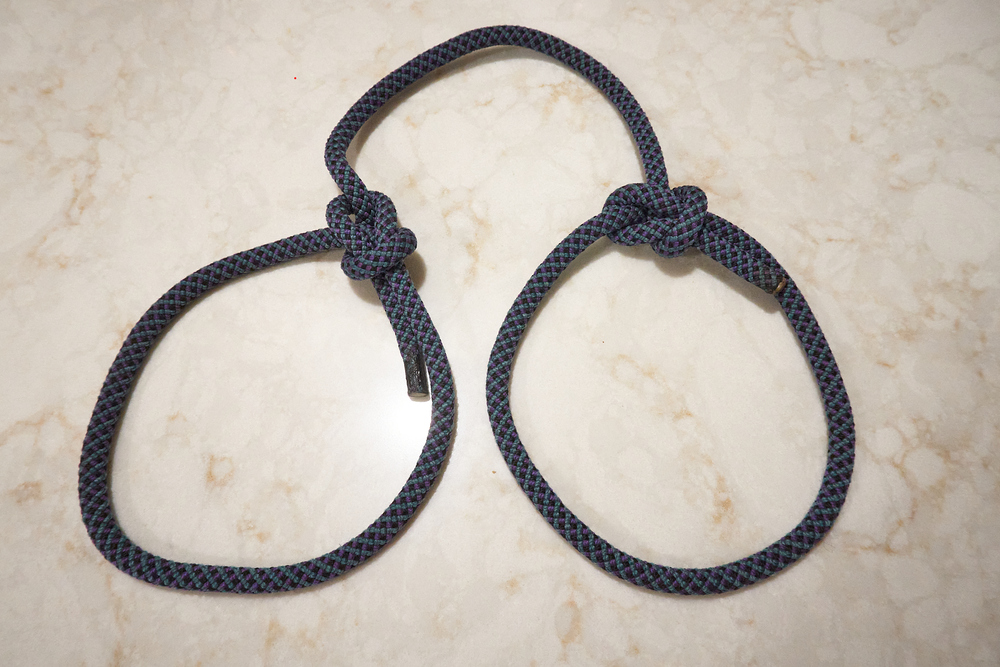 Having chosen a bush, our rabbit has a choice of which way to wrap around it. One way gives the right-handed version, with the tail inside the loop. The other way gives the left-handed version, with the tail outside the loop. The left-handed bowline is also called the Dutch Navy bowline and the cowboy bowline. In spite of a historic preference for the right-handed bowline, testing indicates left and right are equally strong. The right-handed bowline is actually more resistant to ring-loading. The Eskimo bowline is as strong as a standard bowline, more stable under intermittent loading, and stronger under ring loading, so might seem to be a better choice. But it capsizes under high loads unless well snugged. I don't know and haven't heard about is the difficulty of untying after loading. Ease of untying after loading is why some climbers prefer some version of a bowline with appropriate finishes. If the Eskimo bowline jams tighter than a standard bowline under load, then together with its tendency to capsize if not tied tightly enough, it would be less preferable from the climber's perspective. |
|
|
The people who complain are not very smart IMO. It isn’t hard to untie as long as you understand the mechanics of breaking a bowline knot to loosen it. Many regular bowlines can be untied without needing to break them. I find the Eskimo needs to be broken before it can be untied. I’ve also personally never had one fail on me. I’ve used it thousands of times for a wide variety of weights. I’m anal about dressing my knots. I can definitely see it failing if it isn’t dressed; but the way it’s tied naturally dresses itself. No one needs to use it if you are not comfortable with it. I like it a lot. |
|
|
I've played with both versions of the Eskimo Bowline for ring loading with a modern dry-treated rope and found both to be less reliable than the Cowboy/Dutch bowline. I thought the Sheet bend was supposed to be better than the Lapp bend, but apparently not with this rope. |
|
|
I have a lot of real world experience with these knots. It’s weird constantly having people come with internet info that they haven’t got much experience with. Dunning Krueger as fuh bruh We ring load bowlines all day everyday in professional tree work. I’ve never seen any variation of a bowline fail unless it just wasn’t dressed. I don’t back up my bowlines, ever, and none of them have failed. We have abused rope and equipment more than any rock climber would ever dare to do with life supporting equipment(I don’t do it with life supporting equipment)
I also still highly advocate that you should just go learn a cow hitch and be done with using bowlines for top roping. Cow hitch is a vastly better knot for this function. It cinches, doesn’t loosen itself, can be backed up to an absurd degree, is easier to tie, and doesn’t wiggle on the bark(wiggle destroys cambium and eventually killing the tree faster than just choking it for a short time)
|
|
|
I wasn't familiar with the term "cow hitch" but from Google is this just a girth hitch tied in a different way than usual? |
|
|
Erik Strandwrote: I'd argue that we can both appreciate your experience in rope work and likewise doubt it's application in rock climbing. Applications in tree work do not translate directly for the reasons you stated, different ropes, loading cycles, friction, etc. And some of the things you've said straight up go against standard practices in life supporting applications, like not tying a backup. Just because you haven't tied a backup for X number of years and haven't died does not make that a safe thing to do. Likewise for the way you tie the bowline. It certainly adds to the trust in that system, but it doesn't make it free from being criticality analyzed. Worth considering... And thanks for what you've added. It's been an interesting an engagement to learn different ways to tie bowlines and think about them again for a bit, although I won't use them because there are better knots for almost any application could use them on. Do you have a resource for how you would tie the cow hitch. Thanks |
|
|
Jasonwrote: It's basically just a girth hitch that's made with a single length of rope, instead of a loop/sling choking an object |
|
|
rgoldwrote: But this isn't a choice usually in the tying, the end having gone "out" of a hole has only one bush, at this point of orientation, to go around --one of the reasons a good way for tying in is to take the tail in hand and reach out and UNDER the S.Part, turn around it, casting that "hole" and establishing the correct orientation for the basic bowline. (This would all be more clear were the BWL presented from the front side and not the back --grrrrrrRRR!)
The tail can be taken around the crossing point IN A LOOP, reentering hole in same direction as before, or can make the U-fold (bight) collar around the S.Part (or, for Eskimo, the outgoing eye leg). If making this quicker, looping around, variation, wrap away from eye in the BWL orientation, or towards it in the Eskimo-side entry; then REPEAT, and for any which way wrapping, the result will be pretty stable & secure (and put 3dia of rope within the main nipping/compressing S.Part loop).
By whose testing? --I don't think I've come across much if any. --and nothing like the stats-serious testing of the Slovak study! But "ropes (even knotted) don't break" --one shouldn't approach the questionable forces for that. But have your cake & eat it too :: from RGold's R-side knot above, take the tail --now retucked from collaring the outgoing eye leg, and thus tucking through the "hole" from THE SIDE THAT LEADS TO A (basic) BWL, and ... put in the collar around the S.Part, finishing per common BWL tucking back --in opp. direction-- through the hole --putting in a 3rd dia. thus, giving more cushion vs. compression and material qua heat sink(?!). (And, yes, the leftside knot could get similar treatment, its extension collaring the outgoing eye leg (the one on the viewer's left) --this would flow better from the tail-outside BWL ("cowboy").) *kN* |
|
|
Well, thanks, everyone for all the awesome detail. I have to admit my eyes are a bit crossed and my head is still spinning. I didn’t know the size of the can o’ worms that I have apparently opened. So… the bottom line, if I understand correctly, is that I could learn to tie my bowline around the tree in a slightly more optimal way, but I’m probably not going to die doing things the way I always have unless I plan on introducing huge and very unusual forces into the system. |
|
|
Daniel Joderwrote: You pretty much got it correct, other than to learn a cow hitch. IMO, There’s a lot more peace of mind using it as your anchor. No need to worry about strange or unusual forces causing your knot to fail. The second largest tree company in America made me use it instead of bowlines for life support anchors. |
|
|
Hello Daniel Joder, the "can of worms" you allude to is really only an issue if you haven't studied the subject of knots in detail. And that holds true of any complex subject - eg gravity and quantum physics. You can explain things at different levels to different people - eg in the case of gravity, Isaac Newtons laws appear to be more common. However, another way is to understand gravity in terms of Einsteins theory (ie geometry and the curvature of space around large masses - eg the Earth causes the space / space-time around it to be curved/warped). Example video where a subject is explained at different levels of complexity: https://www.youtube.com/watch?v=QcUey-DVYjk The subject of knots and knotting is actually quite complex... and it is difficult to find reliable source material to learn from. In this topic thread you started, it evolved from Simple #1010 Bowline and #1013 Double Bowline to 'anti-Bowlines'... Anti Bowlines can be readily identified by the position of the collar - which always forms around the outgoing eye leg (and never around the SPart). It is possible to create a 'secure' anti-Bowline (ie one that is resistant to combinations of cyclic loading, slack shaking, impulse/impact loading, etc) but, the design intent of these structures is actually to resist transverse loading profiles, rather than loading via the SPart. I've attached a handy summary of anti Bowlines - see images below... There is an interesting side-effect caused by rotating/twisting the collar in an 'anti-Bowline' (refer to bottom image) - which causes jamming. 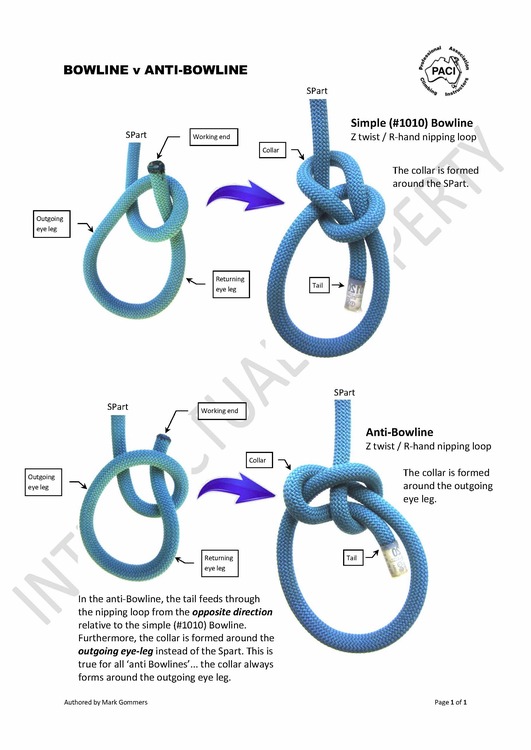 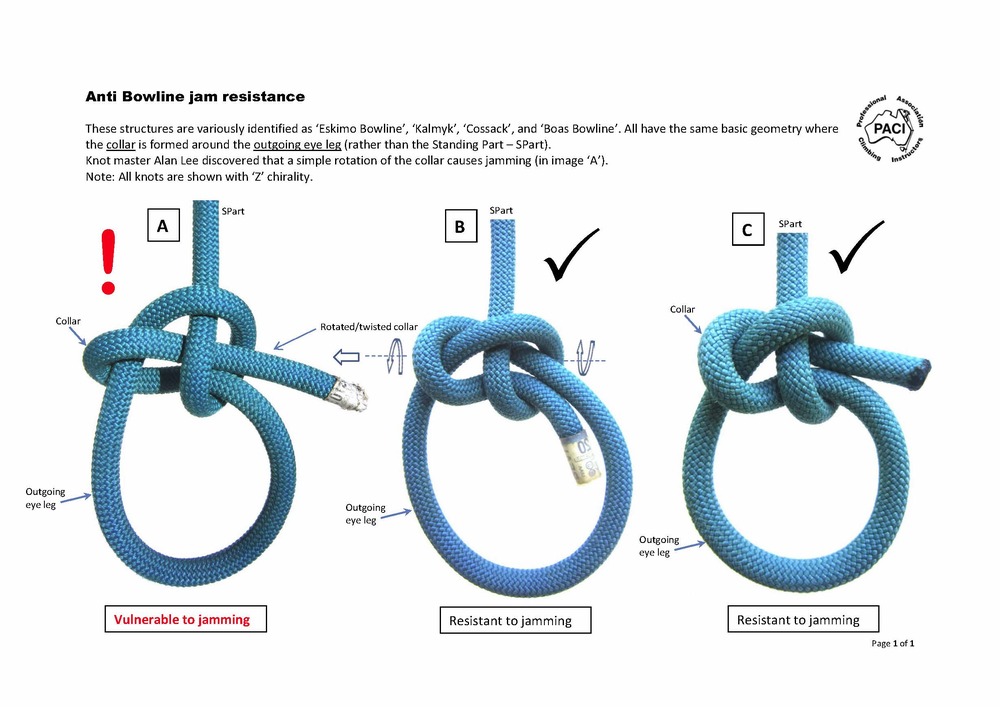 |