
 Continue with onX Maps
 Sign in with Facebook






Is it really a bowline?


|
|
OK, I've gone back and forth with partners about this. I suspect I have been tying bowlines around trees and boulders the wrong way for years. I was actually taught this way BITD, so I'm a bit embarassed to even post this. What does MP think? Dare I even ask? I know we have a lot of knot nerds here, so hopefully I'll get some good feedback... is this really a double bowline/bowline? Or is it simply a "left-handed, upside down" bowline as one buddy thinks it might be. I'd say I'm gunna die, but I've used it quite a few times and I'm not pushing up daisies yet--pure luck? Any other issues? (I guess it might be obvious that I don't tie in with a bowline.) In this picture, the towels represent a big tree. The strand at the bottom would be the loaded strand. In this example, I left the "double bowline" and the backup knot a bit loose so they can be seen a bit better: 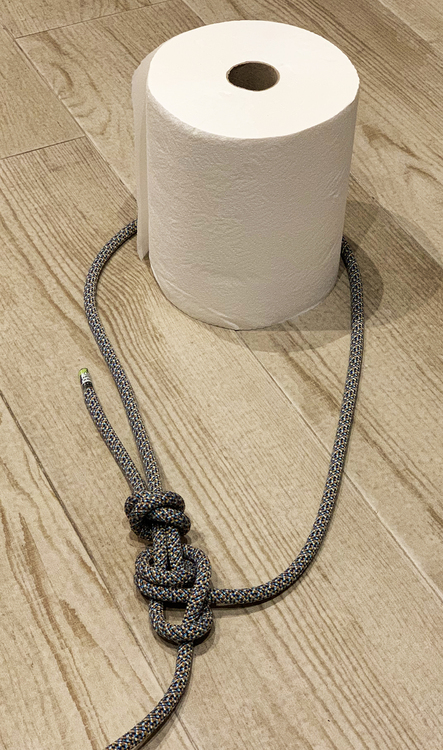 For further clarity and study, here is an example of a single "bowline" as I might tie it, but leaving off the backup knot in the picture just to show the main knot itself in its simplest form: 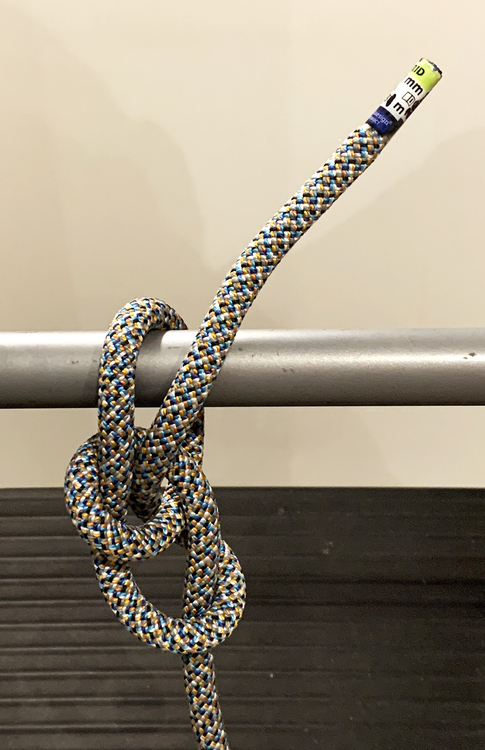 |
|
|
It looks like a normal bowline but with a "left hand nipping loop(s)". It's a mirror image of the way most people tie it, but functionally identical. |
|
|
Those are both bowlines. The first should have the tail on the inside of the loop, not the outside, but that doesn't matter very much. |
|
|
I've also seen the toilet paper one called "double bowline", and I have not seen any other name for it. Wikipedia agrees. |
|
|
Appreciate the input, folks, thanks. |
|
|
Andrew S wrote:The first should have the tail on the inside of the loop, not the outside, but that doesn't matter very much. so, as climbers, we can feel safe knowing its not going to kill us? At what point does it matter? There should be a book dedicated to the bowline knot for climbers. It's amazing how simple or complex it can be tied, and useful in so many applications. EDIT: Daniel your rig looks fine. All the experienced, high level climbers I know use the double bowline to tie off trees and boulders, it's what I was shown none of us have died yet either. I know it's not a popular opinion, but it's really easy to spot an incorrectly tied bowline if you know how the knot works and use it all the time. But some time you get tripped up and have to wrestle with thinking you've been tying it wrong all along, or maybe you just tied it wrong this time. Kind of like how when you say the same word over and over it loses meaning. Never hurts to ask! |
|
|
Serge S wrote: Yes, the first is a double bowline. I was just saying that they are both "bowline" category knots and are acceptably tied. I also think you are right about the tail and the stopper. |

|
Andrew S wrote: I read somewhere that a bowline must be tied with the tail inside the loop; if wrapped the other way around the "Tree", it's only half as strong. That would mean it matters very much. Is this true or not? |
|
|
Mack Johnson wrote: I don't know of any evidence saying it's weaker. For ring loading it's actually much better than the standard version. |
|
|
Austin Donisan wrote: I don't know where I saw it, but I remember reading that the cowboy bowline is actually stronger. |
|
|
Kinda looks like a sheet bend with an extra loop and backup knot too. |
|
|
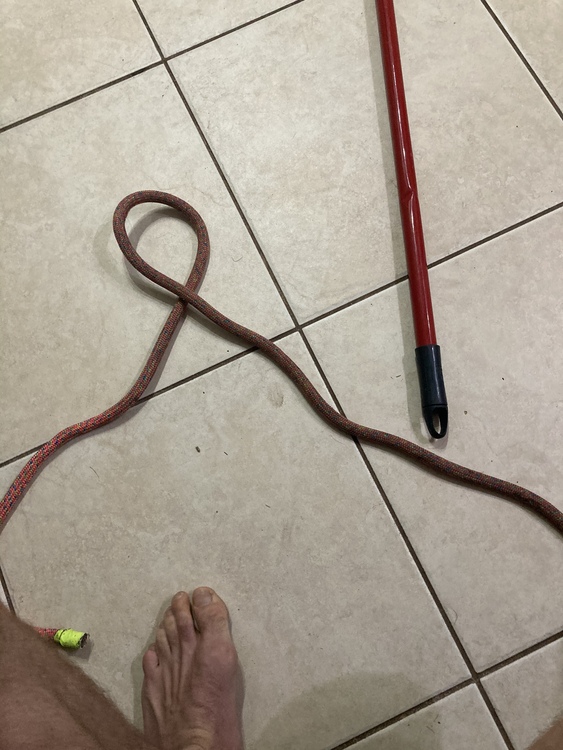
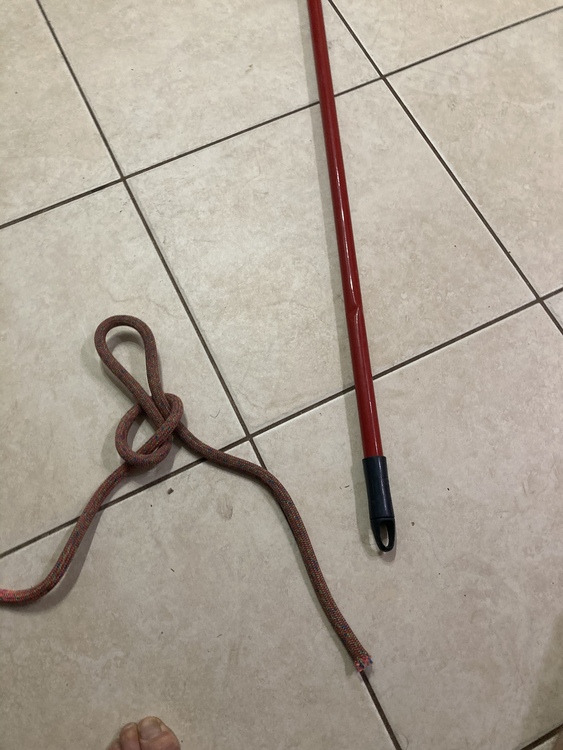
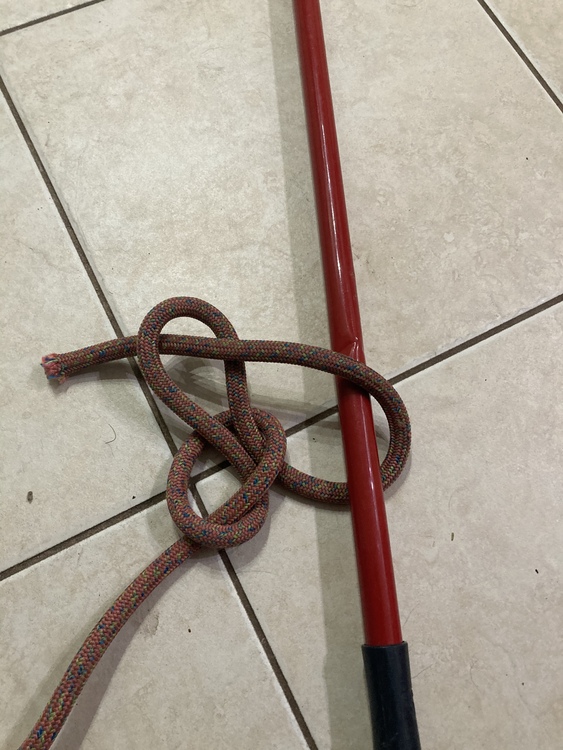
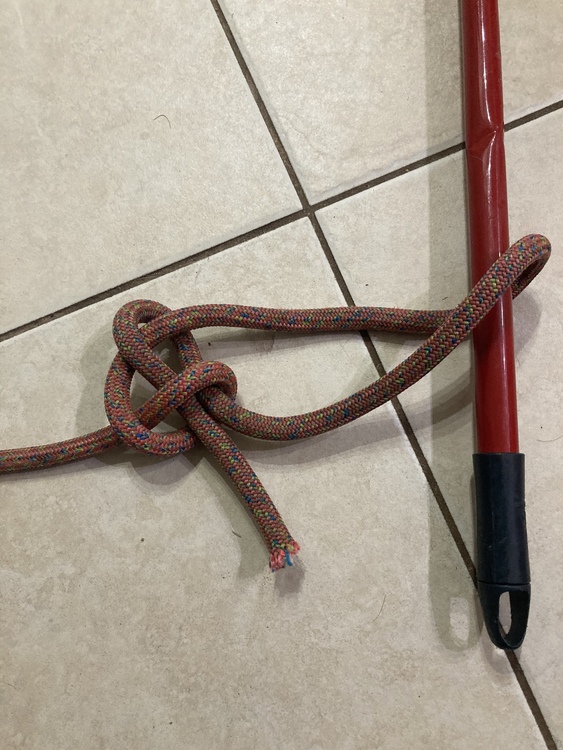
Yours looks incorrect but I cannot point out why. I am also left handed and tie them both directions frequently.
    |
|
|
Ackley The Improved wrote: They have the same knot structure. If you cut the loop on a bowline you're left with a sheet bend. Edit: Erik, that's an Eskimo Bowline and definitely not the standard bowline people expect, although also probably fine. |

|
Bb Cc wrote: The Yosemite finish can also fail on a standard bowline if you fail to dress the knot correctly or it comes loose during use (y'know the standard issue w/ bowline). Lesson.... don't use a Yosemite finish on the bowline without some other backup |
|
|
Erik Strand wrote: That's a sideways bowline. I guess it doesn't matter (maybe) but, I always tie mine with the load coming out the other side of the knot like the OP. |
|
|
Looks like the nomenclature has changed since the 80s and 90s. I've always called the first TP knot a mountaineer's bowline. You can also run the tail back through the lower loop (Yosemite tie off) and then tie a backup knot. All that is illustrated in On Rope, first published in '87 In the fifth edition of Mountaineering FOTH they show a double bowline as basically a bowline tied in a bight (biner clipped to the tail loop as a backup), which is different than a bowline on a bight, which used to be called a rewoven bowline You're not going to die because of that knot. I've been using it as a tie in knot for decades |
|
|
Amazing how many ways this thing can be tied and still work (apparently). I appreciate the input and have wondered if anyone has done extensive pull testing of all the different variants. Before posting I ran into this thread... ...but it didn't really answer my specific question--that I could see. That thread, though, might be interesting to enhance this discussion (among the knot nerds, anyway). P.S. Not to hijack my own thread, but I have discovered that I just happen to tie my figure-8 (to tie in to harness) in the way that makes it easier to untie. There is another way to tie it that makes it harder to untie. Hard Is Easy did a video on the topic: Why Figure 8 knot is NOT hard to untie (Go to 13:20 on the video to see the two ways of tying the Fig-8 that he compares.) |
|
|
Yes I have done extensive pull testing on the way I tie mine. It cinches better than the standard way of tying a bowline for whatever reason. It’s also still easy to untie even when loaded with thousands of pounds. I never do Yosemite finish. I typically make a tail that’s at least one foot long and that’s super good enough for me. I’m also hardly ever using the knot for personal life support. |
|
|
Also, I suggest learning the cow hitch. It’s an awesome knot for tying rope onto anchors. |
|
|
Erik Strand wrote: I don't think that is a bowline. It looks similar to one, but you've threaded the loose the wrong way through the loop and around the wrong strand of line. Perhaps it's worked, as most knots can for at least a moment, but if be highly dubious of that if I saw it in the wild |
|
|
Bowline where to end comes out to the outside is known as "Left Handed Bowline", "Cowboy Knot", etc. - https://en.wikipedia.org/wiki/Cowboy_bowline This version of bowline is stable under ring loading - https://www.researchgate.net/publication/344689340_Revision_of_Commonly_Used_Loop_Knots_Efficiencies BTW - that weird sideways looking knot is https://en.wikipedia.org/wiki/Eskimo_bowline |


