
 Continue with onX Maps
 Sign in with Facebook






Watch recommendations for multipitch efficiency tracking
|
|
Hello all, I've been thinking about getting a watch to have better data on lead/follow times for multipitches. I'm not sure if there's a product out there that does this, but it would be great if a person could easily 1) Press a button to start a new 'lap' (or whatever unit) to capture the time between starting and ending a pitch I know you could technically do this if you want to take notes on your phone or a piece of paper (writing down time as it happens, etc.), but that's cumbersome to do for every chunk of climb time in a multipitch. I'm looking for something quick and easy, so I can remember to do it every time. What do people do for this? Easy-to-do-and-remember techniques, or tools are welcomed. Thanks, P.S. I don't need any of the other fancy watch aspects like calories burned, etc.; those would just be gravy. A simple tool or method is sufficient. |
|
|
So far as I know, nothing exists that will do all that at the moment on your wrist. There is probably a cell phone app that is like a multi-stopwatch, which should approach what you are trying to do. |


|
I had a Green kids timex from walmart that did all of this except for the app thing back in the early 2000s. Maybe just go to a store and look around. |
|
|
Just an FYI if you are being a jerk and timing leads/follows to find out just how much slower your partner is with their follows compared to your leads be sure they aren’t aware of that. Makes for awkward conversation on route… |
|
|
Scarecrow GPG, interesting that’s the perspective you’re potentially assuming. I was coming from the place that perhaps my partner would also be interested in the data, especially for my regular partners I do big routes with. “You can't improve what you don't measure.” |
|
|
Natalie N wrote: Oh very fair! I think that’s a great idea. I’m sorry if you took that as my intention about you. It was my own experience that caused my own issues. Although I wish I had a watch. Doing it on my phone was much less inconspicuous! |
|
|
Data nerd here. I've been using an HR monitor to track my climbs for a while. I specifically use the polar OH1 because its default band allows me to wear it high on my bicep (out of the way for crack climbing) https://www.amazon.com/Polar-OH1-Heart-Rate-Monitor/dp/B074KG6G5Q?th=1 An example climbing profile is shown below. You can clearly tell when I'm on a pitch. (I find the HR data interesting to correlate to perceived exertion/phycological difficultly of a pitch ... i.e. whoa that was higher than expected ... remember to slow down and breath ...) Timing can be extracted from the data. Or, it can be combined with a smartphone app for more specific tracking. 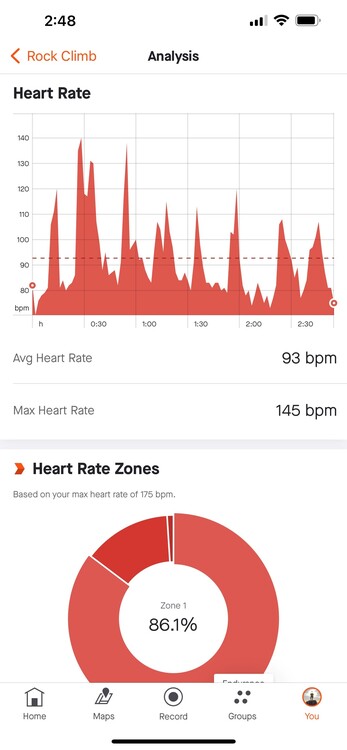 My partner uses a gps watch with a self-modified wrist band to allow her to wear it higher on her bicep. This would probably provide a more seamless way to track "lap times" (i.e. pitch durations, belay transitions, etc) |
|
|
Back in 2015 and 2016. I was very into multi-pitch efficiency and was writing down timestamps for every transition (follower arrives, leader leaves, follower starts, etc.) on a piece of paper without slowing down climbing. Later, I also have used a cheap digital watch (not on my wrist, but accessible) with lap button to record every state transition. I did have to review the stored data to extrapolate the pitch and transition times, but it was not too bad. My main climbing partner back then was into it as well and even tinkered with DIY'ing a tracker. I'm pretty sure I'm the only sucker on MP who funded Whipper: World’s 1st Climbing Performance Tracker . I had some hope that the tracker would allow me to review the state transitions after climbing without having to write down anything. It never delivered and I never got the money back. Over the years, I've played with various GPS devices (phones, watches, dedicated gps units), and have reach the conclusion that NONE could track coordinates or elevations accurately (or even close) on a vertical rock face. I'll elaborate on the above observation made by Chris... I've been tracking my heart rate in all my activities for years, including climbing. The only mechanism that works accurately for climbing (or just about anything I do) is an optical HRM worn on upper arm using a nylon armband (no slippage). Worn on wrist does not provide accurate readings. The strict criteria leaves me with only two options: Polar OH1 (now Verity Sense) and Apple Watch, which is the only watch for which you can purchase Braided Solo Loop (example) that allows for stretching and no slippage. Silicone bands will not work. Even the chest strap HRM gets interference with any bumps (e.g. by the knot) on the chest and have too many artifacts in the data. However, the clear (beautiful in my eyes) pattern shown above is only seen with gym climbing where you thoroughly relax while belaying, which is the reason for the distinct contrast. When tracked in the outdoor multipitch climbing settings, the heart rate peaks and troughs become less obvious and will not be useful to determine state transitions. TL;DR: I don't think what you are looking for exist yet. A cheap digital watch with lap button and storage along with your well-defined lap protocol is the closest and most accurate way of measuring, but it requires a little bit of post-processing. |
|
|
A stop watch, a notebook, and a Pencil |
|
|
HRM straps (aside from optical ones) use electrodes to detect heart beats, not the physical movement of your heart/chest, like I guess you could get with a 3 axis accelerometer and try to extrapolate from data including breaths and overall movement. So I don't think bumps to the unit should mess with the data unless the electrode contact is disrupted, like lifted off the skin for a split second. Optical HR is prone to many issues. If its too light it can bump around, skip readings, etc... If its too tight it can restrict blood flow. Large movements can affect the volume of blood in the area the sensor is mounted ( interpret wrist swing rate as HR ). Body and ambient temperature can affect the perfusion of the skin leading to a situation where it is harder to measure, etc... Mounting to the upper arm is certainly better than wrist though as it is much more resistant to all of those effects. |
|
|
Just posting as a +1 to this idea. A lot of people post a lot of truly bad advice or just incorrect information here about how to move faster on multipitch, and I suspect the reason is that they aren't timing what they're doing. |
|
|
I've done this a few times. I recommend a camera not a watch. Set it up on a tripod at a venue with a few 3 or so pitch climbs. Either use video or time lapse. Then pie chart the results back home over a glass of wine. This has the following advantages 1. doesn't get in the way of your day 2. you can ask questions about stuff you might not have gathered data on using another method (e.g. do I take a long time to place a piece?) - i.e. you can review the footage, then form your questions, rather than pre guessing what you might be fast or slow at. 3. if the venue is popular, you get to see how your timings compare to others, often on the same route. Few people gather such data and are missing a serious learning opportunity - one that just takes an evening and a glass of wine. It is likely to accelerate your multipitch at a rate equivalent to months of just "trying to go faster", or to be honest reading comments from some people who have not done this simple exercise. |
|
|
Seems like what you need is an activity-tracking watch with a barometric altimeter (not a GPS altimeter), and a lap button. You'll also need to be able to sync to Strava or a similar service. Plenty of watches on the market will do that, and you might be able to find a used model if you don't care too much about extended battery life. (My old Garmin Fenix 3 had those features). You'll probably have to pay for other features you might not care about. A barometric altimeter will reliably detect elevation variations of as little as 25 feet or so, so even if you forget to press the lap button you can reconstruct everything afterwards. (Unless you're doing something weird that involves downwards traversing). The numbers may be biased, but the error is typically proportional to the actual elevation change. You don't want a GPS altimeter because small elevation changes will be buried in random GPS noise, especially on a vertical rock face. Here's an example that I recorded at the local climbing gym and uploaded to Strava. The walls are about 40' high and you can clearly see when I was climbing. In this chart the x-axis is distance (which is hopelessly inaccurate, since I was indoors), but on the Strava website you can change the x-axis to time. 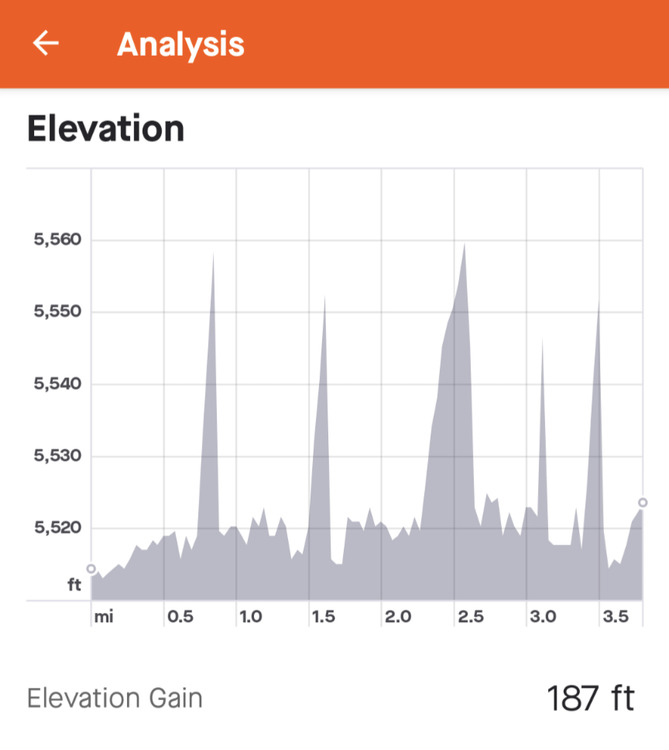 |
|
|
Natalie N wrote: The problem with this is you are ultimately going to be measuring apples, lawn chairs, romance novels, and bicycle seats - and trying to apply this to pork belly prices. it sounds great in theory, but your data will be so varied that trying to simply look at split times for various tasks is going to be very, very misleading. for example, take two 10c pitches. it would be easy to say "we should be leading 10c pitches in 20 minutes or less." really? will a 50 foot well-protected 5.8 pitch with a couple quick well-protected 10 moves be expected to take approximately the same amount of time as a 150 foot 10c wide sustained wide crack pitch? probably not. what about if you take the 150 foot 10c OW pitch at sea level versus at 12000 feet? probably not. ok what about setting up an anchor? is setting up a 2 bolt anchor going to take the same amount of time as a really f****d up choss ledge with gear that is 10 feet apart, charlotte's webolette, and your leg down a hole to back it up? probably not. what about transferring gear? should take the same amount of time every time, right? if it's a long gear-intensive pitch the second will already have most of the gear. if it was a short easy pitch that didn't require much gear it will take longer (especially if you are a harness racker). so again, probably not. basically every step that you look at is going to be like this. then, you have the typical data collection problems. "shit, i forgot to stop the watch at the end of that lead. shit, i forgot to start the watch at the beginning of anchor-building." or, "why is my heart rate monitor not working, i am going to spend half my day trying to get it to work..." if you are really, really serious about doing this the way to do it would for both climbers to have a go-pro. you hit "start" at the same time at the beginning of the route, and then hit "stop" at the same time at the end of the route. then, you both go through the footage, look at the times of the various tasks, determine if these times make sense. "yo fabio, i saw it took you 10 minutes to set up that 2-bolt anchor and now i know why - you were trying to get the sunset-heart-hands selfie for 9 of those minutes..." if you have the video you will easily be able to see what exactly is causing 5 minute transitions at each belay (when they should be a minute or less, preferably 30 seconds or less). oh, i noticed that we both stop, grab a drink, and shoot the shit about how rad the last pitch was. maybe we sneak our drinks in at other moments and chat less... you will also see things like "my partner took forever to lead the 6th pitch - and i can see this was because i used the 3 smallest cams in my anchor and talked us into leaving the RP's in the truck, which must of sucked for that poorly protected wet slab pitch." without this kind of context, the split times are going to be worse than useless. |
|
|
slim wrote: Hence, don't use a watch, film it instead. |
|
|
Natalie N wrote: That “data” is useless, all pitches are different, you can’t compare them timewise. So, what are you trying to learn from timing pitches? How to be faster? |
|
|
I did that a few times on my Garmin Forerunner 35, which I bought (at the time) for like 100$ maybe. Somehow it's more expensive now, even though it's possibly the most entry-level gps watch out there. I stopped doing that after a while. Reasons:
I'm not into super big wall stuff, so perhaps there could be value I didn't find on say multi-day stuff that doesn't show up as much on shorter (<10 pitches). But just a good introspection and discussion with partner about how things went and what to work on seemed to work just as well for me. ymmv |
|
|
haha, i have a forerunner 35 also (have had a handfull of them, i keep returning them because they heart rate monitor never works). i kept using it for less and less, even for training hikes. between the heart rate monitor never working correctly (even with a chest strap), the gps not being that great, and the fact that at the end of the day it didn't ever tell me anything i didn't already know - it has just been collecting dust for a while. |
|
|
Desert Rock Sports wrote: I had shared the same view about chest strap HRM because it's called the golden standard. If I hadn't seen a bunch of data recordings from me and my partner, I would agree with you. But data does not lie -- too many outlier data points even in a mellow gym session. The knot bump is the first possible reason we could come up with, but of course, there is no research study on it. When I look on consumer products for HRM, I realize most studies (all I have seen) were done on runners and cyclists. Maybe they have not seen their lack of accuracy when used in some other sports. I also was surprised to see the accuracy and reliability of the optical HRMs (from a watch or Polar OH1 worn on upper arm/base of bicep). Wrist measurement is useless for climbing (or strength training in general), and still far from being accurate for running. Scanning through the replies, I believe we've established that there is no gadget that automatically and accurately track the progress of vertical movement on a cliff side. Hope OP has found a way to satisfy her need, even if not originally desired. |


