
 Continue with onX Maps
 Sign in with Facebook






Yosemite Helo Rescue 7/10 - Half Dome ?


|
|
Jason Kimwrote: You are talking about the route being easy not safe. The route is relatively easy most of the way up. The first pitch is well protected. If you climb pitch 2 the standard way it isn't terrible protection but not great. Pitch 4 and above is where it starts to get really runout with 50ft between every bolt but you can still find a chicken head to wrap once in a while. 500ft of the climb you are on the dike and the dike is like climbing a ladder, noone even if you have never climbed before should fall on that part. The last pitch is more slab but at that point it isn't like the start where you are thinking you could fall. 90% or more of the climbers (most anyone who is not a climber but in decent shape) can free solo a 200ft 5.2 route but that doesn't mean it is safe to do it. Face it anytime you have slab it isn't safe to fall on! Even 10ft fall hurts. |


|
John Smithwrote: It’s safe if you aren’t leading. |
|
|
Walker Flynnwrote: Yeah, in fact I almost said the same in my original comment - maybe this is just a question of semantics? As I think about it some more, I do think a distinction can, and should, be made between the two. I really enjoy high consequence routes and will occasionally muster up the courage to do them. I absolutely hate unsafe routes, and avoid them at all costs. The way these different types of climbing affect my emotional health is enough to convince me that this isn't an issue of semantics! By my definition, a high consequence route is one where you had better not make a mistake in the wrong place, because doing so would result in severe injury or death. Matthes Crest or the West Face of Mt. Conness jump to mind, as routes at a similar grade (albeit very different styles) than Snake Dike. There are lots of climbs like this - or even their approaches/descents that fall under this category. An unsafe route is one where, even if you do everything right (no mistakes), you run a somewhat significant risk of serious injury or death. Maybe it's danger of rock fall, or cruxy climbing without any protection, that sort of thing. To be fair, I would say that beginners don't have enough experience to be able to tell the difference between an unsafe climb and a high consequence climb. They are basically one in the same. |
|
|
John Smithwrote: There are lots of hard climbs that are safe. And there are easy climbs that are unsafe. I recently did an easy approach in Red Rock that I would deem unsafe - no way in hell I would ever do it again (walking along angled, exposed, sand-covered slab with what appeared to be frequent rockfall from above). What I'm trying to say is, easy does not necessarily equal safe or vice versa. I've done almost all my slab climbing at Tuolumne, Joshua Tree, and Suicide. I've heroically led up to 5.8 or so at these locations, often holding back tears, but I would say that I've been relatively safe (despite being on a high consequence route). Based on what I can follow, I'm probably capable of easy 5.11 slab, but no way in hell do you see me attempting to lead at that grade. EDIT: As I re-read my last sentence, maybe I just made an argument for why a 5.11 slab is unsafe, but just for me. I don't know. |
|
|
Walker Flynnwrote:
|
|
|
Fail Fallingwrote: Kevin, I had this same question, too. I suspect it comes down to tumbling vs. sliding. I don't know if you ski, but if you do, think about the difference between a graceful, high speed sliding wipeout and a full-on tumbling yard sale. Once you start flailing and tumbling the extremities can get really damaged. |
|
|
A route is neither safe nor unsafe. That attribution belongs to the climbers who attempt it. |
|
|
James Jenwrote: James, my brother in christ, I love ya but go ahead and read the first few posts on this thread. There is no need to argue about if this route is safe or not. |
|
|
Snake dike was already retrobolted after bridwell did it, with his consent. Idk how many times I need to say this but if you aren't comfortable on a runout out or nervous for the route then don't do it. Don't ruin the adventure for others because you don't like being scared... for me Climbing is only climbing if I'm scared... |
|
|
 |
|
|
No disrespect. Glad she is alive to make many more choices. There are a few climbers, in the past who are not, under similar circumstances. (Off route on slab in Yosemite, missed seeing bolts.) |
|
|
Bb Cc wrote: You're wrong. Here's the analysis corresponding the description of the accident from climbing.com with the supertopo topo. 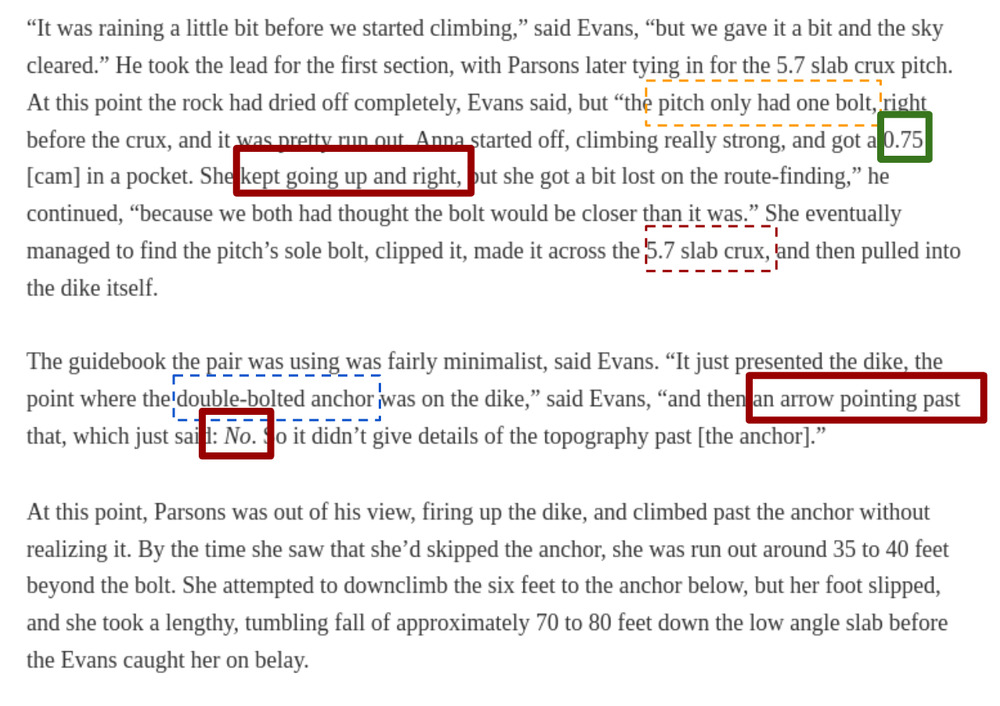 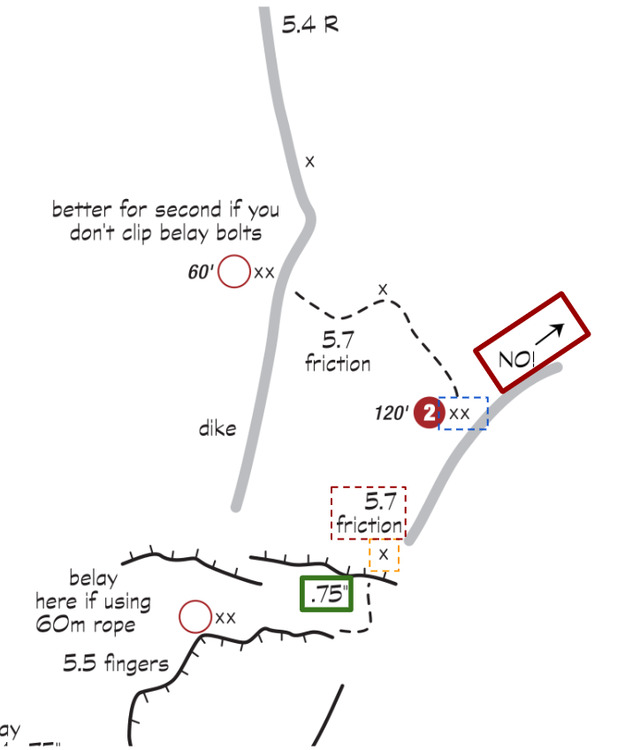 Key descriptors of putting her off-route on Pitch #2:
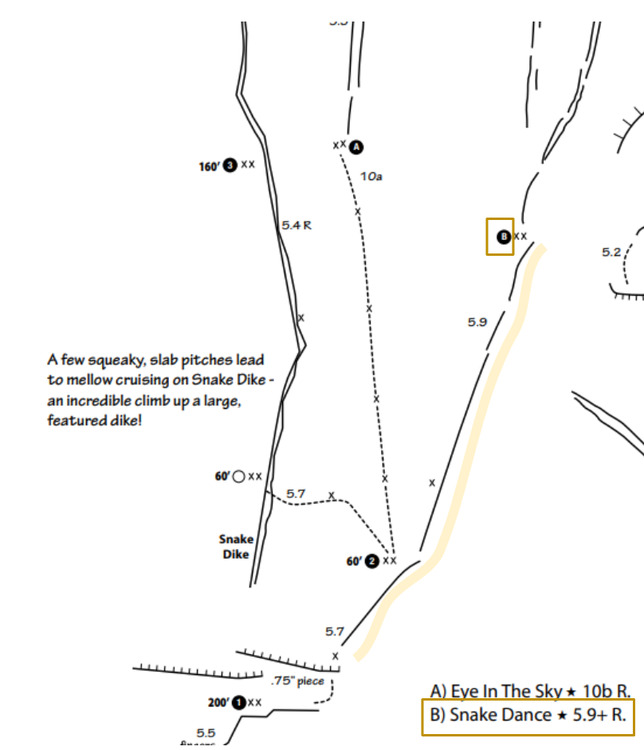 |
|
|
James Jenwrote: So are you trying to claim through your analysis that the bolt she clipped according to the article (weirdly not highlighted text by you) was the bolt on the 3rd pitch traverse slab crux? That really doesn't make sense but I'm not really sure what you're trying to claim in your analysis when you say she skipped the bolt I'd say the Key descriptors of putting her not skipping the bolt would be "managed to find the pitch's sole bolt, clipped it, made it across the 5.7 slab crux, and then pulled into the dike itself." What bolt did she skip according to your analysis? |
|
|
James Jenwrote: IMO - you are too. None of the accounts make any sense. She was lost and her belayer couldn’t see her - both are noob as fuk. In particular I don’t get the mechanism of injury nor the really long fall - other than a mega slack belay made worse by downclimbing and who knows what features she possibly could have hit. Climbing past that blazingly obvious p2 anchor right-fucking-next-to the dike just didn’t happen. A slab fall of the scale from that anchor to the bolt above the 0.75 - it happens all the time - a few scrapes, some blood, rarely a broken bone. People fall off slabs all the time. In any case, it’s a horrible injury for a 21yr old and I hope she recovers and does well with her foot. |
|
|
Jason Kimwrote: To argue semantics what you call high consequence is unsafe, and what you call unsafe is hazardous. Anything that punishes a mistake or momentary incapacitation with severe injury or death is by definition not safe. Driving is not safe. Swimming is not safe. |
|
|
Man, there’s some patronizing d bags surrounding accident discussions. Really impressive display, gents. |
|
|
There is no question that the life-changing fall that sparked this conversation is incredibly unfortunate. I feel for her. The consequences of this day will be with her for the rest of her life. Nonetheless, discussion of the accident and the route in question have led, as they inevitably do, beyond expressions of sympathy to the usual overreactions (more bolts! there oughta be a law!) and that’s what my patronizing db comment sought to address. Apologies for that. But I still don’t see how the mountain should be permanently altered in response to an event, however unfortunate, that is clearly an outlier in the long and largely benign history of this climb. Our chosen pastime is dangerous, and no one forces it upon us. There’s another way up on the other side if more holes is what you’re looking for. |
|
|
I see Snake Dike as an important case study for re-evaluating gatekeeping in an ever-growing and diversifying community of climbers. In Yosemite, this gate-keepy attitude spans from nasty comments about “tourons” to scoffing at “nubes” trying to learn as best they can to a refusal to adapt climbing “ethics” as the needs of the community changes. This concept that we’re more and more entitled to decide what happens in the park as we do progressively more radical things is just… entitled? Historically and today, climbing (and access to natural spaces in general) requires a significant amount of privilege. The argument that people who got to the table first get to make decisions that affect the climbing community for the rest of eternity just doesn’t square with me. We owe a lot to the impressive figures of climbing’s past. But *we* are climbing’s present and future, and today, we represent a much broader set of goals and needs. When we think about a route on an iconic formation like Half Dome, we should be turning to the modern-day community as a whole to discuss how to maintain that route, and not just considering what made sense in the past. I followed Snake Dike once and found it to be a perfectly easy and absolutely terrifying route. I trusted my leader, who regularly leads in the 5.12 range and does a lot of soloing, but I would never lead the route myself. I’ve also turned down a number of very strong climbers who’ve asked me to follow them on it since. My perspective is that it’s just an unnecessarily dangerous climb. It’s fun, it’s easy, it leads to amazing views, but one little slip could mean unfortunate consequences. Am I a newish climber? Yes. A bit of a wimp? Absolutely. But do I have just as much right as anyone else to weigh in on what’s going on in a National Park in my home state? Also 100% yes. (And am I about to be subjected to an onslaught of insults and harassment for having the audacity to comment here as a 5.7 PG Yosemite leader? Maaaaaybe. But it would be super cool if that wasn’t the case!) What I think is that we can’t be so rigid as to never adjust a route just because someone long ago did it a certain way and because an elite few want to keep it that way. Why does Yosemite sometimes feel like Disneyland? Because the purpose of a National Park is to be accessible to all, not just a handful of folks who count themselves more special than the rest. (And honestly, with all your complaining about having to share, it’s no wonder people make the comment that you should look elsewhere to get your climbing kicks. They’re just encouraging you to go after what you’re moaning and groaning that you want.) Sometimes it makes sense to add bolts for the greater good. Snake Dike may be a perfect example of when that’s the case, and when, maybe, the community at large should be able to come to an agreement to make a change. There’s a few factors I think should be heavily considered in such a conversation:
What governing body would help us make these kinds of judgements as a community is yet to be seen. But I agree with one of the posters here (sorry I lost track of who it was!) that if we don’t make these kinds of decisions as a community we will see more accidents and, subsequently, more access lost through higher powers like NPS closing things down. Thanks to S Saunders, btw, for a heartfelt and nuanced perspective about our values. And, of course, my heart goes out to Anna who should have been (but maybe still will be) part of the future of our sport. |
|
|
In the Blue Mountains in Australia a classic easy-but-serious multipitch Sweet Dreams has actually been retrobolted several times - about once a decade a newer climber or guide exclaims "this is too runout for the grade!" and adds a couple of bolts in. It was originally done with *zero* bolts, which meant the traverse pitch was more or less solo except for a couple of dodgy slung horns. Now days people don't take any trad gear and it's considered more or less a sport route. In fact, people are now complaining about the carrot bolts not being up to modern standards (see the MP comments...) so it's probably due for another retro with the carrots being replaced with ringbolts. |
|
|
“This concept that we’re more and more entitled to decide what happens in the park as we do progressively more radical things is just… entitled?” When people with better pro, stickier rubber, better ropes, fatter bolts, better beta and cleaned-up routes still demand that climbs with a vanishingly small injury rate be retrobolted to approach some theoretical level of safeness then yeah, let’s talk about entitlement. Since when is rock climbing meant to be safe? Easy, safe climbs are great. So is the satisfaction of working up to something that’s a bit of a stretch. These qualities exist in somewhat of a tension and to make a stretch goal more attainable inevitably means that it will mean less. There exists a simple solution to the accessibility dilemma: get someone else to lead the scary bits. Sounds like this is not news to the previous poster, but it bears repeating. Call me gatekeepy if you want. We are talking about climbing a cliff forming the side of an 8-thousand-something foot mountain that’s 6 miles from a road. Assuming you don’t want to see a gondola up the thing, then as far as elitism goes, all we’re talking about is the degree of acceptable gatekeeping. But we’re both keeping someone out. The discussion of when to modify existing routes in Yosemite is definitely worth having. I’m not convinced that Snake Dike is the perfect example. Now, those Alan Nelson (?) solos on the side of Fairview… that I could see. |


