
 Continue with onX Maps
 Sign in with Facebook






Climbing Mag physics lesson


|
|
anonymous cowardwrote: The author is completely and absolutely wrong.
|
|
|
The author also confused velocity with acceleration |
|
|
Todd Jenkinswrote: "A kilonewton is a measurement of force, which is the product of mass and acceleration, and it should not be equated to weight. If you’re hanging motionless from a draw, you have zero acceleration and therefore zero force. " On Earth, where we mostly climb, the approximate force of hanging on a quickdraw is your mass in kg * acceleration due to gravity. F=ma Let's say a 150 lb climber is directly clipped into a quickdraw => 68kg * 9.8 m/s^2 = 670 N or .67kN If you are hanging on the rope that is traveling up through the draw and down to your belayer you actually multiply this force by 2, and get around 1.34kN. So the problem with the article is the guy is pompous about the reader not remembering physics, and then is painfully wrong. |
|
|
As a Physics teacher, my first thought is to say, “start by drawing a free body diagram.” :) My second thought is that several of the “corrections” offered so far have some misconceptions as well. Check your work, folks. |
|
|
Anonymous Cowardwrote:  |

|
|

|
Todd Jenkinswrote: What exactly is the intent of saying something that's just blatantly not true, not a useful approximation of the truth, and even if it were corrected would not be all that useful? Maybe I am just dumb, but I think the intent at some was to educate, which they're not in any position to be doing if they don't know the topic, or can't effectively communicate what they know. |
|
|
Folks still seem to be arguing about different things. The force exerted by the climber on the draw/anchor is one thing, the net force on the system, which is in equilibrium, is anoither thing. The quote from original post wasn't clear about this (it just said "your have...zero force") and so could be taken as right or wrong depending on which force or forces are under consideration. People reacting with scorn or outrage are making assumptions about which interpretation was intended. That said, it is of no interest in the situation under discussion to mention that the net force is zero, so it is right to criticize the language if not the author's grasp of physics. But again, there is a distinction between the resultant of all the forces acting---which is zero if the system is motionless or moving at constant velocity---and the force on a component of the system (isolated, for example, by way of a free-body diagram, which omits the forces exerted by the designated free body on the rest of the system). |
|
|
rgoldwrote: You're probably right that they intended to include the word "net", but I don't think it matters. The word "net" in this situation is so integral to the meaning that I don't think we can give the publication a pass. If you were reading this article not knowing the physics, there's no way you could obtain a correct understanding of the physics from this--the word "net" would never occur to you. Even if the author understands the physics, they're horribly failing to communicate it to their audience, which was caught neither by them nor by the editor. And I think we can agree that an error in conversation is a lot more forgivable than an error in a written publication that's intended to be educational, and has ostensibly been proofread by multiple people. I'm all for treating mistakes with compassion, but that has to be balanced with compassion for the subscribers paying to be misinformed. I don't think we should hate anybody involved in the publication, but I also think people deserve to be informed of the correct information, especially when they're paying for it. |
|
|
bless todd's heart. we should all chip in and buy him a fischer price my first phsyics class. maybe start with the difference between newtons and pounds... lolz... (and i am pretty sure the article author didn't forget to use the word "net", they just straight up don't know what they are talking about. you can almost hear them say something like "hey guys, it isn't rocket science!". bwahhaaahhaaaa!) |
|
|
I don't get why everyone is talking about the net force, yeah it's zero, but the article is about carabiners so obviously we want the force on the carabiner. |
|
|
James Mwrote: Because the author's F=ma is a simplification of the equation newton actually developed. It is more intuitive to understand that the sum of the forces = the time rate of change of momentum. So the net force is the key as many other have stated. There can still be a shitload of force in the system even if nothing is moving since it's the sum of the forces. Wow this thread got a lot of traction. That's one of my favorite C&H panels above! Good on ya fritz! |
|
|
Maybe the author was assuming gravitational acceleration is negligible? that's what I do before every redpoint attempt |
|
|
Anonymous Cowardwrote: Never have I ever seen his actually developed equations. But, apparently, his 2nd law of motion, the law applicable here, is written down like this -
I also find it fascinating that the mass was not introduced until the 3rd law From here - https://www.physics.utoronto.ca/~jharlow/teaching/everyday06/reading01.htm |
|
|
amariuswrote: Until that crazy German came along. |
|
|
Anonymous Cowardwrote: Watterson is the man! There's a really good C&H search engine that I used every week to decorate assignment guidelines when teaching fifth grade: https://michaelyingling.com/random/calvin_and_hobbes/ |
|
|
slimwrote: Thank you for better explaining my point. The author was simply trying to make sure people knew there was a difference in newtons and pounds and he tried to use layman language to explain it, much like a Fischer Price physics class. Most people can safely climb with less than a Fischer Price level of understanding of the laws of physics. In fact, the only time climbing that I might even think about real numbers is if I placed a 6kn piece right off the belay and I have a bit of a runout until the next piece. Most other climbing scenarios (for me), everything is strong enough that I don't even need to do 5th grade math. Also, the article seems to have been edited because of the backlash from the scientific community. |
|
|
Can somebody please direct us to a free body diagram that isnt loaded with jargon to decipher that deals with the force on the carabiner? mass x gravity = weight or force on the carabiner you are hanging on assuming a dead vertical hang? Where does friction on the carabiner factor in? Does the carabiner act as a pully, and how does this affect force on the carabiner or anything else in the system? If your feet are on the wall, does this generate the change in direction rgold speaks of, thereby generating acceleration? Does this then increase the force applied to the carabiner? Maybe someone could give some accurate practical use scenarios? A 165 pound climber falling 6 feet on 3 feet of rope, similar to leaving the belay, climbing a move or two, then falling past the belay? 6/3=2. 6 kn of force? Not good because it could pull a piece (or break a piece in some cases), but hard on the climber and the rope? When counting how many falls my rope has taken, am I only counting factor 2 falls? |
|
|
Jimmy Brickerwrote: My simplified version, assuming that the climber is not touching the wall, and the belayer is directly beneath the draw. 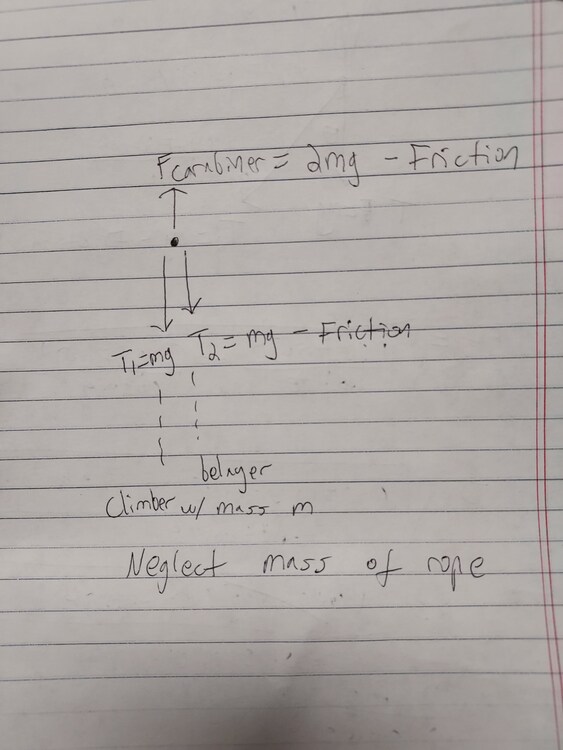 |
|
|
This forum topic is older than Double Cross and how to mark the middle of your rope. I find it hilarious the answer has not yet definitively been found. |


