
 Continue with onX Maps
 Sign in with Facebook






Giving extra slack before placing the Jesus Nut to avoid factor 2 fall?


|
|
I'd love to hear more and for someone to dispute any of the arguments I'm making below, but right now I'm still not convinced that this "technique" wouldn't reduce the peak force exerted on the anchor. To be clear, we're not saying that this won't reduce peak force compared to a factor 2 fall of the same distance. However, you're not recognizing that fall factor doesn't tell you the amount of energy in a system, it just estimates how that energy is dissipated. An 80 foot fall into a bad anchor will have some amount of force dissipated by rope stretch. The amount of force generated by such a fall though, regardless of dissipation to rope stretch, will easily be sufficient to blow your anchor into various climber-specific earrings. |

|
To the people who think this conversation is pointless and “fuk-tarded”. While the OP’s idea might not be the best option to do in most, or any situation. It raises interesting ideas and has started a good conversation about what to do in certain suboptimal situations. It’s good to have a deep bag of tricks and to also understand the physics, intricacies, and limitations of those tricks. I think discussions about how to handle those bad situations we sometimes find ourselves in is one of the best uses of MP. Far better than bickering about how we should grade routes or witch formations look the most like a dick, as entertaining as that may be. If you have never been in an unexpectedly sketchy situation while climbing where you had to do some unconventional and suboptimal things to get out, continue climbing for long enough and you will. In my opinion discussions like this can be educational and increase peoples understanding of the systems we use. |
|
|
Justin Malinwrote: It wouldn't reduce peak force exerted on the anchor, because peak force exerted on the anchor is going to be primarily determined by slippage of the belay device. I'm going to refer you to Craig Connelly's excellent "Mountaineering Handbook" for this, the chapter about Forces in Climbing (forgot which one). Thus the maximal force that can be on the rope between the belayer, and the redirect/anchor point cannot be more than 2x that slippage force (because physics) - draw the force diagrams assuming that for a moment forces are balanced). If the remaining force on the falling climber's side is greater, then that means rope slippage (e.g. F =ma, and there's a net force on the climber's side, thus acceleration). If they are equal, then (for a split moment) nothing moves. If the force is greater on the belayer's side, he was jerked up and is now falling back. |
|
|
Josh Bedard wrote: Imagine we are both at the belay and I play out 12 feet of slack. If you jump how far do you fall? 24 feet? Obviously not. A true factor 2 is nearly impossible as, in fact, slack in the rope would reduce the fall factor. That’s academic but not actually useful from a climbers perspective. |
|
|
anonymous cowardwrote: Yeah, I told my brain to work harder after I posted. Makes sense now. |
|
|
J Bwrote: Happens to us all. Cheers. |
|
|
Another thing that came to mind - a climbing rope isn't that great a spring in terms of storing energy. The energy stored by a spring is W = kx^2, e.g. the spring constant times the square of the displacement of the spring. |

|
If you are using a belay method that slips, then adding slack to the belay is exactly the wrong thing to do, as Frank has already explained. The point is that once energy absorbtion is via sliding friction in the belay device, the fall factor is no longer relevant, and instead what matters is the height of the fall. If devices that lock up are being employed, then the fall factor remains relevant, because there will be no slippage at the belay. In this case---in theory---the maximum load to the anchor can be reduced by adding slack. Some people have claimed that the extra distance fallen would negate whatever peak load reduction the decreased fall factor produces, but this is false. There are, in theory, real reductions. (I still think adding slack is a bad idea, but the question was hypothetical and so is this response.) The analysis below is based on the basic standard equation for peak force. I wrote up something about this for sophomore undergraduates sixteen years ago, and it has found its way onto the web at https://4sport.ua/_upl/2/1404/StandardEqn.pdf. This is the simplest possible model, viewing the rope as a simple harmonic oscillator (i.e. an elastic spring). Much more sophisticated models exist, introducing damping and modeling rope behavior as a combination of simple harmonic oscillators in parallel and series. Some models try to account for some of the sources of friction in the belay chain (which wouldn't be an issue in a factor 2 fall), and some try to factor in the energy absorbed by tightening knots. None of the models (that I know of) takes into account the deflection of the human body. So the simple model is just a first approximation. Please don't read too much into it. On the other hand, it is a lot better than vague intuitions based on who knows what. Using the simple model for a rope with a UIAA impact rating of 9.5 kN, the graph below shows what percentage reduction in peak force you get. There's some information on the left about the calculations, information that should make sense if the article I linked above is consulted. The take-away is not the numbers, but rather that lowered peak forces are possible with extra slack when the belay device doesn't slip and the belayer doesn't move. 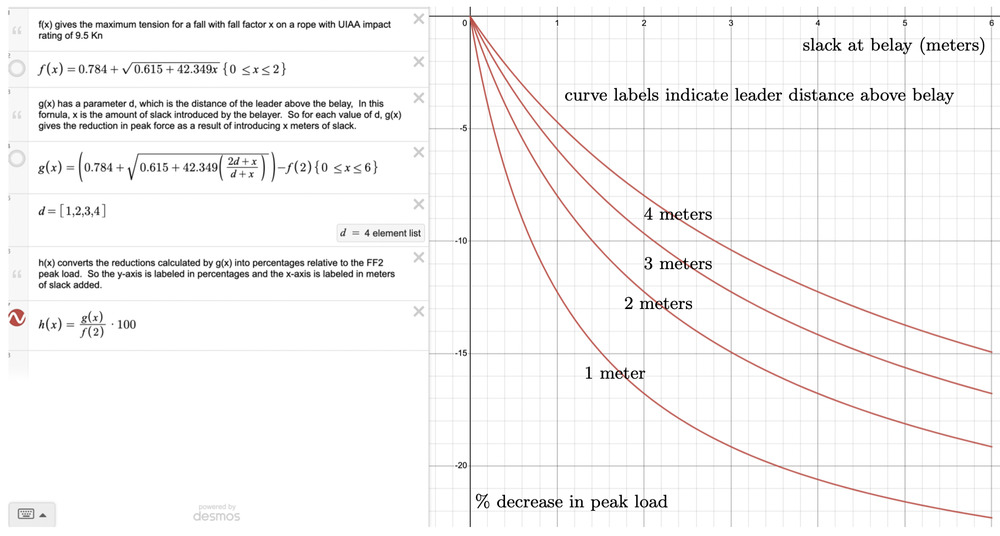 The main point is, of course, to avoid sketchy anchors. Various strategies have been mentioned. I'd say if one can't climb up or down, the best chance of keeping anchor loads low is for the belayer to have a braced stance, a non-locking belay device or Munter hitch on their harness, and a pair of gloves. I've held a factor 2 fall this way and another maybe FF 1.8 with the piece horizontally off to the side, so don't tell me it can't be done. After all that, there may be times hopefully very rare, when the leader just better not fall, because they'll take the belayer with them. |
|
|
Justin Malinwrote: What's a jesus nut? |
|
|
Tradibanwrote: The (horrible) term was appropriated from helicopter mechanic slang by John Long in one of his anchor books. The implication is that it is the one thing standing between you and death and had better be good. The idea is that it is imperative to protect the anchor with a bombproof piece placed soon after leaving the stance. (All very nice if you can actually do it.) |
|
|
rgoldwrote: Oh yea. All this hand wringing over that?? |
|
|
It’s an interesting theoretical solution, but no. If the anchor is suspect enough to have you considering this, I wouldn’t consider taking any lead fall directly onto it regardless of the amount of rope in the system. If additionally the terrain between anchor and first bomber gear opportunity is anything but chill free solo level for the leader, then you need to find a different solution. There’s the obvious increased risk of the climber hitting something during their fall. The obvious “annoyance” and risk of them then jugging back up 70 feet on an already suspect anchor they just took a huge fall on and that both your lives are dependent on… yikes. And I don’t think most climbers would benefit from the psychological effect of 70ft of slack dangling below them in space (oh and let’s hope it gets stuck on nothing, stellar rope management here) while in do-not-fall territory and trying to place a piece of gear solid enough to put both partners back into safe territory. Build a better anchor. Consider rapping down (less force on the anchor than a lead fall). Extend the belayer below to increase rope in the system without increasing the lead fall distance. (But again, if the anchor is this suspect I wouldn’t risk ANY lead fall on it). Climb through the crap anchor to place that first piece for the next lead back before bringing your partner up. Maybe don’t bring your partner up onto an anchor so terrible at all. Think about your life choices. |
|
|
Em Coswrote: Agreed. I tried to make it clear that it was a hypothetical solution to a hypothetical question. By the way, the chariot belay solution is very fraught, because now you're using the anchor in a way that will approximately double the load on it, so the decrease in fall factor has to be enough to mitigate that. I could post another graph, but figgerin' that out in the field ain't gonna happen. The chariot belay is a technique only for an excellent anchor when you want to reduce the impacts on the leader and belayer from a possible factor 2 fall. It is not a way to deal with a sketchy anchor. I think if you climb long enough in enough different environments, and don't always stay on contemporary curated paths, you'll eventually be forced to use a sketchy anchor for the belayer. Then there are the times when, climbing with an unfamiliar partner, you arrive at the belay to find something that is barely managing to hold the weight of the carabiners. |
|
|
glad someone mentioned this, b/c I was going to ask, as a trad noob of just a few years, what is wrong with climbing past, placing the bomber cam (since the OP mentioned that partner found a "bomber cam right off the belay"), and the downclimbing, anchoring in to the crappy anchor and belaying off the harness through the racking biner of the cam... wivanoffwrote: |
|
|
Alec Baker wrote: I thought I made it clear that distances matter! If we do the numbers, I think the conclusion is rather stronger than I suggested: the chariot belay should not be used as a way to reduce anchor load in an otherwise factor 2 fall. The reason is, as I said in the previous post, that the decrease in fall factor might not be enough to overcome the near-doubling of anchor load. The graph below (for the same rope as before with UIAA impact rating of 9.5 kN) illustrates the issue, which is that, for the most part, it won't be practical to position the belayer far enough away, so that the chariot belay is likely to increase the anchor load above the FF2 impact level. And although the model is the same simple one with the attending caveats already mentioned, I have used the fact that rather than doubling the load to the anchor, carabiner friction results in the anchor getting about 1.67 times the load. 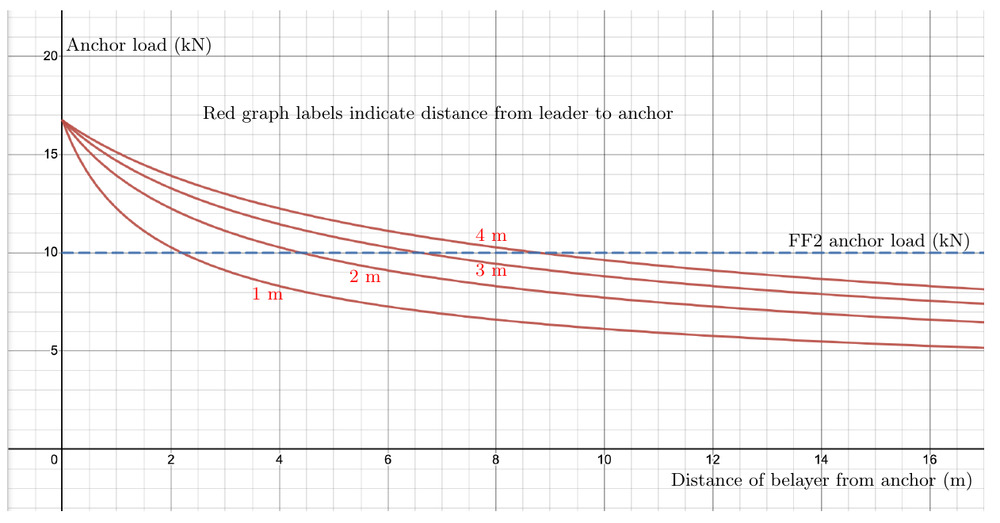 As I said before, it is likely that such a simple model will not produce numbers obtained in the field. But I still think the message is clear: there's a decent chance that the chariot belay will increase the anchor load, there's no way anyone can make good determinations in the field, and if there is any concern about the anchor, the chariot belay is a bad bet. Note that the chariot belay can still reduce impacts on belayer and leader---when the anchor is beyond question. This is about anchor loads, where the 1.67 load multiplication factor is part of the picture. |
|
|
If you have never been in an unexpectedly sketchy situation while climbing where you had to do some unconventional and suboptimal things to get out, continue climbing for long enough and you will. Well over 50 years in for me, etc., etc., unconventional once in a great while, sub-optimal never. In my opinion discussions like this can be educational and increase peoples understanding of the systems we use. Never needed a complicated, in-depth understanding of gear. I think the first part is very much an overstatement. The second part is reasonable - who can argue against caution, education, and knowledge - but it's a generalization; this thread was about a situation. Given that, the connection you've made between the first and the second doesn't hold. |
|
|
rgoldwrote: Thank you for such thorough responses! A couple more questions: 1. If belay devices have a "max force before slipping", once you've reached some minimum force (2-3kN), does fall factor really matter at all with regards to peak anchor force? Where does this 2-3kN figure come from? I'm not seeing these numbers coming from the manufacturers. 2. If it's true that slipping belay devices will max out the peak force, then that has to be a pretty strong argument against locking belay devices like the Grigri, unless it will also slip at a similar level of force. Is there something I'm missing with respect to that? |
|
|
There is no standardised test for the force generated by belay devices because it varies enormously depending on factors such as rope diameter, condition and wetness, belayer hand strength and so on. This has been studied since the first belay plates came out and under reasonable circumstances 2-3kN is about it. The "assisted" braking devices (Jul series etc) are extremely variable and the assistance they apply drops as the falls get harder by virtue of their design. Locking devices like the Grigri have an element of slip built-in to save the rope from damage, Petzl used to publish this but no longer. It's stiil dependent on the rope however and not all manufacturers seem to bother incorperating this useful feature into their design. As rgold has mentioned fall-factor isn't relevant rather fall distance as the slip limits the force in the system, however slip through the device implies that at some stage the rope will also slip through the belayers hand, the maximum length of rope than can slide through before injuring the belayer is naturally a bit variable but about 1.2m is a commonly used value (and probably a bit high). FF2 falls are undesirable because the belay system is normally orientated for a pull in an upwards direction, both their hand position and the device, some belayers and devices are better able to cope with this than others, an aged trad climber with a Sticht plate probably better than someone with a brand new belay tag on their harness! |
|
|
Justin Malinwrote: You may be right about the fall factor stuff but in reality the leader mustn't fall before they get the first piece in. |
|
|
Justin Malinwrote: This is the conclusion you should come to (unless using a grigri or something that doesn't slip). See Jim's response for the slip values. If you can/want to get your hands on Connelly's Mountaineering Handbook, again I'd really recommend. He's researched this rather extensively and isn't the only reliable source talking about this value for slippage. But as Jim mention, you can't just come up with "one number". This is somewhat like saying "how much can a human bench press". You can come up with a range of values that are commonly seen, but not a single one for all.
I wouldn't say that. I think a grigri has its place too. If you're craggin, fall factor doesn't matter, belayer can typically provide a dynamic belay (more so than at a hanging belay!). As Rgold/Jim mentioned it probably slips a little bit anyways (just not as much, and likely result in a higher peak force at the anchor). I'm personally not against having an autoblocking devices for my belayer cragging, I kinda like the redundance it provides (if well used). Plus as a belayer it does make life easier for projecting climbers... |


