
 Continue with onX Maps
 Sign in with Facebook






Spinners from Sideways Pull



|
Jim Titt wrote: "Falls taken higher on the route cause the hanger at the change of direction to turn counter-clockwise, and loosen the nut." Don't be an asshole |
|
|
No comment. |
|
|
Connor Dobson wrote: Is that somehow not a side force? This is not the place for experts who can't accept criticism . Suffering fools doesnt happen much on the MP forum! |
|
|
timothy fisher wrote: Maybe a picture will hlelp 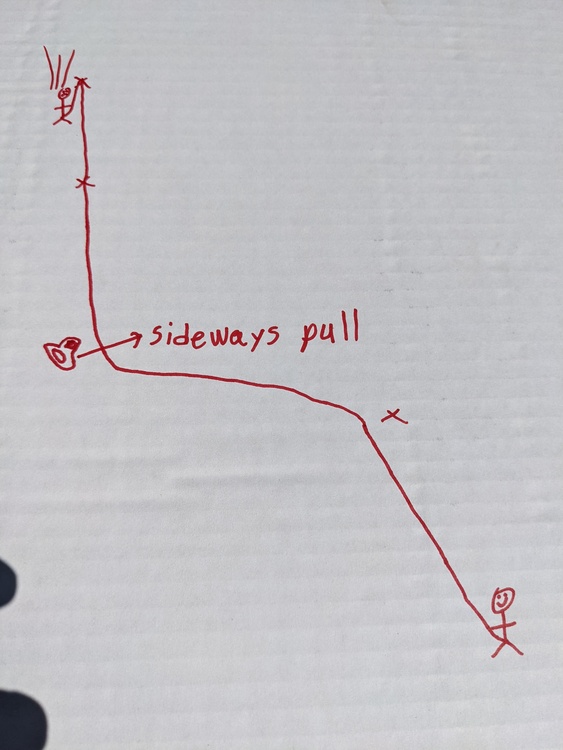 |
|
|
timothy fisher wrote: The issue is an offset sideways force producing a torque on the hanger and loosening the nut. As someone pointed out it's all about not letting the hanger spin to produce the torque on the nut. The sideways force alone is not a concern for how strong the bolt is or for causing it to loosen. This can be fixed by making a hole for the hanger, using a fastening method that is resistant to the torque or using a bolt that is resistant to the torque (glue ins). To fix the problem you have to deal with the torque not the sideways force. This isn't the gotcha that Jim thinks it is. Edit: Also to add, imo for vert climbing where the bolt is going to be sheared and not pulled directly out, I would rather have a nylock or loctite that keeps the nut in place (and by extension the hanger on) than have an optimally torqued bolt. Just the mechanical interference is pretty darn bomber for our rock climbing uses. There are ways of getting these off when replacing bolts (jam nuts, heat, etc.) that I think make it not too big of an issue in my opinion. I think nylocks are totally valid for rock climbing development despite being against code in some places. |
|
|
|
|
|
Lol at the 20 some year-olds on here explaining the intricacies of bolt placement to those (Tim) who've been at it more than twice as long as they've been alive. This forum is ridiculous these days... To the OP: One other thing that hasn't yet been mentioned is to try using those new fangled Fixe or Metolius hangers. Here's an example of the Fixe model: |
|
|
It seems like this was an argument about semantics. A side force creates counterclockwise rotational torque. So "side force", "sideways pull" "torque" everyone is talking about the same thing. +1 vote for chiseling a lip in the rock, using a little epoxy behind the hanger, and using a new Fixe hanger. Those three ideas can all be done without removing the wedge bolt per the OP request Edit to add the dimples in the fixe hangers would work well with a little epoxy behind the hanger |
|
|
nbrown wrote: We tried Belleville (what this is attempting to do) washers on a couple of bolts maybe 18 years ago but I'm not absolutely convinced that standard stainless would have much effect, with a correctly torqued 10mm bolt the tables indicate they would be crushed flat. We ended up with two stacked hardened Iconal ones to get the right value. BUT turning the hanger still loosens the nut due to the friction in the hanger/washer/nut. Observation and some testing showed it's the hundreds of small jerks from clipping above that is the basic problem and the rock under the hanger the gradually lets go. Our next idea was great, we made a pair of top-hat ferrules to fit in the hanger hole and let it rotate freely. The climbers moaned like shit though! (We made a rotating glue-in lower off as well on the same cliff, that freaks people out). It was in Austria though so fun for us! The moving hanger we in the end stopped by drilling a 6mm hole beside it and hammered a short piece of stainless rod in as a peg. |
|
|
Jim Titt wrote: Yeah I've never had much luck with Belleville washers except for maintaining joint compression in electrical joints with a CTE mismatch. It's curious that more hangers don't feature a secondary hole for an anti rotation feature, the only downside would be carrying a second drill bit. |
|
|
This make me wish I had taken a pic of the (accidentally) perfectly place bolt I made the other day. It had a subtle protrusion butting up against the lower right hand side of the hanger. Not helpful for this situation but perhaps for future ones... I have trenched out hanger placements before, and used epoxy, lloctite, etc.. but it's more aesthetic (and easier) if you can incoorporate natural undulations/protrusions into the placement instead. Of course some rock types are easier to do thos with than others. Yeah, I know...a glue-in is still the best option, but I'm a sucker for instant gratification. |
|
|
Connor Dobson wrote: Because a) nobody is going to invest a substantial five figure sum on something they would sell three of b) every wet behind the ears half-wit would come on the internet raving about hole spacing, overlapping cones of fracture and so on. Cavers have had this problem for generations on their traverse lines and before they mostly went over to resin bolts we used to make twin-bolt hangers and still do maybe 10 every few years but the caving organisations are kinda better organised than random climbers, they actually test stuff. The rest of us just tighten the hanger in it's twisted direction and walk away. |
|
|
Jim Titt wrote: A) I don't think a tool change to the stamping would cost that much, probably low-mid 4 figures and would be free on any new tool (but I digress). A drill bit also works at the end user level ;). B) I don't really care what other people think. People are generally wrong about stuff and are way too risk averse. |
|
|
Connor Dobson wrote:B) I don't really care what other people think. Well at least we’ve figured this out! |
|
|
Which kinda leads to why is he reading a forum in the first place? |
|
|
Jim Titt wrote: I mean I appreciate others input and learn a lot reading forums. And hopefully I occasionally say something not super dumb that someone else can benefit from, although that might be rare. I just think that worrying about what other people think is a poor justification for any technical or design decision. I wasn't aware that other people's opinions affected how things actually work. I'll make sure to spell that out more clearly for you next time since you seem to either lack reading comprehension or just like to take things in bad faith. |
|
|
Connor Dobson wrote: Well yeah, sometimes people think and then write their thoughts down then get together with other thinkers and they all agree to produce something like EN959 which is the standard I have to conform to in order to certify and sell bolt hangers. Your simplistic idea of just adding an extra hole (ignoring any strengrh issues) falls down on two issues. The only available place in a conventional hanger is below the existing bolt hole and any bolt fitted there would fail the connector installation requirement (can one install the two specified karabiners). Furthermore the standard requires the anchor itself (the bolt) must be installed according to the manufacturers instructions and they in turn are required by their standards authority to give a mininum anchor spacing if more then one are installed. This varies but for us it's roughly twice the embedded depth so would have to be 100mm. Hangers aren't that big. One can, instead of using a second bolt (the smallest wedge bolt I know of is 6mm) to avoid interfering with the karabiner add a smaller hole and use a stainless steel roll pin, the 3mm ones I tried didn't work as the hole in the rock was too innacurate and the 4mm ones blew the rock out and were loose. The next solution is add another bolt hole somewhere else which means a different design, the better solution is out to the other side of the existing hole (left of the hanger) which is kinda complicated without welding (how I do it) but the fastener spacing problem still exists. However if one is innovative (I've a plaque on my door which says the Outdoor industry thinks I am) AND know and understand the construction industry fastener regulations there is a work-round. The problem with two fasteners close together is the cones of fracture start to overlap and weaken the substrate (the rock) but my idea to avoid this was to put one cone inside the other by using two different length bolts. I made some like this as suspension points in a church built of sandstone (for wire artists who were flying angels in a Nativity play) and they were rejected by two structural engineers because they also only skim the regulations and don't really understand them, only by getting the anchor manufacturer to run a computer simulation persuaded them otherwise. Apart from the cost of making the hangers my faith in climbers actually following the installation requirements are somewhat limited so I don't market them. For the cavers we use a simpler solution but visually I doubt climbers would be real fans, we join two hangers to make in effect a small Vee chainset. Otherwise just do what I said above. |
|
|
Jim Titt wrote: Can you elaborate on this further, please. I can't quite picture it. |
|
|
If the cones of fracture are seperated each anchor can take full load, if they start to overlap you have to calculate the loss of area able to resist the force and downrate the combined strength. If however you place one normal anchor and one much deeper the normal cone is inside the much larger one and they don't interfere with each other. |
|
|
Jim Titt wrote: So if you had a hanger with a half inch hole and a quarter inch hole an inch below it, and use a one half by four or five inch Bolt in the main hole and a 1/4 x 2 inch Bolt in the smaller hole, the cone of fracture of the smaller bolt would be inside the cone of fracture of the larger bolt? |


