Continue with onX Maps
 Sign in with Facebook






Where do I buy, what to do?


|
I think drilling the hanger ( with a step drill or any high speed drill bit/ reamer) could create extra stress on the material that might cause fractures long term. I think that the way to enlarge the hole of a hanger would be to slowly and gently file with a rat tail file, and polish with fine grit sand paper, removing material below the direction of pull. I'm sure it's still not recommended by hanger manufacturers |
|
|
Also I don't think it's terrible to have 1/2 hangers on 3/8 bolts, bit you need a good washer under the nut/ bolt head. With enough force in tension, hangers do peel off over the nut/ bolt head, especially since a 3/8 wedge bolt would probably have a 9/16 nut, which is not a whole lot bigger than a 1/2 hanger. |
|
|
I've had good luck using 1/2" hangers on 3/8" bolts, but I should qualify this. I've never tried this on a steeper-than-vertical plane because, right or wrong, I'm concerned about the scenario Jim proposes. If the force vector is perpendicular to the bolt, I don't see how this would be a concern. |
|
|
Jim Day wrote: Drilling the hole out would remove the highly-stressed region left from punching the hole. |
|
|
Jim Titt wrote: Is drilling/ reaming after punching already part of the process? Or do hanger manufacurers perform any stress relief after punching? |
|
|
Drew Nevius wrote: Thank you for the link. I read down the thread a bit but didn't get too deep into it. So, something like the bolt below will fit my 3/8s hangers it looks like. If I buy this type of 1/2 bolt I shouldn't ever have to buy 1/2 hangers again, correct? I know they were talking about 5 piece sleeves in the thread. What would the downfall be in using the ones I found below? Other than the nut and stud might get in the way of clipping the hanger a bit. 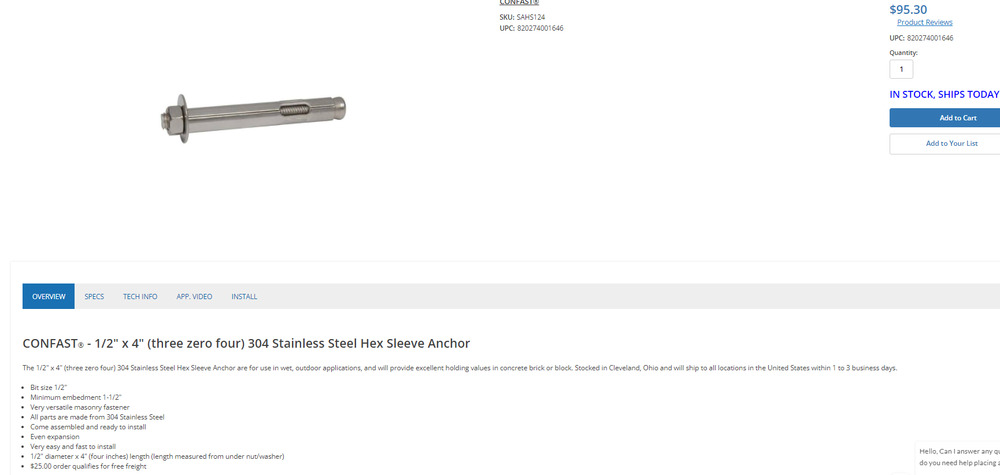 |
|
|
Jim Day wrote: No. |
|
|
Kyran Keisling wrote: Pullout strength (7.45 kN) is pretty low. I won't tell you not to use it anywhere, but I wouldn't install it where a whipper is at all likely. I'll be the first to note that engineering specs don't always translate perfectly to real world performance. However, the simplistic sleeve design doesn't inspire much confidence in me. Compare this design to that of a Powerbolt or even a Lokbolt. In the latter models, the sleeve itself is designed to collapse at torque, providing secondary pullout resistance. If you have questions about bolts, you might specify rock type, as different preferences on this forum often seem to be driven by context. At this point, I must ask: are you looking at specs before you post, or are you only looking at price? |
|
|
Kyran Keisling wrote: I would NOT use those garbage Confast bolts with 3/8th hangers. It’s all about the size of the inner bolt being compatible with the opening for the 3/8th hanger and that thread was talking about the Powers 5 pieces specifically. These Confast sleeves are not strong enough for climbing and have had notorious quality control issues. Do not use them. Buy the Confast Wedge anchors if you really want to be cheap. |
|
|
Logan - I was just being a bit lazy and didn't read the specs, I was more interested in if it was the right idea for use with a 3/8ths hanger. I only need 1/2 inch very occasionally and I can just order 1/2 hangers to go with my SS wedges. I have been searching for a while and all I can find in Stainless 5 piece Power Bolts are $9 buck a piece!!!! Wow! I can find them in plated steel for around $3. BTW - I am developing a Kaibab limestone area in Southern Utah. Most of the base rock is very dense and solid for drilling but every so often (1 out of 30 holes or so) I hit a soft spot and the 3/8ths don't tighten down to my liking so I pull the bolt and replace it with a 1/2 inch. Nathan - Thanks. Point taken! Yeah. I saw that in the thread and I was just trying to play devils advocate with the Confast sleeves and was lazy about it. I should have read up a little before posting. If I was going to use a 1/2 wedge bolt I would have to drill out the 3/8ths hanger to fit the stud and from what I read above, that would be an option. I most definitely won't be spending 9 dollars on a bolt, that's for sure. Just to make sure I understand correctly, I wouldn't want to use a plated steel bolt with a SS hanger because of ionization, correct? Even if the climate is extremely arid? |
|
|
Kyran Keisling wrote: Essentially, yes. When stainless and plated are intimately mated, stainless basically steals electrons from plated, resulting in accelerated rusting of the plated--faster than what you'd get were plated mated with plated. In a soluble-ion-rich environment such as limestone, this process is further accelerated. The only problem with mating like to like is that the offspring are prone to genetic problems, but we never worried about that where I'm from. |
|
|
Jim Day wrote: What are you basing this on? There’s a lot of “I think” in there, but I’m curious if any of this is fact based. It’s fairly common practice for people who are extracting rusty 3/8” bolts and replacing with 1/2”, to ream our the original hanger hole from 3/8” to 1/2” for reuse. |
|
|
Kent Krauza wrote: Was basing this on the fact that I've never read on a hanger manufacurer's website that they approve of upsizing hangers, and that filing below the direction of pull would keep the microstructure of the most functional portion of the hanger hole the same. I understand that, if steel hanger holes are punched to their ID specification without stress relief, the microstructure around the ID of the hole is extra stressed and work hardened. Whether it's intentional or an acceptable side effect, I don't know, so I would try to keep it the same unless I learn differently. I do imagine that the differences of a well drilled vs filed modified hole are negligible for most hangers and climbing applications, I still think the average person is less likely to mess it up by filing than drilling. |
|
|
It's a fairly widely studied subject since making holes in metal is probably the most common activity in engineering. If you look at the grain structure in a punched hole the upper (roughly) half of the material is bent downwards and compressed and the lower half stretched and torn. This area is where cracking starts when tensile loaded and the fatigue strength is roughly halved. The normal methods to combat this are to back-broach or countersink mechanically the burred exit of the hole. This burr on the exit is called the clearance burr as it is due to the clearance between the punch and the back tool, more clearance the bigger the burr and weaker the hole. There is an industry standard test for how this burring effects the materials resistance to cracking, ISO 16630 (or JIS Z 2256) which forces a cone into the hole clamped between two plates from beneath and sees how much the hole expands before cracking occurs. The Hole Expansion Ratio (HER) is the ratio of the original hole diameter to the expanded diameter and the "standard" hole is to be created by machining or water-jet and one sees that the more the burr is removed the more one can expand the hole before it starts tearing and its drastic, for a 210MPa steel you can expand a machined hole more than five times that of a badly de-burred hole. In theory filing would be even worse because the grooves left are across the thickness of the plate and nobody is seriously going to polish the inside of the hole to a level which would make an effect. I've drilled plenty of hangers out for various testing reasons and and failure at the bolt hole is unusual and well over the requirments of the standard and what is achievable, it usually occurs through the area where the dimples to reduce rotation are pressed in anyway since those are a massive stress riser. The manufacturers don't say you can drill them out as this would void the European certification (as incidentally painting them does) but as you are not in the EU this is anyway irrelevant). If I get time this afternoon and can find some strong enough bolts I'll try to test some this afternoon |
|
|
Jim Titt wrote: Very good information Jim, thank you! This was why I asked if punching a small hole and then reaming to the target ID was already part of a good hanger manufacturing process, but I can see how countersinking the burred edge does the same thing. Are any hanger manufacurers doing this, or is it pretty much just back broaching? As for filing vs drilling, filing below the direction of pull wouldn't change anything about the material above the direction of pull, which is the area that would experience the most deformation in a break test. Drilling/ reaming would change in all directions (which as you've said probably isn't a bad thing, but depending on who is doing the drilling with what tools, there's a lot more variation introduced). |
|
|
A quick look at a selection of hangers shows a variation in techniques, some no extra working is done, it's just a single pass. I've been to two manufacturers and that's all I've seen done as well. Others like AustriAlpin do a cut pass to actually make the hanger then another pass to radius the cut edges. The usual de-burr of the whole hanger is using ceramic abrasives, either vibratory or by tumbling, alternatively as part of the electropolishing. Strength wise one can just leave a bit more metal around the hole, the reason for the second pass is to to achieve the radius requirements for the exposed edges. I tried a couple, a stock 12mn hanger and a 10mm one drilled out. Nothing of any interest since as usual the karabiner eye of the hanger ripped as usual. I've never seen the bolt hole fail and I've tested plenty over the years. Even pulling straight out (axial test) if nothing else fails the hanger will actually destroy the nut itself, I've seen one split the nut into two pieces. |
|
|
Jim Day wrote: I’m not sure the average person is even contemplating what we are discussing. A drill press with a high end cobalt step bit and cutting fluid makes a very clean hole in a stainless hanger. A hand drill with a standard HSS bit, not so much. |
|
|
Kent Krauza wrote: Kent- the person contemplating this is Kyran. I doubt he has a drill press with a high end cobalt step bit. A rat tail file is less than $10 at the department store. |
|
|
Jim Day wrote: Fair point. The bit alone is $40, so you need to rescue a dozen hangers to break even (vs just buying new ones), and the bit doesn’t stay sharp forever. |
|
|
Ziggy Chalkdust wrote: Probably gonna struggle to find a compatible quick link for that |