Mountain Project Logo

Mountainering and problem solving at rappels

Andy Wiesner · · New Paltz, NY · Joined Sep 2016 · Points: 35

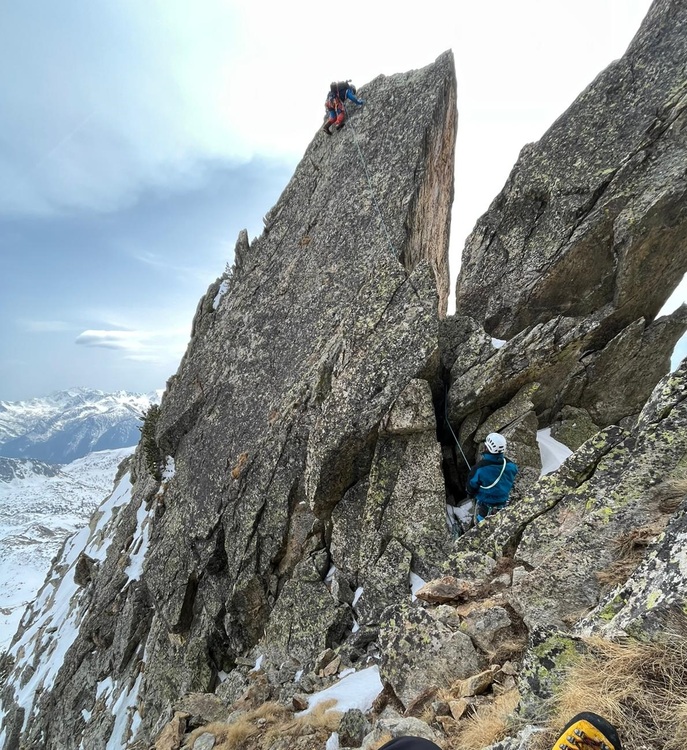
I'm not going to comment on the picture because there's a whole lot of new info there (including a third person with yellow boots and a camera!)

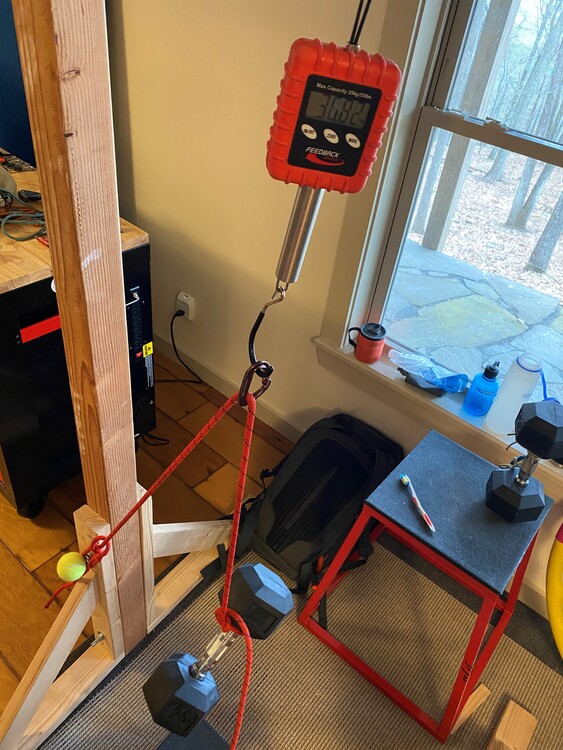
The thing you seem not to be internalizing is that by lowering instead of rapping you risked unnecessarily multiplying force on the pin anchor (Jared and MBK's point above). In that sense, the "calculated risk" was miscalculated, especially if your reasoning was along the lines of "the pin supported my partner rapping, so it should support me lowering." Maybe the picture below will help (25lb weight generating 37 lbs of static load on a high friction top anchor). 
Fabien M · · Cannes · Joined Dec 2019 · Points: 5
Andy Wiesnerwrote:

I'm not going to comment on the picture because there's a whole lot of new info there (including a third person with yellow boots and a camera!)

The thing you seem not to be internalizing is that by lowering instead of rapping you risked unnecessarily multiplying force on the pin anchor (Jared and MBK's point above). In that sense, the "calculated risk" was miscalculated, especially if your reasoning was along the lines of "the pin supported my partner rapping, so it should support me lowering." Maybe the picture below will help (25lb weight generating 37 lbs of static load on a high friction top anchor). 

We were indeed 3 but I don' t see how this is changing anything...
As far as the rest of your message I understand but again I took a decision in the moment, maybe it was/wasn't the best one but it's the one I made

Bill Lawry · · Albuquerque, NM · Joined Apr 2006 · Points: 1,821
Kyle Tarrywrote:

It's really hard to armchair quarterback without having been there, ....

It is really hard to armchair quarterback without having been there.  But still the judgment.

For folks posting here, does that pic even remotely look like the kind of route that would get on the short list of routes for you to do (you = folks posting here, not necessarily Kyle)?

Jeremy Bauman · · Lakewood, CO · Joined Feb 2009 · Points: 1,107
Fabien Mwrote:

It’s hard to say, but it looks like you might have been able to lower or let the first person rap first/ then for the last person, you may have been able to put the rope around the horn/top of the block - counter weighted to your belayer, and rapped down the front side on a single strand. This technique often can get you down stuff that wouldn’t be possible without a buddy. 

Andy Wiesner · · New Paltz, NY · Joined Sep 2016 · Points: 35
Jeremy Baumanwrote:

It’s hard to say, but it looks like you might have been able to lower or let the first person rap first/ then for the last person, you may have been able to put the rope around the horn/top of the block - counter weighted to your belayed, and rapped down the front side on a single strand. This technique often can get you down stuff that wouldn’t be possible without a buddy. 

And all the better with the extra buddy on the counterweight!

Franck Vee · · Unknown Hometown · Joined Apr 2017 · Points: 260

Yeah that's a tough one. What I personally take from previous comments:

  • In case of the fall, the TR setup involves ~1.5-1.7x the forces of a rappel, regardless of how tight the belayer is on the thing, but that's a low chances of putting a (relatively) high force on the single point of failure
  • The setup has been (presumably) tested for slightly higher forces than you on the rappel by the 1st climber and has held (perhaps could be monitored somewhat to ensure the piton is solid and didn't wiggle). If you rappel too, that's a certainty of putting a (relatively) low force on the single point of failure
  • Can't cheat it with additional gear left behind


The picture you posted, for me, would tip the balance towards what you did (assuming being very confident on that terrain, as you said and seems to be relatively easy indeed). The reason is that, with the belayer and the rope passing behind that huge block acts as a low piece of protection for you downclimb. We're not there, so might it actually is really sketchy, but as far as I can tell this wouldn't go anywhere. Thus as per the picture, should you fall on the downclimb, and the python breaks, you STILL have another backup, before you actually load the anchor. So in case of a fall on the downclimb, you actually have 2 additional backups - the rope behind the rock + the belayer/anchors with the 2 cams. If you fall high on the downclimb, that fall would really suck and you might get hurt. But if you fall further down, then it may be uncomfortable but you may get away with major issues.

So even though at 1st glance the downclimb might seem riskier, there's actually decent redundancy in there, much more so than the rap.

Alex R · · Golden · Joined May 2015 · Points: 228
Franck Veewrote:

If you fall high on the downclimb, that fall would really suck and you might get hurt. But if you fall further down, then it may be uncomfortable but you may get away with major issues.

This is not the case. If the piton fails it's a 30m fall from anywhere. Near the top it's 15m of rope out and 15m above the anchor. Near the bottom it's 30m of rope, up to the piton and back, but just above the anchor. Having the third person simultaneously lead belay during the down climb would have the benefit you describe though.

Franck Vee · · Unknown Hometown · Joined Apr 2017 · Points: 260
Alex Rwrote:

This is not the case. If the piton fails it's a 30m fall from anywhere. Near the top it's 15m of rope out and 15m above the anchor. Near the bottom it's 30m of rope, up to the piton and back, but just above the anchor. Having the third person simultaneously lead belay during the down climb would have the benefit you describe though.

You're right - I was thinking this as if he were downleading it, not down tr-ing it.

Bill Lawry · · Albuquerque, NM · Joined Apr 2006 · Points: 1,821

Drawing from recent comments, combine the TR and down lead? 

Initially, A and B rap … B after A, each on two strands while last-to-descend, C (the counterweight), is tied into both ends.   B places gear on one strand during rap.

C then arranges ropes so just the free rope strand is attached to the piton and calls for belays: A does TR belay on the “free” strand via piton while B concurrently belays the down lead.

Requires some care that the dangling rope loop does not become a problem during A / B raps; and A and B don’t use rope to anchor.  But I think that might be manageable here? Or no problem if two suitable ropes are / were available. 

Andy Wiesner · · New Paltz, NY · Joined Sep 2016 · Points: 35

Most excellent! And nice work Fabien getting down in one piece and thanks for offering this one up for discussion. 

Franck Vee · · Unknown Hometown · Joined Apr 2017 · Points: 260
Bill Lawrywrote:

Drawing from recent comments, combine the TR and down lead? 

Initially, A and B rap … B after A, each on two strands while last-to-descend, C (the counterweight), is tied into both ends.   B places gear on one strand during rap.

C then arranges ropes so just the free rope strand is attached to the piton and calls for belays: A does TR belay on the “free” strand via piton while B concurrently belays the down lead.

Requires some care that the dangling rope loop does not become a problem during A / B raps; and A and B don’t use rope to anchor.  But I think that might be manageable here? Or no problem if two suitable ropes are / were available. 

But then I wonder if, at that point, it might not just be better to downlead it, having your safety increase as you go down. If one wants to build confidence, the last to rappel (the downclimber) could even test the downclimb first with being belayed from up top with the counter weight of other climbers& the piton. The complexity of this un-orthodox system could be considered a bit of a problem - you need 3 persons to play their part rights in a procedure no one has likely tried before, while you in the field, on the descent, maybe a bit tired etc... Chances of errors do get a bit higher perhaps, either in the way the setup is thought true or the execution?

Bill Lawry · · Albuquerque, NM · Joined Apr 2006 · Points: 1,821
Franck Veewrote:

The complexity of this un-orthodox system could be considered a bit of a problem - you need 3 persons to play their part rights in a procedure no one has likely tried before, while you in the field, on the descent, maybe a bit tired etc... Chances of errors do get a bit higher perhaps, either in the way the setup is thought true or the execution?

Agree with all.  But we could dither over the degree of unorthodoxy.

Anyone who has done a lead backed up by independent top rope is probably not concerned. And having someone act as a counter weight is already thinking outside the box. Not much of a stretch for person on top to also recognize correct config up top before descending  

From below, belayers are not individually doing anything unorthodox. The last belayer down knows which line has the pro (if not visible). And there were three people in this case allowing two independent belays. So I don’t see a problem with unorthodoxy from below.

Still, yes, cold / tired / hungry can lead to simple mistakes.  And the risk might go up for some when deviating from normal. Then again, for me, the normal seems the bigger danger as going out of normal tends to fire up my brain. :) And, again, this isn’t very complicated even given tired / etc..

Edit: And, yes, first two could also down-climb rather than rap.

Fabien M · · Cannes · Joined Dec 2019 · Points: 5
Bill Lawrywrote:

Edit: And, yes, first two could also down-climb rather than rap.

FWIW I offered this option to my partners but being less sure of themselves, technicaly and mentaly, they declined.
That's when I came up with the solution to use myself as a second anchor point while they were rappeling

Bryan · · Minneapolis, MN · Joined Apr 2015 · Points: 482

I’m confused, you said it wasn’t possible to leave gear but you later said that your method was okay because your belayer was clipped in to 2 good cams. Was it not possible to leave one or both of those cams behind? I might be misunderstanding the situation after seeing your picture. Maybe they put the cams in after they went down first? 

Dirt King · · AK · Joined Jun 2018 · Points: 2
Bryanwrote:

I’m confused, you said it wasn’t possible to leave gear but you later said that your method was okay because your belayer was clipped in to 2 good cams. Was it not possible to leave one or both of those cams behind? I might be misunderstanding the situation after seeing your picture. Maybe they put the cams in after they went down first? 

His belayer built an anchor at the bottom of the rappel 

Nick Goldsmith · · NEK · Joined Aug 2009 · Points: 470

useing the lighter climber to back up the anchor without that climber anchored is a bad idea. pin fails and lighter climber gets  yanked off.  Stronger climber belays weaker climber while they down climb. then the leader does what you did and down climbs with belay.

Bill Lawry · · Albuquerque, NM · Joined Apr 2006 · Points: 1,821
Fabien Mwrote:

FWIW I offered this option to my partners but being less sure of themselves, technicaly and mentaly, they declined.
That's when I came up with the solution to use myself as a second anchor point while they were rappeling

I kind of thought this, that the last one down was probably the most capable.

I have done a lesser but similar kind of thing with non-climbing partners at steep down climbs while sandstone canyoneering. There, the undulating slot canyons often offer almost nothing for gear but do have great stances for lowering someone at least a short distance.  Of course, it is not something to take lightly.

Nick Goldsmithwrote:

useing the lighter climber to back up the anchor without that climber anchored is a bad idea. pin fails and lighter climber gets  yanked off.  Stronger climber belays weaker climber while they down climb. then the leader does what you did and down climbs with belay.

Edit:  Definitely a problem if that lighter person has a crap stance for the circumstances.  Oh, and stronger climber certainly doesn't always mean heavier.  I can speak from experience.  ;)

Mark Pilate · · MN · Joined Jun 2013 · Points: 25
Fabien Mwrote:


Of course I reported the issue on the french equivalent of MP ….

Holy shit.  I can’t even imagine how obnoxious that forum must be  lol  

curt86iroc · · Lakewood, CO · Joined Dec 2014 · Points: 274
Mark Pilatewrote:

Holy shit.  I can’t even imagine how obnoxious that forum must be  lol  

You think they have a meme thread?

Nick Goldsmith · · NEK · Joined Aug 2009 · Points: 470

Having  both climers down  climb while on tight  guides  belay is  best  option.  If the first  climber  rappels and the anchor  fails  that is a much  more  unpredictable  shock load  than a  slip while  on a tight belay. 

Guideline #1: Don't be a jerk.

Mountaineering
Post a Reply to "Mountainering and problem solving at rappels"

Log In to Reply
Welcome

Join the Community! It's FREE

Already have an account? Login to close this notice.