|
|
Fabien M
·
Mar 30, 2022
·
Cannes
· Joined Dec 2019
· Points: 5
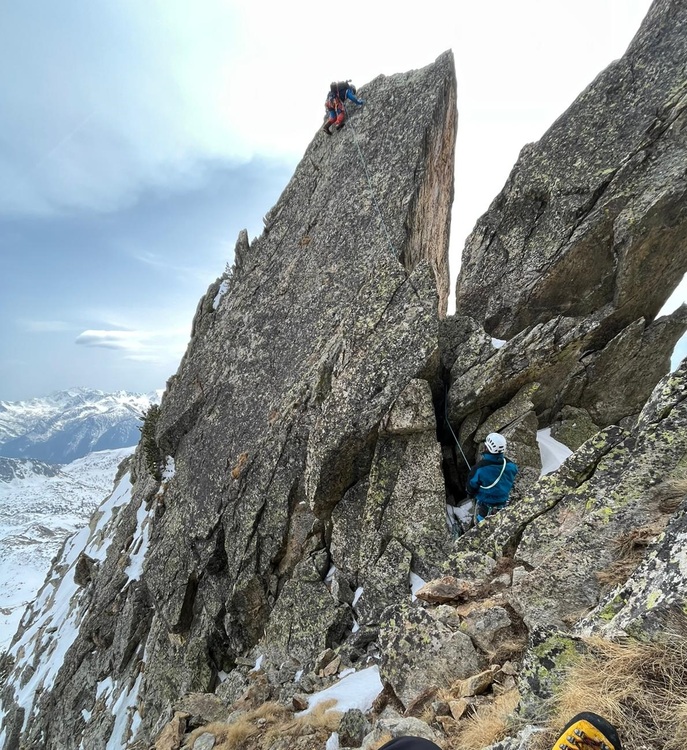
Another case study from my weekly outings. last Sunday on a snowy ridge this happened: there was a 15 meters rappel near the end of the traverse. the rappel was incline something like 80 degrees. what was in place was a cordelette linked by two , fairly new, pitons. It was the only pieces of metal on the whole ridge. one of the piton popped when we tested it and we only had the other piton, it seems to be solid. we had an axe with a hammer end. we tried hammering back the piton, didn’t work. slinging a rock was not possible, leaving cams or nuts was not possible. we had no extra pitons with us. The top of the, bad quality, rock where we were was a pretty smooth, 2 square meters surface going downward to the opposite side of where we were gonna rappel. I found a solution to do this rappel, don’t want to share it just yet. take the hypothesis that going back or escaping from the sides wasn’t an option. what would YOU have done to go over the rappel?
|
|
|
Andy Wiesner
·
Mar 30, 2022
·
New Paltz, NY
· Joined Sep 2016
· Points: 35
Big climber raps down single strand off the one good pin with littler climber backing up pin with body weight from flat spot, making use of terrain to add friction. Then little climber thinks light thoughts and raps off pin. Edit: The better solution (see various posts below) for the second would have been to back up the one good pin with a slung terrain feature (snow bollard, rocks, the mountain, etc.) using surplus rope, accessory cord, etc. Rapping off one piece is extremely dangerous, and almost never (and not in the instance as you'll see below) necessary. Edit 2: The scenario evolved. Read on . . .
|
|
|
Tradiban
·
Mar 30, 2022
·
951-527-7959
· Joined Jul 2020
· Points: 212
Fabien Mwrote:Another case study from my weekly outings. last Sunday on a snowy ridge this happened: there was a 15 meters rappel to do near the end of the traverse. the rappel was incline something like 80 degrees. what was in place was a cordelette linked by two , fairly new, pitons. It was the only pieces of metal on the whole ridge. one of the piton popped when we tested it and we only had the other piton, it seems to be solid. we had an axe with a hammer end. we tried hammering back the piton, didn’t work. slinging a rock was not possible, leaving cams or nuts was not possible. we had no extra pitons with us. The top of the, bad quality, rock where we were was a pretty smooth, 2 square meters surface going downward to the opposite side of where we were gonna rappel. I found a solution to do this rappel, don’t want to share it just yet. take the hypothesis that going back or escaping from the sides wasn’t an option. what would YOU have done to go over the rappel? I dunno, too many unknown factors, one would have to be there. Why don't you just enlighten us?
|
|
|
Rasputin NLN
·
Mar 30, 2022
·
fuckin Hawaii
· Joined Aug 2018
· Points: 0
How come you couldn't hammer the loose pin back in?
|
|
|
Bill Lawry
·
Mar 30, 2022
·
Albuquerque, NM
· Joined Apr 2006
· Points: 1,822
Andy Wiesnerwrote:Big climber raps down single strand off the one good pin with littler climber backing up pin with body weight from flat spot, making use of terrain to add friction. Then little climber thinks light thoughts and raps off pin. Generally agree, assuming the hypothesis rules out a counter-balanced simul-rap and maybe the free piton can’t be pounded in somewhere else. When first person goes, leave just enough slack to the backup person so piton tends to take all the load. First to rap can even get a little rowdy near the bottom. That goes well? Second raps on the loan piton. Post a warning on the route if possible. Edit: Or dig out a snow/ice bollard to supplement the loan piton.
|
|
|
Alex R
·
Mar 30, 2022
·
Golden
· Joined May 2015
· Points: 228
Andy Wiesnerwrote:Big climber raps down single strand off the one good pin with littler climber backing up pin with body weight from flat spot, making use of terrain to add friction. Then little climber thinks light thoughts and raps off pin. This, but the first climber also plugs in gear during the rappel wherever possible and anchors the two ends at the base (either with gear or bodyweight or both). Second climber raps with extended rappel so that their prussic can be locked to their belay loop. They clean the gear as they pass it. If the piton fails the prussic catches and it becomes a lead fall onto the gear. If the piton fails while the first climber is lowering, the second can still down lead on the gear instead of being trapped at the top.
|
|
|
slim
·
Mar 30, 2022
·
Unknown Hometown
· Joined Dec 2004
· Points: 1,093
If the rock is so bad just use your hammer and axe to chisel out a ballard in the rock. Eazy peazy lemon squeezy.
|
|
|
Fabien M
·
Mar 31, 2022
·
Cannes
· Joined Dec 2019
· Points: 5
Andy Wiesnerwrote:Big climber raps down single strand off the one good pin with littler climber backing up pin with body weight from flat spot, making use of terrain to add friction. That's the solution I used for my partner! For myself I still didn't want to rap down on a single piton and the way down was an inprotectable slab (see Alex's message). What I did to go down was threading the rope through a maillon on the single piton and I carefully climbed down as my partner was paying me slack, trying to weight the piton as little as possible. The piton that popped was really bend and the rock quality was pretty bad (not as bad as Slim's suggest lol), we really tried many time to put it back but it wasn't holding much. It was better to consider that it didn't existed Of course I reported the issue on the french equivalent of MP as well as the local guide office. I think one solution I also could have use was slinging the whole top of the spur, I had 10 meters of 7 mm cordelette, that should have work.
|
|
|
JaredG
·
Mar 31, 2022
·
Tucson, AZ
· Joined Aug 2011
· Points: 17
Fabien Mwrote: For myself I still didn't want to rap down on a single piton and the way down was an inprotectable slab (see Alex's message). What I did to go down was threading the rope through a maillon on the single piton and I carefully climbed down as my partner was paying me slack, trying to weight the piton as little as possible. Sounds like a risky maneuver (depending on the difficulty of down-climbing). I believe the anchor forces from a toprope fall can be significantly higher than those from a careful rappel.
|
|
|
Fabien M
·
Mar 31, 2022
·
Cannes
· Joined Dec 2019
· Points: 5
JaredGwrote: Sounds like a risky maneuver (depending on the difficulty of down-climbing). I believe the anchor forces from a toprope fall can be significantly higher than those from a careful rappel. Down climb was fairly easy and my belayer was keeping me on a « tight leash » so I believe the slack in the system was marginal thus close to what you have while rappeling.
|
|
|
mbk
·
Mar 31, 2022
·
Unknown Hometown
· Joined Jul 2013
· Points: 0
Fabien Mwrote: Down climb was fairly easy and my belayer was keeping me on a « tight leash » so I believe the slack in the system was marginal thus close to what you have while you are rappeling. The issue is that with a rappel you are placing only your own mass on the anchor. With a top rope, you are placing your mass on one side of an inefficient (70%?) pulley and the belayer is placing their mass on the other side (in order to counterbalance your mass). So the force on the anchor when holding a top-roper is in the neighborhood of 1.7x the force of a rappel. If you mix in some slack it can be even higher. It might be that the maillon leads to such a tight bend that the friction is high enough to make it more like a direct belay (imagine a munter hitch on the anchor).
|
|
|
Bill Lawry
·
Mar 31, 2022
·
Albuquerque, NM
· Joined Apr 2006
· Points: 1,822
That was a great solution, Fabien. Still, mbk makes an important point. Your idea of slinging a big pile of rocks has other possible applications as well. I once topped out on a summit that was just a pile of loose rubble. Not practical to dig down to find gear placements. The solution was to sling around a large pile of rocks with the rope (plus stance) to bring up my second.
|
|
|
Jeremy Bauman
·
Mar 31, 2022
·
Lakewood, CO
· Joined Feb 2009
· Points: 1,107
Fabien Mwrote: That's the solution I used for my partner! For myself I still didn't want to rap down on a single piton and the way down was an inprotectable slab (see Alex's message). What I did to go down was threading the rope through a maillon on the single piton and I carefully climbed down as my partner was paying me slack, trying to weight the piton as little as possible. The piton that popped was really bend and the rock quality was pretty bad (not as bad as Slim's suggest lol), we really tried many time to put it back but it wasn't holding much. It was better to consider that it didn't existed Of course I reported the issue on the french equivalent of MP as well as the local guide office. I think one solution I also could have use was slinging the whole top of the spur, I had 10 meters of 7 mm cordelette, that should have work. It would have been better in this scenario to gently rappel without a backup and downclimb/rap. With good footing, you can keep the anchor load significantly down and that way you aren't putting twice the load on the anchor like you would in a top rope scenario. I would NEVER top rope in the scenario mentioned as it increases the load beyond the tested weight of the thicker climber. Backing up the first rap with a meat anchor was great though. You say that the piton couldn't be hammered back in? Other rappel options include ghosting techniques practiced in canyoneering. Horns? Rock cairns? Dean man anchor? Retrievable rappel options open up the door to using anchors farther back with less clean pulls that wouldn't be feasible for a normal double strand rappel. Without being there though, it's pretty impossible to adequately armchair quarterback
|
|
|
curt86iroc
·
Mar 31, 2022
·
Lakewood, CO
· Joined Dec 2014
· Points: 274
|
|
|
Kyle Tarry
·
Mar 31, 2022
·
Portland, OR
· Joined Mar 2015
· Points: 448
Fabien Mwrote:
What I did to go down was threading the rope through a maillon on the single piton and I carefully climbed down as my partner was paying me slack, trying to weight the piton as little as possible. This solution: - Trusts a single piece of gear, of dubious strength, with your life, without any redundancy
- Doubles (ish) the load on the piton if you do weight the rope
- Puts both you AND your partner at risk in the case that the piton does fail, since you're now both connected to the rope and you both will take whatever the fall is if the anchor does fail.
- Creates the potential for massive falls, since you have a bunch of rope out with only one dubious piece at the far end of the rope system.
As such, this seems like it creates the worst possible scenario; you make it more likely that the gear will fail, AND you make the consequences of gear failure worse. Yikes! It's really hard to armchair quarterback without having been there, but in general I'd say that my goal in this situation would be to find/build a stronger anchor. Maybe that's a huge cord, maybe that means excavating a hectare of snow until more cracks are found, maybe it's a bollard, but all of those are preferable to trusting my life to one piton that is in poor rock. (I believe you started another thread a while back where you insisted that pickets don't have any use, and it seems like leaving a buried picket would have been a perfect solution to this problem...)
|
|
|
curt86iroc
·
Mar 31, 2022
·
Lakewood, CO
· Joined Dec 2014
· Points: 274
ok, my previous post was obviously a joke, but i'm surprised no one has mentioned leaving gear behind. I'm not sure if you were carrying passive pro, but a $5 nut is cheap insurance. there was an accident in CO last season where a party did exactly as you...and the piece failed.
|
|
|
Kyle Tarry
·
Mar 31, 2022
·
Portland, OR
· Joined Mar 2015
· Points: 448
curt86irocwrote:ok, my previous post was obviously a joke, but i'm surprised no one has mentioned leaving gear behind. I'm not sure if you were carrying passive pro, but a $5 nut is cheap insurance. there was an accident in CO last season where a party did exactly as you...and the piece failed. Great point Curt! Here's the Sharp End podcast about that incident, for anyone who is interested: https://www.thesharpendpodcast.com/episode-56
|
|
|
Marc801 C
·
Mar 31, 2022
·
Sandy, Utah
· Joined Feb 2014
· Points: 65
curt86irocwrote:ok, my previous post was obviously a joke, but i'm surprised no one has mentioned leaving gear behind. I'm not sure if you were carrying passive pro, but a $5 nut is cheap insurance. Part of the OP: Fabien Mwrote:.... we tried hammering back the piton, didn’t work. slinging a rock was not possible, leaving cams or nuts was not possible. we had no extra pitons with us. The top of the, bad quality, rock where we were was a pretty smooth, 2 square meters surface going downward to the opposite side of where we were gonna rappel....
|
|
|
Fabien M
·
Mar 31, 2022
·
Cannes
· Joined Dec 2019
· Points: 5
Kyle Tarrywrote: This solution: - Trusts a single piece of gear, of dubious strength, with your life, without any redundancy
- Doubles (ish) the load on the piton if you do weight the rope
- Puts both you AND your partner at risk in the case that the piton does fail, since you're now both connected to the rope and you both will take whatever the fall is if the anchor does fail.
As such, this seems like it creates the worst possible scenario; you make it more likely that the gear will fail, AND you make the consequences of gear failure worse. Yikes! (I believe you started another thread a while back where you insisted that pickets don't have any use, and it seems like leaving a buried picket would have been a perfect solution to this problem...) OK but what would you have done then? FYI a picket wouldn't have solved anything, the ridge was snowy in the way that it was partialy covered with snow but nothing where you can use ice screws, let alone snow pickets.
|
|
|
Kyle Tarry
·
Mar 31, 2022
·
Portland, OR
· Joined Mar 2015
· Points: 448
Fabien Mwrote: OK but what would you have done then? I posted what I would do in my reply, you just edited it out from the quote for some reason. It's really hard to armchair quarterback without having been there, but in general I'd say that my goal in this situation would be to find/build a stronger anchor. Maybe that's a huge cord, maybe that means excavating a hectare of snow until more cracks are found, maybe it's a bollard, but all of those are preferable to trusting my life to one piton that is in poor rock.
|
|
|
Fabien M
·
Mar 31, 2022
·
Cannes
· Joined Dec 2019
· Points: 5
curt86irocwrote:ok, my previous post was obviously a joke, but i'm surprised no one has mentioned leaving gear behind. I'm not sure if you were carrying passive pro, but a $5 nut is cheap insurance. there was an accident in CO last season where a party did exactly as you...and the piece failed. Leaving pro was not an option due to the configuation of the place where we were. I left pro before and have no problem letting go of some money to stay alive. I ll never be 100% sure I couldn't have die downclimbing this slab but I was very carefull not to weight the rope and my belayer was himself solidely anchor to the wall with 2 well placed cams and he was paying me just enough slack to go down. Should the only piton I was on break (and again it seems to be pretty solid) I m confident enough I would have been ok. I was not really relying on it to begin with and the down climb was easy enough for my taste. The single piton acted more as a (mental) backup while downclimbing. In all fairness if it had happened a year ago I know I would have solo the downclimb but I m about to become a father so I m slowly realizing I m not invicible ;) Honestly I was not posting my anecdote expecting any sort of validation on a forum (doh!) but more hoping for viable alternative solutions I may not have think about at the time. At the end I think I took a calculated risk and that's often what mountaineeing is about. And because forum shitstorm makes me smile lets include a photo of me downclimbing said slab (FYI down this slab there is a 100 meters drop)
|


