
 Continue with onX Maps
 Sign in with Facebook






Best Mostly-Gear-Protected Face Climbs


|
|
There's a special place in my heart for technical face climbing over thin gear. I find it very rewarding to suss out cryptic moves and work hard for intermittent gear placements. What are your favorite areas and routes in this discipline? Here's a great example of a 140' 5.11c with good but thin gear that you have to climb above for 10-15 feet at a time. 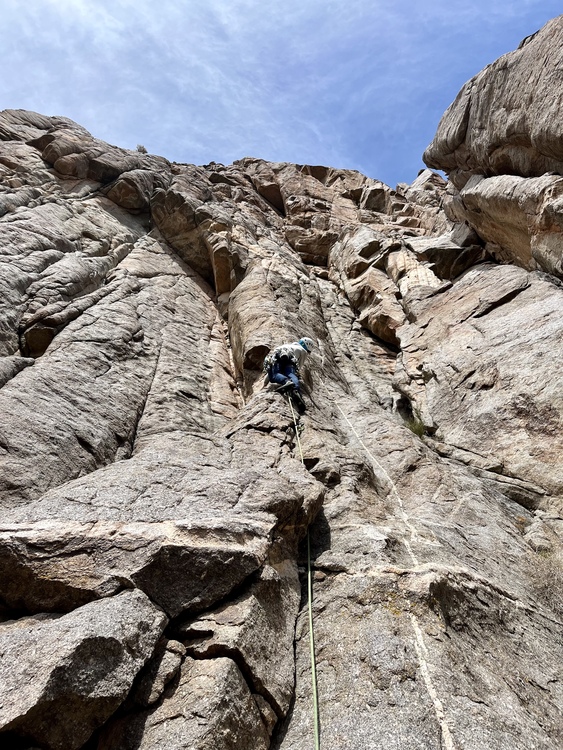 To start: - Middle pitches of Fiddler on the Roof |


|
I love the doubleissima and ridiculissima in the gunks. |
|
|
This is a cool thread. I think a few routes at Tennessee wall fit this bill; particularly the aretes. Margin of Profit comes to mind. |
|
|
Party in my Mind - NRG |
|
|
Good call on the Burning inside finish! So amazing.
Def some mixed lines at the City that I can't think of....maybe Silent Partner? |
|
|
Although short, devils lake is full of spicy thin gear with hard face moves. |
|
|
It’s important to note that “trad” face climbs were originally dubbed “traditional” because the bolts that protected them were placed from stance, strictly ground up, as opposed to sport climbs. At that point in climbing evolution, “traditional” had nothing to do with what gear was used, and everything to do with style and methods of placing it, gear being protection, and including bolts. But that’s just the traditional definition of traditional climbing. As irritating as it is to a climber like me who witnessed and participated in that evolution first hand to hear climbers use the abbreviation to describe climbs with no bolt protection, or even with some bolt protection, I can accept the definition that disrespects true tradition in favor of brevity. I just don’t participate in it’s use. A few of the most engaging, exciting and excellent traditional face climbs I had the privilege of climbing on Middle Cathedral Rock are Space Babble, Black Primo, and Freewheelin, whether they are trad climbs, I suppose is debatable. They do have about half thin gear placements, thought provoking moves with protection well below, and they are steeper than your average slab climb, by the traditional definition of slab. |
|
|
Kevin Worrallwrote: Interesting! It would seem this ethic applies to quite a few mixed City routes. |
|
|
Kevin Worrallwrote: Fascinating! So by that logic, a fully bolted line that's drilled on lead from stances or hooks is a trad line, even if it has no gear placements? I've always thought of "sport" climbs as routes that are fully bolt-protected where you can whip at any point after the second bolt and not deck, given a competent belayer. That could be established ground-up or top-down. Routes like Jay Goodwin masterpieces at the City where you get four bolts in 120' ... "bolted trad route." |
|
|
Aid Crack in Boulder Canyon Lots of climbs in Eldo fall into this category too |
|
|
F r i t zwrote: Correct - that is a trad route. Even with no gear placements. There might be serious runouts because the stances to drill were far and few between. |
|
|
Kevin Worrallwrote: Just because other people don’t understand the proper definition, doesn’t mean we all have to accept their ignorance. As for gear fantastic gear protected face climbs; *Fiddler on the Roof (Red Rocks) for sure. |
|
|
Kevin Worrallwrote: Whilst my British Trad climbing background produces an initial 'hang on now old chap' at this, I have to remember that: A) This is an American based site. and B) Even more importantly I beilieve 'trad' as a term has its origins (via traditionalists) with you lot, not sure but was Tom Higgins its granddaddy with https://www.tomhiggins.net/index.php/style-commentaries/13-tricksters-and-traditionalists ? |
|
|
The original meaning of sport climb, was that it was established without respecting traditional ethics - IOW rap bolted. Simple as that. The frequency of bolts was typically tight spacing compared to traditional face climbs, but that factor did not make a climb a sport climb.The term traditional only appeared in response to that new tactic. Before that, rap bolting routes that could be free climbed was ethically unacceptable, ridiculed if done, and considered an aid ascent. Which brings up another aspect of traditional style on bolt free routes - no top roping first, no hangdogging, no hanging on gear, including hooks, to place bolts or more pro, cleaning on rappel and obviously previewing was occasionally justified, but even inspecting a clean new possibility from the rope first was bad style. So basically, “trad” climbing in the current vernacular has very little to do with traditional free climbing. It’s a catchy term with hollow implications of boldness and history. |
|
|
As Kevin suggests, originally it was all just 'climbing'. The 'need' for a differentiation came with the increasing acceptance by some of certain 'tactics' that, while actually used with some frequency over the years, had always been considered either unethical or 'dubious' by the majority of activist new routers. This led to the distinction between sport and trad being based upon the tactics used on the FA, not just the type of protection. Over time, though, this has changed to fully bolted routes to generally being called sport routes, while those that use 'other' forms of protection are called 'trad'. Obviously this distinction is far from clear, as not only are there those sparsely bolted slab routes, many from back in the 'it was all just climbing' days, but there are the 'alpine sport routes' as well, some of which feature very long and serious runouts--but usually established after much preparation. Getting back to the initial question. There are many excellent climbs that could fit in this category in small, obscure climbing areas across the county (gems in the rough). Devel's Lake (not really obscure) was mentioned above, but, for example, the Connecticut traprock crags have many excellent bold face climbs that compare in quality with others of similar size anywhere. |
|
|
Kevin Worrallwrote: It seems that the disparagement of hangdogging would be the toughest pill for modern climbers to swallow. I personally far prefer onsighting to projecting but couldn't imagine making progression in my technique and strength without being challenged by moves that I will undoubtedly fall on and need to work many times over. |
|
|
Eldo has many good climbs of this style. Jules Verne/Lene’s Dream is one of my favorites ever |
|
|
Candyland, 10.C at Phantom Spires immediately comes to mind. Some routes at Snowshed fit the bill as well. And since we’re taking traditional in the traditional sense The Dike Route on Pywiack Dome is a personal favorite. |
|
|
Where Vultures Dare on Hayden Peak in Utah was such a cool route. Really chill climb too, probably graded soft. (good 'ol secure moves up a vertical wall, not that awkward low grade stuff) One of those routes where if there were hard moves there was an obvious rest, so you just cranked on through, got to the rest, placed bomber gear, rinsed and repeated. |
|
|
Southern Arizona. Basically all of it. Cracks are rare here and you learn to to take advantage of gear wherever and whenever you can, even if it's mid sequence with poor resting opportunities or doesn't really result in shortening a fall as much as you wish it would! Lizard Marmalade Direct and Ripple Cracks on Mt Lemmon are two notable classic test pieces, but there are many bold lines established by the likes of Chip Chase, Ray Ringle, Jim Waugh, and others that require very techinal movement well above gear. In northern Arizona, the Waterfall hosts a number of excellent facey trad lines. No Utopia and Crescent Moon come to mind in the easier category, then there are outrageous ball nut-protected test pieces in the 12-13 range like Slaughterfall and The Trident, to name a few. |
|
|
Seneca has many routes that fit this bill. There could be some in NC but just put that out of you mind... |


