
 Continue with onX Maps
 Sign in with Facebook






Canyoneering Suspension Trauma Death?


|
|
Matthew Jaggerswrote: Belay chair!! |
|
|
Princess Puppy Lovrwrote: I've thought about it several times, but I havent had any real issues with the Waldo. |
|
|
In the linked thread, Tom seems to be suggesting it was more about suspension asphyxiation after exhaustion and that a chest harness may have saved the day. Anyone know more about that? I'm sure we can all imagine ourselves in this guy's position, and hope we'd never be there. It sounds, so far, like the best option in such a situation (assuming climbing rather than canyon gear) would be a prussik to keep the legs level and a chest harness? |

|
A V wrote: Agree with all you wrote but recall this is canyoneering. The most common descending device is a Petzl Critr or something similar as it solves two issues:
Basically, ATCs, guide style devices, and gri-gri's are out of the question. Sure, there are ways to improvise with them for the above situations, but there are better tools. |
|
|
Not the first time for trouble in Heaps. Very sad. There's a big difference between a practice session in a gym and trying to do it exhausted with light failing and gripping exposure.
|
|
|
I am shocked that more climbers don't know about suspension trauma. Harnesses in industrial applications have foot stirrups in a little bag to relieve the pressure if someone can't get to them quickly. An unconscious person will die quickly. This is OSHA 101. |
|
|
A V wrote: To correct the terminology, it would be a Petzl Piranha - but the more common device is the Imlay Critr. Basically think of it as a modern figure-8 device with some fancier features like being able to adjust friction on the fly and it's faster to load. But there isn't a good way to ascend with one once you're on rap. But as you mentioned, nothing a couple prussics couldn't solve. Or 1 prussik and two matching non-lockers for a Garda in a pinch.  |
|
|
Hypothetical situation for you all to ponder… You’re on rappel with a normal ATC, no third hand backup of any sort. You have some extra slings and biners, so ascending the rope is no problem. You realize you missed the last anchor and need to ascend the rope to the last ledge. However, the rope, which is obviously weighted, is buried 6” inside a dead vertical thin hands crack, for the next 8 feet above you. If the crack is beyond your free climbing ability, how do you get back up? *you don’t have any other gear, so plugging cams and yarding on them isn’t an option. |

|
JonasMRwrote: An EMT climbing partner warned me of this, back when I was sometimes doing gym setting. If you are hanging in a climbing harness, up off the ground, and faint for whatever reason (and hanging in a harness can cause this), your head goes back, your tongue relaxes, blocks your airway, and that's that. Asphyxiation, and pretty quickly. Sorry for this loss, condolences to all. H. |
|
|
A V wrote: Not really. It's basically a figure-8 with multiple ears. 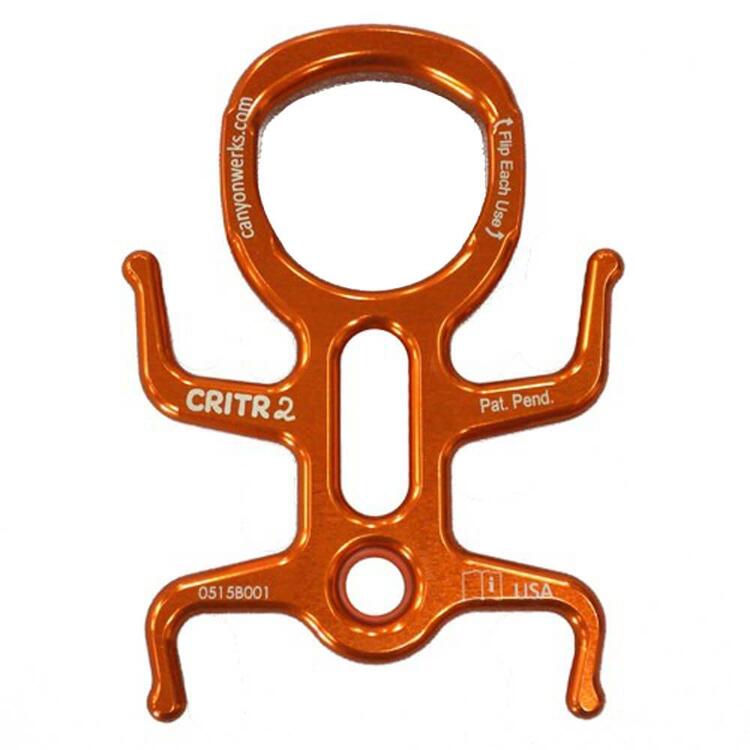 |
|
|
Jason Kimwrote: Good question. Maybe use the slack rope below you or any extra slings to tie knots and aid the crack on the slotted knots, if there are constrictions? |
|
|
Jason Kimwrote: 6 inches inside should be doable, IMHO. You were kind. :) Tie catastrophe knot below and ease down onto it. Hang your pack about foot level from your harness so you can easily move it with your feet when needed. Prussic as usual as high as you can. Rotate / spin on the line as needed until your front is facing outward from the cliff. When you next stand up, you are pulling /shoving/whatever with your free arm and wriggling your head, neck and shoulders out from under the overhang and hopefully onto a more vertical rock above. This maneuver also moves the rope out of the crack - at least in the near vicinity of you. Reset and repeat. Lots of things will make this harder to impossible like nearby rap anchor causing unfavorable angle of rope back into crack, rope being deeper in and yourself also hanging deep under a roof the crack runs through, rough conditions already mentioned, etc.. |
|
|
Marc801 Cwrote: I'd disagree. I've done Heaps a couple of times, Birch Creek (back-to-back 300-foot rappels), Englestead, etc...all on an ATC type device. I find the friction much easier to configure especially on skinny long static-esque ropes. But, that's also what I'm used to using as a climber. Who hasn't rapped off a wall with a fully loaded pig attached to them? Climbers typically don't carry canyon descenders...(and some of us are stubborn). I know folks who really like a mini rappel rack for Heaps...(cavers figured out big pit drops a long time ago I'm guessing). Cavers also can convert to ascend pretty efficiently. Sad deal. Rode the shuttle past this location in Zion Saturday...I always look over there...just to the right of Lady Mountain. Beautiful day. Tragic. |
|
|
Marc801 Cwrote: I agree transitioning to ascend wouldn't be quick, but the middle slot and bottom hole look to be sized such that they could be converted to a plaquette, which could then be used as a progress capture to ascend. |
|
|
Jason Kimwrote: Things I would try since this situation is so desperate and it may or may not work. Fundamentally you need to aid climb this thing. I’m not sure if you mean the rope is actually stuck in the crack or is deep in the crack. The first thing is what I would call a reverse rodeo clip. You take a sling make it as long as you can or your own rope and twirl it with a caribiner and try to hook it to your piece of gear furthest out of the crack. Well that doesn’t work you gotta homemake a cam with what’s in your back pack. If it were fists, I would wrap a water bottle wrapped in slings. If it’s thin hands I would take your rope and make it a knot but a knot that cams as you pull down on it. Third option and most desperate would be tie your back pack to the end of the rope and try to heave it over the ledge and pull yourself up with it. That’s all I got. |
|
|
I have been in a situation in Montemayor cave in Mexico, which has some fairly long vertical drops. One time I and another guy decided to ascend one of the long drops in tandem with me on the top. This was before my friend Joe became aware of rebelay setting techniques that were coming into practice in Europe. So our rope was rigged in such a way that it was in a shallow crack near the top of the climb. Once I got to a point, I couldn't get the rope out of the crack enough to move my ascenders up because, yep, I had a whole extra dude's weight on me. Years later I learned how to switch from ascending to rappelling mid climb, but I doubt that the guy below me knew how to safely do that. I knew I just had to figure it out. As I recall, I would bring both legs up and struggle to stand horizontally to pull the rope out briefly, and then I would jam my upper ascender upwards. This then gave my lower ascender room to move, and slowly we made our way up. It was horrible, to say the least. |
|
|
Nkane 1wrote: Thats pretty genius, and really creative! Thanks for opening my mind! |
|
|
Jason Kimwrote: Why can't you just push away from the wall with one foot, thus freeing the rope from the crack and then ascend using your other foot? I do plenty of rope climbing related to aid/big wall climbing, and this situation seems trivial if indeed "ascending the rope is no problem." Am I missing something? |
|
|
Nope, you're not missing anything. Asking oneself the "what if" questions, and then imagining solutions in detail, is part and parcel to becoming a more competent climber. If a person can't work through solutions in her head she doesn't belong on either sharp end of the rope. |
|
|
Sam Skovgaardwrote: Probably could given the rope was rigged to the above tree anchor, which pitched him out a bit more. My guess is that the rope wasn't in the crack. Or, minimally. Rope line should be off to the side of the crack from the upper anchor he was rappelling from. From the bird perch anchor (the anchor he went by, likely in the dark), there's a "rope eatin' crack" directly below and in line with that rappel. The wall cuts away and the roof is nearly horizontal for a long ways. So, to push off, you'd have to jug up and then flip nearly upside down to push off the underside of the roof. Would suck, in the least. Used to be that folks use to jam a t-shirt or something in the crack as they rapped by to keep the rope from diving into the crack. Makes the rope pull at the bottom much, much easier. |


