
 Continue with onX Maps
 Sign in with Facebook






You Suck at Belaying


|
|
A V wrote: Here's an example. My partner fell on Windsurfer at Beacon, about 35 feet up. It's a 10a trad line in a vertical corner, bomber gear. Pulled the little yellow Z4 that was at his waist when he fell. He wound up with his feet about 6-8 feet off the deck when the long slung nut below his feet held. I did NOT give a soft catch when I saw him slip. Had I done so, he would have decked from 35 feet into rock BECAUSE I fucked up and gave him extra slack which allowed him to deck and lose his life or the best parts of it. To new climbers: do NOT give people extra slack, especially on trad routes. Also, this route has bomber nut placements and there was no reason except laziness and worshipping tiny new cams to slot a Z4 where people have placed nuts since the 70s, nuts that do not pull like tiny cams with little margin for error. My partner and I discussed this issue as well, in addition to the new need to sew it up close to the deck, and he was obviously stoked I did NOT give him the sexy soft catch that all the cool kids say I should be giving. So there. :) |
|
|
bryans wrote: I know a woman who fractured both her heels on a too-hard catch in the gym---she was in a wheelchair for a while because of it. That was around 2003. Another who fractured a hip slamming into the wall, around 2009 or so. I have not been injured myself but had a close call some years ago with a catch from a non-regular partner that was so hard I instinctively put my feet up and slammed the wall painfully, and I was pretty shaken by it but fortunately nothing broke. About 95% of the time I'm being belayed by my 75 lb-heavier partner who gives a fantastic soft catch. I didn't read the whole thread but definitely agree that those who say, "what's the big deal about soft catches" are probably not climbing with massive weight differences between their partners or are the heavier partner. I only take whippers with confidence when I'm being belayed by someone I know can give a soft catch (AND who knows the difference about when not to, like close to the ground, DUH!) and I chat with new partners about soft catches before being fully able to "go for it" and trust taking a lead fall on them. Hard catches really suck IMO, though situationally-dependent can be necessary. But everyone has their belaying preferences and should feel comfortable talking to their partners about what they prefer in a catch. |
|
|
But it also increases the radius of the swing. And that's what a soft catch is about, right? In a gym with tightly bolted climbs if you skip a bolt and then fall the catch is softer... even though you fell farther. There's so many conflicting claims in this thread that I'm convinced that few offering explanations truly understands what's going on. Lots of false confidence here. Jump, don't jump... who knows for sure? How many of the people who got hurt would have been hurt regardless of the belay simply because they hit something sticking out of the rock? |
|
|
Matthew Jaggers wrote: Don't come climb in Europe... belaying is a time to enjoy a cigarette and snack on a baguette. Maybe it's the socialized medical insurance and there are ton's of broken ankles. I'd love to see a video of you and your buddies lined up with eyes glued to your respective partners, ready to spring forth at a milliseconds notice for an entire pitch. Sure, when your partner is cruxing, but literally never looking away? This would be an extremely exceptional belay indeed. |
|
|
Amy Jordan wrote: These anecdotal cases of injury aren't really worth much and you can't really determine the 'hardness/softness' of the catch that coincided with the injury. Every injury that is a result of swinging into the wall will be blamed on a catch that wan't soft enough - even if an appropriate belay was actually employed. There are tons of falls that go wrong due to several reasons, but the afterthought is almost always that the cause was a hard catch. Sometimes this is surely a big factor, but you can't say that for every anecdotal case. Also, a soft catch somewhat lessens injury risk, but it far from negates it. It's not like a hard catch causes injury and a soft catch prevents injury, period. It is more of a mild-to-moderate risk mitigator in specific situations. |
|
|
Hope for Movement wrote: I certainly agree that it is about risk mitigation and that anecdote != data. In both these cases, I was left with the impression that a softer catch would have helped. Both were small people with larger partners belaying, but sure, there could have been other issues and we would have to replay the exact fall with a soft catch to know for sure. If it isn't about the risk mitigation against wall-slamming and broken bones, then at least it is about COMFORT for me. Hard catches are super uncomfortable, which makes me more hesitant to take them (and I have lots of experience taking lots of hard catches). A soft, pillowy, airy whipper is what I want. But to each their own and circumstances differ. |
|
|
Hope for Movement wrote: Yup. Folks regularly break/sprain their ankles stepping off a six inch curb. Even a low speed impact can break an ankle if you land with the foot tilted just a little bit. It should be no surprise that this happens sometimes when taking a climbing fall. |
|
|
Adding more rope to the system does not inherently make a softer catch. Lengthening the distance over which the climber comes to a stop does. Providing a small ‘pop’ during a catch assists this process. It’s the same reason we fall on stretchy ropes and not cables. I don’t understand the confusion. |
|
|
There is a lack of personal accountability in this thread. Those wanting soft catches have you considered gaining some weight? |
|
|
I think the real question concerns the socioeconomics of soft catches. Are they a privilege? Are they fairly distributed? |
|
|
in shallah wrote: When will we get a soft catch equity bill passed through congress? |

|
Emil Briggs wrote: Umm.. yep. There are many foot and lower leg injuries as a result of falling and hitting the wall. That is inarguable (and no one is arguing that injuries don't happen, not Hope either). Automatically surmising that a "hard catch" was the cause of these injuries is another story. I think maybe you misread the post you are citing.... |
|
|
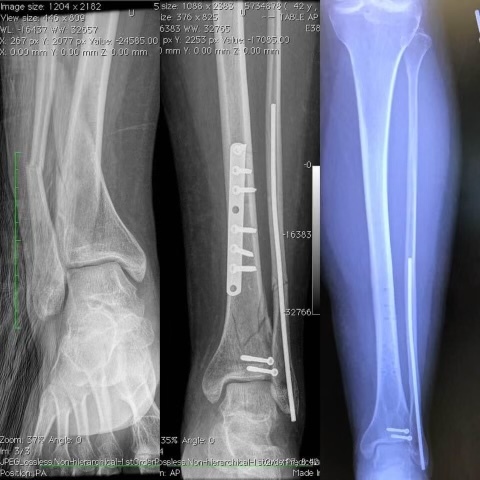 Here’s an injury caused by a hard catch. I’ll let you guys argue about whether it was or wasn’t caused by the catch, and I’ll check on you in another few pages ;) |
|
|
Evan Kirk wrote: It's not the same reason we fall on stretchy ropes and not cables. Stretchy ropes protect the climber from the rope itself. A soft catch protects the climber from the wall. A soft catch is meant to prevent injury from horizontal motion. It's about minimizing the horizontal velocity of the climber at the moment of impact with the wall, or ideally reducing that velocity to zero by not even touching the wall. A climber hits a wall horizontally, or more often diagonally, but it's the horizontal component of the force that will determine how hard they hit and how likely they are to get hurt. On steeper than vertical, as you fall down you also fall away from the wall. So when the climber does swing and the belayer effectively lengthens the rope by going with it, the climber has to swing farther before they hit, allowing more time for the velocity of the swing to diminish. Letting the climber fall farther as they swing changes the trajectory of the fall and reduces the horizontal component of velocity (the angular momentum thing... the radius of the arc increases as the fall progresses.) A bigger swing towards a wall that is farther away will mean an overall lower horizontal velocity vs a short swing into a wall that is close. In other words, a bigger arc gives more runway to slow down the swing before impact with the wall. |
|
|
Josh Squire wrote: Do you thing it was due solely to a hard catch? Do you have any specific data point that a hard catch was used to catch this this fall? Do you think that a softer catch would have completely mitigated all injury, or would you have only needed 6 screws instead of 7? If only Matthew was belaying you,... |
|
|
Joe Prescott wrote: Nope. I'm in agreement with Hope that people often blame a hard catch for an injury even when it wasn't the primary factor. |
|
|
Emil Briggs wrote: I see, my mistake. |
|
|
Anecdote here: last spring I got almost dropped to the ground by a “soft catch” at Vantage, with rope stretch just softening my landing and hitting sharp rocks. Huge heel bruise and had heel issues all season. I took responsibility because I chose to partner with a guy I hadn’t climbed with before. Point is we choose our partners and must accept the risk accordingly. |
|
|
Emil Briggs wrote: Nick is this your second account. First getting injured by not clipping bolts is ego. Is decking onto a ledge mean you didn’t lose enough weight? |

|
Seems the situation can be easily solved for those worried about being “spiked”. Surprised no one has mentioned using a “sad sack”. This is a device invented by trad climbers for their whiny GriGri using sport climbing friends who need every catch to be a soft catch for their spiritual health. the sad sack is simply a lightweight tarp or duffel that is stuffed with gear, water, rocks, whatever to be the perfect calibrated weight to give the climber in question the soft catch of their dreams. Easy to adjust more or less weight as needed. Just set the sad sack on the ground in front of the belayer and clip to the rope. let the rope run freely through its Biner, but when your “lightweight” climber falls, the rope comes taut and has to lift the sad sack into the air, thus dampening the whip in a controlled manner tuned for the individual climber - just like their sleep number. Only drawback is that the trad climber now has to deal with two sad sacks, but shucks, that’s just another day in the wild for a good trad climber. |


