
 Continue with onX Maps
 Sign in with Facebook





Last Exit


|
|
Ok, I'm completely confused. (My first MP post by the way) Darryl - you are complaining about, "hyper development", yet you are a guidebook author. Which crags are bothering you? Point them out. The Garden Wall has a few new routes, but it is hardly a tragedy. I can point you to many crags in the US where most of the routes on a wall share holds. |

|
I have no idea if the following elements of Index development were part of Darryl's original complaint or not, (and I agree with Max’s suggestion for Darryl to offer specifics) but to me the installations of rebar rungs and via ferratas, bolts to anchor your belayer for TR sessions, heavy duty metal boxes cable locked to the walls, metal bath tubs, fixed ropes that stay up for months or years on fully equipped routes, toys/ornaments bolted to the walls near or on routes, flying drones around the walls when others are climbing, drilling V-threads in the granite, drilling pot smoking pipes into the granite, and the elaborate swinging bridges with a painted obstacle course are all part of the recent changes at Index I would consider overly-impactful. Some aren’t even climbing route specific but all were done by climbers. These are on public land and (I'm not speaking for Darryl here, apologies if this is off-topic) could reasonably be said to exceed either courteous climbing behavior or legal/access-minded farsighted behavior in a state park, or both. Obviously Index's cliffs contain a tunnel and once had a quarry - those predated and didn't involve climbers and those developments had explicit permission from the landowning private entity so are not relevant. |
|
|
C. Defecto wrote: Hi C. Defecto, I wrote a book which has encouraged climbing on public land, hopefully in a leave-minimal-trace style, but some user impact as a side effect is inevitable. But you accusing me of hypocrisy if I also oppose a specific intentionally constructed impact from climbers (mostly not even on climbing routes) doesn’t make sense. You are blurring together different categories by fixating on the word “impact” as though all impacts belong to one shared coherent thing. They don’t. It would be hypocrisy if I opposed other guidebook authors or route creators/publicizers doing FAs and books or blogs. But I support those things! Everyone from gym and guide owners to famous climbers to writers, photographers, and prolific instagramers and MountainProj contributors all inspire/encourage outdoor climbing, thereby having an impact. These folks aren’t guilty hypocrites or shouldn't just shut up when they don't support some physical changes/impacts built and left in place long term on shared public land. (especially when the impact is the purpose, and not an accidental unintended result) Fred Beckey, Jeff Smoot, Darryl Cramer, the WCC, the ACC, CC.com, BoeAlps, Mountaineers, MP.com and John Scurlock have also massively inspired and impacted climbing in the Cascades but aren’t guilty of hypocrisy for believing specific environmental changes/impacts are bad. People don't forfeit the option of not liking your rebar via ferratas or painted obstacle courses or steel cable zip lines (in a state park containing Index's walls) merely because they've encouraged public land recreation in the Cascades. Obviously it's convenient for me to see this distinction since I wrote a book, support other books, and didn't illegally install ferratas or painted rebar obstacle courses in a state park. If you have a specific issue on a specific route I helped FA or included in a book, feel free to email me ( BlakeHerringtonATgmail.com) and I'd be happy to consider your suggestion. Likewise if there's a specific peak or wall that you feel is too environmentally fragile to be in a book, let me know, though nearly all peaks and walls in my book were already easily google searched for TRs and mountainproject info and most exist along popular hiking trails or mountaineering routes where rock climbers are vastly outnumbered by other recreation groups. Sorry to derail Darryl’s thread - I’m also curious which specific routes or climber produced constructions/installations he is speaking to. |

|
I just wanna go on the record to say that the moss doesn't need an advocate around Index. Anyone out there cleaning and putting up routes is doing God's work.  |
|
|
I was just hoping for de hombre a hombre old cranky guy stuff. Darryl we still have our chance. Blake - you bring up some good points. I see from C. Defecto, you are not Jesus. Drilled pot pipes, fixed lines and an extra belay bolt here and there are not big issues (to me) - still wondering about granite bollards, a mentor failed. In the 80's a pig head was fixed to the lower wall annually in the fall. If it was removed, it was quickly replaced, the boys wanted it to rot off. Not quite so cuddly. Wondering about the Via ferrata and the obstacle course, does the state offer any oversight today at Index? Agree David - scrubbing moss is god's work. |
|
|
Hangdog Hank wrote: Not down for the jokes today, eh? if I was in kindergarten that means you were in diapers. Point being- who cares? Wayne knows I respect him. |
|
|
Jon Nelson wrote: I think we should really all be taking Jons' advice and use direct communication. It is hard enough to have a conversation over the internet but when there are 10 people with totally conflicting views I think we are only going backwards.... |
|
|
Perhaps we rename this thread “Clash of the Titans” ? |
|
|
Got my vote. |
|
|
Just read this thread after a long break and thought I’d clarify a few things. My primary motivation for posting wasn’t that people were being asocial jerks. I was suggesting that the prevailing culture is one that will in the end be detrimental to the development of new areas. Climbing has an impact on the environment. ( As a side bar MP most certainly amplifies the perception of this impact ) I offered a modest suggestion to help reduce this impact and possible negative repercussions: Climbing is harmed by creating a new route by squeezing in a line of bolts. It is often best to leave some routes as top ropes. This is true on short crags with easily accessed tops but it is especially true on crags with a top roping tradition; however, many routes without walk up accessible anchors are also best left unbolted. We don’t lose much personally when we climb with a little restraint and doing so will help keep the future of WA climbing alive. In Washington the development new routes as a product originated at the Exits and then quickly moved to Vantage. As Max noted squeeze jobs have become common in many locations. This only strengthens my belief that it is in climbers best interest to moderate their behavior. Climbing should not be synonymous with hyper development. The issue is not limited to specific routes but a mode of behavior. If you concentrate on the margin (ie a single route) you’ll miss the forest for the trees. It’s not a good guys versus bad guys scenario. Regarding the so called via ferrata. My comment regarding them earlier in the thread was not to call them out as bad but rather point out how MP refused to even answer me when I pointed out that such pictures may result on negative blowback. It was criticism of MP. Whatever your thoughts on the via ferrata they are in many ways a continuation of historical activity at Index such as the construction of the mid wall bridge. |
|
|
I don't know if you've been following the MP ownership drama, Darryl, but it's currently owned and managed by oNx a company that bought it for the geographical database and doesn't give a shit about climbing, the users, the users' experience, or any access issues resulting from its content. By all means continue to criticize Mountain Project. I hate to start the argument again but if you look at the most popular areas in Washington it exactly correlates with those you say have been hyper developed. Finally, I can hardly think of more than five or six squeeze jobs out of 900 sport routes in the exits & vantage. If it's so prevalent you've gotta be able to list several more than that. |
|
|
If anything the areas you list makes a confusing point. That squeeze jobs were more pervasive in the early 2000s than in 2020. |
|
|
Anyone read the latest Access Fund email about Jtree? 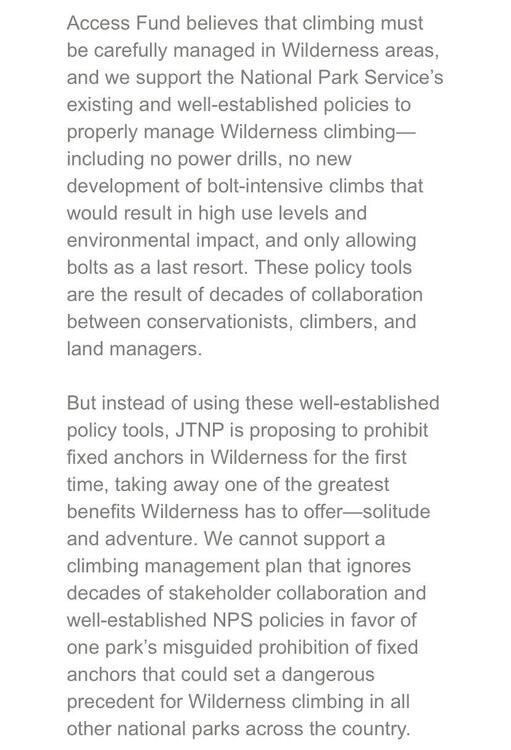 |
|
|
DCR wrote- I hate to start the argument again but if you look at the most popular areas in Washington it exactly correlates with those you say have been hyper developed. Not sure what argument you are starting. I think I have been clear that I believe the hyper development has, to our detriment, become the dominant model. |
|
|
Darryl Cramer wrote: Darryl I think JTree is a poor example, the issue is far more about whether a single bolt can be placed; you are arguing about many bolts being placed. JTree also has the fact that the wilderness area is constantly changing, its a desert so bolt vintage is harder to determine, and its a placed where bolting anything is historically frowned upon. |
|
|
I think JTree is a classic example - it is an area with a huge climbing population surrounding it and that truly effects policy. We are seeing a backlash from land managers because of our behavior. |
|
|
I think the hyper development of crags is a demonstration of the human ability to fuck up a good thing. Our gluttony knows no bounds. The average person gets fatter every year, the average crag gets more climbs per lineal foot. I doubt we can turn either trend around, until it hurts more to continue down these paths than change. But I‘ve always admired optimists and anything that slows the dominant paradigm is good. Keep after it Mr Cramer! |
|
|
Last weekend I was in the Columbia Gorge. Beacon Rock was surprisingly uncrowded. As I drove east on 14 I came across a sign by the road “Dog Mtn Permit Required” miles before the trailhead. Luckily I had a permit; however, on multiple occasions this spring available permits were taken moments after being released and despite hovering over my keyboard counting down the seconds 'till 7am I was out of luck getting one for several weeks running. After the hike I decided to drive the Oregon side of the gorge back to I5 and check out the copious waterfalls. As I turned off the main road I noticed a sign stating that permits were required. Soon I came to a man checking for permits. He let me know I needed a permit to drive the road. I pulled off onto the shoulder, logged into Recreation.gov and tried getting a permit. Ha next window available was in 2 hrs! In my inbox this morning I found an email from the Access Fund the subject line was: "We Are Seeing A Startling Trend, Darryl” I opened the email and saw in a bright red banner: “Shutting Climbers Out Of Public Lands Isn’t The Answer” |
|
|
Yup… Timed entry permits are on the rise all over the states. Sure is easy to get cynical about this snowballing into a ubiquitous aspect of traveling on public land… Doesn’t apply to bikes however. As if I needed another excuse to invest in an E Cargo bike! |
|
|


