
 Continue with onX Maps
 Sign in with Facebook






Accident at Haus Rock near Keystone, CO (Petzl Shunt accident)


|
|
Craig Faulhaberwrote: I did not either (this year). But I did in 2018. And after your accident, I wrote a BIG comment on Dave's Shunt video to try to inform people better. I know for a fact that Dave still employs the Shunt (and will probably continue and will *hopefully* never get injured because of it: he is a pro and now probably knows the Shunt can come off a rope). I also posted on Facebook about your accident to (again) try to convey the information that the Shunt is dangerous for TRSing. Happy to see Dave took it down. For the best and the worse because there were some great elements in that video. The Shunt sure wasn't one of the great ones... I hope more people go towards the Petzl Micro Traxion and probably soon the Petzl Nano Traxion *after it has been tested and checked by the highly skilled TRS community*. And hopefully Petzl comes with clear recommendations about TRSing with the Nano! (I am sure they will, they are great at documenting TRS systems !!!) Also I hope more people use a backup! Backup devices are not always well paired and efficient by TRS beginners but they can be a GREAT option (and the safest if the system is well executed). Also trailing backup knots can be a good in-between BUT not with the Shunt as we "all know" (hopefully) now. One other thing I can say: no one should improvise a TRS system. There are many ways to screw up. I want to make a difference and make TRSing a safer activity! |

|
I was happy to see that Dave took down his video. But (as far as I can tell) he has not replaced it with another one to warn people of a very serious failure mode of the Shunt. Is that his responsibility? Perhaps not, but given that Dave is (from all indications) a pretty compassionate and kind person, I would think he'd want to prevent future injuries/deaths any way that he can. What about Petzl? Certainly they know about this accident by now? They already do not recommend this usage of the Shunt, officially, but surely they know that people (including Dave MacLeod) are using Shunts in a TRS system despite their admonitions not to? Do they have a responsibility to make some kind of announcement warning people that there is a very serious failure mode with this device (far more serious than the failure mode they currently describe in their materials)? Unfortunately both of these questions (should Dave warn people and should Petzl warn people) have legal ramifications. And lawyers have a primary duty not to act for the greatest societal good, but to act in the best interests of their client. Perversely, this can sometimes lead to people and companies seeking first to distance themselves from liability or blame rather than acting to save lives. I believe in Europe things aren't as bad as in the States, but it's still bad. What about other large platforms in the climbing community who could get the message out? Gyms, magazines, major sellers of gear like REI? Well, they likely have advertising revenue from Petzl that they rely on for survival. Can they afford to piss off their advertisers? So it seems it would therefore be on us, the peasants, to get the word out. I'm a nobody, but I've tried to spread the world to anyone who will listen. If I ever saw someone using a Shunt at the crag, I would immediately say something to them. If I see a post here, I will make a comment. Will that save anyone's life? Hard to say... but seems like our only option if the big guys are going to stay silent. |

|
There is responsibility on Petzl's part to update their safety information when new information comes to light. We now know that this device can remove itself from a rope. We also know that if the device hits a stopper knot, the device can open and release a rope. I've asked Petzl to update their safety information, but don't know how to contact them other than contact info provided on their website. Hopefully they will reply. Assuming that climbers can make logical conclusions, safety information like this 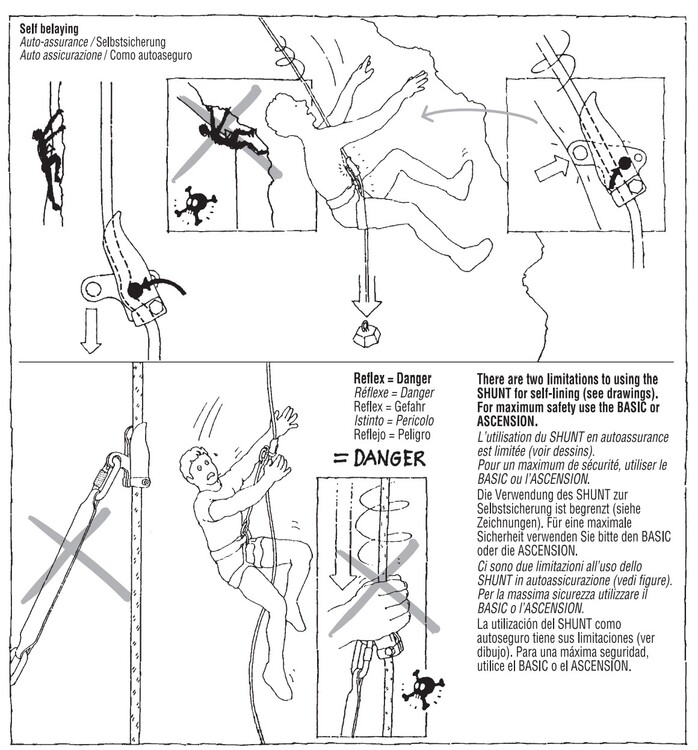 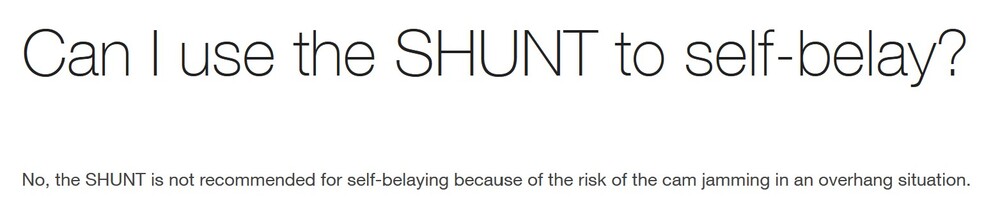 does not dissuade a climber from using the device for TR solo. It makes them cautious when on an overhang and tells them to not grab their rope when they fall. When I researched the Shunt (I did research the safety of the device as best I could before using it), there was no info about how it could release a rope. I also didn't find that a stopper knot could open the device and release a rope, so is not a viable backup. In reality, TR solo is certainly the most common use for this device and the only reason it is still being sold (how many people really need a device for backing up a rappel... is a prusik too inexpensive and simple?). And there are popular websites that sell the device today that still list solo TR as a function of the Shunt. Examples: 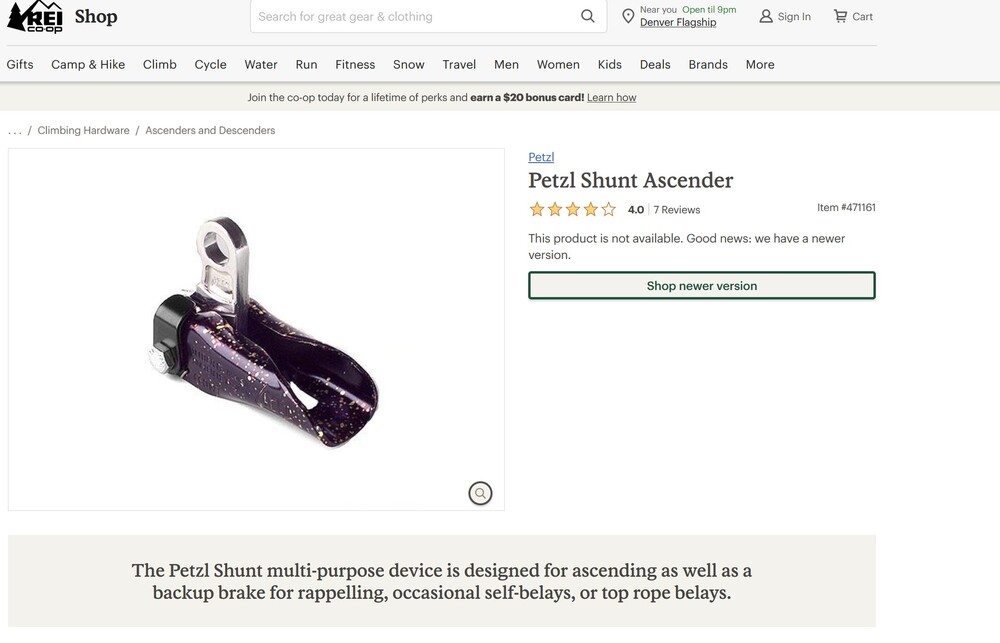 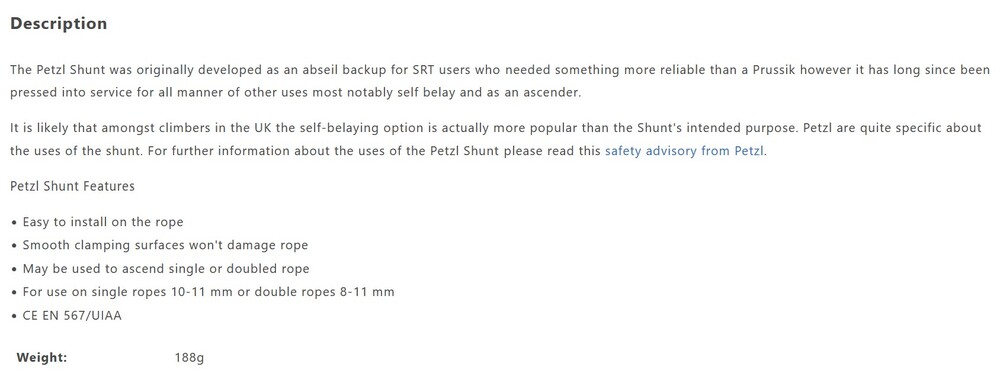 So the word is out that this device can be used for TR Solo. The question is how to get the word out about why it shouldn't be used. We as a community should do all that we can to spread the word. But I think the best way to get the word out to individuals and retailers is for the company that sells it to speak up, redesign it, and/or just stop selling it. That's my $.02 By the way, here's my week 4/5 essay about my recovery. It's about how I poop :) http://www.craigfaulhaber.com/climbing-blog/2021/10/16/fall-risk-week-4-moving-slower Craig
|
|
|
After giving it some thought, I wanted to reply one more time about rope diameter for clarity and so everyone can make the safest decision going forward. This accident happened because the rope ripped out of the device. This could certainly happen with any rope diameter. The fact that the shunt is rated for a single line 10-11mm is clearly based on camming friction and not because they proved in testing that a 9.8mm rope could rip out of the device but a 10.1mm couldn't. Clearly, they approve an 8mm rope with two lines, so Petzl didn't believe that even an 8mm rope would rip out of the device. The suggestion that my 9.5mm was me "asking for trouble" is ludicrous and a dangerous one to make. So please don't go out there with this system and a 10.1mm rope thinking that this accident couldn't happen under those conditions. Anyway, the suggestion that my 9.5mm rope was dangerous and that this was not technically a device failure misses the point. It's not about my accident and making some legal argument for or against Petzl. It's about preventing this accident from ever happening again. If you'd like to give it a read, here's my week 6 post-accident essay http://www.craigfaulhaber.com/climbing-blog/2021/10/29/fall-risk-week-6-waking-up Be safe everyone, and keep each other safe too! Craig |
|
|
Shunts are definitely useful but the safety piece is for sure unresolved. I would say that for me, two strand usage is the standard as the rope popping out seems a lot less likely with a symmetrical load. Thoughts on that Craig? |
|
|
Hi Peter! You may be right about that. First, it seems less likely to me that a rope could pop out with two strands because it seems that the shunt wouldn't tip left or right quite as easily. In my case, my high stepping may have been the cause of the shunt tipping, so it may still happen with two strands. So let's say that happens. Maybe the shunt still tips and the rope somehow snags on the upper strand, as was likely in my accident. As that snagged upper strand pulls its side of the rope downward with your fall, you would think that at the moment when your weight engaged the device, the load on the shunt would be more balanced and it would straighten out and cam. It seems likely in this case then, that the snagged upper strand wouldn't have the time or force to rip all of the way through the device. (Another option: If the two strands were independent, say, each clove hitched to the anchor, then maybe if one strand ripped out, the other would still catch you. In this case though, the shunt is flexing as one side comes out, which would bother me enough to not do it this way.) It's good to remember that the device sliding into a stopper knot can open it up, so that is not a fully viable backup. I would also say that we still aren't 100% sure exactly how my rope was removed, so it's hard to say anything with certainty. Before my accident, I would have said that even a single line would be nearly impossible to remove from the device in a fall. So who knows what's possible without more testing. I'm sure not comfortable using a shunt for any TR solo purposes at the moment. But It certainly seems safer to me to use two strands. And at least in my application on this particular route, it would have been easy enough to set up that way. Thanks for the thought, Peter! Craig |
|
|
I've had several pieces of hardware put in my body over the years. I got all of it taken out except for plates in my wrist that my mom talked me out of getting removed. Truth be told, I always wish i had got it removed but its to late now I think. |
|
|
Awesome sense of humor! Great writing style! I did notice another small positive... It is fortunate that your left arm is functional, as you have to scoot from right to left to slide onto the commode... Much respect Brother! |
|
|
Andrew Jwrote: Can I ask why you got all your other hardware removed? And how long after the initial placement it was? |
|
|
SteveZwrote: I had pins that were put in my knuckles around 13 or 14, I had them removed at 17 because they were causing pain when I would write. |
|
|
Andrew Jwrote: Makes sense, thanks. |
|
|
A small update. I had a phone conversation with Petzl about my accident and the wording on their website. It didn't go well. If you'd like to read more, I wrote about it in my week 8 essay: http://www.craigfaulhaber.com/climbing-blog/2021/11/10/fall-risk-week-8-expectations |
|
|
Great essay Craig |
|
|
I've had two people reach out to me this morning to tell me that this accident had the same description as mine. Shunt detached from the rope. The possibility that this has happened again makes me feel terrible. It also makes me wonder if an accident with this device has happened before, but the difficulty of getting the word out has kept a larger audience from hearing it. Regardless of how this happened, I feel so bad for this climber and their family. |
|
|
Craig, Thank you for sharing your story. I have owned a shunt since the late nineties and have and would still occasionally use it for TRS. I don't climb hard and haven't really used it when working routes when I would fall hard (probably partly why I don't climb hard) but I won't ever use it that way again. So thank you for spreading the word. I am wishing you a speedy recovery. |
|
|
Craig, Pretty sure you've thought about this already but, please submit a report to Accidents in North American Climbing. Climbing magazines are a joke nowadays and they simply strive to survive in a digital era where people self-publicize their ascents via Instagram. Long gone are the days when magazines cared about the sport and its evolution. With regards to Petzl, they (mostly) make pretty good gear, but they are a mess as an organization. Glad to read you're making progress in your recovery. Wishing you to be 100% back on track soon! |
|
|
Insert name, it sounds like you knew that there had been multiple incidents using the shunt before my accident. How did you know that? Did the rope detach from the device in these accidents? Where would someone searching around the internet for the safety of the shunt find this information? Can you offer a website? Because I searched. I couldn't find any incidents. All I could find was from Petzl's website which said that the shunt is not recommended for TR solo "because of the risk of the cam jamming in an overhang situation". Nothing about the device detaching from the rope. Nothing about these incidents. I find the risk of the cam jamming to be an acceptable risk. I don't find the device coming off of a rope to be an acceptable risk, but this information was not available to me. One would imagine that full information was also not available to the other climber who is in the hospital right now. If he knew the device could detach from a rope, he wouldn't even own it. The ultimate question is, how can we keep climbers safer. The answer can't be "they need to fully understand the issues" if information about the issues is not available to climbers. Climbers and companies keeping information to themselves and then criticizing the injured or dead for not knowing enough is perhaps a problem that the climbing community needs to figure out. |
|
|
Oh I forgot to say that I did submit an accident report back in September. I got a reply that it will be in the 2022 issue. |
|
|
Here's a link where Andy Kirkpatrick recommends the Shunt as one of the two best devices to use for solo top roping, in part because he says it can't detach from the rope! ("A bonus with the Shunt is also that it cannot become detached from the rope and also have the best pedigree as a self-lining device.") He also recommends knots as a backup, which would seem fine if the device truly couldn't detach from the rope, but they're useless if the Shunt detaches. https://www.andy-kirkpatrick.com/blog/view/self-lining To summarize: 1. Based on Craig's accident and especially if similar accidents have happened, the Shunt does not appear to be a good device for TR soloing because the rope can become detached from the Shunt, even though that is probably a very rare occurrence. 2. Using the backup method of knots below the Shunt is not safe because if the rope becomes detached, the knots won't do anything, at least not with respect to the Shunt. I have not used a Petzl Shunt and would describe myself as a TR soloer "dabbler" at best--my post is just based on my understanding of Craig's accident. |
|
|
Andy Kirkpatrick is sponsored by Petzl, and has been for many years, which makes the COO's statement that they tell people not to use the Shunt for rope soloing complicated. Are sponsored athletes employees and representatives of the brand? |


