
 Continue with onX Maps
 Sign in with Facebook






Is Boulder, CO an anomaly?


|
L Kapwrote: I think the advocates of Bedrooms have varying and different agendas. The enviros may think that people packed into Boulder will abandon their cars for bicycles and that commuting from outside Boulder will be reduced. I happen to think they're dreaming on both counts. I think the economic justice advocates are envisioning some benefit to the working poor and minorities and aren't concerned about parking and traffic issues. There probably would be some benefit to those groups, but I think it's pretty small and outweighed by the adverse effects. |

|
Geez..... My house is 2 bedrooms, a kitchen, laundry area, tiny pantry/utilities (hot water tank), single bath, and combined living/dining. If a separate "dining room" is required, that would bring it down to a single bedroom. This neighborhood was built in the 1950s, for families. Parents in one bedroom, kids in the other. We only had one kid, most had two, one house a few doors up had 2 boys and a girl sharing that number two bedroom, and a single bath. My house is 796 square feet, the template for the 2 bedroom houses. A nearby trailer court? I betcha they have 6 or more people, in a single wide trailer, a lot of them refugees from all over the world. A huge step up for many, and a step down for many also. But all move up eventually, and can now live lives without conditions and terrors most of us never consider. My neighborhood was NORMAL in 1952, as a starter home. The same neighborhood has 3 bedroom houses, on the corner lots. Original construction, I mean. Over the years, people have tacked on to the back, converted garages, whatever they could do. A neighbor up the street took advantage of Boise's recent new laws, and built a mom in law place in the backyard. Personally, I see no problem with cohousing people tighter these days, plus infill, plus building upwards. That privacy and space thing is fine....but elitist, and super inefficient. So a 5 bedroom house, with a couple baths, reasonable living spaces, shared our to 10ish people? Fine! But build transit so those 10 people don't need a CAR. That's the real rub of pretty much all of the west. Get past THAT crux, and you've got a lot of other issues solved. I do expect to see that happen, and maybe not too far out, actually. Pair electric with autonomous vehicles, so you can easily have a ride anywhere, anytime, where you live, without needing to own anything? That means a whole heckuva lot of good changes. Book an open ended version that hauls you on your freeform roadtrip, or, yes, have a longterm dirtbagmobile that is your living quarters, but autonomous. Remember, I'm old enough to predate pocket calculators to help with math in high school. At 64, I might have 3 or even 4 more decades. Unimaginable....becomes normal, with enough time span for it to happen. Good luck to you, Boulderites, but don't expect the servant class to ever get much consideration from the served. Or for people to not want way too much private property. That's a whole other revolution waiting to happen. Got my pitchforks all sharpened up!
EDIT to add, sadly, I think Wendy is probably right. But? At least there's conversation going on, that's a significant start. |
|
|
L Kapwrote: It isn't about belief. You asserted that there was a one-third occupancy rule that would prevent abuse and that Question 300 didn't delete it. I pointed out that it had been deleted. Now you just shrug and "believe" that there must be something--somewhere--that will prevent abuse. Bedrooms for People apparently doesn't know. Their FAQ refers to a few limitations--none of which would apply to an existing rental. One potential limit would be parking, but the code requires only one parking space for every two "roomers." In practice, I don't think that is much of a limit, although it will exclude some abuses. I think you're being obtuse about the example I provided of my own house. It's just an example; try to extract the principle involved, which is that Question 300's language permits deeming rooms to be "legal bedrooms" to increase occupancy. Investors and non-landlords might not change their behaviour, but every landlord currently renting a dwelling unit--and there are lots of rentals in Boulder (approximately 38% of household units)--will be thinking about how to maximize the number of "legal bedrooms" and how to adjust their occupancy and rents upward accordingly. It's not going to be four bedroom rentals all of a sudden becoming 11 bedroom rentals (although, its possible, as the example of my house shows), but there will be conventional three or four bedroom houses (currently capped at three or four occupants) that will have their occupancy caps doubled (or more) under Question 300. If allowing landlords to pack their rentals to the gills was not a goal of Question 300, why was the one-third rule deleted? And even if it is not a goal, it is certainly a foreseeable consequence of getting rid of the one-third rule. Bedrooms for the People is not being forthcoming on their website about the contents of Question 300. In their presentation of the question (available at bedroomsareforpeople.com/20…) they state that "changes to the existing code are shown in red." But, they don't show the one-third rule as being deleted from § 9-8-5(a)(1), and I don't see any other discussion of the one-third rule on their website. That's quite an oversight. Finally, Bedrooms for the People is being disingenuous about whether and to the extent that the City Council can amend the code if Question 300 passes. Basically, the City Council needs a two-thirds vote to amend any referendum and cannot (even with a two-thirds vote) "alter or modify the basic intent" of a referendum. As we've seen time and again at the federal level, supermajority requirements create legislative paralysis. Even if the City Council can muster a two-thirds supermajority, it cannot alter the "basic intent" of a referendum. Bedrooms for the People claims that the "basic intent" is to "enact significantly more reasonable occupancy limits than the arbitrary fixed caps currently in place." However, the more reasonable argument is the the basic intent is captured entirely in the changes that Question 300 makes to the code: a new "fixed cap" of BR plus one and elimination of the one-third rule. The truth is that the City Council will have a difficult time amending the code with respect to abuses that will inevitably occur--their hands will be tied by both the supermajority requirement and the no amendment with respect to "basic intent" rule. I fully agree that the existing occupancy code is too restrictive, but the BR plus 1 rule in Question 300 will be abused. Why not just increment the current occupancy limits by one? Or include--explicitly in the occupancy limits, instead of in some yet to be determined, backhand way--an overall cap based on square footage? |
|
|
The NY Times just reported on housing in Leadville, CO, in a story about availability and affordability of housing. Short-term rentals are highlighted as the cancer they are but also regulations etc. In small resort towns like Leadville where businesses drive demand for underpaid seasonal labor, the cries of business owners ring a little shallow. And government's profit off of high real estate valves not low property taxes. |
|
|
This is an interesting video that’s related, though poorly titled. Obviously it’s a complicated problem without a clear solution. I can’t imagine trying to buy a house as a young person in today’s economy, anywhere. Let alone anywhere desirable. |
|
|
Teton Climberwrote: That's a funny sentence to read. |
|
|
Long Rangerwrote: You're right. "Resort" doesn't do it justice. Compared to the Roaring Fork Valley / I-70 corridor, it is a gem stuck in stone. |
|
|
The absurdities of the BAFP (bedrooms are for people) farce in Boulder are obvious here - y'all talking about moving to Boulder as a climber's paradise, where you'll live like a Japanese businessman sleeping in a tube, for just a few thou a month. News flash, public transportation doesn't have shuttles to every dinky sport crag in the Canyon, it can and does often snow in all but three months of the year, altitude makes it colder, once summer moves on. If you want to be a climbing bum, you'll be parking your vehicle somewhere that will lack adequate spots, thanks to previous "progressives" who propagate fantasies like all right-minded citizens will live a fifteen minute walk from where they work or study, forever. Except the job just shut down, you have a year lease, and the better paying job is in Wheatridge. Skewed student overpopulation drives the real estate market, along with insane Google paychecks that encourage scrape-offs of modest middle-class homes, to build mega trophy monstrosities. Service jobs that once offered income, a la ski town jobs for ski bums, are competitive, and don't pay enough to live much less take off on cross-country climbing junkets for weeks at a time. So, no, please skip Boulder in your fantasy notions of a perfect climber's paradise. |
|
|
https://www.nytimes.com/2021/11/01/us/politics/ballot-initiatives-voters-voting.html |
|
|
ELAwrote: But, see, here's the real rub. Boulder isn't an anomaly. The youtube link a bit upthread is the sort of thing you think of, "resort" town, mountains, whatever. But Boise is just Boise. Yeah, it's a nice enough place to live, but the selling point is Idaho is a fairly poor state, and prices were low, once upon a time. That's history now, for a lot of reasons. Air BnB helped it along, honestly. Why rent longterm when you can make so much more money short term? That started quite awhile ago. Add in the zoom boom, aging population of boomers retiring to less expensive places, all the upheaval the pandemic created.... And here we are. Almost everyone I know? Couldn't afford to be housed here, now. Businesses can't get enough staff to stay open. Something like a line cook in a run of the mill restaurant used to be a job you could manage on. Not anymore. I'm glad to be old. Sometimes. H. |
|
|
Old lady Hwrote: I know you like to talk about your own situation, but please, whether Boulder is an anomaly or not, it's not remotely close to being a "resort" town. It's close to a large city, and most people live here year-round and work for (some very well paying) employers in or around Boulder. If anything, the gripe more recently has been about it turning into a mini-silicon valley. And that creates more income inequality & residents that serve the high earners can't afford to live here. On top of that, it tends to attract a lot of wide-eyed idealists (in ways similar to large cities like San Fran/LA/NYC) who are more than happy to barely scrape by in objectively shitty situations. And then there are the the college students... Of course, it's also the reason Boulder have a lot of highly educated and super driven (both in work and "semi-pro" athletic pursue) residents, etc, etc. Covid has made Boulder more expensive just like many parts of the country, but it's more about catching up w/ the surrounding than being at the forefront of the explosion. |
|
|
rebootwrote: Sorry, my post was unclear. We agree, actually. There's a good vid someone posted up thread, delineating many of the issues, but it was a mountain town with views, becoming a resort town. Saying Boulder isn't an anomaly, and reinforcing Boulder with Boise, was my way to say this is now a very widespread problem, and not at all just the resort or tourist town problem, as it was in the past. I'm assuming your ballot measure is today? Best wishes all around, to those of you in Boulder! Whatever happens? I hope all of you stay at the table and keep hammering out ways to proceed with equitable housing. With a big student population, I think you might pull it off. Figure out how to keep it reined in on the high end (second home/empty house/nonresident owners problem) and stay aimed toward college town. At least you have great community support for protecting your open spaces, and bike paths, stuff like that. We have that in common. Honestly, fixing the affordable housing problem isn't going to happen here until there's a serious crash that get housing back in line with wages. Not likely. Which means it might get sorta better, short term, but I think this is the new reality here, sadly. Too much money available too easily, from other markets. Boulder is at least considering a whole range of options. Best, H. |
|
|
Old lady Hwrote: Although I think personally that the BAFP ballot measure will pass, it really is a drop in the bucket to the problem of affordable housing - the, "whole range of options" is not being considered - Boulder has pretty severe restrictions to growth across the board - artificially restricting the capacity of already-built housing based on the blood relationship of the occupants is really just one of those. |
|
|
Long Rangerwrote: Well sure, any single thing, even a package, won't get you there. But at least Boulder is talking, and trying. Cheers/hugs from afar. Oodles of places with the same issues, really exacerbated by the pandemic! Anyone wanna try predicting the future, in view of how surprising 2019/20 was?? A pandemic wasn't much of a surprise, but the fallout is pretty interesting. H. |
|
|
Doesn't look like BAFP is going to pass. There's 13k more ballots to count, but a significant majority of votes for BAFP would be needed in them to make it pass. |
|
|
BAFP never had a chance of passing IRL. The idea that residents will go along with infilling the city with "affordable" or any other kind of housing is unrealistic. Boulder has been talking about affordable housing for the almost 30 years I have lived here. Nothing will happen on a large scale as the influx of money is too powerful. Its desirability as a place to live far outstrips any attempts to level the playing field for lower-wage workers. The remote work thing and importation of high-paying tech companies has made it all far worse. Oh, and I forgot the never-ending drive by CU to add more students... |
|
|
There are certainly Powers That Be that don't want it. My partner reports on this sort of stuff (City Council), so I'm witness to a lot of pretty ugly things. Be it the Safer Boulder leaks drama, them getting harassed and threatened by wealthy businessmen and getting ceased and desist letters threatening to sue them over their reporting - seems there are influential people in town that want the status quo to stay the way it is. Boulder will continue to lose it's more quirky characteristics, small business will be replaced with chains, Pearl Street will continue to be gutted, people who clean the floors and make your coffee will have to commute from out of town; the homeless problem isn't going to get better. There's a side of Boulder that's not about being, "The Happiest Place to Live" - it would be naive think otherwise. Although this is highly entertaining, 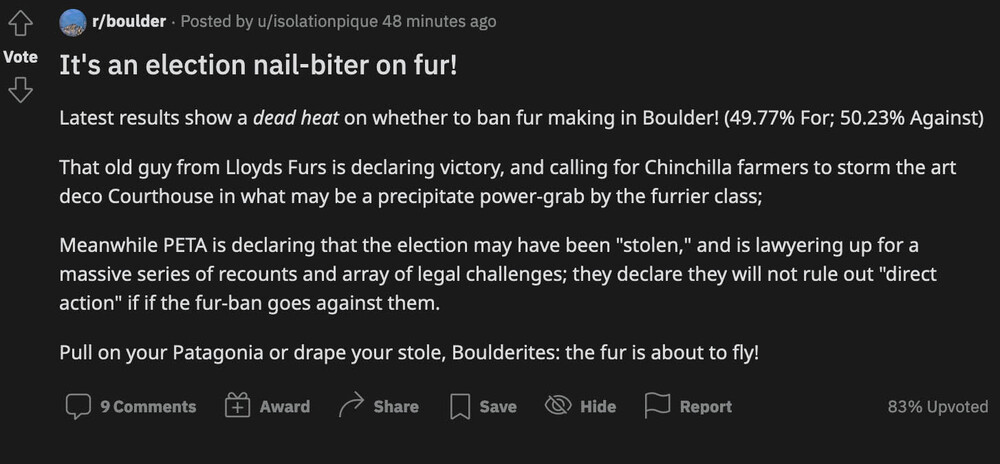 |
|
|
PRRosewrote: TLDR = wealthy land owner says: "we're full here, thanks". |
|
|
The climate change thread has a good article linked in it: I could totally live with what is proposed at the end of the piece above....but even my optimistic self doesn't see any way it would happen. Efforts such as yours in Boulder might pick away at it, though, so who knows? Some pretty huge shifts have happened recently, it isn't impossible once it starts to happen. (Super short conclusion to the article, limit and redistribute wealth. Private sufficiency, public luxury) H. |
|
|
JaredGwrote: That's what you got from that? If you're doing the cheeky 'TLDR' thing, you're not supposed to be the one who didn't read it. |


